A metal roofing company and an asphalt roofing company can run the same ad budget in the same zip codes and end up with completely different businesses. One books 60 asphalt tear-offs at $13,000. The other books 22 standing-seam jobs at $27,000. The second company did less truck work, pulled fewer permits, hired fewer crews, and produced more revenue.
Most roofers who want to sell more metal never make that choice on purpose. They run one roofing campaign, take whatever fills the form, and then wonder why 90 percent of the pipeline is a three-tab replacement with a $500 insurance deductible attached to it. The leads are doing exactly what the campaign told them to do.
Here is how the metal buyer differs, what the ticket is actually worth, and the math for deciding how much you can pay to put one on the schedule.
Why do metal roofing leads behave differently from asphalt leads?
There are two homeowners in the metal market and they have almost nothing in common.
The forced replacement
This homeowner has water coming through a ceiling, missing shingles after wind, or a roof the insurance adjuster already condemned. They want it fixed. Metal is a maybe, not a plan. They call two or three companies, take the first inspection they can get, and buy whatever the contractor in the driveway is most convincing about.
You can sell metal to this homeowner, but you are selling it in a 45-minute window against a cheaper option they already have a number for. Close rates are decent because the decision is urgent. Average ticket is unpredictable because half of them downgrade to architectural shingle when the number lands.
The deliberate upgrade
This is the buyer worth building a campaign around. They are not in crisis. Their asphalt roof has 3 to 6 years left, or they just bought a house, or they got a $42 hail claim denial and decided they are done with this cycle. They have been looking at standing-seam photos for weeks. They are thinking about 40 to 50 years of service life, resale value, fire rating, and never doing this again.
This homeowner is not searching for a roofer yet. They are researching a decision. That is the entire opportunity, and it is why our roofing lead generation page treats metal as its own campaign with its own budget and its own cost-per-lead ceiling rather than folding it into general roof replacement.
Ticket: two to three times an asphalt job. Sales cycle: 2 to 8 weeks from first touch. Close rate on a well-worked exclusive lead: 20 to 30 percent. Competition at the kitchen table: usually one other metal contractor, not four shingle companies racing to the bottom.
What is a metal roof actually worth in 2026?
You cannot set a lead-cost ceiling until you know your real ticket mix. Pitch, roof complexity, panel gauge, tear-off versus overlay, and regional labor all move these, but the ranges are typical for a standard residential roof.
| System | Typical installed range | Buyer type |
|---|---|---|
| SystemExposed-fastener corrugated or R-panel | Typical installed range$9,000-$18,000 | Buyer typeBudget / outbuilding / rural |
| SystemMetal shingle or shake profile | Typical installed range$14,000-$28,000 | Buyer typeAesthetic upgrade |
| SystemStone-coated steel | Typical installed range$15,000-$30,000 | Buyer typeUpgrade / hail market |
| SystemStanding seam, snap-lock | Typical installed range$18,000-$32,000 | Buyer typeDeliberate upgrade |
| SystemStanding seam, mechanically seamed | Typical installed range$22,000-$35,000 | Buyer typeHigh-end / low-slope / coastal |
| SystemMetal over existing shingle (where code allows) | Typical installed range$12,000-$24,000 | Buyer typeCost-conscious upgrade |
| SystemPartial metal accent (porch, dormers, bay) | Typical installed range$2,500-$7,000 | Buyer typeEntry point / add-on |
That last line matters more than it looks. A porch or dormer accent job is a low-friction way into a homeowner who is curious about metal but not ready for a whole roof. It is also a referral engine, because every neighbor who likes the look now knows who installed it.
The formula that sets your lead ceiling
Run this per campaign, not per company.
Max cost per lead = (average job value x gross margin x close rate) / 3
Asphalt campaign: $13,000 x 0.35 margin x 0.25 close = $1,137, divided by 3 = a $379 maximum cost per lead.
Metal campaign: $27,000 x 0.38 margin x 0.22 close = $2,257, divided by 3 = a $752 maximum cost per lead.
You will almost never pay $752 for a roofing lead. That is the point. The ceiling tells you how much headroom you have, and on metal the headroom is enormous. A contractor holding every roofing lead to a $60 ceiling because that is what asphalt tolerates will lose every metal buyer to the company willing to pay $150 for the same homeowner.
Why is cost per lead the wrong number for metal roofers?
Because the invoice price of a lead ignores how many other companies got handed the same homeowner. Cost per acquired job is what pays a crew.
| Channel | Cost per lead | Typical close rate | Cost per acquired job |
|---|---|---|---|
| ChannelReferrals and past customers | Cost per lead$0 | Typical close rate40-60% | Cost per acquired jobNear $0 |
| ChannelSEO and Google Business Profile | Cost per lead$0-50 | Typical close rate20-40% | Cost per acquired job$100-250 |
| ChannelShared marketplace leads | Cost per lead$25-75 | Typical close rate2-8% | Cost per acquired job$900-3,000+ |
| ChannelMeta advertising | Cost per lead$25-110 | Typical close rate10-20% | Cost per acquired job$250-1,100 |
| ChannelGoogle Ads (search intent) | Cost per lead$100-500+ | Typical close rate15-30% | Cost per acquired job$500-2,500 |
| ChannelExclusive leads (performance partner) | Cost per lead$50-200 | Typical close rate15-25% | Cost per acquired job$200-1,000 |
| ChannelExclusive booked appointments | Cost per lead$200-400 | Typical close rate25-40% | Cost per acquired job$200-1,200 |
A $45 shared lead closing at 5 percent costs $900 per job and arrives already quoted by two other roofers. A $140 exclusive metal lead closing at 22 percent costs $636 per job, and the ticket is twice as large because nobody else is in the driveway undercutting you on gauge and seam type. The full breakdown of that math lives in our guide on exclusive vs. shared leads.
There is a second cost almost nobody tracks: inspection time. A proper metal assessment means decking condition, ventilation, fastener pattern, penetrations, and a photo set. That is 60 to 90 minutes plus travel plus the proposal build. At a 5 percent close rate you are running 20 inspections to sell one roof. Price that at your estimator's loaded hourly cost and shared leads stop looking cheap.
How do you reach the metal upgrade buyer before they search?
The deliberate upgrade buyer almost never begins with a search. They begin with a feeling that their roof is a recurring problem and a half-formed idea that there is a permanent version of it. Meta advertising is the channel that reaches them in that window, and it works for a specific reason covered in why your best customers aren't on Google yet.
Lead with the finished roof, not the crew
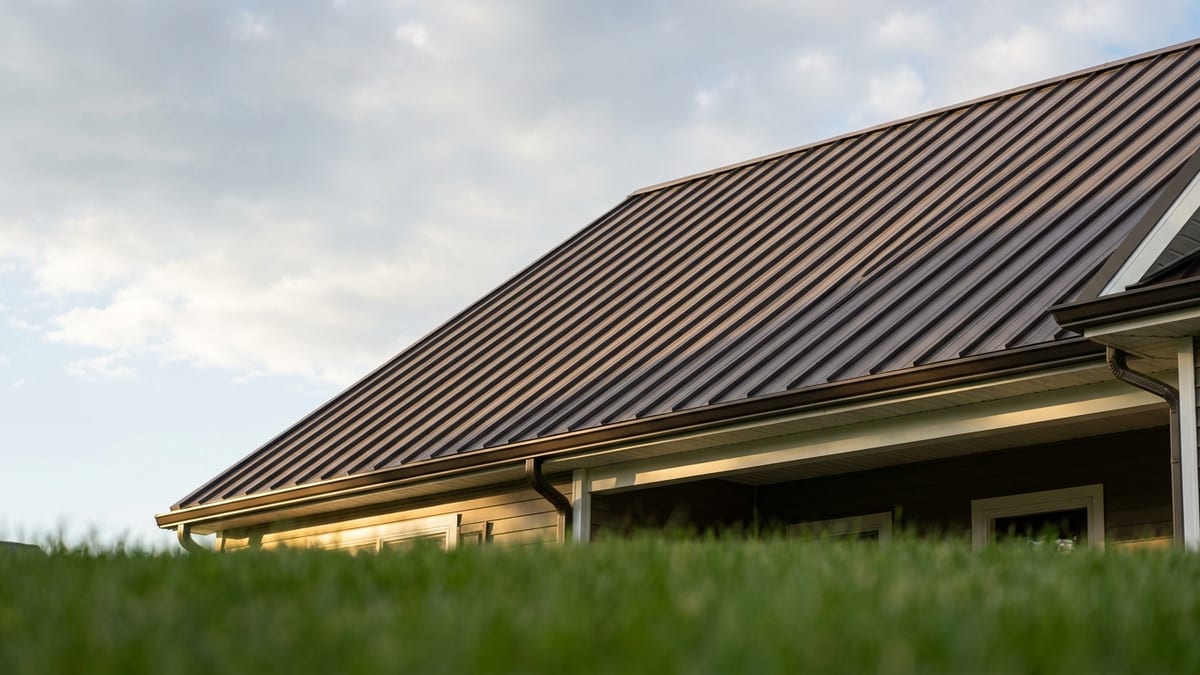
Metal is bought with the eyes. The ad that works is a clean, well-lit photo of a completed standing-seam roof on a house that looks like the houses in your service area. Raking afternoon light on the ribs. Real job, your crew, your truck out of frame. Stock photography and rendered mockups read as fake to homeowners and they scroll past.
Target the house, not the hobby
The useful signals are home ownership, home age in the 18-to-30-year band where the original roof is aging out, and property value bands that support a $20,000-plus exterior decision. Add a retargeting layer against anyone who viewed your metal gallery or watched more than half of a roof-walk video.
Sell the 40-year math, not the install price
The comparison that moves this buyer is not metal versus asphalt today. It is one metal roof versus two or three asphalt roofs over the same period. Put that in the ad copy plainly. A homeowner who does that arithmetic themselves has already pre-sold your proposal before you knock.
Give the ad somewhere real to land
A templated form page with radio buttons and a stock house kills a high-ticket lead. The landing page should carry gallery photos, panel profiles, warranty terms, financing, and a short form. If you want the deeper version of why the page matters as much as the ad, read why most contractor websites don't generate leads.
If you want this built as a dedicated metal campaign running in your own ad account, with the asphalt and metal budgets separated so neither one cannibalizes the other, get started here.
What should a metal roofing campaign actually say?
Five things, in this order. This is the framework that separates a metal ad from a generic roofing ad.
- Name the permanence. "The last roof this house will need" outperforms any discount headline in this category. The buyer is already thinking it. Say it first.
- Show the profile. Standing seam, metal shingle, and stone-coated steel attract different homeowners. Show the one that matches the housing stock you are targeting, not a catalog of all three.
- Handle the price objection inside the ad. Say the range. Something like "most of our standing-seam roofs land between $18,000 and $32,000 installed" filters out the homeowner who wanted a $7,000 shingle job and warms up the one who did not. Fewer leads, better leads.
- Put financing on the surface. A $27,000 roof at a monthly payment is a different conversation than a $27,000 roof. Monthly framing, clearly labeled as subject to approval, moves this ticket more than any seasonal promotion.
- Ask for the inspection, not the quote. A free roof inspection with photos is a concrete, low-commitment next step. A "free quote" invites a price-shopping text exchange you will lose.
How many metal roofing leads do you need to hit a revenue target?
Work backward from the revenue number, never forward from a budget you guessed at.
Say the goal is $1,000,000 in added metal revenue over 12 months.
- Jobs needed: $1,000,000 ÷ $25,000 average ticket = 40 jobs
- Leads needed at a 25 percent close rate: 40 ÷ 0.25 = 160 leads per year
- Monthly lead target: 160 ÷ 12 = 13 to 14 leads per month
- Appointments needed to produce those closes: at a 60 percent lead-to-appointment rate, roughly 8 appointments a month
- Ad spend to produce it: at $70 to $110 per lead through Meta, roughly $900 to $1,500 per month paid directly to Meta out of your own ad account, plus the per-lead fee on exclusive delivery
Run that same sequence with your numbers. If your close rate is 18 percent instead of 25, the monthly lead target jumps to 19 and the budget moves with it. If your average metal ticket is $19,000, you need 53 jobs and 212 leads. The formula does not care about optimism.
| Monthly ad spend | Expected leads/mo | Closed metal jobs/mo | Revenue added/yr at $25K |
|---|---|---|---|
| Monthly ad spend$750-1,000 | Expected leads/mo8-12 | Closed metal jobs/mo2-3 | Revenue added/yr at $25K$600K-900K |
| Monthly ad spend$1,500-2,000 | Expected leads/mo16-24 | Closed metal jobs/mo4-6 | Revenue added/yr at $25K$1.2M-1.8M |
| Monthly ad spend$3,000-4,000 | Expected leads/mo32-48 | Closed metal jobs/mo8-12 | Revenue added/yr at $25K$2.4M-3.6M |
Those are modeled ranges using typical roofing CPLs and close rates, not promises. Your crew capacity is the real governor. There is no point generating 48 metal leads a month if you can only install four roofs.
What kills metal roofing leads after they come in?
Three things, and all of them are inside your building.
Slow response
A homeowner who just raised their hand on a $27,000 decision is at peak interest for about 10 minutes. Calling within five minutes produces dramatically higher qualification rates than calling at 30, and a meaningful share of sales go to whoever responds first. If your estimator is on a roof at 2 p.m., someone else has to make that call. The full system for this is in our guide on speed to lead.
Quoting over text
The fastest way to lose a metal lead is to answer "what does it cost per square foot" with a number. You have just handed a stranger a figure they will take to a cheaper contractor. Answer with the inspection. Price belongs in front of the homeowner, next to the panel samples and the warranty document.
No follow-up past day three
Metal buyers take 2 to 8 weeks. Most roofing companies stop calling after two attempts. If your CRM drops a metal lead at day four, you are funding a campaign that fills somebody else's pipeline. A 30-day cadence of texts, calls, and photo-driven emails is not aggressive on a ticket this size; it is the minimum.
The short version
Metal roofing is the highest-ticket work most roofing companies can sell without changing their license, their crews, or their service area. The buyer exists in every market. The only question is whether your marketing is set up to find the homeowner who is deliberately choosing a 40-year roof, or whether it is set up to catch whoever is leaking today and hope a few of them upgrade.
Split the campaigns. Set a separate, higher cost-per-lead ceiling for metal. Lead with real finished-roof photography. Put the price range in the ad. Answer the phone in five minutes. Then judge the whole thing on cost per acquired job, because the per-lead invoice has never once paid a crew.
If you want exclusive metal roofing leads delivered into your own ad account, with your brand on the ads and the full spend visible to you, book a call and we'll walk the numbers for your market. Pricing runs from $50 per qualified lead and from $200 per booked appointment, with a one-time setup, no retainers, and no shared leads. Track-record specifics for roofing clients are available on request.
Frequently asked questions
What do metal roofing leads cost in 2026?
Shared marketplace roofing leads typically run $25 to $75 each but close at 2 to 8 percent because three to five contractors get the same homeowner. Exclusive roofing leads generally run $50 to $200 and close at 15 to 25 percent. Metal-specific leads usually sit at the top of those ranges because the audience is narrower, but the ticket is two to three times an asphalt job, so the higher cost per lead is still cheap on a cost-per-acquired-job basis.
Should I run separate campaigns for metal roofing and asphalt?
Yes. Asphalt replacement and metal upgrades have different tickets, different sales cycles, and different maximum costs per lead. Blending them into one campaign forces you to judge a $28,000 standing-seam job by the economics of a $12,000 asphalt tear-off, and the algorithm will optimize toward whichever form fills fastest, which is almost always the cheaper job.
How many metal roofing leads do I need to add $1 million in revenue?
At a $25,000 average metal ticket you need 40 closed jobs. At a 25 percent close rate on exclusive leads that is 160 leads a year, roughly 13 to 14 a month. At a 20 percent close rate it is 200 leads a year, about 17 a month. Run the same math on your own ticket and close rate before you set a budget.
Is Meta advertising or Google better for metal roofing leads?
Meta for the upgrade buyer, Google for the emergency. Homeowners who choose metal are rarely searching for it yet, so Meta reaches them during the research phase at roughly $25 to $110 per lead with real finished-roof photography. Google search captures the homeowner who already typed metal roof cost, which is higher intent but higher cost at $100 to $500 per lead and much lower volume.
Why do metal roofing leads ask about price so fast?
Because most of them have already seen an asphalt number and metal sounds expensive. Do not quote a square-foot price over text. Set the appointment, show the system options side by side with photos and warranty terms at the kitchen table, and anchor the conversation on cost per year of service life rather than the install invoice.