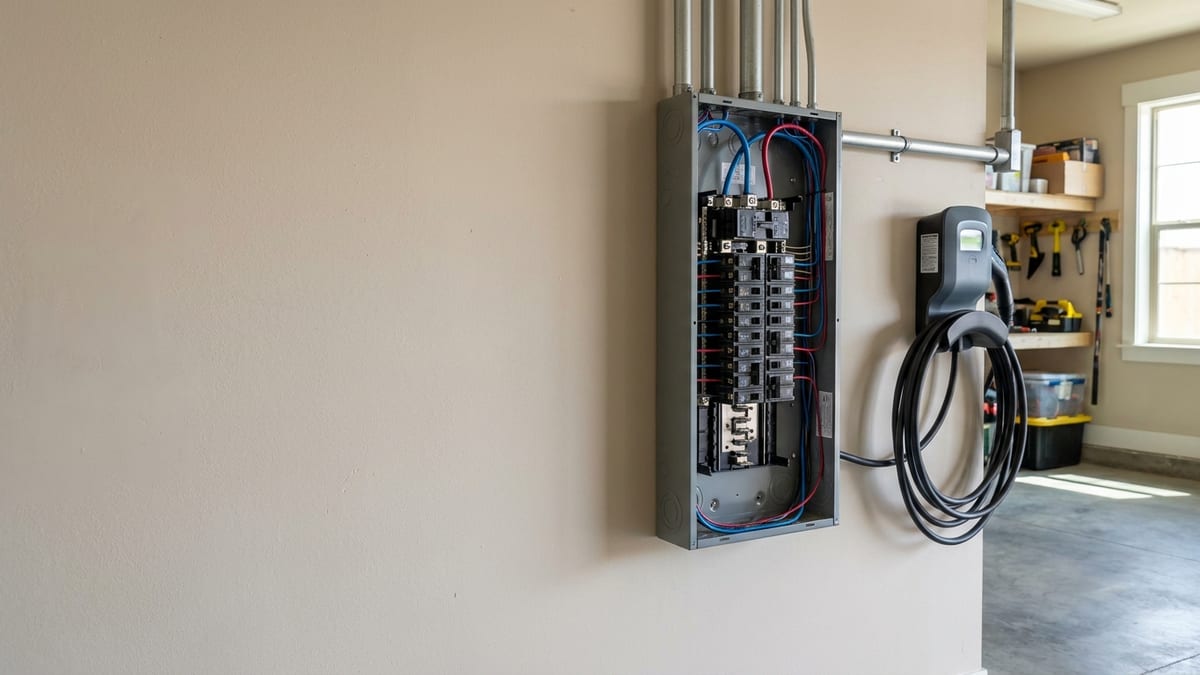
An electrician can run two campaigns on the same street with the same budget and end up in two different businesses. One books 40 charger drops at $1,100 a ticket. The other books 22 service upgrades with a charger bundled in at $4,600 a ticket. The second one produces more revenue on half the truck rolls, and the crew spends its day on one address instead of two.
Most electrical marketing plans never make that choice on purpose. They run one generic "electrician near me" campaign, take whatever comes in, and then complain the leads are all light-fixture swaps and outlets that stopped working. The leads are behaving exactly the way the campaign told them to behave.
Here is how the two buyers differ, what each ticket is actually worth, and the math for deciding which one your budget should be chasing.
Why do panel upgrade and EV charger leads behave like two different buyers?
They are two different purchases with two different triggers, and they arrive on two different clocks.
The EV charger buyer plans around a delivery date
This homeowner ordered a vehicle. They have a delivery window, and somewhere in the paperwork or the dealer conversation somebody told them they should have a Level 2 charger installed before the car shows up. They are not in a panic. They have four to eight weeks, they are reading forums, and they are trying to figure out whether the included mobile charger is good enough.
Ticket: $750 to $2,200 if the panel has capacity. Sales cycle: two to six weeks from first contact. Close rate on a well-worked exclusive lead: 25 to 35 percent, because the decision is small enough to make from a site visit and a written quote.
The important thing about this buyer is what happens at the site visit. A meaningful share of them have a 100-amp panel that is already full. That $1,100 charger job becomes a $4,000 job the second you pull the cover and count the spaces. You did not sell a panel upgrade. You found one.
The panel upgrade buyer is usually forced
This homeowner did not wake up wanting a load center. Something pushed them. A home inspection during a sale flagged a Federal Pacific or Zinsco panel. An insurance carrier sent a non-renewal letter over knob-and-tube or aluminum branch wiring. A breaker trips every time the microwave and the space heater run together. A solar installer told them the envelope has to be handled before interconnection. A contractor doing a kitchen remodel said the service will not carry the new circuits.
Ticket: $1,800 to $4,500 for a straight 100-to-200-amp upgrade, $2,500 to $6,000 when the meter main goes with it. Sales cycle: days to two weeks, because there is usually a deadline attached. Close rate on an exclusive lead: 20 to 35 percent.
These two buyers respond to different ads, different offers, and different response speeds. That is why the campaign structure on our electrical lead generation page treats them as separate line items with separate budgets rather than one pooled "electrician" spend.
What is a panel upgrade or EV charger job actually worth in 2026?
You cannot set a lead-cost ceiling until you know your real ticket mix. Regional labor rates, utility coordination requirements, and permit costs move these numbers, but the ranges are typical.
| Scope of work | Typical installed price | Buyer type |
|---|---|---|
| Scope of workLevel 2 charger install, existing panel capacity | Typical installed price$750-$2,200 | Buyer typePlanned |
| Scope of workCharger install with subpanel or load management | Typical installed price$2,000-$4,500 | Buyer typePlanned |
| Scope of work100A to 200A service and panel upgrade | Typical installed price$1,800-$4,500 | Buyer typeForced / planned |
| Scope of workPanel plus meter main combination replacement | Typical installed price$2,500-$6,000 | Buyer typeForced |
| Scope of workPanel upgrade bundled with a charger circuit | Typical installed price$3,000-$6,500 | Buyer typePlanned |
| Scope of workWhole-home standby generator | Typical installed price$6,000-$15,000 | Buyer typeStorm-driven / planned |
| Scope of workPartial or whole-home rewire | Typical installed price$8,000-$25,000+ | Buyer typeRenovation / forced |
The pattern matters more than any single row. Turning one charger buyer into a bundled panel-and-charger job is worth more than winning three additional standalone charger drops, and it costs you one permit, one utility coordination, and one crew day instead of three.
The formula that sets your lead ceiling
Run this per campaign, not per company.
Max cost per lead = (average job value x gross margin x close rate) / 3
Charger campaign: $1,200 x 0.45 margin x 0.30 close = $162, divided by 3 = a $54 maximum cost per lead.
Panel campaign: $4,200 x 0.42 margin x 0.28 close = $494, divided by 3 = a $165 maximum cost per lead.
Those numbers are three times apart. If you run one blended campaign at a $54 ceiling, you will never outbid anyone for the panel buyer. If you hold it at $165, you lose money on every standalone charger drop you book. That single gap is the entire argument for splitting the campaigns. The general version of this math is in our guide on how much you should pay per lead.
Why is cost per lead the wrong number for electricians?
Because the invoice price ignores how many other companies got handed the same homeowner. Cost per acquired job is what pays a crew.
| Channel | Cost per lead | Typical close rate | Cost per acquired job |
|---|---|---|---|
| ChannelReferrals and past customers | Cost per lead$0 | Typical close rate40-60% | Cost per acquired jobNear $0 |
| ChannelGoogle Business Profile / organic | Cost per lead$0-50 | Typical close rate20-40% | Cost per acquired job$100-250 |
| ChannelShared marketplace leads | Cost per lead$25-75 | Typical close rate5-12% | Cost per acquired job$300-1,200 |
| ChannelGoogle Local Services Ads | Cost per lead$25-95 | Typical close rate15-30% | Cost per acquired job$150-550 |
| ChannelMeta advertising | Cost per lead$25-110 | Typical close rate10-20% | Cost per acquired job$250-1,100 |
| ChannelExclusive leads (performance partner) | Cost per lead$50-200 | Typical close rate20-38% | Cost per acquired job$200-900 |
| ChannelExclusive booked appointments | Cost per lead$200-400 | Typical close rate25-40% | Cost per acquired job$600-1,400 |
A $45 shared lead closing at 8 percent costs $563 per acquired job. A $120 exclusive lead closing at 30 percent costs $400 per acquired job, and the ticket is usually larger because you are not the third electrician standing in the same garage that week quoting the same charger. The full breakdown of why that gap holds up is in exclusive vs. shared leads.
There is a second cost almost nobody puts on the P&L: the site visit. A charger quote means driving out, pulling a cover, counting spaces, measuring a conduit run, and writing a scope. Call it 60 to 90 minutes plus travel. At an 8 percent close rate you are running twelve of those to sell one job. Price that at your estimator's loaded hourly cost and shared leads stop looking cheap.
If you want to run your own numbers against your actual close rate and ticket, the lead ROI calculator does the arithmetic in about two minutes. Or skip ahead and get started with a system built around your ticket mix instead of a generic electrician campaign.
How do you reach the panel and charger buyer before they search?
The forced panel job announces itself. The planned one does not, and neither does the charger job in its first month.
Search captures the homeowner who has already decided. Local Services Ads and a strong Google Business Profile should absolutely be running, because they catch the person typing "panel upgrade cost" at 9pm. But that person has already collected two other names. You are bidding on the last mile of a decision that got made without you.
Meta advertising works the opposite way. It reaches the homeowner during the window between "we ordered the car" and "we should probably call an electrician." That window is four to eight weeks long, and almost nobody is competing for it.
What actually works in the creative
- Real finished work. A clean, labeled 200-amp load center with a charger mounted beside it does more than any stock photo. Homeowners judge electricians on neatness.
- The panel-age hook. "Still running a 100-amp panel from the 1970s?" pulls the forced buyer and the planning buyer at the same time. So does naming the panel brands that fail insurance inspections.
- The vehicle-delivery hook. "Car arriving in the next 60 days? Here is what your garage needs first." Specific, time-bound, and it filters out people who are just curious.
- A price range, not a price. "Most installs run $900 to $2,200 depending on your panel" builds more trust than a fake flat rate and pre-qualifies the homeowner before you drive out.
- The capacity question. Ask it in the ad. "Do you know if your panel has room?" Most homeowners do not, and the honest answer is what starts the panel conversation.
How do you win the panel upgrade that starts as a service call?
This is the highest-margin lead in the trade and most shops throw it away.
A homeowner calls about a tripping breaker. You send a tech, he resets it, charges a service fee, and leaves. Nobody looked at the panel age. Nobody asked what else is planned for the house. Nobody left a written recommendation.
Build the panel conversation into the service call itself:
- Photograph every panel you open. Every single one. The photo goes in the CRM with the panel brand, amperage, and open space count.
- Flag the failures automatically. Any panel over 35 years old, any 100-amp service, any known problem brand gets a follow-up task attached the same day.
- Leave a written finding, not a verbal one. A one-page summary with the photo, the amperage, and the recommendation. Homeowners forward those to a spouse. They do not forward a comment made in a garage.
- Ask the forward-looking question. "Any plans for an EV, a hot tub, a heat pump, or a finished basement in the next two years?" A yes turns a $200 service call into a scheduled $4,000 job.
- Follow up on a calendar, not a feeling. Ninety days, then six months. Insurance letters and vehicle orders show up on their schedule, not yours.
Speed matters just as much on the inbound side. The charger buyer is calling three electricians in one sitting, and the first one to answer usually gets the site visit. Our breakdown of speed to lead covers what a five-minute response is actually worth compared to a thirty-minute one.
How many leads do you need to hit a revenue target?
Work it backward from revenue, not forward from budget.
Say the goal is $600,000 in added panel and charger revenue over twelve months.
- Set the average ticket. With a healthy bundle rate, a mixed book of charger installs and panel upgrades averages around $4,200.
- Divide. $600,000 / $4,200 = 143 closed jobs.
- Apply a realistic close rate. Exclusive leads worked with a fast phone answer land in the 20 to 38 percent range. Use 28 percent. 143 / 0.28 = 511 leads a year.
- Convert to monthly. 511 / 12 = 43 leads a month.
- Price it. At $90 a lead, that is roughly $3,870 a month.
- Check the ratio. Cost per acquired job = $90 / 0.28 = $321, against a $4,200 ticket. That is 7.6 percent of revenue, comfortably under the 10 percent ceiling most contractors target.
Now rerun step 1 with a $1,200 average ticket and no bundling. You need 500 closed jobs and roughly 1,786 leads a year to hit the same $600,000. Same revenue, three and a half times the lead volume, three and a half times the truck rolls. The bundle rate is the whole ballgame.
What does the seasonal calendar look like?
Electrical demand is steadier than most exterior trades, but it is not flat.
| Window | What drives demand | What to run |
|---|---|---|
| WindowJanuary-March | What drives demandInsurance renewals, tax-season budgets, indoor projects | What to runPanel age and insurance messaging |
| WindowApril-June | What drives demandRemodels start, hot tubs and pools get wired, home sales pick up | What to runBundle and capacity messaging |
| WindowJuly-August | What drives demandHeat waves strain service, AC and heat pump adds | What to runLoad capacity and upgrade offers |
| WindowSeptember-November | What drives demandStorm season, generator interest, vehicle model-year deliveries | What to runGenerator plus charger campaigns |
| WindowDecember | What drives demandSlow inbound, cheap ad inventory after the holiday rush | What to runBuild retargeting audiences for Q1 |
The mistake is going dark in the slow window. Meta audiences and pixel data compound, and the homeowner you reached in December is the one who calls in March when the insurance letter lands. Because campaigns run through your own ad account, that audience stays yours whether or not you are actively spending.
The short version
- Panel upgrades and EV chargers are two buyers with two clocks. Do not pool them into one campaign.
- The charger buyer plans four to eight weeks out. Reach them in that window with Meta, before they search.
- The panel buyer is usually forced by an inspection, an insurer, or a failure. Answer fast and inspect faster.
- Every charger site visit is a panel audit. Pull the cover, count the spaces, quote both.
- Judge every channel on cost per acquired job. A $45 shared lead at 8 percent costs more than a $120 exclusive lead at 30 percent.
- Set your lead ceiling with (job value x margin x close rate) / 3, per campaign.
If you are ready to run panel and charger campaigns as two separate systems through your own ad account, with exclusive leads priced from $50 and booked appointments from $200, see how electrical lead generation works or get started here. Setup is a one-time $2,000, currently half the normal $4,000, and there is no monthly retainer attached to it.
Frequently asked questions
Should electricians run separate campaigns for panel upgrades and EV chargers?
Yes. A standalone charger install and a full service upgrade have different tickets, different urgency, and different maximum costs per lead, so blending them forces you to judge a $4,500 panel job by the economics of an $1,100 charger drop. Run them as separate campaigns with separate budgets and separate ceilings, then let the bundle happen at the appointment.
What do electrical leads cost in 2026?
Shared marketplace electrical leads typically run $25 to $75 each but close at 5 to 12 percent because three to five companies get the same homeowner. Exclusive electrical leads generally run $50 to $200 and close at 20 to 38 percent. Google Local Services Ads for electrical work usually land between $25 and $95 per lead with high intent but limited and unpredictable volume.
How many panel upgrade leads do I need to add $600,000 in revenue?
At a $4,200 average ticket you need about 143 closed jobs. At a 28 percent close rate on exclusive leads that is roughly 511 leads a year, about 43 a month. At $90 a lead that is around $3,870 a month in lead cost, or a cost per acquired job near $321 against a $4,200 ticket.
Is Meta advertising or Google better for EV charger leads?
Meta wins the planning window and Google wins the moment of search. A homeowner with a vehicle arriving in six weeks is not searching for an electrician yet, and Meta reaches them during that gap at roughly $25 to $110 per lead. Local Services Ads capture the homeowner who already knows what they need, which skews toward smaller, faster jobs.
Should I quote an EV charger install over the phone?
Give a starting range, never a firm number. Final price depends on panel capacity, breaker space, conduit run length, and whether load management or a service upgrade is required. Quote a range, book a site visit, and treat that visit as the sales appointment where the panel conversation actually happens.
Frequently asked questions
Should electricians run separate campaigns for panel upgrades and EV chargers?
Yes. A standalone charger install and a full service upgrade have different tickets, different urgency, and different maximum costs per lead, so blending them forces you to judge a $4,500 panel job by the economics of an $1,100 charger drop. Run them as separate campaigns with separate budgets and separate ceilings, then let the bundle happen at the appointment.
What do electrical leads cost in 2026?
Shared marketplace electrical leads typically run $25 to $75 each but close at 5 to 12 percent because three to five companies get the same homeowner. Exclusive electrical leads generally run $50 to $200 and close at 20 to 38 percent. Google Local Services Ads for electrical work usually land between $25 and $95 per lead with high intent but limited and unpredictable volume.
How many panel upgrade leads do I need to add $600,000 in revenue?
At a $4,200 average ticket you need about 143 closed jobs. At a 28 percent close rate on exclusive leads that is roughly 511 leads a year, about 43 a month. At $90 a lead that is around $3,870 a month in lead cost, or a cost per acquired job near $321 against a $4,200 ticket.
Is Meta advertising or Google better for EV charger leads?
Meta wins the planning window and Google wins the moment of search. A homeowner with a vehicle arriving in six weeks is not searching for an electrician yet, and Meta reaches them during that gap at roughly $25 to $110 per lead. Local Services Ads capture the homeowner who already knows what they need, which skews toward smaller, faster jobs.
Should I quote an EV charger install over the phone?
Give a starting range, never a firm number. Final price depends on panel capacity, breaker space, conduit run length, and whether load management or a service upgrade is required. Quote a range, book a site visit, and treat that visit as the sales appointment where the panel conversation actually happens.