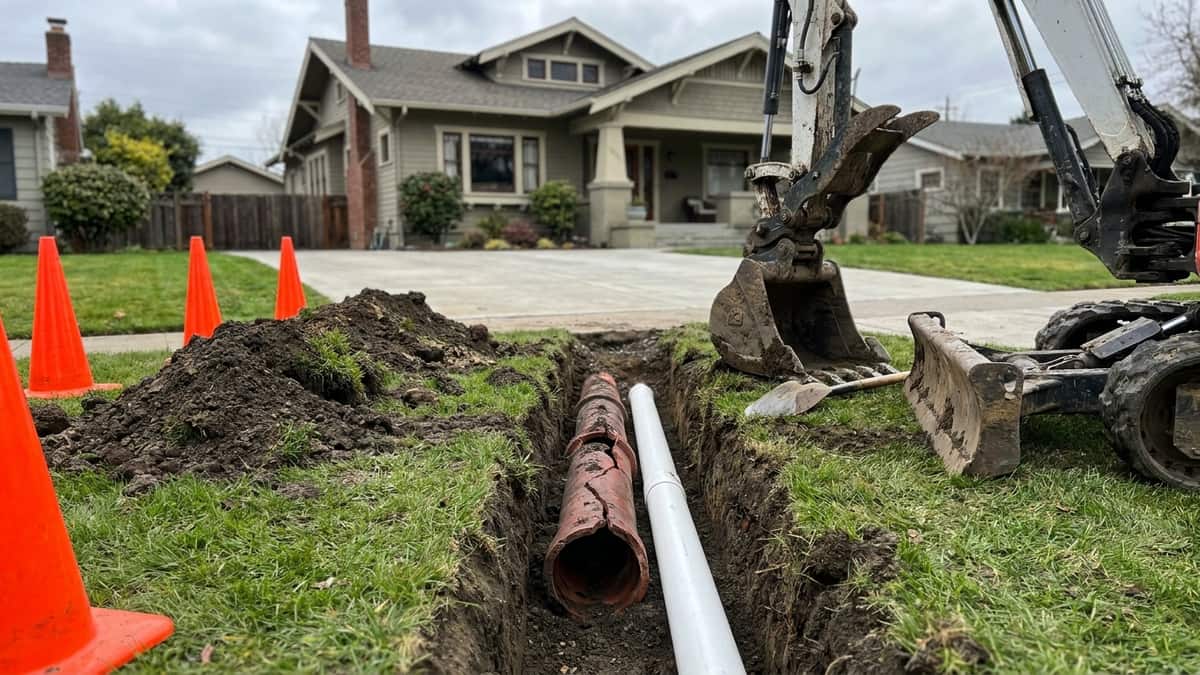
A plumbing company can run a full week of drain calls, clear twenty lines at $350 a pop, and bill $7,000. One sewer line replacement on a 60-foot run of cracked clay can beat that in a single day. Same trucks, same techs, same service area, completely different business.
Most plumbing marketing does not treat it that way. Sewer and water service replacement gets buried inside a general plumbing campaign, judged by the same cost-per-lead number as a $200 faucet call, and starved of budget because the leads "cost too much." They do not cost too much. They are being measured against the wrong ticket.
Here is what this work is actually worth, what you can afford to pay for a lead, and how to reach the homeowner before the line collapses.
Why is sewer and water service replacement the highest-ticket work in plumbing?
Because it is excavation, permitting, restoration, and a code inspection wrapped around a pipe nobody can see. Three things stack the ticket:
Scope. A replacement is not a repair. You are pulling or bursting a full run from the house to the main, sometimes under a driveway, sometimes under a mature tree, sometimes under a city sidewalk that requires its own permit.
Restoration. Concrete, sod, landscaping, and driveway patch are real line items. On a lot of jobs the dirt work costs more than the pipe.
Non-negotiability. A homeowner can live with a slow drain. They cannot live with sewage backing into a finished basement, and they cannot close on a house with a failed lateral. When the trigger hits, the job happens.
That combination is why these jobs regularly land between $3,000 and $25,000 while the rest of your board is running $200 to $600. It is also why they deserve their own campaign, their own budget, and their own cost-per-lead ceiling. Our plumbing lead generation page is built around exactly that split.
The two buyers behind this work
The failure buyer has water or sewage where it should not be. Basement backup, sinkhole in the yard, a water service line leaking under the slab and spiking the bill. They call three companies in ten minutes and book whoever can get a camera and an excavator out first. Sales cycle: hours.
The planned buyer has known about it for a while. The line has been snaked twice a year for three years. A home inspector's camera report flagged a belly and root intrusion during a sale. The city sent a notice about a lead water service. They are collecting bids, comparing trenchless versus open cut, and deciding in weeks, not hours. Sales cycle: two to eight weeks.
Those two buyers do not live on the same channel, and the second one is where the margin is.
What is a sewer or water service job actually worth in 2026?
You cannot set a lead ceiling until you know your real ticket mix. Depth, soil, access, permit fees, and restoration move all of these, but the ranges are typical.
| Scope of work | Typical installed price | Buyer type |
|---|---|---|
| Scope of workCamera inspection and locate | Typical installed price$150-$600 | Buyer typeDiagnostic / entry |
| Scope of workHydro jetting and root cutting | Typical installed price$400-$1,200 | Buyer typeRecurring / stopgap |
| Scope of workSpot repair, single section dig | Typical installed price$1,500-$4,500 | Buyer typeFailure |
| Scope of workWater service line replacement | Typical installed price$2,500-$8,000 | Buyer typePlanned or forced |
| Scope of workTrenchless pipe lining, full lateral | Typical installed price$6,000-$18,000 | Buyer typePlanned |
| Scope of workPipe bursting or full open-cut replacement | Typical installed price$8,000-$25,000 | Buyer typeFailure or planned |
| Scope of workWhole-home repipe (added on) | Typical installed price$4,000-$15,000 | Buyer typePlanned |
The pattern matters more than any single row. Converting one recurring jetting customer into a lined lateral is worth more revenue than thirty additional drain calls, and it consumes one crew day instead of thirty dispatches.
The formula that sets your lead ceiling
Run this per campaign, not per company.
Max cost per lead = (average job value x gross margin x close rate) / 3
- Drain and service campaign: $450 x 0.55 margin x 0.35 close = $87, divided by 3 = a $29 maximum cost per lead.
- Water service campaign: $4,000 x 0.45 x 0.30 = $540, divided by 3 = a $180 maximum cost per lead.
- Sewer replacement campaign: $12,000 x 0.40 x 0.25 = $1,200, divided by 3 = a $400 maximum cost per lead.
Those numbers are not in the same universe. If you run one blended plumbing campaign and hold the whole thing to $29, you will never win a sewer lead against a company that split them out. If you hold it to $400, you will lose money on every drain call you buy. That single spread is the entire argument for separating the campaigns.
Why does cost per lead mislead plumbing contractors on this work?
Because the invoice price ignores how many other companies got handed the same homeowner, and it ignores what a truck roll costs you.
| Channel | Cost per lead | Typical close rate | Cost per acquired job |
|---|---|---|---|
| ChannelReferrals and past customers | Cost per lead$0 | Typical close rate40-60% | Cost per acquired jobNear $0 |
| ChannelGoogle Business Profile / organic | Cost per lead$0-50 | Typical close rate20-40% | Cost per acquired job$100-250 |
| ChannelShared marketplace leads | Cost per lead$25-75 | Typical close rate5-12% | Cost per acquired job$300-1,200 |
| ChannelGoogle Local Services Ads | Cost per lead$35-110 | Typical close rate15-30% | Cost per acquired job$200-600 |
| ChannelMeta advertising | Cost per lead$25-110 | Typical close rate10-20% | Cost per acquired job$250-1,100 |
| ChannelExclusive leads (performance partner) | Cost per lead$50-200 | Typical close rate20-40% | Cost per acquired job$200-900 |
| ChannelExclusive booked appointments | Cost per lead$200-400 | Typical close rate25-40% | Cost per acquired job$600-1,400 |
A $50 shared lead closing at 8 percent costs $625 per acquired job. A $150 exclusive lead closing at 30 percent costs $500 per acquired job, and the ticket is usually larger because you are not the third company standing in the same yard bidding against a quote the homeowner already has in hand. The long-form version of that math is in our breakdown of exclusive vs. shared leads.
There is a second cost almost nobody tracks on sewer work: the diagnostic itself. A camera inspection with a locate, footage, and a written scope is 60 to 120 minutes plus travel, plus equipment. At an 8 percent close rate you are running twelve of those to sell one job. Price that at your loaded tech hour and shared leads stop looking cheap in a hurry. If you want to see your own version of that number, run it through the lead ROI calculator.
How do you reach homeowners before the sewer line fails?
The planned buyer is not searching. That is the whole point. They have a problem they have decided to live with, and search only catches them on the day they stop being able to live with it — by which point three other companies are in the queue.
Target the house, not the keyword
Sewer failure correlates with housing stock. Clay and Orangeburg laterals sit under homes built before roughly 1975. Galvanized and lead water services sit under the same neighborhoods. Mature trees mean root intrusion. Meta lets you reach homeowners in those areas at scale, months before the backup, for roughly $25 to $110 per lead.
Lead with the symptom, not the service
Nobody wakes up wanting a lateral replacement. They wake up annoyed that the basement floor drain gurgles when the washer empties. Ad copy that names the symptom outperforms copy that names the product every time:
- Snaking the same line twice a year
- Gurgling drains or a toilet that bubbles when the tub empties
- A soft, always-green patch in the yard
- A water bill that jumped with no change in usage
- Slow drains in the whole house, not one fixture
Use the triggers that force the decision
Three events reliably turn a tolerated problem into a signed contract: a home sale inspection, a municipal notice about lead service lines or a sewer lateral ordinance, and a first backup. Build campaigns around all three. Homeowners under contract to sell are the fastest-closing planned buyers in this trade because they have a deadline that is not negotiable.
Show the camera footage
This is the most under-used creative asset in plumbing. Thirty seconds of camera video showing roots filling a pipe does more selling than any headline. Homeowners cannot picture a failed lateral. Show them one. Real footage from your own jobs, not stock.
If you want a campaign built this way — running through your own Meta ad account, with the leads exclusive to you — book a call and we will walk the numbers for your market.
How do you win the emergency sewer call?
Differently. The failure buyer is a speed problem, not a targeting problem.
- Answer live, every time. Not a voicemail, not a callback in twenty minutes. The homeowner is calling down a list and stops at the first live human.
- Own Local Services Ads and your Google Business Profile. This is the search-intent half of the business. Reviews and proximity decide who gets the tap.
- Dispatch a camera same day. Whoever puts eyes in the pipe first controls the diagnosis and usually the job.
- Quote on site, in writing, with restoration included. Vague verbal numbers get re-shopped.
- Follow up in writing within the hour. The reasons homeowners go quiet are covered in our guide on speed to lead, and they apply double when the ticket has five figures in it.
Speed is not a marketing tactic here. It is the product.
How many sewer leads do you need to hit a revenue target?
Work backward. Do not start from a budget.
- Pick the revenue. Say $600,000 in added sewer and water service work.
- Divide by average ticket. At $12,000, that is 50 jobs.
- Divide by close rate. At 25 percent on exclusive leads, that is 200 leads.
- Divide by 12. About 17 leads a month.
- Multiply by cost per lead. At $150, roughly $2,550 a month.
$2,550 a month against $600,000 in revenue is well inside a healthy ratio. Now run the same five steps with a $4,000 water service average and a 30 percent close rate: 150 jobs, 500 leads, 42 a month. Same revenue, two and a half times the lead volume and far more dispatch load. That is why ticket mix, not lead count, is the number to manage. Budget frameworks by revenue tier are in our post on setting a contractor marketing budget.
What kills sewer replacement leads after they come in?
The lead is rarely the problem. Four things are.
No camera, no close. Selling a five-figure dig off a verbal opinion asks the homeowner to take your word on something invisible. Footage, a locate mark, and a depth note turn an opinion into evidence.
No financing on the table. This is an unbudgeted repair. Present it as a monthly number alongside the total. A homeowner who says the total is impossible will often say yes to the payment.
A quote with no scope. Permit, depth, restoration, tie-in, warranty length, and what happens if the excavation hits something unexpected. Every gap in the scope is a place the cheaper bid looks cheaper.
Silence after day two. These decisions take two to eight weeks and involve a spouse. One follow-up call is not a follow-up system. Build a real cadence and work it, or you are funding someone else's close.
What should a plumbing company do first?
Split the campaigns. Set a separate cost-per-lead ceiling for replacement work using the formula above. Keep Local Services Ads and your Google Business Profile funded for the emergency half, because that traffic is already looking for you. Then put a planning-phase Meta campaign in front of the pre-1975 housing stock in your service area, built on your own camera footage and your own trench photos, running through your own ad account so the brand equity stays with your company.
Minyona installs and manages that system for plumbing contractors. Setup is $2,000 one time, currently half the normal $4,000. Ad spend goes directly from you to Meta out of your own account, so you see every dollar. You pay from $50 to $200 per qualified exclusive lead, or from $200 to $400 per booked appointment, and nothing when the system does not produce. Track-record specifics for plumbing are available on request.
If sewer and water service replacement should be a bigger share of your board next year, tell us your market and we will show you the live numbers.
Frequently asked questions
What does a sewer line replacement lead cost in 2026?
Shared marketplace plumbing leads typically run $25 to $75 each but close at 5 to 12 percent because three to five companies get the same homeowner. Exclusive plumbing leads generally run $50 to $200 and close at 20 to 40 percent. Google Local Services Ads for sewer and drain terms usually land between $35 and $110 per lead with high intent but limited and unpredictable volume.
Should sewer replacement have its own campaign separate from drain cleaning?
Yes. A $450 drain clearing supports a cost per lead around $30, while a $12,000 sewer replacement supports several hundred dollars per lead. Blending them into one campaign forces you to judge your biggest ticket by the economics of your smallest one, and you will underbid every competitor who split them.
How many sewer line leads do I need to add $600,000 in revenue?
At a $12,000 average replacement and a 25 percent close rate on exclusive leads, you need about 50 jobs, which means roughly 200 leads a year or 17 a month. At $150 per lead that is about $2,550 a month in lead cost against $600,000 in revenue. Change the ticket or the close rate and the whole number moves, so run it with your own figures.
Is Meta advertising or Google better for sewer line leads?
You need both, for different buyers. Google and Local Services Ads capture the homeowner with sewage on the basement floor right now, and that homeowner books whoever answers first. Meta reaches the homeowner who has been snaking the same line twice a year, or who just got a camera report during a home sale, before they ever type a search, and that is where most of the planned full replacements come from.
Why do homeowners stall on sewer replacement quotes?
Because it is a five-figure repair on something they cannot see and did not plan for, and it produces nothing visible when it is done. Camera footage, a marked-up sketch of the run, a written scope with restoration included, and financing presented as a monthly number are what move the decision. Silence after the quote is the single most expensive habit in this trade.
Frequently asked questions
What does a sewer line replacement lead cost in 2026?
Shared marketplace plumbing leads typically run $25 to $75 each but close at 5 to 12 percent because three to five companies get the same homeowner. Exclusive plumbing leads generally run $50 to $200 and close at 20 to 40 percent. Google Local Services Ads for sewer and drain terms usually land between $35 and $110 per lead with high intent but limited and unpredictable volume.
Should sewer replacement have its own campaign separate from drain cleaning?
Yes. A $450 drain clearing supports a cost per lead around $30, while a $12,000 sewer replacement supports several hundred dollars per lead. Blending them into one campaign forces you to judge your biggest ticket by the economics of your smallest one, and you will underbid every competitor who split them.
How many sewer line leads do I need to add $600,000 in revenue?
At a $12,000 average replacement and a 25 percent close rate on exclusive leads, you need about 50 jobs, which means roughly 200 leads a year or 17 a month. At $150 per lead that is about $2,550 a month in lead cost against $600,000 in revenue. Change the ticket or the close rate and the whole number moves, so run it with your own figures.
Is Meta advertising or Google better for sewer line leads?
You need both, for different buyers. Google and Local Services Ads capture the homeowner with sewage on the basement floor right now, and that homeowner books whoever answers first. Meta reaches the homeowner who has been snaking the same line twice a year, or who just got a camera report during a home sale, before they ever type a search, and that is where most of the planned full replacements come from.
Why do homeowners stall on sewer replacement quotes?
Because it is a five-figure repair on something they cannot see and did not plan for, and it produces nothing visible when it is done. Camera footage, a marked-up sketch of the run, a written scope with restoration included, and financing presented as a monthly number are what move the decision. Silence after the quote is the single most expensive habit in this trade.