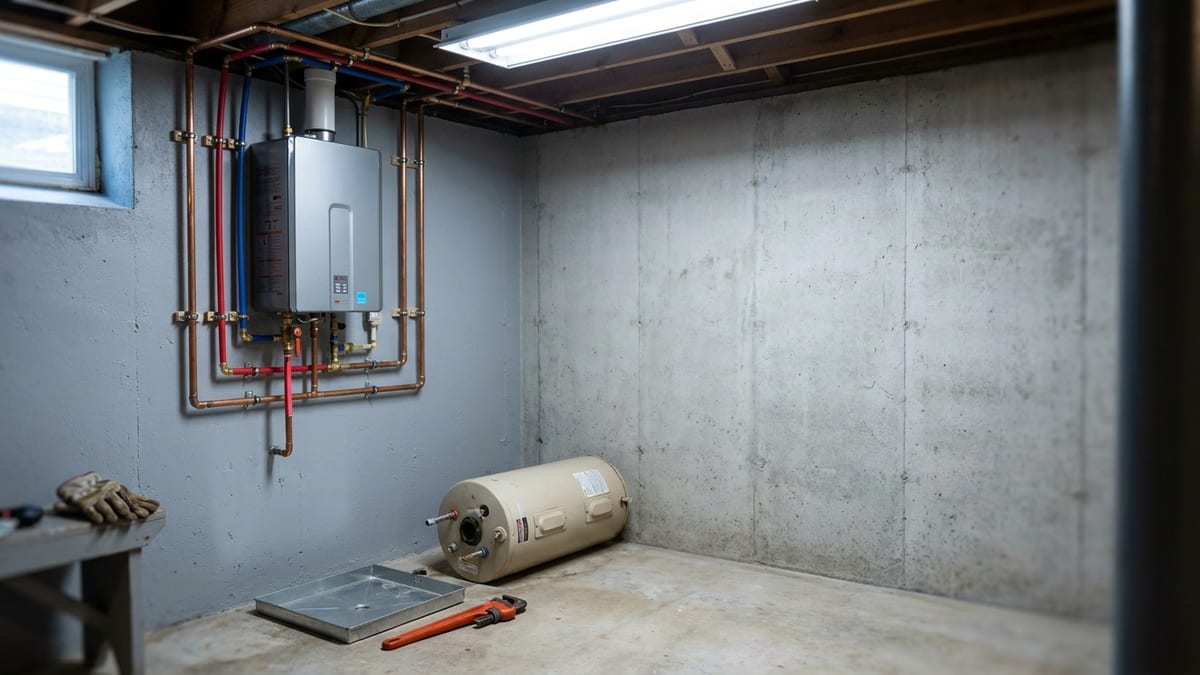
A burst supply line at 11 p.m. and a whole-home repipe are the same trade, the same truck, and the same license. One pays $380. The other pays $9,000. Most plumbing companies run one marketing budget across both and then wonder why the leads feel expensive some months and free the next.
The leads behave differently because the buyers behave differently. Emergency callers are in a race and will book whoever answers. Replacement buyers are in a decision and will book whoever reached them first with something credible. If you judge both on the same cost per lead, you will underfund the channel that actually builds your revenue.
Here is the money math on each side, and how to split a budget between them.
What does an emergency plumbing call actually pay?
Emergency work is high volume, high close rate, low ticket. That combination is fine as long as you do the gross profit math before you set a lead-cost ceiling.
| Emergency job type | Typical ticket | Notes |
|---|---|---|
| Emergency job typeClogged drain or toilet | Typical ticket$150-$450 | NotesFastest booking, thinnest margin |
| Emergency job typeBurst or leaking supply line | Typical ticket$250-$900 | NotesOften after-hours premium |
| Emergency job typeFailed sump pump | Typical ticket$800-$2,500 | NotesFrequently upsells to backup system |
| Emergency job typeEmergency water heater failure | Typical ticket$1,200-$3,500 | NotesThe best emergency call you can get |
| Emergency job typeMain line backup | Typical ticket$400-$2,500 | NotesCamera inspection opens sewer work |
At a $450 average ticket and a 40% gross margin, an emergency call produces about $180 of gross profit. That is your entire budget for acquiring it, plus dispatch, plus overhead. Which means the ceiling for a paid emergency lead is tight.
Run the standard formula:
Max cost per lead = (average job value x gross margin x close rate) / 3
$450 x 0.40 x 0.35 = $63, divided by 3 = a $21 maximum cost per lead on pure emergency work. That is why plumbers who buy nothing but emergency leads always feel squeezed. The channel only works when the calls are cheap, the close rate is high because you answer every time, and a meaningful share of those calls convert into larger work later.
That last part is the actual argument for running emergency campaigns. The value of an emergency call is not the $380 invoice. It is the water heater you replace for the same homeowner 14 months later, the service agreement, and the review. Our plumbing lead generation page breaks down how both sides of the trade get campaigned separately.
What does a repipe or water heater job actually pay?
Now run the same math on planned replacement work.
| Replacement job type | Typical installed price |
|---|---|
| Replacement job typeTank water heater replacement | Typical installed price$1,200-$2,500 |
| Replacement job typeTankless water heater install | Typical installed price$3,000-$6,500 |
| Replacement job typePartial repipe (one bathroom or wet wall) | Typical installed price$1,500-$4,000 |
| Replacement job typeWhole-home repipe (PEX or copper) | Typical installed price$4,000-$15,000 |
| Replacement job typeSewer line repair or spot fix | Typical installed price$3,000-$8,000 |
| Replacement job typeFull sewer line replacement | Typical installed price$8,000-$25,000 |
| Replacement job typeWater treatment or softener system | Typical installed price$1,500-$5,000 |
Take a $5,500 blended replacement ticket at 40% margin and a 25% close rate: $5,500 x 0.40 x 0.25 = $550, divided by 3 = a $183 maximum cost per lead.
That is roughly nine times the ceiling on emergency work. Same company, same trucks, same license. The difference is entirely in what the homeowner is buying.
Which plumbing leads cost more to generate?
This is where most plumbers get surprised. The expensive job is often the cheaper lead.
| Channel | Typical cost per lead | Close rate | Cost per acquired job | Best for |
|---|---|---|---|---|
| ChannelReferrals | Typical cost per lead$0 | Close rate40-60% | Cost per acquired jobNear $0 | Best forBoth |
| ChannelGoogle Business Profile / organic | Typical cost per lead$0-50 | Close rate20-40% | Cost per acquired job$100-250 | Best forEmergency |
| ChannelLocal Services Ads | Typical cost per lead$25-90 | Close rate25-45% | Cost per acquired job$80-350 | Best forEmergency |
| ChannelGoogle search ads | Typical cost per lead$60-250 | Close rate15-30% | Cost per acquired job$400-1,500 | Best forEmergency and heaters |
| ChannelShared marketplace leads | Typical cost per lead$15-60 | Close rate5-12% | Cost per acquired job$200-1,000 | Best forNeither, honestly |
| ChannelMeta advertising | Typical cost per lead$25-110 | Close rate10-20% | Cost per acquired job$250-1,100 | Best forReplacement |
| ChannelExclusive leads (performance partner) | Typical cost per lead$50-200 | Close rate20-40% | Cost per acquired job$200-1,000 | Best forReplacement |
| ChannelExclusive booked appointments | Typical cost per lead$200-400 | Close rate25-40% | Cost per acquired job$600-1,400 | Best forRepipe and sewer |
Emergency demand is a search auction. Every plumber in the county is bidding on the same 40 people who typed "emergency plumber near me" today, and the auction price is set by whoever has the deepest pockets and the best review count. You cannot manufacture more burst pipes.
Replacement demand is not an auction, because most of it has not entered the search results yet. The homeowner with a 13-year-old tank in the garage is not searching for anything. They will search the week it fails, and at that point the job becomes an emergency and gets sold at emergency speed and emergency price by whoever answers. Reaching that homeowner six months earlier is cheaper than winning them six months later.
Why is cost per lead the wrong number for plumbers?
Because it hides both the close rate and the ticket.
A $22 shared marketplace lead sounds like the cheapest thing on the list. Three to five plumbers get the same homeowner, so you close 8% of them. That is $275 in lead cost per acquired job, on jobs that average $400 because shared leads skew toward small, price-shopped work. You just spent $275 in acquisition to earn $160 in gross profit.
A $130 exclusive lead closing at 28% costs $464 per acquired job. On a $5,500 repipe at 40% margin, that is $464 spent to earn $2,200. The lead cost is six times higher and the deal is dramatically better.
The only number that pays a crew is cost per acquired job, measured separately by job type. If you want the full breakdown of why exclusivity changes the math, read exclusive vs. shared leads, and for the ceiling formulas by channel, how much you should pay per lead.
Track these four numbers by lead source
- Cost per lead
- Close rate
- Average ticket on closed jobs
- Cost per acquired job, and gross profit per acquired job
Most plumbing companies track the first one and guess at the other three. If your CRM cannot report average ticket by lead source, that is the single highest-value reporting fix you can make this quarter.
---
Want the real numbers for your market? We build the campaigns in your own Meta ad account, you pay the ad platform directly, and you pay us when a qualified lead or a booked appointment shows up. Get started here.
---
How do you win the emergency plumbing call?
There is no clever strategy here. It is operational.
Answer the phone. Every ring, including nights and weekends. A homeowner with water on the floor calls until someone picks up, and the calling stops at the first live human. If you send emergency calls to voicemail after 6 p.m., you are paying for leads and handing them to the next plumber in the list.
Get the truck committed on the call. "We can have someone there between 2 and 4" ends the shopping. A callback promise does not.
Be visible where the panic search happens. That means Local Services Ads, a Google Business Profile with a heavy and recent review count, and service pages that name the city.
Respond in minutes, not hours, on form fills. Even in emergencies, a share of homeowners fill out a form instead of calling. Those go stale faster than any lead type in home improvement. The mechanics of that are covered in speed to lead.
Upsell on site, not on the phone. The technician standing in front of a 12-year-old tank with visible corrosion is the highest-converting salesperson in your company. Give them a replacement quote sheet and a financing option before they leave the driveway.
How do you win the repipe and water heater job before the search happens?
This is where Meta advertising earns its place in a plumbing budget, and where most plumbers have never run a serious campaign.
- Target the housing stock, not the search term. Homes built in eras with galvanized or polybutylene supply lines. Neighborhoods with known water quality issues. Recent homebuyers, who spend heavily in the first 12 months and just read an inspection report listing the water heater's age.
- Lead with symptoms, not part names. Rusty or discolored water. Pressure that drops when someone starts the shower. A tank that takes forever to recover. Pinhole leaks that keep showing up. Homeowners recognize symptoms; they do not recognize "PEX manifold repipe."
- Show finished work. Clean copper and PEX runs, a wall-mounted tankless unit, a tidy utility room. Plumbing is invisible work. The creative has to show the outcome someone would be proud to have in their basement.
- Name the age trigger. "If your water heater is over 10 years old, it is on borrowed time" converts because it is true and because the homeowner can check it in 30 seconds.
- Put financing in the ad. A $9,000 repipe reframed as a monthly payment moves the decision from "someday" to "this month."
- Offer a real first step. A flat-fee inspection, a water quality test, or a scheduled estimate visit. Not "contact us."
These campaigns produce fewer leads per dollar than emergency search. They also produce tickets five to fifteen times larger, which is exactly the trade you want.
How should you split a plumbing marketing budget?
Use two budgets, two ceilings, and two scoreboards. A blended target will always overpay for emergency leads and starve replacement campaigns.
| Company stage | Emergency channels | Replacement channels | Typical monthly total |
|---|---|---|---|
| Company stageUnder $1M revenue | Emergency channels65% | Replacement channels35% | Typical monthly total$2,000-$4,000 |
| Company stage$1M-$3M | Emergency channels50% | Replacement channels50% | Typical monthly total$4,000-$9,000 |
| Company stage$3M-$7M | Emergency channels35% | Replacement channels65% | Typical monthly total$9,000-$20,000 |
| Company stage$7M+ | Emergency channels30% | Replacement channels70% | Typical monthly total$20,000+ |
The shift is deliberate. Early on, emergency work funds payroll and builds the review base you need to win the search auction. As the company grows, the constraint stops being cash flow and starts being ticket size, and replacement work is the only way to grow revenue without doubling headcount.
How many leads do you need to hit a revenue target?
Work backward. Say you want to add $500,000 in revenue.
- Blended average ticket: $2,500
- Jobs needed: 200
- Close rate on exclusive leads: 30%
- Leads needed: 667 per year, or about 56 per month
- At $70 per qualified lead: roughly $3,900 per month in lead cost
- Plus ad spend paid directly to the ad platform from your own account
Now run the same target with a replacement-weighted mix. At a $5,500 average ticket, $500,000 takes 91 jobs. At a 25% close rate that is 364 leads a year, or about 30 a month. Even at $150 per lead, that is $4,500 a month for the same revenue with a quarter of the dispatch load and far less wear on your trucks.
Same revenue. Very different business.
What should a plumbing company do first?
In order:
- Make sure every emergency call is answered live, 24 hours a day. Nothing else in this article matters if that is broken.
- Pull last 12 months of closed jobs and split them by ticket size and lead source. Find your real close rate and average ticket per source.
- Set two maximum cost-per-lead ceilings using the formula, one for emergency and one for replacement.
- Cut any source that exceeds its ceiling on cost per acquired job for two consecutive months.
- Start a replacement campaign aimed at planning-phase homeowners, sized so it can run at least 90 days without being turned off.
Most plumbing companies are one channel away from a materially different revenue mix. It is almost never the emergency channel.
Ready to build the replacement side of your lead flow? Campaigns run in your ad account, under your brand, with leads that go to you and nobody else. Book a call and we will walk your numbers.
Frequently asked questions
What do emergency plumbing leads cost in 2026?
Local Services Ads and Google search typically deliver emergency plumbing leads at $25 to $90 each, and they close at 25 to 45 percent when the phone is actually answered. Shared marketplace leads run $15 to $60 but close at 5 to 12 percent because three to five plumbers get the same homeowner. Exclusive leads generally run $50 to $200 and close at 20 to 40 percent.
Are emergency plumbing calls worth advertising for at all?
Yes, but only as a volume and reputation play, not a margin play. A $450 average emergency ticket at a 40 percent gross margin leaves $180 of gross profit, so your cost per acquired job has to stay near or under $150 for the channel to earn its keep. The real return comes from the water heaters, repipes, and service agreements those calls turn into later.
How do you generate repipe and water heater leads before the homeowner searches?
Meta advertising reaches homeowners during the planning phase, when the water is still hot but the tank is 12 years old and the pressure is dropping. Target older housing stock and recent homebuyers, lead with rusty-water and low-pressure symptom hooks, show finished installs, and put monthly financing in the ad. These campaigns produce fewer leads than emergency search, at larger tickets.
How many plumbing leads do I need to add $500,000 in revenue?
At a blended $2,500 average ticket you need roughly 200 additional jobs. At a 30 percent close rate that is about 667 leads a year, or 56 exclusive leads a month. At $70 per lead that is roughly $3,900 a month in lead cost, plus the ad spend you pay directly to the ad platform out of your own account.
Should emergency and replacement plumbing leads share one budget?
No. They have different close rates, different tickets, and different maximum cost per lead, so a single blended target will always overpay for one and underfund the other. Set separate monthly budgets and separate cost-per-acquired-job ceilings, then report on them separately every month.
Frequently asked questions
What do emergency plumbing leads cost in 2026?
Local Services Ads and Google search typically deliver emergency plumbing leads at $25 to $90 each, and they close at 25 to 45 percent when the phone is actually answered. Shared marketplace leads run $15 to $60 but close at 5 to 12 percent because three to five plumbers get the same homeowner. Exclusive leads generally run $50 to $200 and close at 20 to 40 percent.
Are emergency plumbing calls worth advertising for at all?
Yes, but only as a volume and reputation play, not a margin play. A $450 average emergency ticket at a 40 percent gross margin leaves $180 of gross profit, so your cost per acquired job has to stay near or under $150 for the channel to earn its keep. The real return comes from the water heaters, repipes, and service agreements those calls turn into later.
How do you generate repipe and water heater leads before the homeowner searches?
Meta advertising reaches homeowners during the planning phase, when the water is still hot but the tank is 12 years old and the pressure is dropping. Target older housing stock and recent homebuyers, lead with rusty-water and low-pressure symptom hooks, show finished installs, and put monthly financing in the ad. These campaigns produce fewer leads than emergency search, at larger tickets.
How many plumbing leads do I need to add $500,000 in revenue?
At a blended $2,500 average ticket you need roughly 200 additional jobs. At a 30 percent close rate that is about 667 leads a year, or 56 exclusive leads a month. At $70 per lead that is roughly $3,900 a month in lead cost, plus the ad spend you pay directly to the ad platform out of your own account.
Should emergency and replacement plumbing leads share one budget?
No. They have different close rates, different tickets, and different maximum cost per lead, so a single blended target will always overpay for one and underfund the other. Set separate monthly budgets and separate cost-per-acquired-job ceilings, then report on them separately every month.