Two plumbing trucks leave the shop on the same morning. The first one swaps a leaking 50 gallon tank for $1,900 and is back on the road in three hours. The second one converts a homeowner to tankless for $5,800, spends most of the day on gas line and venting work, and bills three times the ticket on one job.
Same trade. Same crew skill. Completely different lead.
Most plumbing companies market for the first truck and hope the second one shows up by accident. It doesn't. The failed-tank buyer and the planned-upgrade buyer are found in different places, at different moments, at wildly different costs per lead. Here is the ticket math, the cost per acquired job, and the campaign split that books both.
Why do water heater leads split into two completely different jobs?
Because one is a failure and one is a decision.
The failed-tank buyer
There is water on the floor, or there is no hot water, or the pressure relief valve is dumping. This homeowner is not comparing brands. They are calling three numbers in a row and booking whoever says "we can be there this afternoon." Price matters less than availability, but the scope is fixed: replace what's there, like for like.
Ticket: $1,200 to $3,500. Sales cycle: hours. Close rate on a good exclusive lead: 30 to 40 percent, because there is nothing to think about.
This is a volume-and-dispatch game. It works when your cost per lead is low, your phone is answered every time, and you have a truck that can move. It does not scale past your capacity to answer calls, and it almost never produces a tankless upsell, because nobody chooses a two-day gas and venting project while standing in an inch of water.
The planned upgrade buyer
This homeowner's tank is 11 years old and hasn't failed yet. They are researching tankless because the upstairs shower runs cold, because they just finished a bathroom, because the utility mailed them a rebate flyer, or because they are tired of waiting for a recovery cycle with three people in the house. Maybe they're looking at a heat pump unit for the tax credit.
Ticket: $3,000 to $7,500 and up. Sales cycle: one to six weeks. Close rate on a well-worked exclusive lead: 20 to 30 percent, at two to three times the revenue.
This buyer is not searching yet. That is the whole point, and it is why our plumbing lead generation campaigns run these as two separate builds with two separate budgets and two separate cost-per-lead ceilings.
What is a water heater job actually worth in 2026?
You cannot set a lead-cost ceiling without knowing your real ticket mix. Regional labor, permit requirements, and existing gas and electrical capacity move all of these, but the ranges are typical.
| Scope of work | Typical installed price | Buyer type |
|---|---|---|
| Scope of workStandard 40-50 gal tank swap, like for like | Typical installed price$1,200-$2,400 | Buyer typeFailed / urgent |
| Scope of work75 gal or high-recovery tank replacement | Typical installed price$2,000-$3,500 | Buyer typeFailed / planned |
| Scope of workTank swap with code upgrades (expansion tank, pan, venting) | Typical installed price$1,800-$4,000 | Buyer typeFailed / forced |
| Scope of workTankless retrofit, existing gas capacity adequate | Typical installed price$3,000-$5,000 | Buyer typePlanned |
| Scope of workTankless retrofit with gas line upsize and new venting | Typical installed price$4,500-$7,500 | Buyer typePlanned |
| Scope of workHeat pump (hybrid) water heater install | Typical installed price$2,500-$5,000 before rebates | Buyer typePlanned / rebate |
| Scope of workRecirculation pump or loop add-on | Typical installed price$500-$1,800 | Buyer typeAdd-on |
| Scope of workWater heater plus softener or filtration bundle | Typical installed price$3,500-$8,000 | Buyer typePlanned |
The pattern matters more than any single line. Converting one homeowner from a $1,900 tank swap to a $5,800 tankless retrofit is worth more than winning two extra swaps, and the add-ons attach at a far higher rate on the planned job than on the emergency.
The formula that sets your lead ceiling
Run this per campaign, never per company.
Max cost per lead = (average job value x gross margin x close rate) / 3
Emergency swap campaign: $2,000 x 0.40 margin x 0.35 close = $280, divided by 3 = a $93 maximum cost per lead.
Tankless conversion campaign: $5,500 x 0.38 margin x 0.25 close = $522, divided by 3 = a $174 maximum cost per lead.
Those numbers are not close to each other. Hold one blended campaign to $93 and you will never outbid anybody for the tankless buyer. Hold it to $174 and you will lose money on swaps. That gap is the entire argument for splitting the campaigns. If you want to run your own numbers against your actual ticket and close rate, the ROI calculator does the arithmetic.
Why is cost per lead the wrong number to judge water heater leads on?
Because the invoice price ignores how many other plumbers got handed the same homeowner. Cost per acquired job is what pays a crew.
| Channel | Cost per lead | Typical close rate | Cost per acquired job |
|---|---|---|---|
| ChannelReferrals and past customers | Cost per lead$0 | Typical close rate40-60% | Cost per acquired jobNear $0 |
| ChannelGoogle Business Profile / organic | Cost per lead$0-50 | Typical close rate20-40% | Cost per acquired job$100-250 |
| ChannelShared marketplace leads | Cost per lead$25-75 | Typical close rate5-12% | Cost per acquired job$300-1,200 |
| ChannelGoogle Local Services Ads | Cost per lead$25-90 | Typical close rate15-30% | Cost per acquired job$150-500 |
| ChannelMeta advertising | Cost per lead$25-110 | Typical close rate10-20% | Cost per acquired job$250-1,100 |
| ChannelExclusive leads (performance partner) | Cost per lead$50-200 | Typical close rate20-40% | Cost per acquired job$200-900 |
| ChannelExclusive booked appointments | Cost per lead$200-400 | Typical close rate25-40% | Cost per acquired job$600-1,400 |
A $40 shared lead closing at 8 percent costs $500 per acquired job on a $1,900 ticket. That is 26 percent of revenue gone to marketing before a fitting is touched. A $120 exclusive lead closing at 32 percent costs $375 per job, and the ticket tends to be larger because you are not the third plumber quoting the same tank that afternoon. The full version of that math is in our breakdown of exclusive vs. shared leads.
There is a second cost almost nobody tracks in plumbing: windshield time. An in-home look at a utility closet, a gas meter, and a vent run is 30 to 60 minutes plus travel. At an 8 percent close rate you are running twelve of those to sell one job. Price that against your tech's loaded hourly cost and the cheap lead stops being cheap.
How do you reach the tankless buyer before the tank fails?
The $5,800 conversion rarely starts with a search. It starts with a homeowner who is annoyed, curious, or looking at a rebate, and the company that gets in front of them during that window wins the job without a bidding war.
Target the trigger, not the keyword
The signals that predict a tankless or heat pump conversion are ownership signals, not search signals: home age, owner-occupied status, recent purchase, and recent renovation activity. A house built 12 to 18 years ago is on its original tank or its first replacement. A homeowner who bought in the last 12 months is rebuilding the mechanicals list in their head right now.
Lead with the problem, not the product
"Tankless water heater installation" is a product ad. "Running out of hot water before the last shower?" is a problem ad, and it pulls the homeowner who has not yet learned the vocabulary for the fix. Endless hot water, no more cold showers, reclaimed closet space, and a 20-year service life do more work than a brand name.
Put the money math in the ad
Rebates and tax credits do not create demand, they compress timing. A qualifying heat pump water heater can carry a federal efficiency tax credit worth up to $2,000, and many utilities stack their own rebates on annual budgets with hard deadlines. Confirm the current program rules before you quote them, then name the dollar figure and the deadline. Financing does the same job for the tankless ticket: a monthly number makes a $5,500 project feel like a decision instead of an emergency.
Show the finished install
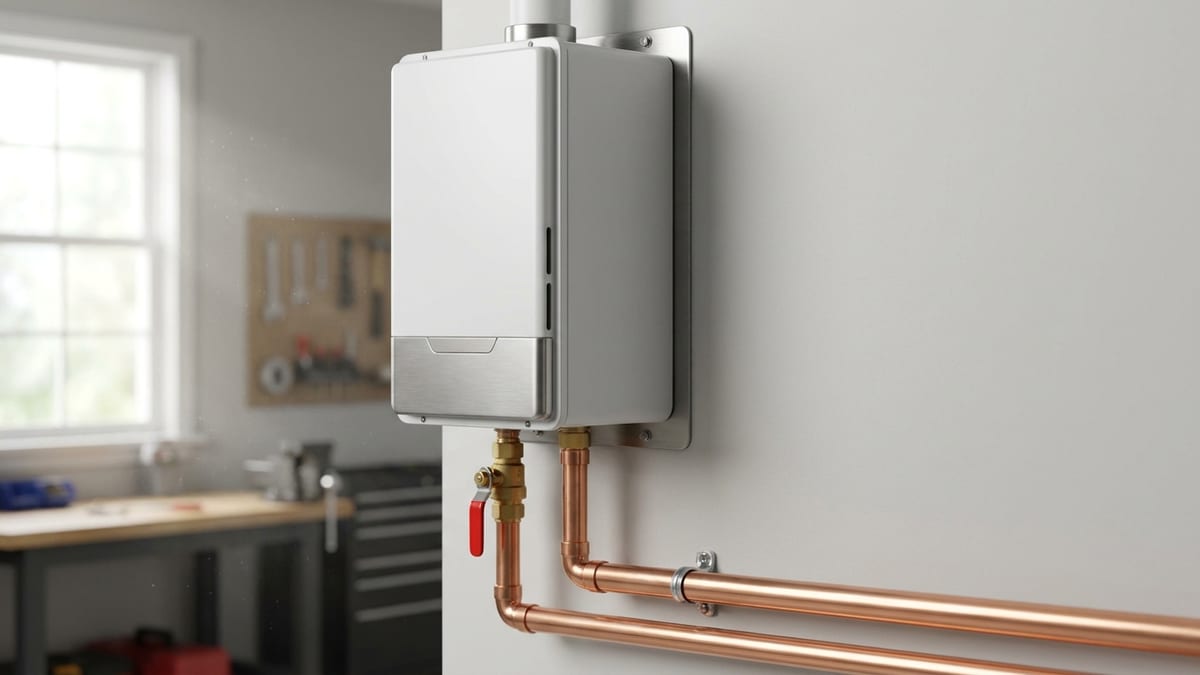
A clean tankless unit on a garage wall with tidy copper and a labeled shutoff sells the upgrade better than any spec sheet. Real photos of your own work, not manufacturer renders. Homeowners are buying the craftsmanship as much as the appliance.
Run it in your own ad account
Every impression from a campaign like this should build your company's name, not a lead platform's. When the ads run through your Meta account, you keep the pixel data, the audiences, and the retargeting lists that make month six cheaper than month one. That is how the system gets installed on our side — the campaigns live in your account, and you only pay when a qualified lead or booked appointment lands. Start at get started if you want the build mapped against your ticket mix.
What does the math look like against a revenue target?
Work backward from revenue, not forward from a budget.
| Target added revenue | Blended ticket | Jobs needed | Close rate | Leads needed / month |
|---|---|---|---|---|
| Target added revenue$250,000 | Blended ticket$2,000 | Jobs needed125 | Close rate30% | Leads needed / month~35 |
| Target added revenue$500,000 | Blended ticket$2,600 | Jobs needed192 | Close rate30% | Leads needed / month~53 |
| Target added revenue$500,000 | Blended ticket$4,500 | Jobs needed111 | Close rate30% | Leads needed / month~31 |
| Target added revenue$1,000,000 | Blended ticket$4,500 | Jobs needed222 | Close rate28% | Leads needed / month~66 |
Look at rows two and three. Same revenue. Raise the blended ticket from $2,600 to $4,500 by winning more conversions and the lead requirement drops by 42 percent. Fewer leads, fewer truck rolls, less dispatch stress, same top line. That is the argument for funding the tankless campaign even though its cost per lead looks worse on a spreadsheet.
On spend: 53 leads a month at a $70 to $90 blended ad cost is roughly $3,700 to $4,800 in ad spend paid directly to Meta out of your own account, plus the per-lead fee on qualified leads delivered. Run the numbers at your own margin before you commit. Our guide to what you should pay per lead walks the all-in version of this calculation.
What kills water heater leads after they come in?
The channel is rarely the problem. The first ten minutes usually are.
- Nobody answers. Water heater leads are the most time-sensitive in plumbing outside of a main break. A five-minute callback qualifies at a dramatically higher rate than a 30-minute one, and on emergency leads a 30-minute callback is often just a courtesy call to somebody who already booked. Our speed to lead breakdown covers the staffing side of this.
- The tech quotes one option. Every failed-tank call should carry three prices: like-for-like, high-recovery tank, tankless. Roughly a quarter of emergency homeowners will take the upgrade if it is presented as a real choice with a monthly payment attached. Zero will take it if nobody offers.
- Planned leads get worked like emergencies. A homeowner researching tankless six weeks out will not book on call one. They need two or three touches, a photo of a comparable install, and a rebate reminder. Drop them after one voicemail and you fund your competitor's job.
- No permit or code conversation up front. Venting, gas capacity, and expansion tank requirements are where tankless quotes die at the kitchen table. Name them in the first call so the number doesn't move later.
- Age data goes unused. Every tank you install has an expiration date. A homeowner you serviced nine years ago is the cheapest tankless lead you will ever get, and most plumbing companies never call them.
The short version
Water heater replacement is two businesses wearing one trade name. The emergency swap is a dispatch business won on answer speed and capacity. The tankless and heat pump conversion is a marketing business won weeks earlier, at two to three times the ticket, by whoever reached the homeowner while the old tank was still working.
Run them as separate campaigns with separate ceilings. Judge both on cost per acquired job. Present three options on every call. And stop treating a nine-year-old tank in your own service history as a closed file.
If you want the plumbing side of this built and managed in your own ad account, with exclusive leads priced from $50 and booked appointments from $200, start at get started or read how the plumbing lead system is structured by ticket type.
Frequently asked questions
What do water heater replacement leads cost in 2026?
Shared marketplace plumbing leads typically run $25 to $75 each but close at 5 to 12 percent because three to five companies get the same homeowner. Exclusive water heater leads generally run $50 to $200 and close at 20 to 40 percent. Google Local Services Ads for emergency water heater calls usually land between $25 and $90 per lead with high intent but limited volume.
Are tankless conversion leads worth more than tank replacement leads?
Yes, usually two to three times more. A standard 40 or 50 gallon tank swap runs roughly $1,200 to $3,500 installed, while a tankless retrofit with gas line and venting work commonly runs $3,000 to $7,500. Because the ticket is larger, the tankless campaign can justify a much higher cost per lead than the emergency swap campaign can.
How many water heater leads do I need to add $500,000 in revenue?
It depends on your ticket mix. At a $2,600 blended average and a 30 percent close rate you need about 640 leads a year, roughly 53 a month. Push the average ticket to $4,500 through tankless and heat pump conversions and the same $500,000 takes about 111 jobs, roughly 31 leads a month at the same close rate.
Should plumbers run Google or Meta ads for water heater leads?
Both, for different buyers. Google and Local Services Ads capture the homeowner standing in a wet utility closet searching right now, which skews toward same-day tank swaps. Meta reaches the homeowner whose tank is 11 years old and who is thinking about tankless but has not searched yet, which is where the bigger tickets come from.
Do rebates and tax credits actually move water heater leads?
They move timing more than demand. A qualifying heat pump water heater can carry a federal efficiency tax credit worth up to $2,000, and many utilities layer their own rebates on top with annual budgets and deadlines. Put the dollar figure and the deadline in the ad, confirm current program rules before you quote them, and have someone ready to answer the phone.
Frequently asked questions
What do water heater replacement leads cost in 2026?
Shared marketplace plumbing leads typically run $25 to $75 each but close at 5 to 12 percent because three to five companies get the same homeowner. Exclusive water heater leads generally run $50 to $200 and close at 20 to 40 percent. Google Local Services Ads for emergency water heater calls usually land between $25 and $90 per lead with high intent but limited volume.
Are tankless conversion leads worth more than tank replacement leads?
Yes, usually two to three times more. A standard 40 or 50 gallon tank swap runs roughly $1,200 to $3,500 installed, while a tankless retrofit with gas line and venting work commonly runs $3,000 to $7,500. Because the ticket is larger, the tankless campaign can justify a much higher cost per lead than the emergency swap campaign can.
How many water heater leads do I need to add $500,000 in revenue?
It depends on your ticket mix. At a $2,600 blended average and a 30 percent close rate you need about 640 leads a year, roughly 53 a month. Push the average ticket to $4,500 through tankless and heat pump conversions and the same $500,000 takes about 111 jobs, roughly 31 leads a month at the same close rate.
Should plumbers run Google or Meta ads for water heater leads?
Both, for different buyers. Google and Local Services Ads capture the homeowner standing in a wet utility closet searching right now, which skews toward same-day tank swaps. Meta reaches the homeowner whose tank is 11 years old and who is thinking about tankless but has not searched yet, which is where the bigger tickets come from.
Do rebates and tax credits actually move water heater leads?
They move timing more than demand. A qualifying heat pump water heater can carry a federal efficiency tax credit worth up to $2,000, and many utilities layer their own rebates on top with annual budgets and deadlines. Put the dollar figure and the deadline in the ad, confirm current program rules before you quote them, and have someone ready to answer the phone.