The Data on Speed to Lead
Let's start with what the research shows, because the numbers are striking.
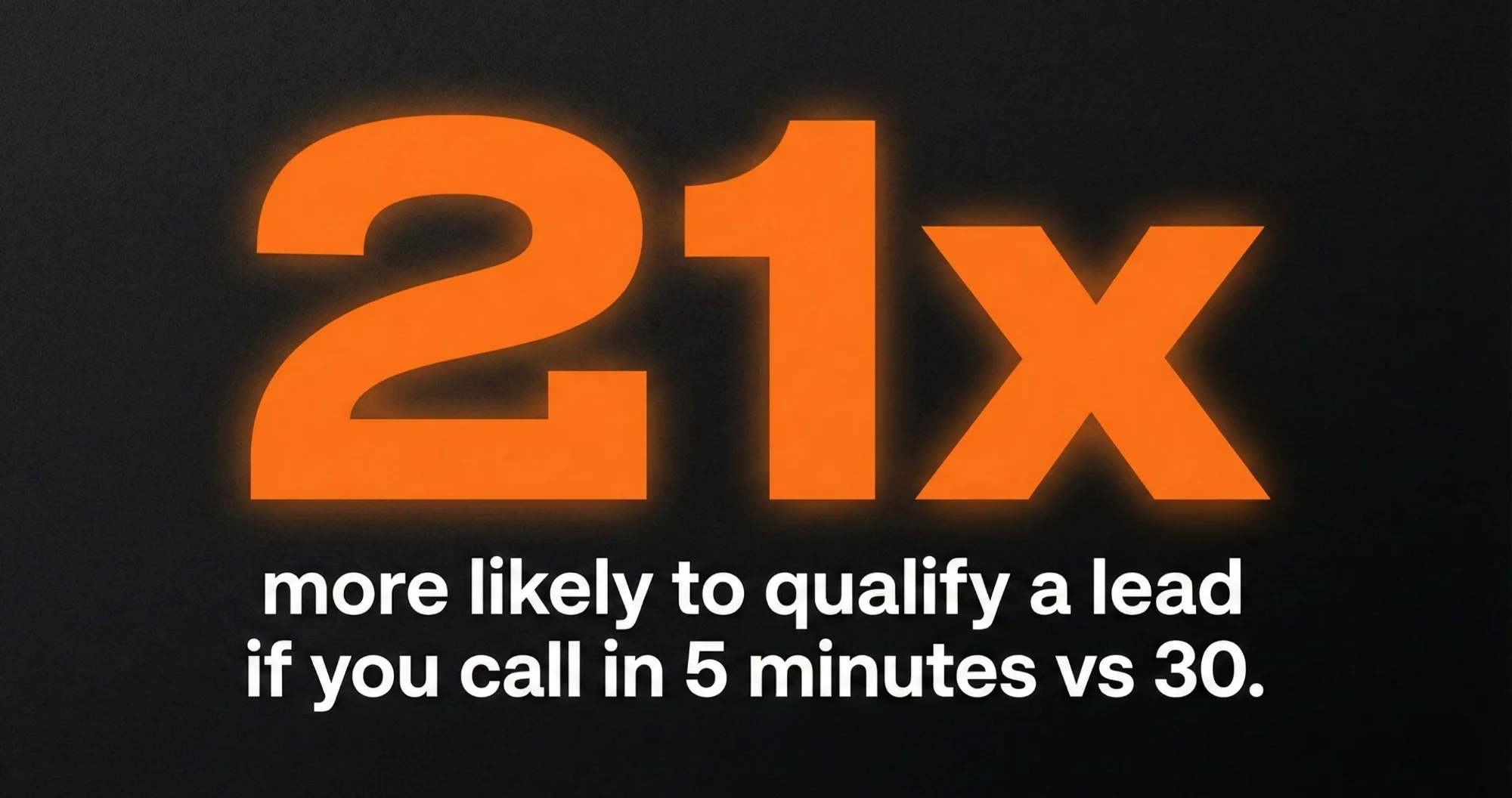
A study from Lead Response Management found that calling a lead within 5 minutes versus 30 minutes makes you 21 times more likely to qualify that lead. Not 21% more likely. Twenty-one times.
Another study from InsideSales found that 35-50% of sales go to the vendor who responds first. Not the cheapest. Not the best. The first.
Harvard Business Review published research showing that companies who contacted leads within an hour were 7 times more likely to have meaningful conversations than those who waited even 60 minutes—and 60 times more likely than companies who waited 24 hours or more.
The data is overwhelming and consistent: speed matters more than almost anything else in lead conversion.
But here's what most contractors get wrong: they think speed to lead means "call them faster."
That's part of it. But it's not the whole picture.
The Real Problem With "Just Call Faster"
Yes, you should call leads quickly. If a lead comes in and you call back within 5 minutes, your odds of connecting go way up.
But let's be realistic about how most contracting businesses operate.
You're on a roof. You're in a crawl space. You're driving between jobs. You're in the middle of a sales presentation. You're eating lunch for the first time at 2pm.
The idea that you're going to see a notification pop up on your phone and immediately drop everything to call a stranger—every single time—is a fantasy. Maybe you do it sometimes. Maybe your team does it sometimes. But consistently, reliably, within 5 minutes, every time? That's hard.
And what happens when you can't call right away?
The lead sits there. They submitted their info, felt a little spark of motivation to finally address that roof or those windows, and then... nothing. The moment passes. They go back to their life. By the time you call two hours later—or the next morning—they barely remember filling out the form.
"I requested a quote? When was that?"
Now you're not the contractor who responded to their need. You're an interruption. A cold call. And your odds of booking that appointment just dropped dramatically.
So what's the solution?
Flip the Script: Get Them to Reach Out First
The smartest approach to speed to lead isn't trying to be faster at calling. It's building a system where the homeowner takes action immediately—before you ever have to pick up the phone.
Think about what happens right after someone fills out a lead form. They're engaged. They just took an action. They're thinking about their roof, their windows, their siding, whatever problem prompted them to click. This is the moment of maximum motivation.
What do most contractors do with that moment?
They show a generic thank you page that says "Thanks! We'll be in touch soon." Maybe it has a stock photo of a house. Maybe it has the company phone number buried somewhere. Then the homeowner closes the tab and moves on with their day.
What a waste.
That thank you page is prime real estate. The homeowner is RIGHT THERE, actively engaged, having just committed to taking action on a problem they've been putting off. And you're going to let them wander off with a "we'll call you eventually"?
Here's what a good system does instead:
Immediate call to action. The thank you page doesn't just say thanks—it gives them something to do RIGHT NOW. Book your inspection online. Call us now to speak with someone immediately. The goal is to convert that lead into a scheduled appointment before they ever leave the funnel.
Urgency that's real. "Spots fill up fast—book now to lock in your inspection this week." "Call now and we'll include a free gutter inspection with your roof assessment." Give them a reason to act immediately, not "whenever."
Make it dead simple. One click to book. One tap to call. No hunting for a phone number. No filling out another form. The path forward is obvious and frictionless.
When this works—and it works more often than you'd think—the homeowner books an appointment or calls your office before you even know the lead came in. They've moved themselves down the funnel. They're not a "lead" anymore—they're a scheduled appointment.
That's speed to lead without you having to be glued to your phone.
The Thank You Page Test
Here's a quick way to evaluate whether your lead funnel is working: look at your thank you page.
Pull it up right now. What does it look like? What does it say? What does it ask the homeowner to do?
If it's a generic page with a stock photo and "Thanks, we'll be in touch"—you're leaking money. Every lead that hits that page and wanders off is a lead that could have booked an appointment on the spot.
Now here's the harder question: does your thank you page match the quality of your landing page?
Most contractors—and honestly, most marketing agencies—put all their effort into the landing page. Nice design. Compelling copy. Professional photos. Trust badges. The works.
Then the homeowner fills out the form and lands on a thank you page that looks like it was built in 2009. Different fonts. No branding. A plain white background with black text. Maybe a logo slapped on as an afterthought.
You know what that tells the homeowner?
It tells them the landing page was a facade. It tells them your company isn't actually as professional as the ad suggested. It tells them you care about getting the lead but not about the experience after.
It's like walking into a beautiful restaurant lobby, being impressed by the decor and the ambiance, and then being led to a dining room with folding chairs and plastic tablecloths. The illusion is shattered. You feel tricked.
Every Touchpoint Is a Brand Moment
The landing page isn't where the brand experience ends. It's where it begins.
Every touchpoint after that first click either reinforces your positioning or undermines it:
The thank you page. Does it look as good as the landing page? Does it continue the same visual language, the same messaging, the same level of professionalism? Or does it feel like an afterthought?
The booking page. If you're asking them to schedule an appointment online, what does that page look like? Is it clean, branded, and easy to use? Or is it a clunky default calendar widget that looks nothing like the rest of your funnel?
The confirmation email. When they book, what lands in their inbox? A well-designed email that makes them feel good about their decision? Or a plain text message that looks like spam?
The reminder sequence. What do they see before the appointment? Do they get a professional reminder with your branding, maybe a video introducing the inspector, something that builds anticipation? Or do they get a generic calendar notification?
Each of these moments is an opportunity to reinforce that they made the right choice. That you're a premium company. That you have your act together.
And each of these moments is also an opportunity to blow it—to reveal that the nice landing page was just marketing, and the real company behind it is disorganized, cheap, or indifferent.
Homeowners notice. Maybe not consciously. But they feel it. And it affects whether they show up for the appointment, how they interact with your sales team, and whether they trust you enough to sign a $15,000 contract.
The Contractor Follow-Up Layer
Let's say you've built a great system. The thank you page is gorgeous. It has a strong call to action. A percentage of your leads book appointments immediately or call in right away.
That's great. But not everyone will do that. Some homeowners won't book on the spot. They'll see the thank you page, think "I'll do that later," and close the tab.
Now what?
This is where contractor follow-up matters. For the leads who don't self-convert, you need to reach out—and fast.
If you can build a rhythm where someone on your team is monitoring leads and calling immediately during business hours, you'll see a meaningful lift in your contact rate and your booking rate.
But let's be honest: that's hard for a lot of contractors. You're small. You're busy. You don't have someone sitting at a desk waiting for leads to come in.
When You Can't Be Fast Enough
Here's the reality for most contractors, especially those doing $1-5M: you don't have a dedicated person whose only job is to answer leads instantly.
You're the owner, and you're also selling, also managing crews, also putting out fires. Your office manager is answering phones but also doing invoicing and scheduling and dealing with whatever crisis popped up today. Your salespeople are in the field running appointments, not sitting by a computer.
So what happens when a lead comes in at 11am and nobody's available to call until 3pm?
That lead goes cold. And it's not your fault—you were busy running your business. But the result is the same: lower contact rates, lower booking rates, money left on the table.
This is where a live call center becomes valuable.
The best lead generation partners offer this as part of the service: real humans who call your leads immediately, within minutes, every time. Not a robocall. Not a text blast. A real person who introduces themselves, confirms the homeowner's interest, answers basic questions, and books the appointment on your calendar.
By the time you even know the lead came in, it's already a scheduled appointment.
For contractors who can't realistically be glued to their phones—which is most of them—this solves the speed to lead problem entirely. The system handles the immediate response. You show up for the appointment.
Some performance-based lead generation companies include this at no extra charge. It's in their interest—they only get paid for qualified leads, so they're motivated to make sure those leads actually convert into appointments. Aligned incentives again.
More on how performance-based models align incentives: The Complete Guide to Lead Generation
The Full Speed to Lead System
Let's put it all together. Here's what a real speed to lead system looks like:
Get them to act first
- Thank you page with strong, urgent call to action
- Easy online booking—one click, no friction
- Click-to-call prominently displayed
- Urgency messaging: "Lock in your spot," "Limited availability"
- Thank you page looks as premium as the landing page
Contractor follow-up
- Immediate notification when a lead comes in
- Call within 5 minutes during business hours
- Simple script so anyone on the team can handle it
- Clear goal: book the appointment, confirm the details
Call center backup
- Real humans calling leads within minutes
- Professional, branded introduction
- Appointment booked directly to your calendar
- Works when you're on a roof, in a meeting, or at your kid's soccer game
Consistent brand experience
- Booking page matches landing page quality
- Confirmation email is designed and branded
- Reminder sequence builds anticipation
- Every touchpoint reinforces premium positioning
When all four layers are working, you're not dependent on any single one. Homeowners who want to self-serve can book immediately. Homeowners who need a nudge get a fast call. And the brand experience stays consistent from first click to appointment day.
That's how you turn a 15% close rate into a 35% close rate without changing your pricing or your sales pitch.
The Hidden Benefit: Fewer "Bad Leads"
Here's something contractors don't always realize: a lot of "bad leads" aren't actually bad. They're just stale.
When you call a lead two days after they submitted a form, and they say "Oh, I already talked to someone" or "I'm not interested anymore" or "I don't remember filling that out"—that's not a bad lead. That's a lead you lost because you were too slow.
They were interested. They had a real need. They took action. And then they waited, and waited, and eventually someone else got to them first—or they just lost momentum and decided it wasn't worth the hassle.
When you tighten your speed to lead, your "lead quality" magically improves. Not because the leads themselves changed, but because you're catching people while they're still engaged.
If you're currently complaining about lead quality, ask yourself honestly: how fast are you following up? If it's more than 30 minutes on average, that's your first problem to solve.
What This Looks Like in Practice
Let me give you a concrete example of how this plays out.
- Homeowner fills out form
- Thank you page: "Thanks! We'll call you soon." (Plain text, no design)
- Lead notification goes to contractor's email
- Contractor sees it 3 hours later, calls back
- Homeowner doesn't answer
- Contractor leaves voicemail
- Homeowner calls back next day, but they've talked to two other contractors
- Homeowner gets three quotes, picks the cheapest
- Homeowner fills out form
- Thank you page: Gorgeous, branded, with urgent CTA and "Book Now" button
- Homeowner clicks "Book Now," schedules for Thursday
- Confirmation page: Professional, includes inspector photo and video
- Confirmation email: Branded, with "Add to Calendar" button
- Reminder text the day before with inspector intro
- Homeowner shows up engaged and ready
- No other contractors involved—you're the only one they talked to
Same lead. Completely different outcome. Not because the homeowner was different, but because the system was different.
The Bottom Line
Speed to lead isn't a single tactic. It's a philosophy that runs through your entire funnel.
It starts with recognizing that the moment a homeowner fills out a form is the moment of maximum motivation—and building a system that captures that momentum instead of letting it dissipate.
It means designing thank you pages that drive action, not just say thanks.
It means making booking easy, obvious, and immediate.
It means following up fast when the homeowner doesn't self-convert—or having a call center that does it for you.
And it means maintaining a premium, consistent brand experience through every touchpoint, so the homeowner never has a moment where they think "wait, this company isn't what I thought it was."
The contractors who do this well don't need to be the cheapest. They don't need to have the slickest sales pitch. They win because they showed up first, made it easy, and felt like professionals the entire way through.
That's worth more than a 10% discount. And it's the real reason some contractors close 40% of their leads while others struggle at 15%.
Frequently Asked Questions
How fast is fast enough?
Minutes, not hours. The window where a homeowner is still actively researching is short, and it closes long before the end of the business day. A lead that sat overnight isn't a bad lead—it's a lead that already talked to somebody else.
What if I can't answer the phone during a job?
Then something has to answer for you. An assistant, a call service, or an automated text that buys you time and sets an expectation. The homeowner doesn't need you on the phone in five minutes. They need to know a real company received their request and when you'll call.
Does calling fast make me look desperate?
No. It makes you look available. The homeowner just asked for help—answering quickly reads as competence, not desperation. The contractor who calls two days later is the one who looks like he doesn't need the work or doesn't have his business together.
Why do leads go cold in the first place?
Most of the time, they didn't lose interest and they didn't object to price. Somebody else answered first and the problem got solved. By the time a slow contractor calls, the homeowner has already had the conversation, and the polite non-answer that follows gets misread as a bad lead.
Want a System That Does This for You?
We build lead funnels that get homeowners to book appointments immediately—with landing pages, thank you pages, and booking flows that match. And if they don't book on the spot, our call center follows up within minutes. You just show up for the appointment.
See How It Works