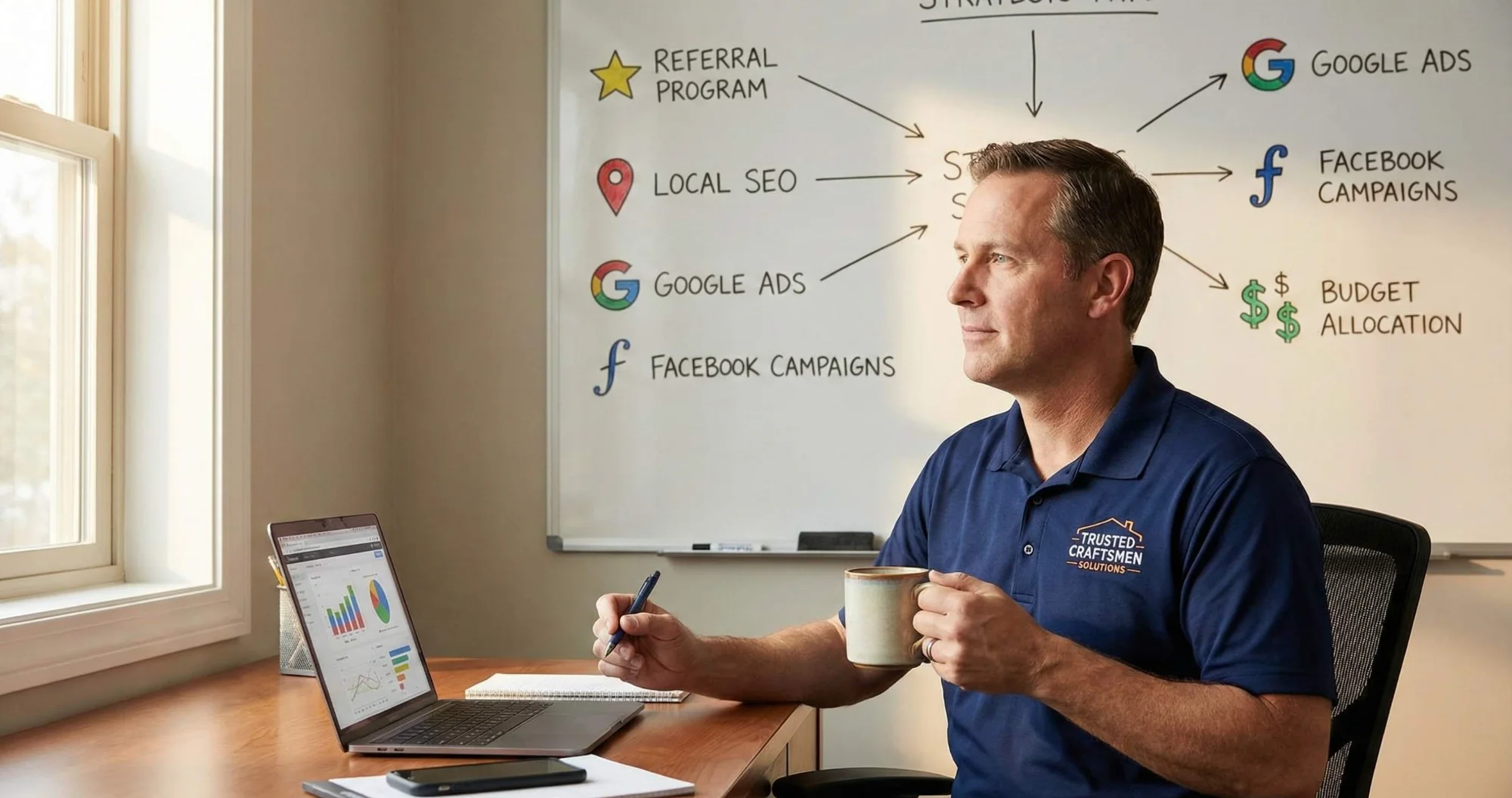
The Lead Generation Landscape
If you run a home improvement business—roofing, windows, siding, HVAC, remodeling, whatever—you've probably been pitched a dozen different ways to get more leads. SEO companies. Google Ads agencies. Facebook marketers. Angi. Thumbtack. HomeAdvisor. Some guy on YouTube selling a course.
It's overwhelming. And most of the information out there is biased—someone's trying to sell you their thing.
This guide is different. I'm going to walk you through every major lead generation method, explain the real pros and cons, and help you figure out what actually makes sense for YOUR business at YOUR stage of growth.
Some of these methods you can do yourself. Some require outside help. Some are great for newer contractors. Some only make sense once you're doing $1M+.
Let's get into it.
Know Your Numbers First
Before you spend a dollar on marketing, you need to know four numbers:
1. Average Job Value
What's your typical job worth? Not your biggest job ever—your average. If you're a roofer, maybe it's $12,000. Windows might be $8,000. Decks might be $15,000. Know this number.
2. Close Rate
Of the leads you actually talk to, what percentage become paying customers? Be honest. For most contractors, this is somewhere between 15% and 35%. If you're closing 50%+, you're either exceptional or you're only counting warm referrals.
3. Acceptable Cost Per Acquisition (CPA)
How much can you afford to spend to get one paying customer and still be profitable? This depends on your margins, but a common rule of thumb is 5-10% of your average job value.
4. Monthly Marketing Budget
What can you realistically allocate? This should be predictable money, not "whatever's left over."
For a deeper breakdown of how to calculate these numbers, see How Much Should You Pay Per Lead?
The Formula That Matters
Here's the formula that determines whether any lead source is working:
NOT cost per lead. Cost per CLOSED JOB.
A $50 lead that never answers the phone costs you infinite dollars per job. A $150 lead that closes at 40% costs you $375 per job. The second one is better.
- You spend $3,000/month on marketing
- You get 40 leads
- 30 answer the phone
- You run 15 appointments
- You close 5 jobs
If your average job is $12,000 and your margins are healthy, $600 to acquire a customer is probably fine. If your average job is $4,000, it might not be.
Know your numbers. Everything else flows from there.
Referrals: The Foundation
Referrals are the gold standard. A referred customer already trusts you because someone they know vouched for you. They're easier to close, less price-sensitive, and more likely to refer others.
Free. High close rate. Best quality leads you'll ever get.
Unpredictable. Hard to scale. You can't control when they come in.
How to Get More Referrals
Ask for them. Sounds obvious, but most contractors don't systematically ask. After every completed job, when the customer is happiest, ask: "Do you know anyone else who might need [your service]?" Make it a habit. Put it in your process.
Make it easy. Give customers something to hand out—a card, a flyer, a link. Better yet, create a simple referral incentive. "$100 off your next service for every referral that books" or "$100 gift card for every referral that closes." The exact amount doesn't matter as much as having a system.
Stay in touch. Past customers forget about you. A simple email or postcard twice a year keeps you top of mind. "Hey, just checking in—if you know anyone who needs roofing work, we'd appreciate the referral."
Do great work. This is the unsexy answer, but it's the real one. Referrals come from customers who had a genuinely good experience. Show up on time. Communicate clearly. Clean up after yourself. Do what you said you'd do.
The bottom line: Referrals should be part of every contractor's strategy, but they can't be your ONLY strategy if you want predictable growth. You need something you can control.
Google Business Profile & Local SEO
When someone searches "roofer near me" or "window replacement [city name]," Google shows a map with three local businesses. Getting into that map pack is free—you just need to optimize your Google Business Profile.
What to Do
Claim and verify your profile. Go to business.google.com if you haven't already. This is free and takes about a week to verify.
Complete every field. Business name, address, phone, hours, services, service area. The more complete your profile, the better Google understands when to show you.
Get reviews. This is the biggest factor. More reviews (and higher ratings) = more visibility. Ask every happy customer to leave a Google review. Make it easy—send them a direct link.
Post regularly. Google lets you post updates, offers, and photos to your profile. Businesses that post regularly tend to rank better. Once a week is plenty. Show job photos, seasonal promotions, whatever.
Respond to reviews. Every review—good or bad. It shows you're active and engaged.
Free. People searching on Google have high intent—they're actively looking for your service.
Competitive. Takes time to build. You're at Google's mercy—algorithm changes can tank your visibility overnight.
The reality: GBP is table stakes. Every contractor should have an optimized profile. But in competitive markets, you won't rank in the top 3 without either a LOT of reviews or a lot of time. It's a long game.
Google Ads (Pay-Per-Click)
Google Ads lets you pay to appear at the top of search results. When someone searches "roof repair houston," you can bid to show up above the organic results.
How it works: You bid on keywords. When someone searches that keyword, Google runs an auction. The highest bidders (adjusted for ad quality) get shown. You pay when someone clicks.
Immediate visibility. High-intent leads—they're actively searching for your service.
Expensive. Competitive home improvement keywords can cost $30-100+ per click. Not per lead—per CLICK.
The Math Problem
Let's say you're a roofer in a competitive market:
- Cost per click: $75
- Click-to-lead rate: 10%
- Cost per lead: $750
- Lead-to-close rate: 20%
If your average roof is $12,000 with 35% margins ($4,200 profit), you're spending almost your entire profit on customer acquisition. That's not sustainable.
When Google Ads Makes Sense
- You're in a less competitive market (smaller cities)
- Your average job value is very high ($30K+ remodels)
- You have a sophisticated system to maximize every click
- You're using it for branded search (people searching your company name)
When It Doesn't
- Competitive metro areas for standard services
- Lower-ticket jobs
- You don't have budget to test and optimize for months
For a detailed comparison of Google vs Facebook for contractors, see Facebook Ads vs Google Ads for Contractors
Social Media Advertising
Social media ads—primarily Facebook and Instagram (both owned by Meta)—work differently than Google. Instead of waiting for someone to search, you show ads to people who match your target customer profile.
How it works: You define an audience (homeowners in specific zip codes, certain age range, certain interests) and show them ads. They're scrolling through their feed, they see your ad, and if it's compelling, they click through to learn more.
The key difference from Google: These people weren't searching for you. They might not even know they need a new roof yet. You're interrupting them—which means your ad has to work harder to get attention.
Much cheaper per impression and click. You reach people BEFORE they start shopping around. The first contractor to get in front of a homeowner often wins. Very specific geographic targeting.
Lower intent than search. Requires good creative to stand out. Algorithm changes constantly. These leads need more nurturing.
The "Get There First" Advantage
Here's something most contractors don't think about: when a homeowner has a problem (leaky roof, drafty windows), the first contractor who shows up in their world often gets the job. If they see your ad on Facebook before they ever go to Google, you might be the only contractor they call.
Compare that to Google, where they're searching "roofers near me" and calling 3-5 companies for quotes. Which scenario would you rather be in?
The reality: Facebook/Instagram ads can work extremely well for contractors, but they require more sophistication than "boost this post." You need good creative, proper targeting, a landing page that converts, and fast follow-up. Most contractors don't have the time or expertise to run these themselves.
Lead Aggregators (Angi, Thumbtack, HomeAdvisor, etc.)
Lead aggregators are companies that collect homeowner information through their own marketing and sell those leads to contractors. The big ones you've probably heard of: Angi (formerly HomeAdvisor), Thumbtack, Networx, Modernize, Fixr.
How they work: The aggregator runs ads and builds websites to capture homeowner info. When someone fills out a form ("I need a roof estimate"), the aggregator sells that lead to you—either on a per-lead basis or through a subscription.
The appeal: Easy. No marketing expertise required. Just sign up, set a budget, and leads come in.
The problem: Most of these leads are shared.
For the full math on this, see Exclusive vs. Shared Leads: The Real Cost Difference
When a lead is "shared," it means the aggregator sells the same lead to 3-5 contractors simultaneously. You're all calling the same homeowner. This creates a race to be first—and even if you win that race, the homeowner is now overwhelmed with calls.
What This Does to Your Economics
- $80 lead shared with 4 contractors = 25% chance of even getting a conversation
- Real cost: $80 ÷ 25% = $320 for a lead you can actually work
- If only 20% of those close...
The Other Problems
Lead quality variance. Some leads are ready to buy. Some are "just researching." Some gave a fake number. You pay the same for all of them.
No brand building. The homeowner remembers Angi, not you. You're a commodity—one of several contractors they're talking to.
Dispute nightmares. Ever tried to get a credit for a bad lead? Good luck. Most aggregators make it difficult, and even when they approve a credit, it's often partial.
Dependency. If you build your business on aggregator leads, you're at their mercy. Raise prices? You pay. Change algorithms? Your lead flow changes. You have no leverage.
When Aggregators Might Make Sense
- You're brand new and need ANY leads to get started
- You're in a slow season and need to fill gaps
- You use them as ONE channel among many, not your primary source
When They Don't
- You're trying to grow a premium brand
- You're in a competitive market where every aggregator lead is slammed with calls
- You're doing $1M+ and need predictable, quality lead flow
Performance-Based Lead Generation
This is a newer model that's grown over the past several years. Instead of traditional agency retainers (where incentives are often misaligned) or aggregator subscriptions, some companies operate on a pay-per-lead basis with dedicated campaigns.
How It's Different From Aggregators
- Leads are typically exclusive (not shared with other contractors)
- Campaigns are often run through YOUR branding and YOUR ad accounts
- You pay per qualified lead, not per click or per month
- The lead generation company only makes money when you get leads
Aligned incentives. Exclusivity. Brand building. Transparency into what's working.
Higher cost per lead than shared. Still requires qualification. Not all providers are equal.
Questions to Ask Any Performance-Based Lead Company
- Are leads shared or exclusive?
- Who owns the ad account and pixel data?
- What counts as a "qualified" lead?
- What's your dispute process?
- Do campaigns run under my brand or yours?
- What happens to my data if I leave?
Not Sure Which Lead Model Fits Your Business?
We work with contractors doing $1M+ who want exclusive leads without the guesswork. No long-term contracts. No hidden fees. You only pay for qualified leads delivered.
See How It WorksSpeed to Lead: The Hidden Factor
Here's something that matters more than most contractors realize: how fast you respond to a lead.
Research consistently shows that responding within 5 minutes versus 30 minutes can be the difference between winning and losing the job—regardless of how good your work is or how competitive your pricing.
Why Speed Matters
The homeowner is in "buying mode" right now. They filled out a form. They're thinking about their problem. If you call while they're still in that headspace, you have their attention.
Wait an hour, and they've moved on. They're making dinner. They're watching TV. They forgot they even filled out that form. Now you're an interruption, not a solution.
Wait a day, and they've probably talked to someone else. Someone who called faster. And humans are lazy—once they've had a good conversation with one contractor, they often stop looking.
What "Fast" Actually Means
- Under 5 minutes is ideal
- Under 15 minutes is acceptable
- Over 30 minutes and you've lost significant ground
- Next-day follow-up is almost worthless for internet leads
How to Be Fast
Notifications. Whatever system you're using, make sure you get instant notifications when a lead comes in. Push notifications, text alerts, whatever works for you.
Dedicated call time. Block time specifically for lead follow-up. If you're on a roof all day with your phone off, those leads are going cold.
Have a process. Know exactly what you're going to say. Don't wing it. A simple script ensures you sound professional even when you're caught off guard.
Consider a service. If you can't be fast consistently, some companies offer answering services or lead qualification calls to ensure fast response.
Red Flags When Evaluating Any Lead Source
Whether you're talking to a marketing agency, a lead aggregator, or any other vendor, watch for these warning signs:
Run. No one can guarantee lead volume without knowing your market, your budget, your competition, and a dozen other variables. Guarantees like this usually mean either: (1) they'll send you garbage to hit the number, or (2) they're lying.
Good marketing shows results relatively quickly. If someone needs to lock you into 12 months with $10K upfront before they'll start, ask why they're not confident enough to earn your business month over month.
If an agency or lead provider won't show you the actual campaigns, targeting, and creative, what are they hiding? Transparency should be standard.
For SEO, yes, there's a longer runway. For paid advertising? You should see signal within weeks. If someone's asking for months of budget before you'll know if it's working, that's a problem.
If someone tries to sell you a marketing solution without asking about your average job value, close rate, target market, and capacity—they're selling a one-size-fits-all box. That rarely works.
Some agencies run everything through their accounts. Their Facebook pixel. Their landing pages. Their CRM. When you leave, you start over from zero. Make sure you understand who owns what.
Choosing the Right Mix for Your Business
There's no single answer to "what's the best lead generation strategy?" It depends on your situation.
If You're Doing Under $500K/Year
Focus on referrals and Google Business Profile. These are free and foundational. Get your reviews up. Ask every customer for referrals. Build your reputation in your market.
Paid advertising at this stage can work, but margins are tight. If you experiment, keep budgets modest until you find what works.
If You're Doing $500K-$1M/Year
You have some budget to play with. This is when paid channels start making sense. Consider testing Facebook/Instagram ads or a performance-based lead provider.
Keep referral systems strong. Add one paid channel and give it 90 days to prove itself before adding another.
If You're Doing $1M+/Year
You need predictable, scalable lead flow. Referrals alone won't get you to $2M+. This is when investing in real marketing infrastructure makes sense.
Consider: performance-based lead generation, dedicated advertising campaigns, maybe SEO if you're willing to play the long game.
The key at this stage is TRACKING. Know your cost per acquisition across every channel. Double down on what works. Cut what doesn't.
If You're Doing $3M+/Year
You should have multiple lead sources working simultaneously. Don't put all your eggs in one basket. A healthy mix might look like:
- 30% referrals
- 30% social media advertising
- 20% Google Ads or LSA
- 20% other (aggregators, direct mail, partnerships)
At this stage, you might also consider bringing marketing in-house—hiring someone whose full-time job is managing your lead flow.
Frequently Asked Questions
What's a good cost per lead?
It depends entirely on your close rate and average job value. A $50 lead that closes 10% of the time is worse than a $200 lead that closes 50% of the time. Focus on cost per CLOSED JOB, not cost per lead. More on this here.
Should I use Angi/HomeAdvisor?
It can be one piece of your strategy, but be aware that most of those leads are shared with multiple contractors. Do the math on your actual cost per closed job from that source—it's probably higher than the per-lead cost suggests. Full breakdown here.
How much should I spend on marketing?
A common benchmark is 5-10% of revenue, but it varies by growth goals. A company trying to grow 50% year-over-year will spend more than one trying to maintain current revenue.
Facebook or Google—which is better?
Different tools for different jobs. Google captures people actively searching. Facebook reaches them before they search. For most contractors, Facebook offers better economics if executed well. Detailed comparison here.
How do I know if a marketing company is good?
Ask to see recent results for similar businesses. Ask what happens if you leave—do you keep any data or assets? Ask what their process is for bad leads. Ask if you can see where ads are running. Transparency is the baseline.
What if I can't follow up on leads fast enough?
This is a real problem. If leads are coming in and sitting for hours, you're burning money. Either adjust your lead volume to match your capacity, hire someone to handle initial calls, or use an answering/qualification service.
Final Thoughts
Lead generation isn't magic. It's math. Every method has costs, conversion rates, and tradeoffs. Your job is to understand the numbers for YOUR business and make smart decisions.
Don't chase shiny objects. Don't believe anyone who promises results without understanding your situation. And remember that even the best lead source in the world won't save a business that doesn't close, doesn't follow up fast, or doesn't do good work.
Get the fundamentals right. Know your numbers. Then scale what works.
Want to Talk Real Numbers?
We run campaigns through your ad account (full transparency) and charge per qualified lead delivered. Let's look at what that means for your specific trade and market.
Get Your Free Strategy Call