The Deck Builder in the Feed
Let me paint a picture.
Your wife says, "Honey, the deck is getting really bad. We should probably get someone out here to look at it."
You know she's right. The boards are splintering. The railing feels wobbly. You haven't had anyone over for a barbecue in two summers because you're embarrassed by how it looks. But it's not falling down. It's not an emergency. So you say, "Yeah, I'll look into it," and then you don't. You're busy. Work is crazy. The kids need things. It's on your mental list somewhere, but you haven't written it down, haven't Googled anything, haven't asked anyone for a recommendation.
A few weeks later, she asks again. "Did you call someone about the deck?"
"I'll do it this weekend."
More weeks pass. Summer's almost over again.
Then one night, you're scrolling through Facebook before bed. An ad pops up. It's a local deck builder. The video shows a beautiful composite deck with built-in lighting, a guy explaining how they handle everything from permits to cleanup, and before-and-after shots that look incredible. No pressure. No gimmicks. Just quality work.
You think: That's exactly what I need. Someone who'll just come give me options without making it weird.
You click. You fill out the form. Takes 30 seconds.
Now you're waiting for your wife to ask about the deck again. Because this time, you have an answer: "Guy's coming Tuesday to measure and give us a quote."
That's how Facebook advertising works.
This Isn't Just Decks—It's Roofs, Windows, Siding, and Everything Else
The worn-out deck is a simple example, but this same dynamic plays out for every home improvement project that falls into a specific category: needs that aren't emergencies.
Think about it:
Roofing
The homeowner noticed shingles in the yard after the last storm. There's a water stain on the ceiling. Their neighbor just got a new roof and mentioned theirs is the same age. They know they should get someone out. But the roof isn't actively leaking. It's not an emergency. So it sits on the mental to-do list.
Windows
The drafts are getting worse every winter. The energy bills keep climbing. They can feel cold air coming through the frames. They know they need new windows eventually. But "eventually" isn't today. So they put on a sweater and keep procrastinating.
Siding
The paint is peeling. Some boards are starting to warp. It looks dated and they're a little embarrassed when guests come over. They know it needs to be addressed. But it's not falling off the house. So it waits.
Decking
The boards are splintering. They're nervous about the kids getting hurt. They haven't used the deck for entertaining in two years because it looks bad. They need a new deck. But they'll deal with it "next spring." And then next spring becomes the spring after that.
HVAC
The system is 15 years old and making weird noises. It still works, but they know it's on borrowed time. They should probably replace it before it dies in the middle of July. But it's working today, so they'll think about it later.
None of these are emergencies. The roof isn't collapsing. The windows aren't shattered. The siding isn't on fire. But they're also not just "nice to haves"—they're real problems that need to be solved. The homeowner knows it. They just haven't done anything about it yet.
This is the middle zone where most homeowners live: aware of the problem, planning to address it eventually, but not actively shopping.
And this group is massive.
The Funnel Most Contractors Ignore
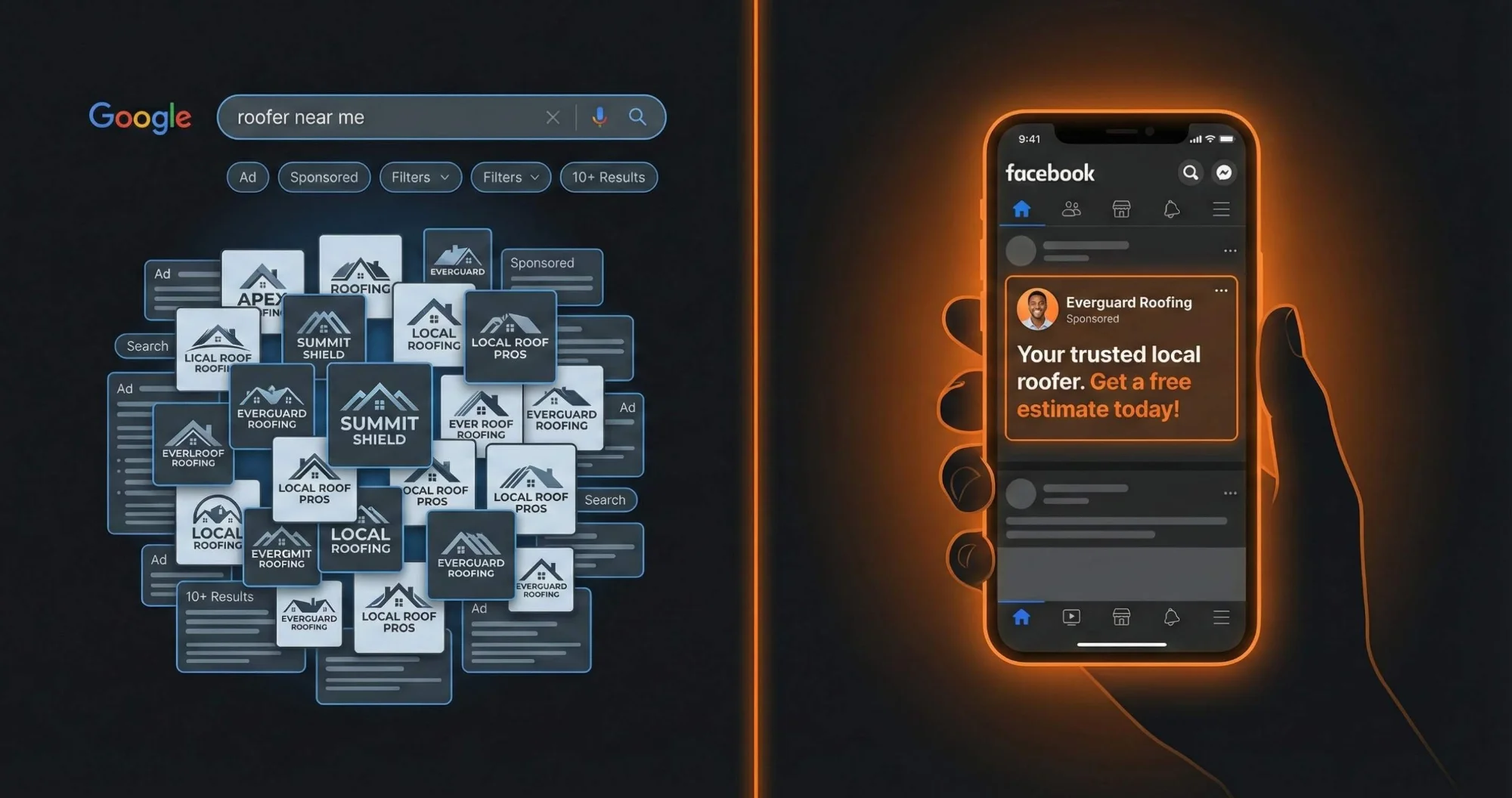
Here's the thing about Google: the people searching "roof replacement near me" are at the bottom of the funnel. They've already decided they need a roof. They're actively shopping. They're going to call multiple contractors, get multiple quotes, and compare prices.
That's not bad—those are real leads. But it's competitive. Everyone is fighting over the same small pool of active searchers. That's why Google pay-per-click can cost $50-150 per click in competitive markets. Not per lead. Per click.
Meanwhile, there's a much larger group of people who aren't searching yet.
The homeowner with the aging roof who noticed shingles in the gutter. The couple who complained about drafty windows all winter but never called anyone. The family who's been talking about new siding for two years. The guy whose deck is embarrassing but functional.
They all have real needs. They all intend to do something about it. But they haven't Googled anything because it doesn't feel urgent enough to prioritize today.
This group is enormous compared to the people actively searching. And most contractors completely ignore them.
Getting There First
When you reach someone on Facebook or Instagram before they start shopping, something interesting happens: you become the first contractor in their world.
They weren't looking for you. But now they've seen you. And if your ad resonated—if it spoke to what they were already thinking about but hadn't acted on—you've made a first impression before anyone else even had a chance.
The homeowner who's been putting off the roof decision for six months sees your ad. It's a video of a local crew doing quality work, an owner explaining their process, real customer testimonials. It doesn't feel like an ad—it feels like exactly what they've been needing to see.
They click. They fill out the form. And suddenly that thing they've been procrastinating on is scheduled for an inspection next Tuesday.
Compare that to Google, where they search, click three ads, and suddenly they're fielding calls from multiple contractors, comparing quotes, forgetting who said what.
On Facebook, if you reach them first and your follow-up is fast, you might be the only contractor they ever talk to.
That's a completely different sales dynamic. No bidding war. No race to be cheapest. Just a homeowner who saw your ad, liked what they saw, and decided to go with you.
The Objection Everyone Raises
Here's what contractors always say when they hear this: "But I see roofing ads all the time on Facebook. Once you click one, you see all of them. How is that any different from Google?"
Fair point. Facebook does notice when you engage with an ad and starts showing you similar ones. If you click on one roofer's ad, you'll probably see ads from other roofers in your area.
But here's the difference: you still saw one first.
And if that first ad was better—better video, better message, better landing page—and if that company followed up faster and made a better first impression, they're already the leader. The other ads are just noise.
Think about it from the homeowner's perspective. They clicked your ad. They filled out the form. They got a call within five minutes from someone professional and friendly. They liked the experience. Now they're seeing other ads, but they're already talking to you. They're not starting over.
Most people don't want to talk to five contractors. They want to find one good one and be done with it. If you're that one—the first one who showed up and didn't make it weird—the other ads don't matter.
Why This Only Works If You Do It Right
Here's where most contractors mess up Facebook advertising: they treat it like Google.
They run an ad, leads come in, and they call them back whenever they get around to it. Maybe that afternoon. Maybe the next day.
That doesn't work with Facebook leads.
When someone fills out a form on Google, they were actively searching. They're expecting calls. They're in buying mode.
When someone fills out a form on Facebook, they were scrolling. They saw something that finally prompted them to take action on that thing they'd been putting off—the roof, the windows, the siding, whatever. They took 30 seconds to submit their info, and then went back to their life. Five minutes later, they might not even remember doing it.
If you call them the next day, you're interrupting someone who's moved on. They might not even remember filling out the form. "I requested a quote? When?"
But if you call within five minutes? They're still in that moment. They remember why they clicked. They're impressed that you responded so fast. The conversation is completely different.
Speed to lead matters for all leads. But for social media leads—where you're catching people who finally decided to act on a problem they've been ignoring—it's the difference between a warm conversation and a cold call.
The Hidden Problem: Training the Algorithm Wrong
There's another issue with Facebook advertising that most people don't think about, and it kills campaigns silently.
Facebook's algorithm learns from your results. When it thinks it got you a good lead, it tries to find more people like that person. When it thinks a lead converted, it optimizes toward similar users.
Here's the problem: Facebook can't tell the difference between a good lead and a bad lead unless you tell it.
Let's say you're a roofer in Houston. Someone from Austin is visiting family for Thanksgiving. They see your ad because they're physically in your service area. They fill out the form. Facebook thinks: "Great! This person converted. Let me find more people like them."
But that lead is useless to you. They live 200 miles away. You'll never close that job.
If you don't have a system to filter those leads out—and more importantly, to prevent Facebook from counting them as successes—your algorithm gets trained on garbage. The more out-of-area leads slip through, the more Facebook optimizes toward out-of-area people.
This is why so many contractors try Facebook, get terrible leads, and conclude "Facebook doesn't work for contractors." It does work. But you have to protect the algorithm from learning the wrong lessons.
The best campaigns have systems that validate leads before they count—checking zip codes, verifying contact information, filtering out renters and tire-kickers. When only real, qualified leads count as conversions, Facebook gets smarter instead of dumber.
Quality Over Volume
The contractors who do well with Facebook advertising aren't chasing volume. They're not trying to get leads for $20 each. They want fewer, better leads—homeowners who are actually qualified, actually in the service area, and actually ready to have a conversation about the project they've been putting off.
That costs more per lead. A qualified, exclusive lead might cost $100-150 instead of $30. But the math works out better.
A $30 lead that doesn't answer the phone, or lives 50 miles away, or was just curious about pricing, costs you infinite dollars per closed job. A $150 lead that picks up, books an appointment, and closes at a reasonable rate might cost you $400-500 per job. For a $15,000 roof or a $12,000 window job, that's a great return.
The full breakdown on calculating your true cost: How Much Should You Pay Per Lead?
The goal isn't more leads. It's more jobs at an acceptable cost per acquisition. Volume is vanity. Revenue is sanity.
The First Impression Advantage
Here's what makes Facebook powerful for contractors who actually run great operations: the first impression starts before you ever talk to the homeowner.
On Google, they're clicking through multiple results. They might visit your website, but they're also visiting three others. You're one of many from the very first moment.
On Facebook, if your ad and your landing page are dialed in, you're making an impression before they've talked to anyone else. They're seeing your brand, your message, your professionalism—and forming an opinion.
If you're a contractor who shows up on time, communicates well, does quality work, and treats customers right, this is your chance to signal that before the first phone call. The ad, the landing page, the confirmation email, the first call—every touchpoint reinforces that this is a company that has its act together.
By the time competitors' ads start showing up in their feed, they're already sold on you. They're not starting a comparison process. They're just confirming a decision they already made.
When Facebook Makes Sense (And When It Doesn't)
Facebook isn't for everyone. Here's when it works:
- You sell services that are needs but not emergencies (roofing, windows, siding, decks, HVAC replacement, remodeling)
- You're in a market with limited search volume or expensive Google PPC
- You have capacity to follow up on leads quickly (within 5 minutes)
- You want to build brand awareness, not just buy transactions
- You're willing to invest in quality creative and landing pages
- You're doing $1M+ and can handle a real advertising budget
- You do emergency-only services where people need help right now (burst pipes, fire damage)
- You can't follow up quickly (leads will die)
- You're looking for the absolute cheapest cost per lead (quality costs more)
- You don't have budget for proper campaign setup and creative
- You're in an area where Google is cheap and effective already
Facebook isn't better than Google. It's different. It reaches a different audience at a different stage of the buying journey—people who have real needs but haven't started shopping yet. For contractors who understand that difference—and who have the systems to capitalize on it—it's one of the most powerful tools available.
Full comparison of the two platforms: Facebook Ads vs Google Ads for Contractors
The Bottom Line
Most contractors are fighting over the same small pool of people actively searching on Google. That's a crowded, expensive battle.
Meanwhile, there's a much larger group of homeowners who know they have a problem but haven't started shopping yet. The roof that needs replacing. The windows that are drafty. The siding that's an eyesore. The deck that's falling apart. These aren't just "nice to haves"—they're real needs that homeowners have been putting off because they're not emergencies.
These people are scrolling through Facebook and Instagram, living their lives, waiting for something to prompt them to finally take action.
If you can be that prompt—if you can reach them with the right message at the right time—you become the first contractor in their world. And in this business, getting there first is often the whole ballgame.
The homeowner who's been ignoring their aging roof for two years isn't going to call five roofers. They're going to call the one who showed up in their feed, seemed trustworthy, and made it easy to take the next step. If your ad is better, your follow-up is faster, and your first impression is stronger, you win before the competition even knows you were there.
Want Leads Before They Start Shopping Around?
We help contractors reach homeowners on Facebook and Instagram with exclusive leads, fast delivery, and campaigns that build your brand—not ours. No long contracts. You only pay for qualified leads.
See How It Works