A furnace that quits in January is either a $280 service call or a $12,000 system changeout. Which one you end up with is mostly decided before the tech gets in the truck, and the lead source you used is a bigger part of that than most HVAC owners admit.
The gap between those two tickets is the whole reason HVAC lead math confuses people. A contractor pays $45 for a shared lead, books a diagnostic, collects $280, and decides paid leads do not work. A second contractor pays $200 for an exclusive replacement lead, sits an in-home appointment, and signs a $14,000 dual-fuel system. Same trade, same month, same market. Different buyer, different campaign, different ceiling.
This post is the arithmetic: what a full changeout is actually worth, what that lets you pay per lead and per booked appointment, and how many of each you need to hit a revenue number.
Why do HVAC replacement leads behave differently from service calls?
HVAC is two businesses sharing one truck. The marketing almost always gets built for the wrong one.
The broken-today buyer
The system is down. It is 96 degrees or it is 20 degrees. This homeowner is not comparing brands or reading about SEER2 ratings. They are calling whoever answers and can dispatch today. They convert at a very high rate, they convert fast, and the ticket is small. Most of these calls end in a capacitor, a motor, a coil cleaning, or a refrigerant issue. A portion of them, usually on units past twelve years, turn into replacement conversations, but only if your tech is trained to have that conversation and your company can quote and install inside a few days.
The economics here are tight. A $150 to $600 repair invoice cannot absorb a $150 lead cost. Speed is the entire competitive advantage, which is why answering inside five minutes matters more than ad creative on this side of the business.
The planned-replacement buyer
This homeowner has a 15-year-old system that still runs. The upstairs never cools. The electric bill climbed again. A tech told them last spring that the compressor is on borrowed time. They are not searching for anything yet, because nothing is broken. They are thinking about it.
That homeowner is worth ten to forty times the repair call, and they will be won by whoever reaches them during that thinking window. That is a Meta advertising problem, not a search problem, because there is no search to capture. If you want this buyer, you have to show up in the feed with a real system, a real starting price, and a real reason to act before the unit fails in the worst week of the year. If you want help building that side of the business, start here.
What is a full HVAC changeout actually worth in 2026?
These are industry-typical installed ranges, not quotes. Your market, your equipment lines, and your labor rate move them.
| Job type | Typical installed ticket | Decision speed |
|---|---|---|
| Job typeDiagnostic or repair call | Typical installed ticket$150 to $600 | Decision speedSame day |
| Job typeCondenser only replacement | Typical installed ticket$4,500 to $8,000 | Decision speedDays |
| Job typeFurnace only replacement | Typical installed ticket$4,000 to $9,000 | Decision speedDays to weeks |
| Job typeFull split system changeout | Typical installed ticket$8,000 to $18,000 | Decision speed1 to 4 weeks |
| Job typeHeat pump or dual-fuel conversion | Typical installed ticket$12,000 to $25,000 | Decision speed2 to 8 weeks |
| Job typeDuctwork added to a changeout | Typical installed ticket$3,000 to $10,000 extra | Decision speedSame appointment |
| Job typeMini-split multi-zone install | Typical installed ticket$6,000 to $20,000 | Decision speed2 to 8 weeks |
The line that matters: the full changeout at $8,000 to $18,000 carries roughly 30 to 40 percent gross margin for most companies, which means $2,400 to $7,200 of gross profit per job. That number, not the invoice, is what funds your lead budget.
What can you actually pay for an HVAC replacement lead?
Use the standard formula. Break-even cost per lead equals average job value multiplied by gross margin multiplied by close rate. Then take roughly one third of that as your working ceiling so the channel actually makes you money instead of breaking even.
Example: a $12,000 average changeout at 35 percent gross margin is $4,200 gross profit. On exclusive leads closing at 25 percent, each lead is worth $1,050 in expected gross profit. Break-even is $1,050. One third of that is a $350 working ceiling, and most contractors will never need to pay near it.
Now run the same exercise across channels.
| Lead source | Typical price | Typical close rate | Cost per acquired job |
|---|---|---|---|
| Lead sourceShared marketplace lead | Typical price$30 to $75 | Typical close rate3 to 8% | Cost per acquired job$600 to $2,000 |
| Lead sourceSelf-run Meta campaign | Typical price$25 to $110 | Typical close rate10 to 20% | Cost per acquired job$250 to $1,000 |
| Lead sourceGoogle search lead | Typical price$100 to $300 | Typical close rate15 to 30% | Cost per acquired job$500 to $1,800 |
| Lead sourceExclusive lead (performance partner) | Typical price$50 to $200 | Typical close rate15 to 25% | Cost per acquired job$250 to $1,000 |
| Lead sourceExclusive booked appointment | Typical price$200 to $400 | Typical close rate25 to 40% | Cost per acquired job$600 to $1,400 |
The shared lead is the cheapest line and frequently the worst outcome, because the homeowner's phone rings four times in ten minutes and your quote becomes one of four. That dynamic is covered in detail in exclusive vs shared leads. The benchmark to hold yourself to is cost per acquired job under 10 percent of average job value. On a $12,000 changeout that is $1,200. Every row above can clear it except the shared lead at a 3 percent close.
What about repair leads
Run the same formula on a $300 ticket at 55 percent margin and a 50 percent close rate and you get a break-even near $82 and a working ceiling closer to $27. That is why repair campaigns need their own budget, their own creative, and their own kill switch. They are a feeder, not a profit center, and they only pay when your techs reliably convert aging systems into replacement quotes.
If you want to run your own numbers instead of mine, the ROI calculator does the cost per acquired job math in about two minutes. Or if you would rather have the campaigns built and run for you inside your own ad account, book a call and we will walk the numbers for your market.
Why is a booked appointment priced differently from a lead?
A lead is a name, a number, and a stated interest. An appointment is a confirmed time on a rep's calendar with the homeowner expecting an in-home visit and a price at the end of it. Those are not the same product and they should not cost the same.
Exclusive booked appointments for home improvement trades typically run $200 to $400. On HVAC that looks expensive next to a $45 shared lead until you put it through the math.
Example: 20 booked appointments at $300 is $6,000. Say 80 percent sit, so 16 real in-home visits. At a 30 percent close rate that is roughly 5 jobs. Five changeouts at $12,000 is $60,000 in revenue and about $21,000 in gross profit against $6,000 of appointment cost. Cost per acquired job is $1,200, right at the 10 percent benchmark, with none of your office staff spending the week chasing people who never answer.
The variable that decides whether this works is not the appointment price. It is the sit rate. An appointment booked for next Tuesday with one spouse who did not tell the other is not an appointment. Confirm both decision makers, confirm the address, confirm the length of the visit, and confirm that an on-site estimate is a sales visit where they will get a price.
How many HVAC replacement leads do you need to hit a revenue target?
Work backward from revenue, never forward from budget.
- Pick the revenue number. Example: add $1.2 million in replacement work.
- Divide by average job value. $1,200,000 divided by $12,000 is 100 jobs.
- Divide by close rate. At 25 percent that is 400 leads a year.
- Divide by 12. That is about 33 leads a month.
- Multiply by cost per lead. At $150 that is $4,950 a month in lead fees.
Now look at what the close rate does to the same goal.
| Close rate | Leads needed per year | Leads per month | Lead fees at $150 |
|---|---|---|---|
| Close rate15% | Leads needed per year667 | Leads per month56 | Lead fees at $150$8,400 per month |
| Close rate20% | Leads needed per year500 | Leads per month42 | Lead fees at $150$6,300 per month |
| Close rate25% | Leads needed per year400 | Leads per month33 | Lead fees at $150$4,950 per month |
| Close rate30% | Leads needed per year334 | Leads per month28 | Lead fees at $150$4,200 per month |
Ten points of close rate is worth more than any discount you will ever negotiate on lead price. Fix the sales process before you shop for cheaper leads.
One more number belongs in the plan: ad spend. If your campaigns run inside your own Meta ad account, you pay Meta directly for the media and you can see every dollar of it. Most HVAC companies running a stable replacement campaign land somewhere in the $2,500 to $6,000 per month range on spend, on top of per-lead or per-appointment fees. Budget both, not one.
How do you reach the planned-replacement buyer before the unit fails?
The planned buyer is not searching, so the campaign has to interrupt rather than capture.
Lead with the system, not the coupon
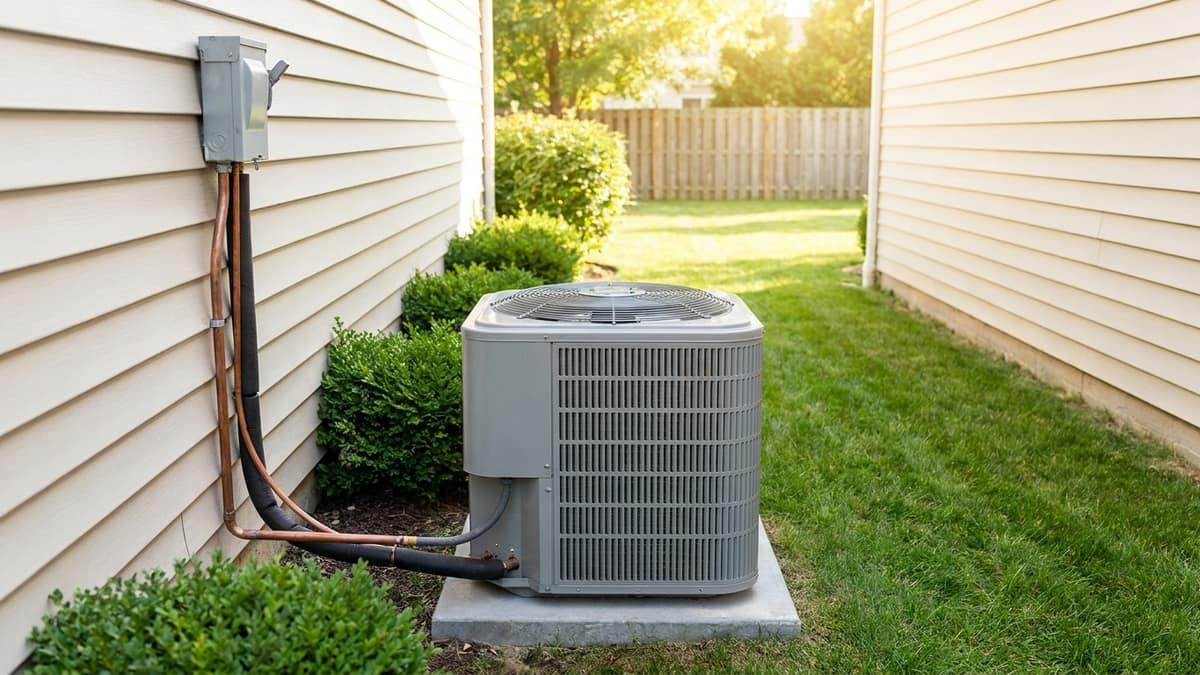
Show the actual equipment and the actual install. A photo of a clean new condenser on a fresh pad with a tidy line set outperforms a stock graphic every time. Homeowners judge HVAC companies on whether the work looks neat, because that is the only quality signal they can evaluate.
Name a real starting price
"Complete systems from $8,900 installed" filters out the homeowner who thought a new AC was $2,000 and anchors the one who is serious. Price in the ad costs you volume and buys you appointment quality. Keep financing language off the ad itself and save payment conversation for the landing page and the appointment.
Target the age of the home and the system
Homes built in a specific window tend to be on their second system right now. Owner-occupied properties with the right age profile are the whole target. Our HVAC lead generation guide goes deeper on channel selection, and the HVAC leads page covers how the program is structured.
Sell the inspection, not the system
The easiest yes is a system evaluation: a tech checks the age, the refrigerant type, static pressure, and the duct situation, then gives a written replacement range. That is a far lower commitment than "get a quote on a $14,000 system," and it puts your company in the house months before the failure.
What does the HVAC calendar do to your lead cost?
Seasonality moves HVAC lead cost more than almost any other trade.
| Period | What the buyer wants | Campaign posture |
|---|---|---|
| PeriodJanuary and February | What the buyer wantsHeat that keeps up, failed furnaces | Campaign postureEmergency capacity plus furnace replacement |
| PeriodMarch and April | What the buyer wantsPre-season planning, spring tune-ups | Campaign postureReplacement evaluations, best auction pricing |
| PeriodMay through August | What the buyer wantsCooling, fast dispatch, failed AC | Campaign postureRepair plus same-week changeout capacity |
| PeriodSeptember and October | What the buyer wantsHeating check, aging system planning | Campaign postureReplacement offers, off-peak install dates |
| PeriodNovember and December | What the buyer wantsFirst cold snap, budget season | Campaign postureReplacement with install-date scheduling |
The shoulder months are where the margin is. Auction costs are lower, your crews have open days, and the homeowner is deciding without a gun to their head, which means they buy a better system instead of the cheapest one you can install tomorrow.
What kills HVAC replacement leads after they come in?
Most dead HVAC leads were not bad leads.
- Slow response. A replacement lead that sits two hours has already been contacted by a competitor. Text in 60 seconds, call in five minutes.
- Quoting over the phone. A number without an inspection is a number the homeowner shops. Get in the house.
- One decision maker at the table. A $14,000 purchase goes to committee. Confirm both people before you dispatch a rep.
- Option sheets with one option. Good, better, best raises average ticket and gives the homeowner something to decide besides yes or no.
- No follow-up past three touches. Plenty of planned-replacement buyers sign 30 to 90 days out. If your CRM stops at three attempts, you paid for leads you then threw away.
- Techs who do not sell the evaluation. Every repair on a unit past twelve years should end with a written replacement range handed to the homeowner.
The short version
A full HVAC changeout at $8,000 to $18,000 supports $150 to $250 per exclusive lead and $200 to $400 per booked appointment. Repair work supports a fraction of that, so it gets its own campaign and its own ceiling. Reach the planned-replacement buyer during the shoulder months with real install photos and a real starting price, confirm both decision makers before you dispatch, and judge every channel on cost per acquired job against a 10 percent of job value benchmark.
If you want HVAC replacement campaigns built and managed inside your own Meta ad account, where you keep the pixel, the audiences, and the lead data, get started here and we will show you what the numbers look like in your market.
Frequently asked questions
What is a fair cost per lead for HVAC replacement?
On a $12,000 average changeout at roughly 35 percent gross margin and a 20 to 25 percent close rate, the break-even cost per lead lands near $840 to $1,050 and the working ceiling is about one third of that, so $150 to $250 per exclusive lead is defensible. Shared marketplace leads at $40 look cheaper until you divide by a 3 to 8 percent close rate.
Should HVAC repair and replacement run in the same campaign?
No. A $150 to $600 repair call supports maybe $25 to $50 per lead, while a $12,000 changeout supports $150 to $250, so blending them means you either overpay for service calls or get outbid on replacements. Run two campaigns with two budgets and two cost per lead ceilings.
What should an HVAC contractor pay per booked appointment?
Exclusive booked appointments for home improvement trades generally run $200 to $400. On a changeout with $4,000 or more in gross profit, a $300 appointment that sits and closes at 30 percent produces roughly a $1,000 cost per acquired job, which is comfortably under the 10 percent of job value benchmark most contractors target.
How many HVAC replacement leads does it take to add $1.2 million?
At a $12,000 average changeout that is 100 jobs, and at a 25 percent close rate on exclusive leads that is 400 leads a year, or about 33 a month. Drop the close rate to 15 percent and the same revenue goal needs 667 leads, which is why the sales process moves the budget more than the lead price does.
When should HVAC replacement campaigns run?
Run replacement campaigns year round, but shift creative with the calendar: pre-season tune-up and planning offers in March and September, emergency capacity messaging during the first heat wave and the first freeze, and aging-system replacement offers in the shoulder months when auction costs drop and your crews have open install days.