A pool builder and a spa dealer can serve the same backyard, in the same zip code, and run completely different businesses. One sells eleven projects a year at $65,000 and lives or dies on a spring pipeline built the previous fall. The other sells sixty units at $12,000 and books the heaviest months when the pool crews are parked.
Most companies that sell both treat spa leads as leftovers from the pool campaign. That is how you end up paying pool-build lead prices for a $9,000 ticket, or worse, starving the spa side of budget because the cost per lead looks the same on a spreadsheet and the ticket does not.
Here is what hot tub and swim spa leads are actually worth, how they compare to a full pool build on cost per acquired job, and how to split the campaigns so one does not subsidize the other.
Why do hot tub and swim spa leads behave differently from pool build leads?
Three different purchases, three different decision cycles.
The hot tub buyer
This homeowner has been thinking about a tub for a season or two. Something triggered it: a bad back, a kid in travel sports, a patio that got rebuilt and now has an empty corner, a neighbor who got one. They are not comparing excavation bids. They are comparing models, seat counts, and whether the pad and the electrical are included.
Ticket: $8,000 to $20,000 installed. Decision window: two to six weeks. Close rate on a worked exclusive lead: 20 to 35 percent. They usually talk to one or two companies, not four.
The swim spa buyer
This is the homeowner who wanted a pool and either does not have the yard, does not want the maintenance, or got a pool bid back and flinched. Swim spas sit in the gap: lap swimming, therapy jets, year-round use, no excavation on most installs.
Ticket: $20,000 to $40,000 installed, higher with a deck surround or a partial in-ground set. Decision window: four to twelve weeks. Close rate: 15 to 25 percent, because the number is big enough to make them check financing.
The swim spa buyer is the most valuable lead most dealers never target on purpose. They are a pool-shopper in everything but budget, which is exactly why they respond to pool-adjacent creative. Our pool and spa lead generation page treats them as their own campaign for that reason.
The pool build buyer
Full new construction runs $50,000 to $80,000 and frequently over $150,000 with hardscape, water features, and an outdoor kitchen. The homeowner standardly collects three or more bids, permitting and excavation push the start date out, and the decision takes months.
That long cycle is not a flaw. It is why pool builders need to be advertising in October for a June dig. It is also why the same budget behaves completely differently when you point it at a spa.
What is a hot tub or swim spa job actually worth in 2026?
You cannot set a cost-per-lead ceiling until you know your real ticket mix. Site access, electrical runs, and pad work move these, but the ranges are typical.
| Scope of work | Typical installed price | Decision window |
|---|---|---|
| Scope of workEntry-level hot tub, existing pad and power | Typical installed price$8,000-$12,000 | Decision window2-4 weeks |
| Scope of workPremium hot tub with pad, electrical, and delivery | Typical installed price$12,000-$20,000 | Decision window3-6 weeks |
| Scope of workHot tub plus patio or deck modification | Typical installed price$15,000-$28,000 | Decision window4-8 weeks |
| Scope of workSwim spa, above-grade install | Typical installed price$20,000-$32,000 | Decision window4-10 weeks |
| Scope of workSwim spa with deck surround or partial in-ground | Typical installed price$30,000-$45,000 | Decision window6-12 weeks |
| Scope of workPool renovation and resurfacing | Typical installed price$15,000-$40,000 | Decision window1-3 months |
| Scope of workNew pool construction | Typical installed price$50,000-$80,000+ | Decision window3-9 months |
The pattern is the point. A swim spa is roughly half a pool build at a third of the sales cycle and a meaningfully higher close rate, because the homeowner is not sitting on three competing proposals.
The formula that sets your lead ceiling
Run this per campaign, not per company.
Max cost per lead = (average job value x gross margin x close rate) / 3
- Hot tub campaign: $12,000 x 0.30 margin x 0.25 close = $900, divided by 3 = a $300 maximum cost per lead.
- Swim spa campaign: $28,000 x 0.28 margin x 0.20 close = $1,568, divided by 3 = a $523 maximum cost per lead.
- Pool build campaign: $65,000 x 0.25 margin x 0.20 close = $3,250, divided by 3 = a $1,083 maximum cost per lead.
Those three numbers are nowhere near each other. Blend them into one campaign held to a single ceiling and you will either overpay on every tub or get outbid on every build. If you want to run your own numbers before you set budgets, the ROI calculator does this math against your actual close rate.
Why is cost per lead the wrong number to judge spa leads on?
Because the invoice price ignores how many other companies got handed the same homeowner. Cost per acquired job is what pays for the truck and the crane rental.
| Channel | Cost per lead | Typical close rate | Cost per acquired job |
|---|---|---|---|
| ChannelReferrals and past customers | Cost per lead$0 | Typical close rate40-60% | Cost per acquired jobNear $0 |
| ChannelGoogle Business Profile / organic | Cost per lead$0-50 | Typical close rate20-40% | Cost per acquired job$125-250 |
| ChannelShared marketplace leads | Cost per lead$25-75 | Typical close rate5-12% | Cost per acquired job$300-1,200 |
| ChannelLocal Services Ads | Cost per lead$25-80 | Typical close rate15-30% | Cost per acquired job$150-500 |
| ChannelMeta advertising | Cost per lead$25-110 | Typical close rate10-20% | Cost per acquired job$250-1,100 |
| ChannelExclusive leads (performance partner) | Cost per lead$50-200 | Typical close rate20-35% | Cost per acquired job$200-900 |
| ChannelExclusive booked appointments | Cost per lead$200-400 | Typical close rate25-40% | Cost per acquired job$600-1,400 |
A $40 shared lead closing at 8 percent costs $500 per sale. A $130 exclusive lead closing at 30 percent costs $433 per sale, and the ticket is usually bigger because you are not one of four dealers racing each other down on the same model. The full breakdown of why the cheaper lead usually costs more is in our guide on exclusive vs. shared leads.
There is a second cost almost nobody tracks on the spa side: site visits. Checking panel capacity, measuring gate clearance for delivery, and confirming the pad can carry a filled tub is 45 to 90 minutes plus drive time. At an 8 percent close rate you are running twelve of those to sell one unit.
How do you reach hot tub and swim spa buyers before they start shopping?
Almost nobody wakes up and searches "swim spa dealer near me" cold. They have an idea about the backyard first, and the search happens weeks later once they have decided it is real. If you only show up in search results, you are meeting a homeowner who already has a favorite.
What works on the planning-phase buyer:
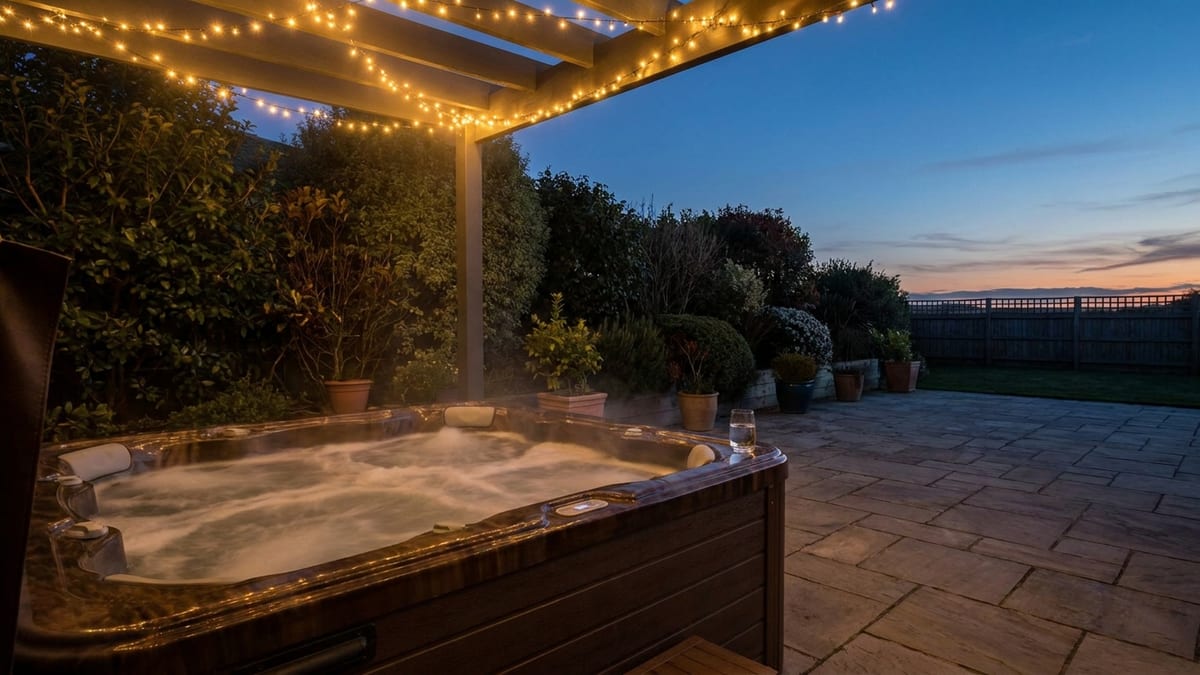
- Finished installs, shot at dusk. Steam on the water, lights on, furniture in frame. Spa purchases are emotional and visual. A product catalog photo on a white background does nothing.
- Show the whole job, not the box. The pad, the electrical, the delivery, the cover lifter. The number one unspoken objection is "what else is this going to cost me," and the ad that answers it pre-sells the price.
- Lead with use, not specs. Therapy, recovery, year-round, three nights a week in February. Jet counts close nobody who has not already shopped.
- Separate the swim spa creative entirely. Different headline, different photo, different landing page. The swim spa buyer is comparing against a pool, not against a smaller tub, and the ad should sit in that comparison.
- Put financing in the ad for swim spas. A $28,000 purchase almost always runs through a monthly payment conversation. Starting it in the ad shortens the cycle by a week.
Running those campaigns through your own ad account matters more than most dealers realize. The pixel data, the audiences, and the retargeting lists from a season of spa advertising are the asset that makes next season cheaper, and they stay with your company instead of a vendor's.
Ready to split your spa and pool campaigns properly? Get started here and we will build the ticket math for your market before anything goes live.
What does the seasonal calendar look like for spa leads?
This is where hot tubs earn their place in a pool company's budget. The two demand curves are nearly opposite.
| Quarter | Pool build demand | Hot tub demand | Where budget should sit |
|---|---|---|---|
| QuarterQ1 (Jan-Mar) | Pool build demandPeak planning for summer digs | Hot tub demandModerate, post-holiday | Where budget should sitPool-heavy, spa retargeting only |
| QuarterQ2 (Apr-Jun) | Pool build demandPeak booking and construction | Hot tub demandLow | Where budget should sitPool-heavy, renovation secondary |
| QuarterQ3 (Jul-Sep) | Pool build demandFalling off, next-year planning | Hot tub demandClimbing from late August | Where budget should sitShift to spa by Labor Day |
| QuarterQ4 (Oct-Dec) | Pool build demandQuiet except early planners | Hot tub demandPeak, holiday-driven | Where budget should sitSpa-heavy, pool planning seeds |
Launch spa campaigns six to eight weeks before your local cold snap. In most markets that means August or early September, not the week after Thanksgiving when every competitor finally shows up and the auction gets expensive.
One honest note for the ads: delivery and electrical scheduling can push an install out several weeks in Q4. Say so in the follow-up. A homeowner who was told January and gets January is happy. A homeowner who assumed December and gets January leaves a review about it.
How many spa leads do you need to hit a revenue target?
Work backward from revenue, not forward from a budget.
- Pick the revenue number. Say $600,000 in added spa revenue.
- Divide by average ticket. At $12,000 hot tubs, that is 50 units. At $28,000 swim spas, that is 21 units.
- Divide by close rate. At 25 percent on tubs, 200 leads a year. At 20 percent on swim spas, 105 leads a year.
- Divide by twelve, then weight for season. 200 leads is about 17 a month on a flat average, but realistically 10 a month in spring and 25 a month from September through December.
- Multiply by your cost per lead. At $125 per exclusive lead, 17 leads a month is roughly $2,125 a month. At 9 swim spa leads a month, roughly $1,125 a month.
That is the entire plan. $600,000 in spa revenue is a four-figure monthly lead investment, not a six-figure one, because the close rate does the heavy lifting. The reason most dealers never see those numbers is not the channel. It is what happens after the lead comes in.
What kills hot tub and swim spa leads after they arrive?
Slow response
A homeowner who filled out a spa form at 9pm on a Sunday is usually looking at two or three brands in the same hour. Responding Monday at 11am means you are the third call, and the third call sells on price. Speed is the cheapest close-rate improvement available, and the system for it is laid out in our guide on speed to lead.
Quoting a model instead of a project
"That one is $14,900" invites a price comparison against an online listing. "Delivered, set on a new pad, with the 50-amp circuit run and the cover lifter, you're at $16,400 and we're scheduling three weeks out" is a project nobody can price-shop line for line.
Abandoning the slow ones
Swim spa buyers routinely take eight to twelve weeks. Most dealers stop following up at day seven. A ninety-day cadence (text, photo of a finished install, financing reminder, seasonal offer) recovers a meaningful share of the pipeline that otherwise looks dead.
Treating a delivery check as a sales call
The site visit is a sales appointment. Send someone who can quote, close, and take a deposit, not just measure a gate.
Should a pool builder run spa campaigns at all?
If you can install them, yes, but run them as a separate profit center with their own budget and their own ceiling, not as a discount offer inside the pool campaign.
The argument for it is simple. Spa campaigns produce revenue in the quarter your construction calendar is empty. They give your sales team something to sell to the pool prospect who just found out their yard will not take a pool. And they generate pixel data and an audience of backyard-improvement homeowners that your spring pool campaign can retarget at a lower cost than cold traffic.
The argument against it is capacity. If you are one crew deep and booked through August, more leads do not help you. Fix the bottleneck first.
The short version
- Hot tubs run $8,000 to $20,000 installed and close in two to six weeks at 20 to 35 percent.
- Swim spas run $20,000 to $40,000 and close in four to twelve weeks at 15 to 25 percent, often against a pool bid.
- New pool construction runs $50,000 to $80,000 and up, takes months, and faces three or more competing bids.
- Set a separate maximum cost per lead for each with the margin-and-close-rate formula. They differ by a factor of three or more.
- Judge every channel on cost per acquired job. A $40 shared lead at 8 percent is more expensive than a $130 exclusive lead at 30 percent.
- Launch spa campaigns in August or early September, not December.
- Answer fast, quote the project instead of the model, and keep following up for ninety days.
If you sell spas, pools, or both and want the campaigns priced and separated correctly before next season, book a call to get started. We will run the ticket math for your market, show you the live numbers from your own ad account, and build the spa and pool campaigns as the two different businesses they are.
Frequently asked questions
Are hot tub leads worth running if I already build pools?
Yes, and the main reason is calendar. Pool construction inquiries peak in late winter and spring while hot tub demand peaks from September through December, so a spa campaign fills the months your pool pipeline goes quiet. Run them as separate campaigns with separate budgets because the ticket, close rate, and maximum cost per lead are not close to each other.
What do hot tub and swim spa leads cost in 2026?
Shared marketplace leads typically run $25 to $75 each but close at 5 to 12 percent because three to five companies get the same homeowner. Exclusive spa leads generally run $50 to $200 and close at 20 to 35 percent. Meta advertising usually lands in the $25 to $110 range per lead depending on market, creative, and offer.
How many hot tub leads do I need to add $600,000 in revenue?
At a $12,000 average installed ticket you need about 50 units, which at a 25 percent close rate means roughly 200 leads a year or 17 a month. On the swim spa side at a $28,000 average and a 20 percent close rate, the same $600,000 takes about 21 units and roughly 9 leads a month. Same revenue, half the lead volume on the higher ticket.
When should hot tub campaigns start?
Six to eight weeks ahead of your local cold snap, which in most markets means launching in August or early September. Delivery lead times and electrical scheduling mean a homeowner who inquires in November may not be soaking until January, so the ad has to set that expectation instead of hiding it.
Is Meta advertising or Google better for spa leads?
Meta for the planning-phase buyer and Google for the homeowner already shopping models. Most hot tub and swim spa purchases start as a backyard idea rather than a search, so Meta reaches them earlier and cheaper, while Google and Local Services Ads capture the smaller pool of people who already typed in a brand name or a size.