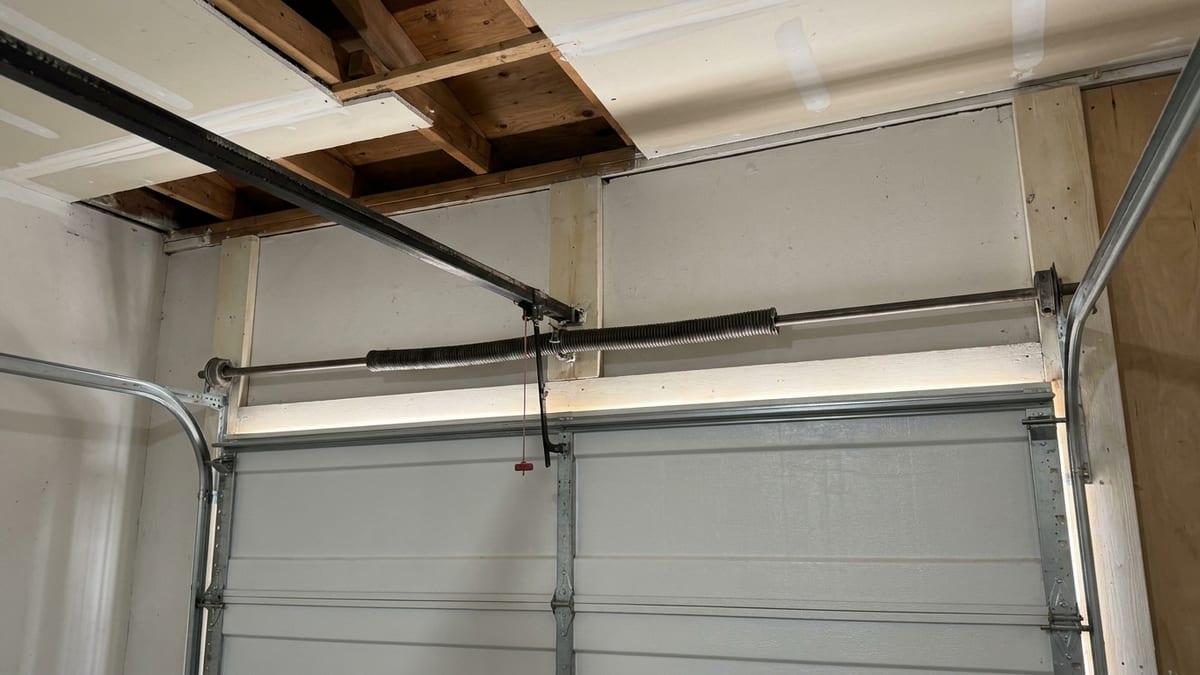
A broken torsion spring is a $250 to $600 ticket. A carriage-style insulated door with new hardware and a smart opener is $4,000. Both start as a phone call from the same street, and most garage door companies pay roughly the same amount to get either one.
That is the whole problem with garage door repair lead generation. The repair call is the easiest lead in the trade to generate — the homeowner's car is trapped, the urgency is total, the close rate is high — and it is also the lead most likely to lose money once you pay market rates for it. Meanwhile the replacement job that actually funds your year does not arrive as an emergency at all.
Here is the ticket math, the real cost per acquired job by channel, and the framework for deciding whether opener repair leads belong in your budget at all.
Are garage door opener repair leads worth paying for?
They are worth paying for at a price almost nobody quotes you.
Run the ceiling before you run the campaign. The formula every trade should be using:
Max cost per lead = (average job value x gross margin x close rate) / 3
Repair campaign: $350 average ticket x 0.55 margin x 0.50 close rate = $96, divided by 3 = a $32 maximum cost per lead.
Replacement campaign: $2,800 average ticket x 0.40 margin x 0.30 close rate = $336, divided by 3 = a $112 maximum cost per lead.
Those two numbers are three and a half times apart. If you run one blended garage door campaign and hold it to $32, you will never outbid anyone for the replacement buyer. If you hold it to $112, you will lose money on every spring call you book. That gap is the entire argument for splitting the campaigns, and it is how the garage door lead generation side of this business should be structured from day one.
The repair call is not the product
The repair call is distribution. It is a paid ticket into a garage where the door is fifteen years old, the panels are dented, the opener is a chain drive from 2009, and the homeowner has never once priced a replacement. That is the only reason a $32-ceiling lead is worth chasing at all.
If your techs roll out with a new spring and no replacement conversation, you did not buy a lead. You bought a $180 gross profit and a drive.
What is a garage door job actually worth in 2026?
You cannot set a ceiling without knowing your mix. Regional pricing, door size, and hardware quality move these, but the ranges are typical.
| Scope of work | Typical installed price | Buyer type |
|---|---|---|
| Scope of workOpener repair (gear, board, sensor, remote) | Typical installed price$150-$350 | Buyer typeUrgent |
| Scope of workTorsion spring replacement (pair) | Typical installed price$250-$600 | Buyer typeUrgent |
| Scope of workCable, roller, or off-track repair | Typical installed price$150-$400 | Buyer typeUrgent |
| Scope of workSingle panel replacement | Typical installed price$300-$900 | Buyer typeUrgent / forced |
| Scope of workNew opener install (belt drive, smart) | Typical installed price$400-$800 | Buyer typeUpgrade |
| Scope of workStandard steel door replacement | Typical installed price$750-$1,500 | Buyer typePlanned |
| Scope of workInsulated door replacement | Typical installed price$1,500-$3,500 | Buyer typePlanned |
| Scope of workCarriage-style or custom door | Typical installed price$2,500-$10,000+ | Buyer typePlanned / design-driven |
| Scope of workTwo-door replacement with openers | Typical installed price$3,500-$12,000 | Buyer typePlanned |
The pattern matters more than any single row. Converting one repair call into a $2,800 insulated door is worth more gross profit than eight additional spring jobs, and it costs you one crew slot instead of eight truck rolls.
What attach rate does to your lead ceiling
Run 100 paid repair calls with zero replacement conversion and you produce roughly $35,000 at a $350 average. Now assume 15 of those 100 homeowners buy a $2,800 door instead of a repair. The other 85 still pay $350.
- 85 repairs x $350 = $29,750
- 15 replacements x $2,800 = $42,000
- Total on the same 100 calls = $71,750, or $717 of revenue per call
Rerun the ceiling on the blended number: $717 x 0.42 margin x 0.50 close rate = $150, divided by 3 = a $50 maximum cost per lead. A 15 percent attach rate moved your ceiling from $32 to $50 without buying a single extra lead.
Why is cost per lead the wrong number for garage door contractors?
Because the invoice price ignores how many other companies got handed the same homeowner at the same moment. Cost per acquired job is the number your P&L reacts to.
| Channel | Cost per lead | Typical close rate | Cost per acquired job |
|---|---|---|---|
| ChannelReferrals and past customers | Cost per lead$0 | Typical close rate40-60% | Cost per acquired jobNear $0 |
| ChannelGoogle Business Profile / organic | Cost per lead$0-50 | Typical close rate20-40% | Cost per acquired job$100-250 |
| ChannelShared marketplace leads | Cost per lead$15-60 | Typical close rate5-12% | Cost per acquired job$250-1,000 |
| ChannelLocal Services Ads | Cost per lead$20-70 | Typical close rate15-30% | Cost per acquired job$130-400 |
| ChannelMeta advertising | Cost per lead$25-110 | Typical close rate10-20% | Cost per acquired job$250-1,000 |
| ChannelExclusive leads (performance partner) | Cost per lead$50-200 | Typical close rate20-35% | Cost per acquired job$200-900 |
| ChannelExclusive booked appointments | Cost per lead$200-400 | Typical close rate25-40% | Cost per acquired job$600-1,400 |
A $40 shared repair lead closing at 8 percent costs $500 per acquired job on a $350 ticket. That is a losing trade before the truck leaves the shop. A $110 exclusive replacement lead closing at 30 percent costs $367 per acquired job on a $2,800 ticket. Same industry, opposite economics. The full breakdown of why shared leads cost more per job than exclusive ones is in our guide on exclusive vs. shared leads.
There is a second cost almost nobody tracks in the garage door trade: the truck roll itself. Fuel, tech hours, and the schedule slot on a $250 spring job is real money. At an 8 percent close rate on shared leads you are answering twelve calls to book one, and several of those homeowners already booked somebody else while you were dialing.
How do you turn a repair call into a full replacement?
This is a process, not a personality. Five steps, in order.
- Answer inside five minutes, every time. Repair intent decays faster than in any other trade because the homeowner's car is stuck. Whoever picks up gets the job. Our breakdown of speed to lead covers what that actually requires in staffing.
- Quote the repair honestly on the phone as a range. Do not bait. Give the spring range, give the service call fee, book the slot. The replacement conversation happens in the garage, not on the phone.
- Photograph the door before you touch anything. Panel dents, rust at the bottom seal, delamination, the age sticker on the opener. Photos on a tablet convert; opinions do not.
- Present two numbers, not one. "Here is the spring repair at $380. Here is what a new insulated door with a belt-drive opener runs, and here is what it looks like on your house." Give the homeowner the choice. Most will still take the repair — that is fine, because you only need one in six or seven to move.
- Put the non-converters in the CRM with a door age and a photo. A fifteen-year-old door that got a new spring today is a replacement lead in eighteen months. Tag it and market to it.
That is the difference between a garage door company that buys repair leads and one that runs a lead generation system. If you want to see what that looks like built out on your own ad account, start here.
How do you reach the replacement buyer before they search?
The $2,800 door does not start with a search. Nobody googles "garage door replacement" because their door is ugly. They look at it every day, get used to it, and then something breaks or a neighbor replaces theirs.
That buyer is reachable on Meta, months earlier, with three things:
- Real finished-install photography. Not manufacturer renders. The homeowner is buying curb appeal, and curb appeal is a photo decision. Show your own completed doors on houses that look like theirs.
- Before-and-after pairs. Faded builder-grade white steel next to a carriage-style insulated door on the same house is the highest-performing creative in this trade.
- A homeowner-age and home-value targeting layer. Doors go out at fifteen to twenty-five years. Homes built in that window, owner-occupied, are your list.
Start the replacement campaign six to eight weeks ahead of your local spring exterior-project season. Bump the repair budget around the first hard freeze and again in late-summer heat, when springs and openers fail in volume.
How many leads do you need to hit a revenue target?
Work backward from revenue, not forward from budget. Say the goal is $300,000 in added annual revenue.
Replacement path: $300,000 / $2,800 average ticket = 107 jobs. At a 30 percent close rate that is 357 leads a year, about 30 leads a month. At $110 per exclusive lead, roughly $3,300 a month.
Repair-only path: $300,000 / $350 average ticket = 857 jobs. At a 50 percent close rate that is 1,714 leads a year, about 143 leads a month. Even at a $30 lead that is $4,290 a month for far more dispatch load, far more truck time, and much thinner margin dollars.
Same revenue. One path needs 30 leads a month; the other needs 143. Run the numbers against your own ticket and close rate with the ROI calculator before you set a budget.
The budget split that works
| Campaign | Share of budget | Ceiling per lead | Primary channel |
|---|---|---|---|
| CampaignReplacement (planned) | Share of budget60-70% | Ceiling per lead$80-150 | Primary channelMeta advertising |
| CampaignRepair (urgent) | Share of budget25-35% | Ceiling per lead$30-50 | Primary channelLocal Services Ads, GBP |
| CampaignPast-customer reactivation | Share of budget5-10% | Ceiling per leadNear $0 | Primary channelEmail, text, retargeting |
The reactivation slice is the cheapest revenue in this trade and almost every garage door company skips it. Every repair invoice you have written in the last three years contains a door age. Sort by age, market the oldest first.
The short version
Opener and spring repair leads are cheap calls that only pay when your techs convert a share of them into doors. Price them at a $30 to $50 ceiling, measure attach rate weekly, and stop expecting a $350 ticket to absorb a $75 lead.
The replacement side is where the margin lives, and it is won months before the homeowner searches — with real photos of your own finished installs, in front of the right houses, through your own ad account so the brand you build is yours. If you want that built and running for your company, book a call and we will show you the live numbers.
Frequently asked questions
Are garage door opener repair leads worth buying?
Only at the right price. A repair ticket of $150 to $600 caps your maximum cost per lead near $30 to $50, so a $75 shared repair lead loses money on volume. Repair leads become worth real money when your techs consistently convert a share of those calls into full door or opener replacements, which lifts the blended revenue per call and lifts the lead ceiling with it.
What does a garage door repair lead cost in 2026?
Shared marketplace repair leads typically run $15 to $60 but close at 5 to 12 percent because three to five companies get the same homeowner. Local Services Ads for garage door repair usually land between $20 and $70 per lead with high intent. Exclusive leads generally run $50 to $200 and close at 20 to 35 percent, which is where the replacement side of the business gets paid for.
Should garage door companies run separate campaigns for repair and replacement?
Yes. The two jobs have different tickets, different urgency, and different maximum costs per lead, so a blended campaign forces you to judge a $2,800 door replacement by the economics of a $300 spring repair. Run repair on fast-response search channels and replacement on Meta advertising built around finished install photography, each with its own budget and its own ceiling.
How many garage door leads do you need to add $300,000 in revenue?
At a $2,800 average replacement and a 30 percent close rate, you need about 107 jobs a year, which is roughly 357 leads a year or 30 a month. At $110 per exclusive lead that is about $3,300 a month. Hitting the same $300,000 on $350 repair tickets alone would take roughly 857 jobs and 143 paid leads a month, which almost never pencils.
Is Meta or Google better for garage door leads?
Both, for different jobs. Google and Local Services Ads capture the homeowner whose car is trapped behind a broken spring right now, which skews to small repair tickets. Meta advertising reaches homeowners looking at a dented, faded, uninsulated door months before they search, which is where the $2,500 to $10,000 replacement jobs come from.
Frequently asked questions
Are garage door opener repair leads worth buying?
Only at the right price. A repair ticket of $150 to $600 caps your maximum cost per lead near $30 to $50, so a $75 shared repair lead loses money on volume. Repair leads become worth real money when your techs consistently convert a share of those calls into full door or opener replacements, which lifts the blended revenue per call and lifts the lead ceiling with it.
What does a garage door repair lead cost in 2026?
Shared marketplace repair leads typically run $15 to $60 but close at 5 to 12 percent because three to five companies get the same homeowner. Local Services Ads for garage door repair usually land between $20 and $70 per lead with high intent. Exclusive leads generally run $50 to $200 and close at 20 to 35 percent, which is where the replacement side of the business gets paid for.
Should garage door companies run separate campaigns for repair and replacement?
Yes. The two jobs have different tickets, different urgency, and different maximum costs per lead, so a blended campaign forces you to judge a $2,800 door replacement by the economics of a $300 spring repair. Run repair on fast-response search channels and replacement on Meta advertising built around finished install photography, each with its own budget and its own ceiling.
How many garage door leads do you need to add $300,000 in revenue?
At a $2,800 average replacement and a 30 percent close rate, you need about 107 jobs a year, which is roughly 357 leads a year or 30 a month. At $110 per exclusive lead that is about $3,300 a month. Hitting the same $300,000 on $350 repair tickets alone would take roughly 857 jobs and 143 paid leads a month, which almost never pencils.
Is Meta or Google better for garage door leads?
Both, for different jobs. Google and Local Services Ads capture the homeowner whose car is trapped behind a broken spring right now, which skews to small repair tickets. Meta advertising reaches homeowners looking at a dented, faded, uninsulated door months before they search, which is where the $2,500 to $10,000 replacement jobs come from.