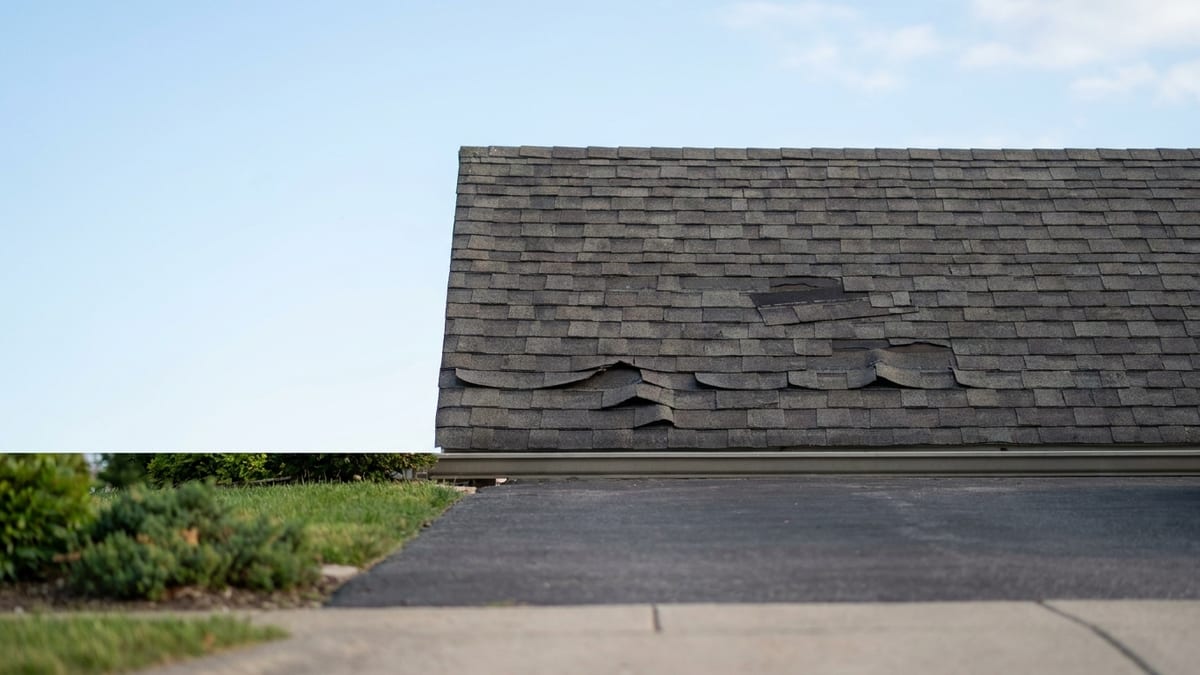
A roof repair lead and a roof replacement lead can cost you almost exactly the same amount to generate. One of them turns into a $650 invoice and half a crew day. The other turns into a $9,000 to $25,000 contract.
That is the whole decision, and most roofing companies never actually make it. They run one campaign that says "roofing" and take whatever the algorithm sends. Then they wonder why the leads are all small leaks and why the replacement pipeline is thin in October.
The leads are behaving exactly the way the campaign told them to behave.
Why do roof repair leads and replacement leads behave like two different businesses?
Because they are two different purchases, with two different triggers, two different timelines, and two different amounts of money on the table.
The leak buyer
There is water coming through a ceiling, a shingle in the driveway after a windy night, or a stain spreading over the dining room. This homeowner is not comparing materials or reading warranty language. They are calling the first three roofers that come up and booking whoever answers and says "we can be there Thursday."
Ticket: $350 to $1,500 for most repairs. Sales cycle: hours to days. Close rate on an exclusive, fast-answered lead: 30 to 45 percent, because the decision is small and urgent.
This is a speed game. It works when your cost per lead is genuinely low, your schedule has gaps you need filled, and somebody picks up the phone every single time.
The replacement buyer
This homeowner has a 22-year-old roof, granules in the gutters, and a neighbor who just had a crew out. Or they got an insurance letter. Or they are refinancing. Or they are finally tired of the patch cycle. They are going to get two or three quotes, ask about financing, and sign in one to six weeks.
Ticket: $9,000 to $12,000 typical, $15,000 to $25,000 for larger or upgraded replacements, and up toward $35,000 on big or complex roofs. Sales cycle: appointment within the week, signed at or shortly after the appointment. Close rate on a well-worked exclusive lead: 15 to 25 percent, and much higher on a booked appointment.
The replacement buyer usually is not searching for a roofer at the moment your campaign first reaches them. They know the roof is old. They have not started shopping. That is why the channel that wins replacements looks nothing like the channel that wins a leak call, and why our roofing lead generation page treats them as two separate campaigns with separate budgets and separate ceilings.
What is a roof job actually worth in 2026?
You cannot set a lead-cost ceiling until you know what each scope is worth in your market. Pitch, stories, layers to tear off, and material choice move all of these, but the ranges are typical.
| Scope of work | Typical installed price | Buyer type |
|---|---|---|
| Scope of workEmergency tarp or temporary dry-in | Typical installed price$300-$800 | Buyer typeUrgent |
| Scope of workShingle and flashing repair | Typical installed price$400-$1,500 | Buyer typeUrgent |
| Scope of workPartial slope replacement | Typical installed price$2,500-$6,000 | Buyer typeForced |
| Scope of workFull asphalt shingle replacement (average home) | Typical installed price$9,000-$14,000 | Buyer typePlanned |
| Scope of workArchitectural or upgraded shingle replacement | Typical installed price$15,000-$25,000 | Buyer typePlanned |
| Scope of workLarge, steep, or multi-layer replacement | Typical installed price$25,000-$35,000 | Buyer typePlanned |
The pattern matters more than any single row. Moving one homeowner from a $900 repair to a $16,000 replacement is worth more than winning seventeen extra repairs, and it costs you one job instead of seventeen dispatches.
The formula that sets your lead ceiling
Run this per campaign, not per company.
Max cost per lead = (average job value x gross margin x close rate) / 3
Repair campaign: $700 x 0.50 margin x 0.35 close = $122.50, divided by 3 = a $41 maximum cost per lead.
Replacement campaign: $14,000 x 0.30 margin x 0.25 close = $1,050, divided by 3 = a $350 maximum cost per lead.
Those numbers are not close to each other. If you run one blended roofing campaign and hold it to $41, you will never outbid anyone for a replacement buyer. If you hold it to $350, you will lose money on repairs all year. That single gap is the entire argument for splitting the campaigns. If you want to run your own version of this with your real margin and close rate, the ROI calculator does the arithmetic.
Why is cost per lead the wrong number to judge roofing leads on?
Because the invoice price of a lead ignores how many other contractors got handed the same homeowner. Cost per acquired job is the number your P&L reacts to.
| Channel | Cost per lead | Typical close rate | Cost per acquired job |
|---|---|---|---|
| ChannelReferrals and past customers | Cost per lead$0 | Typical close rate40-60% | Cost per acquired jobNear $0 |
| ChannelSEO and Google Business Profile | Cost per lead$0-50 | Typical close rate20-40% | Cost per acquired job$100-250 |
| ChannelShared leads (marketplaces) | Cost per lead$25-75 | Typical close rate2-8% | Cost per acquired job$900-3,000+ |
| ChannelAffiliate / marketplace leads | Cost per lead$40-100 | Typical close rate5-12% | Cost per acquired job$800-2,000 |
| ChannelMeta advertising | Cost per lead$25-110 | Typical close rate10-20% | Cost per acquired job$250-1,100 |
| ChannelExclusive leads (performance partner) | Cost per lead$50-200 | Typical close rate15-25% | Cost per acquired job$200-1,000 |
| ChannelGoogle Ads (search intent) | Cost per lead$100-500+ | Typical close rate15-30% | Cost per acquired job$500-2,500 |
| ChannelExclusive booked appointments | Cost per lead$200-400 | Typical close rate25-40% | Cost per acquired job$200-1,200 |
A $50 shared lead closing at 3 percent costs $1,667 per acquired job. A $99 exclusive lead closing at 20 percent costs $495. The target for most roofing companies is a cost per acquired job under 10 percent of average job value, which is roughly $900 to $1,200 on a typical replacement. Shared leads miss that badly on replacements and miss it catastrophically on repairs, because a $1,667 acquisition cost against a $700 ticket is not a marketing problem, it is a loss. The full breakdown of that math sits in our guide to exclusive vs. shared leads.
There is a second cost almost nobody tracks on the repair side: truck time. A repair inspection is 45 to 90 minutes plus travel, and roughly a third of them turn out to be someone else's scope, a $200 job you do not want, or a homeowner who wanted a free diagnosis. Price that at your loaded hourly cost and cheap repair leads get expensive fast.
Should you advertise roof repair at all?
Yes, deliberately, with a capped budget and a specific job to do. Repair campaigns are useful for three reasons and dangerous for one.
Useful:
- Schedule filler. Repairs slot into gaps between replacements and keep crews and service techs billable.
- Cash velocity. Repair money lands in days, not weeks, with no material deposit drag.
- Conversion feeder. A meaningful share of repair calls are on roofs at or past end of life.
Dangerous: repair campaigns are cheap, so they win the internal argument on cost per lead and quietly eat the budget that was supposed to build the replacement pipeline. Cost per lead is the vanity metric here. Revenue per lead is the real one.
The repair-to-replacement conversion play
This is where repair advertising earns its keep, and it only works if the process is built on purpose:
- Inspect the whole roof, not the leak. Age, granule loss, flashing, valleys, decking, ventilation.
- Document it with photos. Every homeowner who gets a written, photo-backed condition report trusts the recommendation more than a verbal one.
- Present two options in writing. Repair now with an expected remaining life, or replace with pricing and financing. Let the homeowner choose.
- Never texting a bare price. A number with no context invites a shopping spree.
- Put the decliners on a nurture track. A roof you flagged as five years from end of life is a replacement lead with a date on it.
A homeowner who says no to replacement today is not a dead lead. They are a scheduled one. The contractor follow-up system covers the cadence that keeps those roofs from going to a competitor in year three.
How should the two campaigns actually be structured?
| Repair campaign | Replacement campaign | |
|---|---|---|
| Primary channel | Repair campaignLocal search, Local Services Ads, Google Business Profile | Replacement campaignMeta advertising to homeowners with aging roofs |
| Buyer state | Repair campaignProblem happening now | Replacement campaignAware, not yet shopping |
| Creative angle | Repair campaignFast response, same-week service, licensed and insured | Replacement campaignFinished-roof photography, financing, condition-report offer |
| Max cost per lead | Repair campaign$30-$60 | Replacement campaign$250-$400 |
| Share of budget | Repair campaign15-30% | Replacement campaign70-85% |
| Success metric | Repair campaignBooked service calls per week | Replacement campaignCost per signed replacement |
| Response requirement | Repair campaignAnswer live, dispatch same or next day | Replacement campaignAppointment set inside 24 hours |
The budget split is the part people fight. If repair is eating more than a third of your spend, your revenue plan is being set by whichever campaign was cheapest, not by what you actually need to produce. One caveat: after a storm, repair demand spikes and the split can flip for a few weeks. That is a deliberate, temporary reallocation, not a new normal.
If you want the two-campaign structure built and managed against your own numbers, get started here and we will map the split to your ticket mix and capacity.
How many leads do you need to hit a revenue target?
Work backward from revenue, not forward from a budget.
Replacement side, $1,000,000 in added revenue:
- $1,000,000 / $14,000 average = 72 jobs
- 72 jobs / 25 percent close rate = 288 exclusive leads per year
- 288 / 12 = 24 leads per month
- At $120 per exclusive lead, that is roughly $2,880 per month in lead cost
Repair side, the same $1,000,000:
- $1,000,000 / $700 average = 1,429 jobs
- 1,429 / 35 percent close rate = 4,082 leads per year
- 4,082 / 12 = 340 leads per month
Same revenue. Fourteen times the lead volume, fourteen times the dispatches, fourteen times the scheduling load. Nobody builds a $1M repair division on advertising alone, and nobody should try. Repair is a margin and utilization tool. Replacement is the revenue engine.
What kills roofing leads after they come in?
The campaign is usually not the problem. Three things are.
Response time. You are 21 times more likely to qualify a lead when you call inside five minutes instead of thirty, and 35 to 50 percent of sales go to whoever responds first. On repair leads, where the homeowner is calling three companies in a row, that is the entire contest. See speed to lead for how to staff it.
No appointment discipline. A lead with no date on the calendar is a lead someone else will book. Set the appointment on the first call or the first text back, not after a week of phone tag.
One-touch follow-up. Replacement buyers are on a one-to-six-week clock. If your sequence is a single missed call and a voicemail, you lose the ones who were always going to buy, just not today.
The short version
Roof repair leads are cheap, fast, and small. Replacement leads are expensive, slower, and worth ten to twenty times more. Advertise both, but never in the same campaign and never against the same cost-per-lead ceiling. Give replacement 70 to 85 percent of the budget, cap repair at a ceiling your actual repair ticket supports, and build a real conversion process so the repair calls that sit on a worn-out roof turn into contracts instead of patches.
Judge all of it on cost per acquired job, not cost per lead. If you want a system built around that split, running through your own ad account so the brand you build is yours, book a call and we will walk the numbers.
Frequently asked questions
Should roofing contractors advertise roof repair at all?
Yes, but on purpose and with its own budget. Repair campaigns produce cheap, fast, high-intent leads that fill crew gaps and feed replacement conversions, but they cannot carry your revenue target because the ticket is too small. Run repair as a controlled percentage of spend with a hard cost-per-lead ceiling, and run replacement as the primary campaign.
What do roofing leads cost in 2026?
Shared marketplace roofing leads typically run $25 to $75 each but close at 2 to 8 percent because three to five contractors get the same homeowner. Exclusive roofing leads generally run $50 to $200 and close at 15 to 25 percent. Exclusive booked appointments run $200 to $400 and close at 25 to 40 percent.
What is the maximum I should pay for a roof repair lead?
Run the formula on the repair ticket, not your company average. At a $700 average repair, a 50 percent gross margin, and a 35 percent close rate, the math is $700 times 0.50 times 0.35 divided by 3, which is about $41 per lead. Anything much above that only works if your repair-to-replacement conversion rate is strong enough to justify it.
How many leads do I need to add $1 million in roof replacement revenue?
At a $14,000 average replacement and a 25 percent close rate, you need about 72 jobs, which is roughly 288 exclusive leads a year or 24 a month. The same $1 million in repair work at a $700 ticket would require about 1,429 jobs and roughly 340 leads a month. Same revenue, fourteen times the lead volume on the repair side.
Do repair leads convert into full replacements?
Often, and that is the strongest argument for running them. A significant share of repair calls are on roofs at or past end of life, so the inspection becomes a replacement conversation. The conversion only happens if you inspect properly, document the roof with photos, and present both options in writing instead of texting a patch price.