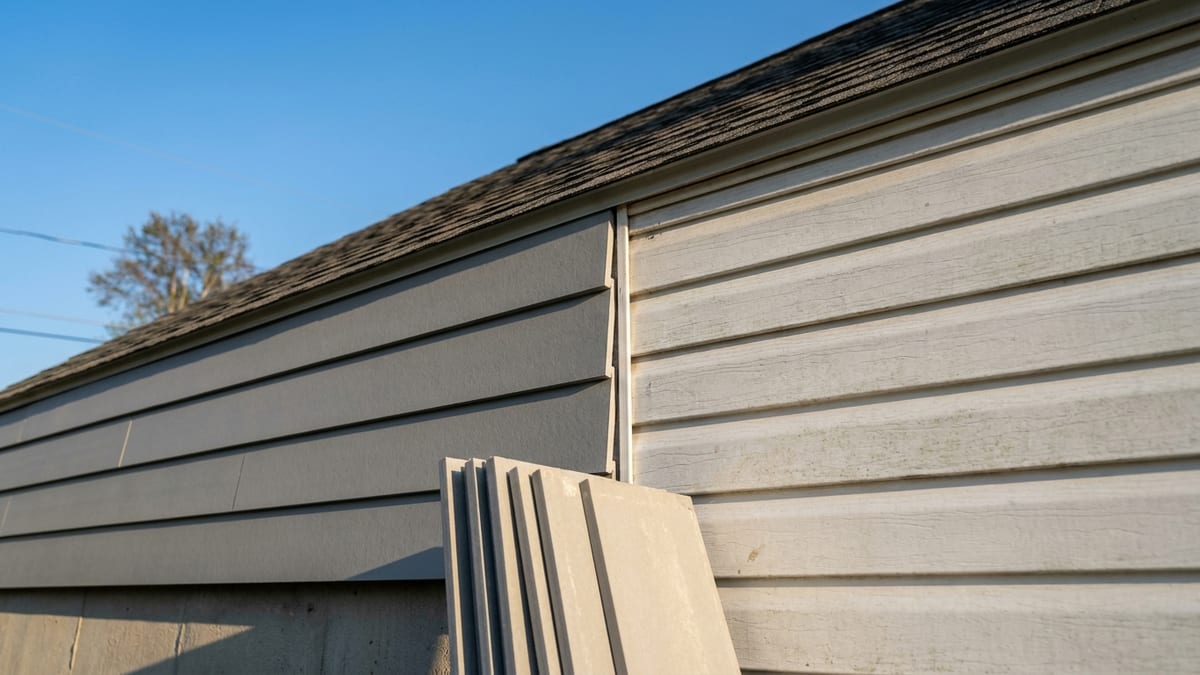
Two siding companies can spend the same money in the same market and end up in different businesses. One books 30 vinyl wraps at $12,000. The other books 14 fiber cement re-sides at $28,000. The second one produced more revenue on half the leads, half the estimates, and half the crew mobilizations.
Most siding marketing never makes that choice on purpose. One campaign runs, whatever comes in comes in, and then the owner says the leads are cheap and unqualified. The leads are behaving exactly the way the campaign told them to behave.
Here is how the two buyers differ, what each ticket is worth, and the math that decides which one your budget should be chasing.
Why do fiber cement and vinyl siding leads behave like two different businesses?
Same trade, same trucks, two different purchases.
The price-and-payment buyer
This homeowner has faded, cracked, or hail-dented siding and wants the house to stop looking tired. They want a number and a monthly payment. They will get two or three quotes, they will compare line items, and they will ask what the cheapest option is that still looks good.
Ticket: roughly $8,000 to $22,000 depending on square footage and whether the product is insulated. Sales cycle: one appointment, then days to a few weeks. Close rate on a well-worked exclusive lead: 25 to 35 percent, because the decision is mostly about price and financing.
This is a throughput game. It works when your cost per lead is disciplined, your quote turnaround is same-day, and someone answers the phone the first time it rings.
The permanence buyer
This homeowner is not shopping siding. They are deciding what the house should look like for the next 30 years. They are in a neighborhood where the nice houses have crisp lap siding and painted trim. They just finished windows or a roof and the siding now looks worse by comparison. They are staying put, or they are prepping a home to sell into a market where curb appeal moves the number.
Ticket: $18,000 to $50,000 with trim packages, wrap, and accent work. Sales cycle: longer to first contact, then a design-heavy appointment and a signature. Close rate on an exclusive lead: 20 to 28 percent, but revenue per closed job is two to three times the vinyl wrap.
This buyer almost never starts with a product search. They start with a picture of a house they like. That is why the channel that wins them looks nothing like the channel that wins a vinyl repair call, and why our siding lead generation page builds them as separate campaigns with separate budgets.
What is a siding job actually worth in 2026?
You cannot set a lead-cost ceiling until you know your real ticket mix. Regional labor, wall height, tear-off, and trim scope move these numbers, but the ranges are typical.
| Scope of work | Typical installed price | Buyer type |
|---|---|---|
| Scope of workStorm or impact repair, partial panels | Typical installed price$500-$3,000 | Buyer typeForced / urgent |
| Scope of workSingle elevation vinyl replacement | Typical installed price$3,000-$7,000 | Buyer typePrice-driven |
| Scope of workFull standard vinyl re-side | Typical installed price$8,000-$16,000 | Buyer typePrice-driven |
| Scope of workInsulated vinyl re-side | Typical installed price$12,000-$22,000 | Buyer typeValue / comfort |
| Scope of workFiber cement re-side, standard trim | Typical installed price$18,000-$32,000 | Buyer typePermanence |
| Scope of workFiber cement with full trim and accent package | Typical installed price$25,000-$45,000 | Buyer typePermanence / design |
| Scope of workLarge or multi-story fiber cement with wrap and detail work | Typical installed priceup to $50,000 | Buyer typePermanence / design |
The pattern matters more than any single row. Moving one homeowner from a $12,000 vinyl wrap to a $28,000 fiber cement package is worth more than winning two extra vinyl jobs, and it costs you one crew mobilization instead of three.
The formula that sets your lead ceiling
Run this per campaign, not per company.
Max cost per lead = (average job value x gross margin x close rate) / 3
Vinyl campaign: $12,000 x 0.32 margin x 0.30 close = $1,152, divided by 3 = a $384 maximum cost per lead.
Fiber cement campaign: $28,000 x 0.30 margin x 0.22 close = $1,848, divided by 3 = a $616 maximum cost per lead.
Both ceilings are well above what exclusive siding leads actually cost, which is why siding is one of the better trades in home improvement for paid lead generation. But the two numbers are not the same, and that gap is the whole argument for splitting the campaigns. Hold one blended campaign to the vinyl ceiling and you will never outbid anyone for the fiber cement buyer. Hold it to the fiber cement ceiling and you will overpay for every repair call that comes in. If you want to run your own numbers instead of mine, the ROI calculator does the same math against your close rate.
Why is cost per lead the wrong number for siding contractors?
Because the invoice price of a lead ignores how many other companies were handed the same homeowner. Cost per acquired job is what pays a crew.
| Channel | Cost per lead | Typical close rate | Cost per acquired job |
|---|---|---|---|
| ChannelReferrals and past customers | Cost per lead$0 | Typical close rate40-60% | Cost per acquired jobNear $0 |
| ChannelGoogle Business Profile / organic | Cost per lead$0-50 | Typical close rate20-40% | Cost per acquired job$100-250 |
| ChannelShared marketplace leads | Cost per lead$25-85 | Typical close rate5-12% | Cost per acquired job$350-1,400 |
| ChannelMeta advertising | Cost per lead$25-110 | Typical close rate10-20% | Cost per acquired job$250-1,100 |
| ChannelExclusive leads (performance partner) | Cost per lead$50-200 | Typical close rate20-35% | Cost per acquired job$200-1,000 |
| ChannelExclusive booked appointments | Cost per lead$200-400 | Typical close rate25-40% | Cost per acquired job$500-1,600 |
A $50 shared lead closing at 8 percent costs $625 per acquired job. A $140 exclusive lead closing at 28 percent costs $500 per acquired job, and the ticket is usually larger, because you are not one of four companies racing each other to the bottom on the same elevation. The full version of that math is in our breakdown of exclusive vs. shared leads.
Siding also carries a second cost almost nobody tracks: measure time. A real siding estimate means walking the house, counting squares, photographing trim and soffit conditions, and building a quote with product and color options. That is 60 to 90 minutes plus travel. At an 8 percent close rate you are running twelve of those to sell one job. Price that at your estimator's loaded hourly cost and shared leads stop looking cheap.
Want the fiber cement side of your calendar built on purpose instead of by accident? Start with our siding lead generation program and we will show you what the split looks like in your market.
How do you run campaigns that book the fiber cement ticket?
The $28,000 re-side rarely starts with a search. It starts with a homeowner seeing a finished house that looks like what theirs could be. Your job is to be that image, in front of that homeowner, before a competitor is.
Creative that filters for the bigger ticket
The creative is the qualifier. Change the creative and you change the buyer.
- Fiber cement creative: real finished-project photography, full-house exteriors, tight shots of trim and corner detail, color and style choices, and language about how long the homeowner plans to stay in the house. No price anchors. No "cheapest" language. Show two or three color schemes and let the homeowner self-select into a design conversation.
- Vinyl creative: curb-appeal before and after, financing framing, seasonal offers, and clear speed of installation. Price framing is fine here because price is the buying trigger.
Stock photos poison both campaigns. Homeowners can tell, and a homeowner who suspects the photos are not yours discounts everything else on the page. Shoot your own jobs. See what homeowners actually respond to in what homeowners want from a contractor's website.
The five-step split
- Separate the campaigns. One for fiber cement and premium re-sides, one for vinyl and price-led work. Separate budgets, separate creative, separate cost-per-lead ceilings.
- Set the ceiling from the formula, not from feel. Write both numbers down. Judge each campaign only against its own number.
- Route the leads differently. Fiber cement leads go to your strongest design-and-close rep. Vinyl leads go to whoever can quote fastest.
- Match the appointment to the ticket. A fiber cement in-home appointment is a design consultation with color boards and a real proposal. That is still a sales appointment, and it should be sold as one.
- Report by campaign. Track leads, appointments, closes, average ticket, and cost per acquired job for each campaign separately every month. Blended reporting hides which half of your budget is working.
How many siding leads do you need to hit a revenue target?
Work backward from the revenue, not forward from the budget.
Say the goal is $1,000,000 in added siding revenue.
Fiber cement path: $1,000,000 / $28,000 average = 36 jobs. At a 22 percent close rate, that is 164 leads a year, about 14 a month. At $150 per exclusive lead, roughly $2,100 a month in lead cost.
Vinyl path: $1,000,000 / $12,000 average = 84 jobs. At a 30 percent close rate, that is 280 leads a year, about 23 a month. At $110 per exclusive lead, roughly $2,530 a month in lead cost.
Same revenue. The vinyl path requires 116 more leads, 48 more jobs, and 48 more crew mobilizations to get there. That is not an argument against vinyl, which fills schedule gaps and keeps crews busy. It is an argument for knowing which path you are funding, and for budgeting each one against its own numbers rather than one blended guess. Our guide to setting a contractor marketing budget walks through the percentage-of-target-revenue approach that keeps this honest.
What kills siding leads after they come in?
Three things, in this order.
Response time. Siding leads go stale fast, especially the price-driven ones. A homeowner who filled out a form on Sunday night has talked to two other companies by Tuesday. Calling within five minutes rather than thirty makes you dramatically more likely to qualify the lead at all. The full framework is in speed to lead.
Quoting the wrong scope. Sending a fiber cement buyer a vinyl number, or vice versa, ends the conversation. Qualify the product interest, the square footage, and the timeline on the first call so the estimate matches the buyer.
No follow-up past day three. Siding decisions involve color selection, spouses, HOA rules, and financing. Most companies quote once and stop. A 30-day cadence of texts and calls recovers a meaningful share of the leads your competitors already gave up on.
When should siding campaigns start?
Six to ten weeks ahead of your local install season, not the week the weather breaks.
Between the first conversation and the first plank there is a measure, a color selection, sometimes an HOA approval, sometimes financing, and always crew scheduling. Campaigns that start in late winter fill a spring calendar. Campaigns that start in April chase it all summer.
Two other timing notes. Storm events create a short, sharp surge in repair and replacement demand, so keep a repair-side campaign ready to scale rather than building one after the hail hits. And the fiber cement buyer is often reachable in the off-season, because planning a big exterior project is a winter activity.
The short version
Vinyl siding leads and fiber cement siding leads are different products with different economics. Vinyl is volume, price, and speed. Fiber cement is design, permanence, and a much bigger ticket on fewer leads. Split the campaigns, set a cost-per-lead ceiling for each from the formula, and judge both on cost per acquired job instead of cost per lead.
If you want that split built inside your own ad account, with exclusive leads that build your brand instead of a marketplace's, get started here and we will walk your numbers with you.
Frequently asked questions
Should siding contractors run separate campaigns for fiber cement and vinyl?
Yes. The tickets, close rates, and maximum cost per lead are different enough that blending them forces you to judge a $28,000 fiber cement job by the economics of a $12,000 vinyl wrap. Run them as separate campaigns with separate creative, separate budgets, and separate cost-per-lead ceilings.
What do siding leads cost in 2026?
Shared marketplace siding leads typically run $25 to $85 each but close at 5 to 12 percent because three to five companies get the same homeowner. Exclusive siding leads generally run $50 to $200 and close at 20 to 35 percent. Exclusive booked appointments usually run $200 to $400 and close at 25 to 40 percent.
How many siding leads do I need to add $1,000,000 in revenue?
It depends on your ticket mix. At a $28,000 fiber cement average and a 22 percent close rate you need roughly 164 leads a year, about 14 a month. At a $12,000 vinyl average and a 30 percent close rate you need about 280 leads a year, roughly 23 a month. Same revenue, very different lead volume and crew load.
Is Meta advertising or Google better for fiber cement siding leads?
Meta, for the high-ticket side. Homeowners planning a full fiber cement re-side are usually thinking about curb appeal and how long they will own the house, not searching a product name yet, and Meta reaches them in that window at roughly $25 to $110 per lead. Google captures the homeowner who already knows what they want, which skews toward repairs and faster vinyl jobs.
When should siding campaigns start for the spring season?
Six to ten weeks ahead of your local install season. Color selection, HOA approval, financing, and crew scheduling all sit between the first conversation and the first plank, so campaigns that begin in late winter fill the spring calendar instead of chasing it.
Frequently asked questions
Should siding contractors run separate campaigns for fiber cement and vinyl?
Yes. The tickets, close rates, and maximum cost per lead are different enough that blending them forces you to judge a $28,000 fiber cement job by the economics of a $12,000 vinyl wrap. Run them as separate campaigns with separate creative, separate budgets, and separate cost-per-lead ceilings.
What do siding leads cost in 2026?
Shared marketplace siding leads typically run $25 to $85 each but close at 5 to 12 percent because three to five companies get the same homeowner. Exclusive siding leads generally run $50 to $200 and close at 20 to 35 percent. Exclusive booked appointments usually run $200 to $400 and close at 25 to 40 percent.
How many siding leads do I need to add $1,000,000 in revenue?
It depends on your ticket mix. At a $28,000 fiber cement average and a 22 percent close rate you need roughly 164 leads a year, about 14 a month. At a $12,000 vinyl average and a 30 percent close rate you need about 280 leads a year, roughly 23 a month. Same revenue, very different lead volume and crew load.
Is Meta advertising or Google better for fiber cement siding leads?
Meta, for the high-ticket side. Homeowners planning a full fiber cement re-side are usually thinking about curb appeal and how long they will own the house, not searching a product name yet, and Meta reaches them in that window at roughly $25 to $110 per lead. Google captures the homeowner who already knows what they want, which skews toward repairs and faster vinyl jobs.
When should siding campaigns start for the spring season?
Six to ten weeks ahead of your local install season. Color selection, HOA approval, financing, and crew scheduling all sit between the first conversation and the first plank, so campaigns that begin in late winter fill the spring calendar instead of chasing it.