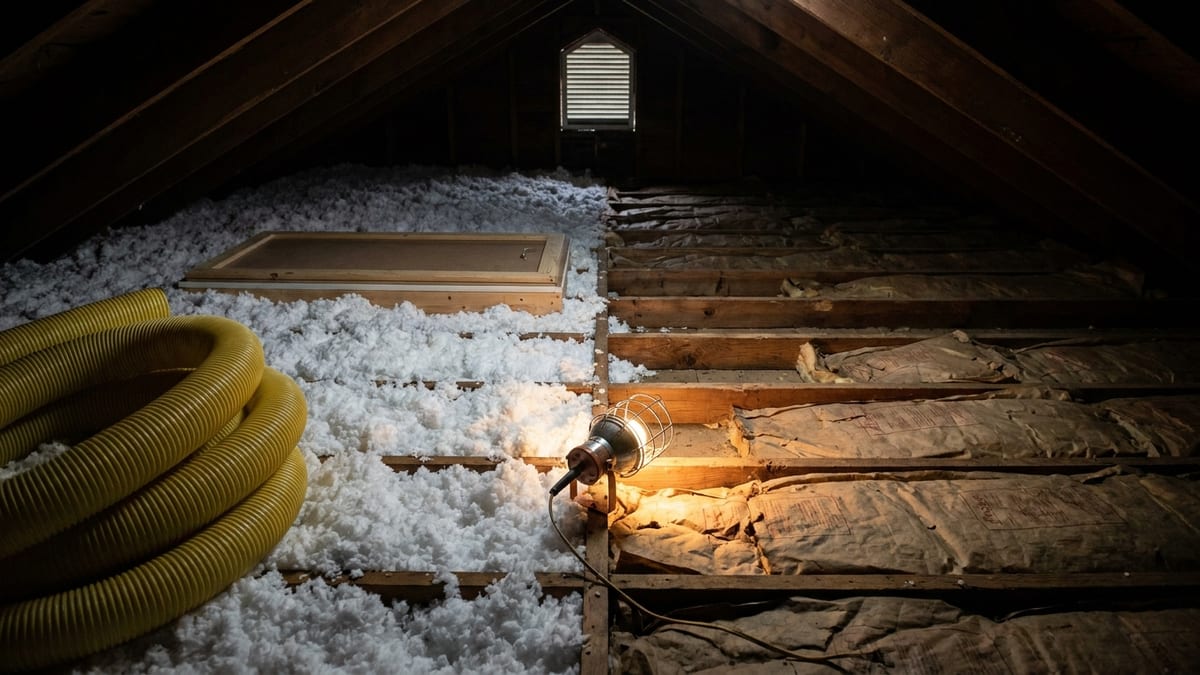
An insulation company can run two campaigns on the same street, in the same week, with the same budget, and end up with two completely different businesses. One books 40 attic top-offs at $1,700 a ticket. The other books six whole-home foam retrofits at $9,000 a ticket. The second one produces more revenue on fewer leads, less truck time, and less price shopping.
Most insulation marketing plans do not make that choice on purpose. They run one campaign, take whatever comes in, and then complain that the leads are cheap tire-kickers. The leads are behaving exactly the way the campaign told them to.
Here is how the two buyers actually differ, what each ticket is worth, and the math for deciding which one your budget should be chasing.
Why do attic insulation and spray foam leads behave like two different businesses?
They are two different purchases with two different triggers.
The rebate and comfort buyer
This homeowner has a cold bedroom over the garage, an upstairs that never cools in August, or a utility bill that jumped. They Google "attic insulation near me," call two or three companies, and book whoever answers and can quote fast. They are also aware that a rebate or tax credit exists, and that awareness is often what finally moved them.
Ticket: $800 to $3,000. Sales cycle: days. Close rate on a good exclusive lead: 25 to 35 percent, because the decision is small enough to make on the phone or at the hatch.
This is a volume game. It works when your cost per lead is low, your crew scheduling is tight, and someone answers on the first ring.
The retrofit and renovation buyer
This homeowner is doing something bigger. Finishing a bonus room. Converting a vented attic to conditioned space. Encapsulating a crawl space because the floors are cold and the house smells like the ground under it. Buying a house that failed an energy audit. Adding solar and being told the envelope has to come first.
Ticket: $4,000 to $15,000 and up. Sales cycle: appointment in the first week, signed at the appointment. Close rate on a well-worked exclusive lead: 20 to 30 percent, but the revenue per closed job is five to eight times the top-off.
This buyer is almost never searching for spray foam when the campaign first reaches them. They are planning a project. That is why the channel that wins them looks nothing like the channel that wins an attic top-off, and why our insulation lead generation page builds them as separate campaigns with separate budgets.
What is an insulation job actually worth in 2026?
You cannot set a lead-cost ceiling until you know your real ticket mix. Regional pricing, attic access, and removal requirements move these, but the ranges are typical.
| Scope of work | Typical installed price | Buyer type |
|---|---|---|
| Scope of workAttic air sealing package | Typical installed price$800-$2,500 | Buyer typeRebate / comfort |
| Scope of workBlown attic top-off (fiberglass or cellulose) | Typical installed price$1,200-$3,000 | Buyer typeRebate / comfort |
| Scope of workRemoval and reinstall after rodents or moisture | Typical installed price$2,500-$6,000 | Buyer typeForced / urgent |
| Scope of workWall injection retrofit | Typical installed price$3,000-$8,000 | Buyer typePlanned |
| Scope of workSpray foam attic deck (unvented assembly) | Typical installed price$4,000-$12,000 | Buyer typePlanned / renovation |
| Scope of workCrawl space encapsulation with insulation | Typical installed price$5,000-$15,000 | Buyer typePlanned |
| Scope of workWhole-home foam retrofit | Typical installed price$8,000-$18,000 | Buyer typeRenovation-driven |
The pattern matters more than any single line. Moving one homeowner from a $1,700 top-off to a $9,000 conditioned-attic assembly is worth more than winning four extra top-offs, and it costs you one crew day instead of four.
The formula that sets your lead ceiling
Run this per campaign, not per company.
Max cost per lead = (average job value x gross margin x close rate) / 3
Top-off campaign: $1,800 x 0.45 margin x 0.30 close = $243, divided by 3 = an $81 maximum cost per lead.
Retrofit campaign: $9,000 x 0.40 margin x 0.25 close = $900, divided by 3 = a $300 maximum cost per lead.
Those are not close. If you run one blended campaign and hold it to an $81 ceiling, you will never outbid anyone for the retrofit buyer. If you hold it to $300, you will lose money on every top-off you book. That single number is the reason to split the campaigns.
Why is cost per lead the wrong number for insulation contractors?
Because the invoice price ignores how many other companies got handed the same homeowner. Cost per acquired job is what pays a crew.
| Channel | Cost per lead | Typical close rate | Cost per acquired job |
|---|---|---|---|
| ChannelReferrals and past customers | Cost per lead$0 | Typical close rate40-60% | Cost per acquired jobNear $0 |
| ChannelGoogle Business Profile / organic | Cost per lead$0-50 | Typical close rate20-40% | Cost per acquired job$100-250 |
| ChannelShared marketplace leads | Cost per lead$25-75 | Typical close rate5-12% | Cost per acquired job$300-1,200 |
| ChannelLocal Services Ads | Cost per lead$25-70 | Typical close rate15-30% | Cost per acquired job$150-450 |
| ChannelMeta advertising | Cost per lead$25-110 | Typical close rate10-20% | Cost per acquired job$250-1,100 |
| ChannelExclusive leads (performance partner) | Cost per lead$50-200 | Typical close rate20-38% | Cost per acquired job$200-900 |
| ChannelExclusive booked assessments | Cost per lead$200-400 | Typical close rate25-40% | Cost per acquired job$600-1,400 |
A $40 shared lead closing at 8 percent costs $500 per job. A $120 exclusive lead closing at 30 percent costs $400 per job, and the ticket is usually larger because you are not one of four companies racing to the bottom on the same attic. The full breakdown of that math is in our guide on exclusive vs. shared leads.
There is a second cost almost nobody tracks in insulation: assessment time. An attic inspection with a depth check, a photo set, and a scope write-up is 45 to 75 minutes plus travel. At an 8 percent close rate you are running twelve assessments to sell one job. Price that at your estimator's loaded hourly cost and shared leads stop being cheap.
How do you run campaigns that book the spray foam ticket?
The $9,000 retrofit rarely starts with a search. It starts with a homeowner already planning something, scrolling on a phone at night. That is why Meta advertising carries the high-ticket side of insulation.
- Sell the outcome, not the material. "The upstairs finally matches the downstairs" pulls a bigger buyer than "spray foam insulation services." Nobody wants foam. They want a room they can use in August.
- Show the attic before and after. Thin, matted, dirty batts and daylight at the eaves, then a clean sealed deck or an even blanket across the joists. Insulation is invisible work, so the creative has to make the difference visible.
- Target the trigger, not the trade. Recent home purchase, finished bonus room, new HVAC install, solar interest, older housing stock. These are the moments a tolerated problem becomes a funded project.
- Put the money on the screen. Utility rebates and the federal efficiency tax credit worth up to $1,200 a year are real and deadline-driven. Name the number and the deadline in the ad.
- Offer an assessment, not a quote. A scheduled energy or attic assessment converts better than "free estimate" because it sounds like diagnosis instead of a sales visit. Say plainly that a technician walks the attic and presents pricing on site.
- Run retargeting off your own pixel. Retrofit buyers take weeks. If the audience data lives in someone else's ad account, you are rebuilding that audience every time you switch vendors.
If you want to see what your current channel actually costs per closed job before you change anything, run the numbers in the ROI calculator, then book a call and we will map the campaign split against your ticket mix.
How do you win the attic top-off lead without losing money?
The small ticket is winnable, but only on speed and cost discipline.
- Answer the phone. These homeowners contact two or three companies in one sitting. Whoever speaks with them first sets the scope, the R-value recommendation, and the price frame every later quote gets compared against. Our breakdown of speed to lead covers what a five-minute response is actually worth.
- Quote a package, not a square-foot number. Air sealing plus top-off as one price protects margin and stops the homeowner from shopping a per-square-foot rate across three companies.
- Bundle the upsell into every visit. Crawl space, rim joist, duct sealing, attic hatch. The truck is already there and the ladder is already up.
- Cap the spend. If your ceiling is $81 a lead, hold it. Top-off campaigns that drift to $150 a lead quietly eat the entire gross margin on the job.
What does the seasonal calendar look like for insulation marketing?
Insulation demand is weather-triggered and rebate-triggered, and the two do not line up.
| Period | What drives demand | What to run |
|---|---|---|
| PeriodJanuary-March | What drives demandCold-weather complaints, high heating bills | What to runTop-off and air sealing, heavy phone coverage |
| PeriodApril-June | What drives demandRenovation planning, home purchases | What to runRetrofit and crawl space campaigns, planning-phase creative |
| PeriodJuly-August | What drives demandHot upstairs, HVAC struggling | What to runAttic deck and comfort messaging |
| PeriodSeptember-November | What drives demandPre-winter urgency, rebate budgets closing | What to runBoth campaigns at peak spend, deadline messaging |
| PeriodDecember | What drives demandSlow, cheap inventory | What to runRetrofit brand and retargeting at low cost |
The mistake is going dark in the shoulder months and then paying peak prices in November alongside every competitor in the market. Planning-phase advertising is cheapest exactly when nobody else is running it. The broader version of that argument is in our guide to seasonal contractor marketing.
How many insulation leads do you need to hit a revenue target?
Work backward from revenue, not forward from budget. Two paths to the same $500,000.
Top-off path. $500,000 divided by a $1,800 average ticket is 278 jobs. At a 30 percent close rate that is 926 leads a year, about 77 a month. At $70 a lead that is roughly $5,400 a month in lead cost, plus the ad spend you pay directly to Meta out of your own account, plus 278 crew days.
Retrofit path. $500,000 divided by a $9,000 average ticket is 56 jobs. At a 25 percent close rate that is 224 leads a year, about 19 a month. At $130 a lead that is roughly $2,470 a month in lead cost, plus ad spend, plus 56 to 90 crew days.
Same revenue. Four times the lead volume, twice the lead cost, and three times the labor on the low-ticket path. Most insulation companies should be spending the majority of their budget chasing the retrofit buyer and letting the top-off campaign run as a controlled, capped volume layer underneath it.
What should you run first?
In order:
- Pull your last 50 jobs and split them by ticket. You cannot set ceilings without knowing your real mix.
- Calculate a separate max cost per lead for each campaign using the formula above.
- Fix the phone. Every dollar of ad spend runs through whoever picks up.
- Launch the retrofit campaign first with real attic and crawl space photography, then layer the top-off campaign under a hard cost cap.
- Judge both on cost per acquired job at 90 days, not cost per lead at 30 days.
We build these as exclusive campaigns inside your own Meta ad account, so the pixel, the audience, and the brand recognition stay with your company. You see every dollar of ad spend because you pay Meta directly. Setup is $2,000 one-time, and leads run from $50 each depending on trade and volume, with booked appointments from $200.
If you want the campaign split mapped against your own numbers, get started here and we will walk your ticket mix, your close rate, and what each campaign can realistically carry.
Frequently asked questions
Should insulation contractors run separate campaigns for attic top-offs and spray foam?
Yes. The two jobs have different tickets, different close windows, and different maximum costs per lead, so blending them into one campaign forces you to judge a $9,000 foam job by the economics of a $1,800 top-off. Run them as separate campaigns with separate budgets and separate cost-per-lead ceilings.
What do insulation leads cost in 2026?
Shared marketplace insulation leads typically run $25 to $75 each but close at 5 to 12 percent because three to five companies get the same homeowner. Exclusive insulation leads generally run $50 to $200 and close at 20 to 38 percent. Local Services Ads for attic work usually land between $25 and $70 per lead with high intent but limited volume.
How many insulation leads do I need to add $500,000 in revenue?
It depends entirely on ticket mix. At a $1,800 average top-off and a 30 percent close rate you need roughly 926 leads a year, about 77 a month. At a $9,000 average retrofit and a 25 percent close rate you need about 224 leads a year, roughly 19 a month. Same revenue, four times the lead volume on the low-ticket side.
Do utility rebates and the federal tax credit actually move insulation leads?
They move timing more than demand. The federal efficiency tax credit is worth up to $1,200 a year and utility rebate programs run on annual budgets, so deadlines create urgency spikes late in the program year. Put the dollar figure and the deadline in the ad, then have someone ready to answer the phone when it rings.
Is Meta advertising or Google better for spray foam leads?
Meta, for the high-ticket side. Homeowners planning a whole-home retrofit are not searching for spray foam yet, they are planning a renovation, and Meta reaches them during that window at roughly $25 to $110 per lead. Google and Local Services Ads capture the homeowner who already knows what they want, which skews toward attic top-offs and faster, smaller tickets.