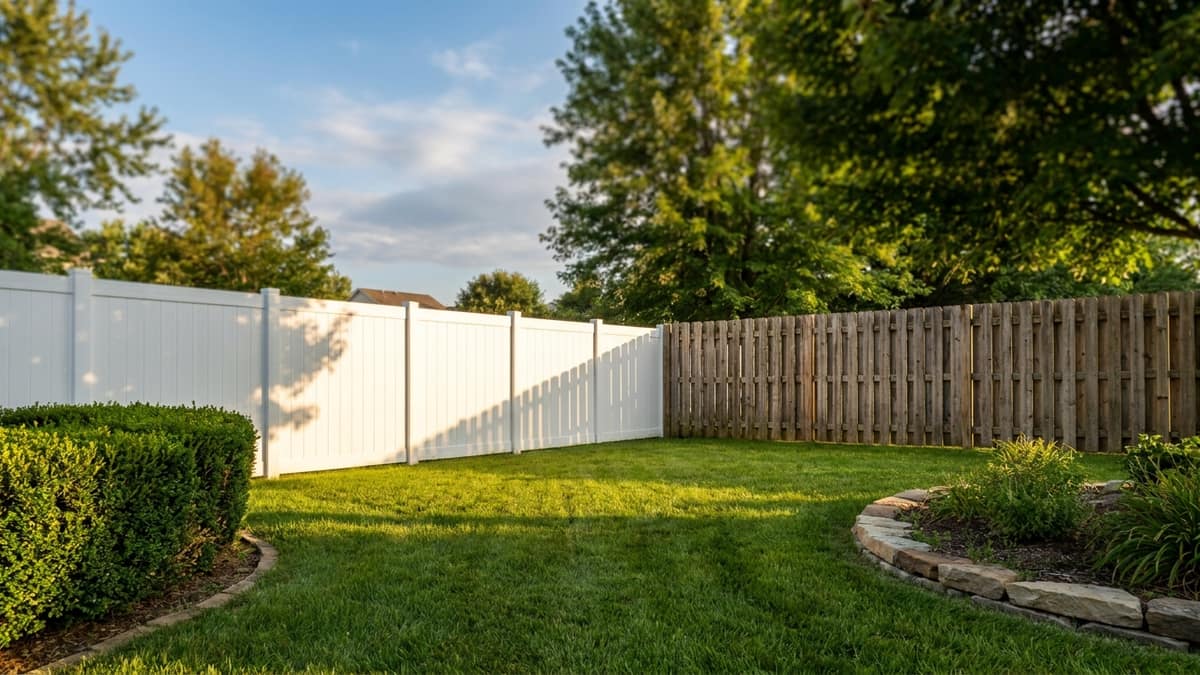
Two fence companies in the same county can run the same monthly budget and end the season in completely different places. One books 60 wood privacy jobs at $4,800 and runs crews flat out from April to July. The other books 24 vinyl and aluminum jobs at $9,500 and does more revenue with half the truck rolls, half the permit headaches, and a fraction of the price haggling.
Neither is wrong. But most fence contractors never choose. They run one "fence leads" campaign, take whatever the algorithm hands them, and then wonder why half the calls want a 40-foot chain link repair and the other half ghost after hearing a vinyl number.
The material is the offer. Here is what each one is worth, what each one can afford to pay for a lead, and which one actually fills the schedule faster.
Why do vinyl, wood, and aluminum fence leads behave like three different offers?
Same trade, same crews, three different purchase decisions.
The wood privacy buyer
A new dog. A new neighbor. A kid who keeps getting into the street. Wood is the default answer because it is the cheapest way to get six feet of privacy across a property line, and most homeowners already have a rough number in their head from a neighbor's job.
Ticket: $3,000 to $9,000. Decision window: one to two weeks. Close rate on a good exclusive lead: 28 to 35 percent. This buyer wants a quote fast and will book with whoever measures first and answers the phone.
The vinyl buyer
This homeowner is buying out of maintenance. They had a wood fence that grayed, warped, and started losing pickets, and they are done staining it. They are running lifetime-cost math, not sticker math, and they care about color, cap style, and how the panels look from the street.
Ticket: $4,000 to $10,000. Decision window: two to six weeks. Close rate on a well-worked exclusive lead: 22 to 30 percent. They will quote two or three companies and they will ask about warranty.
The ornamental aluminum buyer
Pool code, HOA requirement, or a front-yard look they saw and wanted. Aluminum and iron buyers are usually the least price-driven of the three and the most spec-driven. Pool enclosure jobs come with code requirements on gate hardware and picket spacing, which is a conversation that eliminates half your competition on the phone.
Ticket: $5,000 to $15,000 and up. Decision window: three to eight weeks, and often tied to a pool build or a landscape project with its own timeline. Close rate: 20 to 28 percent, but the ticket is two to three times the wood job.
Those three buyers do not respond to the same ad, do not close in the same window, and cannot be held to the same cost per lead. That is why our fence lead generation page builds them as separate campaigns with separate budgets rather than one generic "free fence estimate" offer.
What is each fence job actually worth in 2026?
Regional labor, terrain, gate count, and post depth move all of these, but the ranges are typical for a straightforward residential install.
| Material | Typical installed price per foot | Typical job total | Buyer type |
|---|---|---|---|
| MaterialChain link | Typical installed price per foot$15-$30 | Typical job total$1,500-$5,000 | Buyer typeUtility / budget |
| MaterialWood privacy (6 ft) | Typical installed price per foot$25-$45 | Typical job total$3,000-$9,000 | Buyer typeFast / privacy-driven |
| MaterialVinyl privacy | Typical installed price per foot$30-$60 | Typical job total$4,000-$10,000 | Buyer typeMaintenance-driven |
| MaterialOrnamental aluminum | Typical installed price per foot$40-$80 | Typical job total$5,000-$15,000+ | Buyer typeSpec / code / curb appeal |
| MaterialRepair, panels, gates | Typical installed price per footVaries | Typical job total$150-$3,000 | Buyer typeUrgent |
The gap between a wood job and an aluminum job looks enormous on the invoice. It shrinks once you convert it to crew time.
Revenue per crew day is closer than the ticket suggests
Take a 150-foot job on a clean, flat lot with one gate:
| Material | 150 ft job at midpoint | Crew days | Revenue per crew day |
|---|---|---|---|
| MaterialChain link | 150 ft job at midpoint$3,600 | Crew days1.0 | Revenue per crew day$3,600 |
| MaterialWood privacy | 150 ft job at midpoint$5,250 | Crew days1.5 | Revenue per crew day$3,500 |
| MaterialVinyl privacy | 150 ft job at midpoint$6,750 | Crew days2.0 | Revenue per crew day$3,375 |
| MaterialOrnamental aluminum | 150 ft job at midpoint$9,000 | Crew days2.5 | Revenue per crew day$3,600 |
That is the number most fence owners have never run. Per crew day, the four materials are within a few hundred dollars of each other. The premium materials cost more because the material costs more and the install is slower, not because you are magically making more per hour.
So the real argument for chasing vinyl and aluminum is not revenue per crew day. It is that a higher ticket lets you pay more for a lead, compete for a buyer most of your local competition is ignoring, and book fewer, larger jobs with less scheduling churn.
What is the maximum you can pay for a lead on each material?
Run this per campaign, not per company.
Max cost per lead = (average job value x gross margin x close rate) / 3
- Wood: $5,000 x 0.32 margin x 0.30 close = $480, divided by 3 = a $160 maximum cost per lead
- Vinyl: $8,000 x 0.30 x 0.25 = $600, divided by 3 = a $200 maximum cost per lead
- Aluminum: $11,000 x 0.32 x 0.22 = $774, divided by 3 = a $258 maximum cost per lead
- Repair and gates: $600 x 0.45 x 0.45 = $121, divided by 3 = a $40 maximum cost per lead
Now look at what a blended campaign does. If you set one ceiling at $160, you will never outbid anyone for the aluminum buyer. If you set it at $258, every repair lead you take in loses money. Averaging those two ceilings produces a number that is wrong for all four offers at once.
Which offer actually fills the schedule faster?
Speed to a booked install, not speed to a lead. Here is how the three stack up in a typical spring season.
| Material | Lead-to-quote | Quote-to-signed | Typical close rate | Fills schedule |
|---|---|---|---|---|
| MaterialWood privacy | Lead-to-quote1-3 days | Quote-to-signed3-10 days | Typical close rate28-35% | Fills scheduleFastest |
| MaterialVinyl privacy | Lead-to-quote2-5 days | Quote-to-signed2-4 weeks | Typical close rate22-30% | Fills scheduleMedium |
| MaterialOrnamental aluminum | Lead-to-quote3-7 days | Quote-to-signed3-8 weeks | Typical close rate20-28% | Fills scheduleSlowest |
Wood wins on speed. If your crews are idle in March and you need work on the board inside 30 days, the wood offer is the one that does it. Nothing else in fencing turns a lead into a scheduled install that fast.
Vinyl and aluminum win on the back half of the season. A vinyl lead generated in March often signs in April and installs in May. If you only start those campaigns when you notice a hole in the schedule, you have already missed the window.
The practical answer for most fence companies: run wood as the volume offer that keeps crews busy, and run vinyl or aluminum as the margin offer that builds a backlog six to ten weeks out. Our guide to seasonal contractor marketing covers how far ahead each of those has to start in a cold-weather market.
If you want the same math run against your own ticket mix, close rate, and crew capacity, get started here and we will build it out with your numbers before anything goes live.
Why is cost per lead the wrong number to compare fence leads on?
Because the invoice price ignores how many other companies got the same homeowner's phone number. Cost per acquired job is what pays crews.
| Channel | Cost per lead | Typical close rate | Cost per acquired job |
|---|---|---|---|
| ChannelReferrals and past customers | Cost per lead$0 | Typical close rate40-60% | Cost per acquired jobNear $0 |
| ChannelGoogle Business Profile / organic | Cost per lead$0-$50 | Typical close rate20-40% | Cost per acquired job$100-$250 |
| ChannelShared marketplace leads | Cost per lead$20-$70 | Typical close rate5-10% | Cost per acquired job$350-$1,200 |
| ChannelLocal Services Ads | Cost per lead$20-$60 | Typical close rate15-30% | Cost per acquired job$120-$400 |
| ChannelMeta advertising | Cost per lead$25-$110 | Typical close rate10-20% | Cost per acquired job$250-$1,000 |
| ChannelExclusive leads (performance partner) | Cost per lead$50-$200 | Typical close rate20-35% | Cost per acquired job$200-$900 |
| ChannelExclusive booked appointments | Cost per lead$200-$400 | Typical close rate25-40% | Cost per acquired job$600-$1,400 |
A $35 shared lead closing at 8 percent costs $437 per job, and you fought three companies for it on price. A $120 exclusive lead closing at 30 percent costs $400 per job, and the ticket is usually higher because nobody undercut you on the same property line. The long-form version of that math is in our breakdown of exclusive vs. shared leads.
There is a second cost fence contractors rarely track: the measure. A property walk with a footage count, a gate discussion, and a line-of-sight check on grade is 45 to 90 minutes plus drive time. At an 8 percent close rate you are doing twelve of those to sell one fence. Price that at your estimator's loaded hourly rate and the cheap lead stops being cheap.
How do you split campaigns by material without tripling your budget?
You do not need three full budgets on day one. You need a sequence.
- Start with two campaigns, not four. Wood and premium. Premium holds vinyl and aluminum together until each has enough volume to stand alone.
- Write the ad to the material, not the trade. A white vinyl privacy line photographed from the yard side sells a different homeowner than a stained cedar fence. Generic "fence installation" creative pulls generic leads.
- Put the price frame in the ad. "Vinyl privacy fencing from $35 a foot installed" filters out the homeowner shopping a $1,800 budget before they ever fill out a form. Fewer leads, better leads.
- Ask material preference on the form. One question, three options, plus "not sure." That single field routes the lead, sets the estimator's expectations, and lets you report close rate by material instead of guessing.
- Hold each campaign to its own ceiling. Wood at $160, vinyl at $200, aluminum at $258, repair at $40. Kill or rebuild anything that runs above its ceiling for 30 days, and scale anything that runs well under it.
Every one of those steps depends on the campaign running through your own ad account, so the pixel data, the audiences, and the material-level performance history stay with your company instead of a vendor's platform.
How many leads does each material need to hit a revenue target?
Work backward from revenue, not forward from budget.
Wood, $250,000 target. At a $5,000 average ticket that is 50 jobs. At a 30 percent close rate that is about 167 leads a year, roughly 17 a month. At $110 per exclusive lead that is around $1,870 a month in lead cost.
Vinyl, $250,000 target. At an $8,000 average ticket that is 31 jobs. At a 25 percent close rate that is about 124 leads a year, roughly 11 a month. At $130 per lead that is around $1,430 a month.
Aluminum, $250,000 target. At an $11,000 average ticket that is 23 jobs. At a 22 percent close rate that is about 105 leads a year, roughly 9 a month. At $150 per lead that is around $1,350 a month.
Same revenue. Nearly double the lead volume, measures, and truck rolls on the wood side. That is the trade you are making when you let the wood campaign carry the whole company.
What kills fence leads after they come in?
Three things, in this order.
Response time. Fence buyers call two or three companies in one sitting. A callback the next morning is a callback to someone who already has a measure scheduled. Five minutes is the standard, and the reasoning is in our piece on speed to lead.
Quoting over the phone without footage. A homeowner who gets a per-foot number with no measurement will use it to beat up whoever shows up. Book the measure, then quote.
Skipping the property line, HOA, and permit conversation. Survey questions, HOA color and height rules, and permit timelines are where fence jobs stall out for three weeks and die. Surface all three on the first call and the ones that survive are real.
The short version
Wood fills the schedule fastest and is the right offer when crews are idle. Vinyl and aluminum build the backlog and can afford a materially higher cost per lead, which is exactly why most of your competition is not bidding for them. Per crew day the three are closer than the ticket suggests, so the real leverage is running each one as its own campaign with its own ceiling and its own creative.
If your current campaign reports one blended cost per lead across every material you install, you cannot tell which offer is carrying the season and which one is quietly losing money. Book a call and we will map material-level campaigns and cost-per-acquired-job targets against your own ticket mix.
Frequently asked questions
Which fence material generates leads and books jobs the fastest?
Wood privacy fencing books fastest. It is the lowest entry price of the three, the homeowner usually decides within one to two weeks, and close rates on exclusive wood leads typically run 28 to 35 percent. Vinyl and aluminum take longer because the homeowner is comparing lifetime cost, color, and style, but they bring a larger ticket when they sign.
Should fence contractors run separate campaigns for vinyl, wood, and aluminum?
Yes, once you are spending enough to give each one real data. The three materials have different tickets, different close windows, and maximum costs per lead that can differ by more than 50 percent, so one blended campaign forces you to judge an $11,000 aluminum job by the economics of a $4,500 wood fence. Start with two campaigns, wood and premium, then split premium into vinyl and aluminum as volume allows.
What do fence leads cost in 2026?
Shared marketplace fence leads typically run $20 to $70 each but close at 5 to 10 percent on new installs because three to five companies get the same homeowner. Exclusive fence leads generally run $50 to $200 and close at 20 to 35 percent. Local Services Ads for repair and gate work usually land between $20 and $60 per lead with high intent and limited volume.
How many fence leads do I need to add $250,000 in revenue?
It depends on your material mix. At a $5,000 average wood ticket and a 30 percent close rate you need about 50 jobs, roughly 167 leads a year or 17 a month, which is about $1,870 a month in lead cost at $110 per lead. At an $8,000 vinyl average and a 25 percent close rate the same revenue takes about 31 jobs and 11 leads a month.
Is Meta or Google better for vinyl and aluminum fence leads?
Meta, for the planning-phase buyer. Homeowners choosing between vinyl and aluminum are usually months from searching, and Meta reaches them while they are still looking at finished fence photography at roughly $25 to $110 per lead. Google and Local Services Ads capture the homeowner who already knows what they want, which skews toward repair, gate work, and fast wood installs.
Frequently asked questions
Which fence material generates leads and books jobs the fastest?
Wood privacy fencing books fastest. It is the lowest entry price of the three, the homeowner usually decides within one to two weeks, and close rates on exclusive wood leads typically run 28 to 35 percent. Vinyl and aluminum take longer because the homeowner is comparing lifetime cost, color, and style, but they bring a larger ticket when they sign.
Should fence contractors run separate campaigns for vinyl, wood, and aluminum?
Yes, once you are spending enough to give each one real data. The three materials have different tickets, different close windows, and maximum costs per lead that can differ by more than 50 percent, so one blended campaign forces you to judge an $11,000 aluminum job by the economics of a $4,500 wood fence. Start with two campaigns, wood and premium, then split premium into vinyl and aluminum as volume allows.
What do fence leads cost in 2026?
Shared marketplace fence leads typically run $20 to $70 each but close at 5 to 10 percent on new installs because three to five companies get the same homeowner. Exclusive fence leads generally run $50 to $200 and close at 20 to 35 percent. Local Services Ads for repair and gate work usually land between $20 and $60 per lead with high intent and limited volume.
How many fence leads do I need to add $250,000 in revenue?
It depends on your material mix. At a $5,000 average wood ticket and a 30 percent close rate you need about 50 jobs, roughly 167 leads a year or 17 a month, which is about $1,870 a month in lead cost at $110 per lead. At an $8,000 vinyl average and a 25 percent close rate the same revenue takes about 31 jobs and 11 leads a month.
Is Meta or Google better for vinyl and aluminum fence leads?
Meta, for the planning-phase buyer. Homeowners choosing between vinyl and aluminum are usually months from searching, and Meta reaches them while they are still looking at finished fence photography at roughly $25 to $110 per lead. Google and Local Services Ads capture the homeowner who already knows what they want, which skews toward repair, gate work, and fast wood installs.