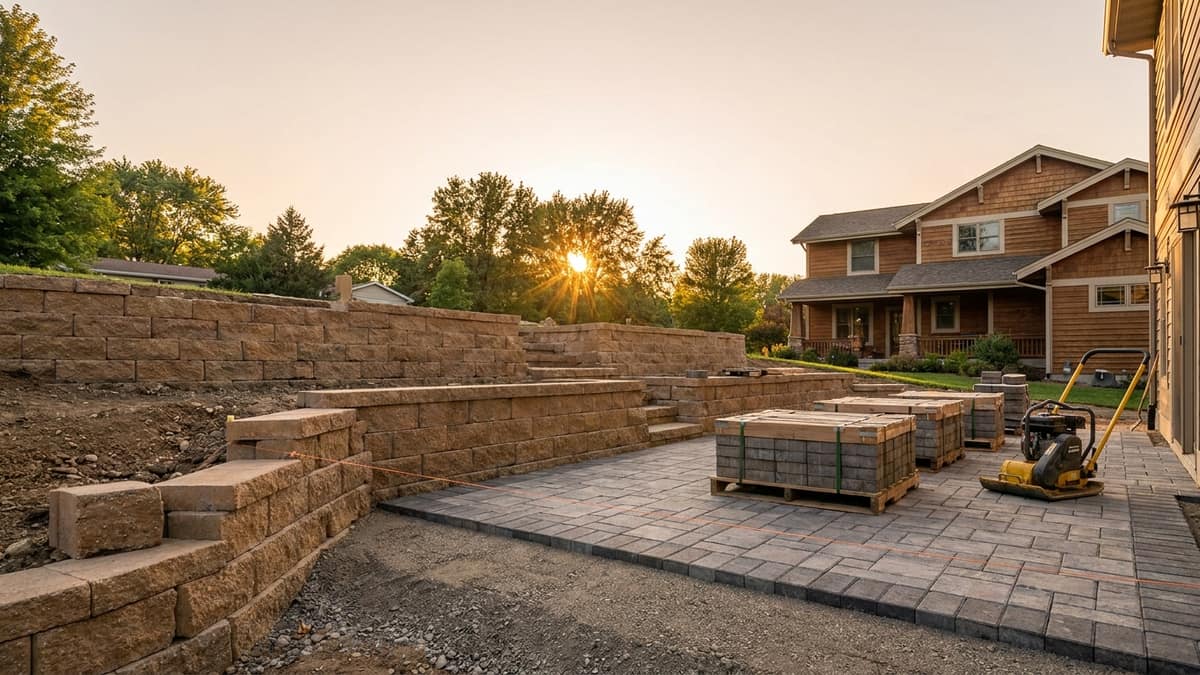
A hardscape crew can spend a week rebuilding a $4,000 failed wall or a week setting base for a $28,000 backyard. Same truck, same guys, same plate compactor, same fuel, roughly the same labor hours. The only thing that changed is which homeowner called.
Most landscape and hardscape companies do not decide which one they get. They run one generic campaign, take whatever comes in, and end the season with a schedule full of small repairs and two or three real projects that happened by luck. Then they blame the leads.
The leads behaved exactly the way the campaign told them to behave. Here is the ticket math, the cost per acquired job, and the campaign structure that puts $25,000 backyards on the board instead of $3,500 patch jobs.
Why do retaining wall and hardscape leads split into two different businesses?
Because two completely different purchases share the same trade name.
The failing-wall and drainage buyer
This homeowner has a block wall leaning into the yard, a timber wall that finally rotted through, a paver patio that settled into a birdbath, or water running through the garage every time it rains hard. Something is broken. They search, they call two or three companies, and they book whoever can come look at it soonest.
Ticket: $1,500 to $8,000 for most repair and rebuild work. Sales cycle: days to a couple of weeks. Close rate on a good exclusive lead: 25 to 35 percent, because the decision is forced and the scope is narrow.
This is a response game. It only works when someone answers the phone, an estimator can get out fast, and the quote goes out the same week.
The backyard project buyer
This homeowner is not fixing anything. They have a sloped, unusable yard, a slab patio they hate, or a blank space behind a house they bought eighteen months ago. They are looking at finished backyards, saving photos, and imagining a tiered wall with steps down to a paver patio, a seat wall, and lighting.
Ticket: $12,000 to $40,000 and up, higher when an outdoor kitchen, pergola, or pool surround is in scope. Sales cycle: weeks of design and revision, then a signed contract and a deposit. Close rate on a well-worked exclusive lead: 20 to 30 percent, but each closed job is worth five to ten repairs.
This buyer is almost never typing "retaining wall contractor near me" when your campaign first reaches them. They are in the planning phase, and planning-phase homeowners are reached, not captured. That is why the campaigns behind our landscaping lead generation work are built as two separate programs with separate budgets, separate creative, and separate cost-per-lead ceilings.
What is a hardscape job actually worth in 2026?
You cannot set a lead-cost ceiling until you know your real ticket mix. Regional labor, access, block type, and engineering requirements move these numbers, but the ranges are typical.
| Scope of work | Typical installed price | Buyer type |
|---|---|---|
| Scope of workPaver walkway or small landing | Typical installed price$1,500-$4,500 | Buyer typePlanned, low ticket |
| Scope of workRepair or reset of a settled patio section | Typical installed price$1,500-$5,000 | Buyer typeForced / urgent |
| Scope of workRebuild of a failed timber or block wall | Typical installed price$3,000-$12,000 | Buyer typeForced / urgent |
| Scope of workSegmental block retaining wall (under 4 ft) | Typical installed price$30-$60 per face sq ft | Buyer typeMixed |
| Scope of workEngineered wall with geogrid and drainage | Typical installed price$12,000-$35,000 | Buyer typePlanned |
| Scope of workPaver patio, 400-700 sq ft | Typical installed price$8,000-$20,000 | Buyer typePlanned |
| Scope of workFull backyard build (wall, patio, steps, lighting) | Typical installed price$25,000-$60,000 | Buyer typePlanned |
| Scope of workOutdoor kitchen or fireplace add-on | Typical installed price$8,000-$25,000 | Buyer typePlanned upsell |
The pattern matters more than any single line. Moving one homeowner from a $4,000 wall rebuild to a $28,000 tiered backyard is worth more than winning six extra repairs, and it costs you one mobilization instead of six.
The formula that sets your lead ceiling
Run this per campaign, not per company.
Max cost per lead = (average job value x gross margin x close rate) / 3
Repair campaign: $4,000 x 0.40 margin x 0.30 close = $480, divided by 3 = a $160 maximum cost per lead.
Backyard build campaign: $25,000 x 0.35 margin x 0.25 close = $2,187, divided by 3 = a $729 maximum cost per lead.
Those two numbers are not in the same universe. If you hold one blended campaign to $160, you will never outbid anyone for the backyard buyer. If you hold it to $729, you will lose money on every repair you book. That gap is the entire argument for splitting the campaigns, and it is the same math laid out in our cost per lead guide.
Why is cost per lead the wrong number for hardscape contractors?
Because the invoice price of a lead says nothing about how many other companies got handed the same homeowner. Cost per acquired job is what pays a crew.
| Channel | Cost per lead | Typical close rate | Cost per acquired job |
|---|---|---|---|
| ChannelReferrals and past customers | Cost per lead$0 | Typical close rate40-60% | Cost per acquired jobNear $0 |
| ChannelGoogle Business Profile / organic | Cost per lead$0-50 | Typical close rate20-40% | Cost per acquired job$100-250 |
| ChannelShared marketplace leads | Cost per lead$25-75 | Typical close rate5-12% | Cost per acquired job$300-1,200 |
| ChannelLocal Services Ads | Cost per lead$20-65 | Typical close rate15-30% | Cost per acquired job$130-430 |
| ChannelMeta advertising | Cost per lead$25-110 | Typical close rate10-20% | Cost per acquired job$250-1,100 |
| ChannelExclusive leads (performance partner) | Cost per lead$50-200 | Typical close rate20-35% | Cost per acquired job$200-900 |
| ChannelExclusive booked consultations | Cost per lead$200-400 | Typical close rate25-40% | Cost per acquired job$600-1,400 |
A $40 shared lead closing at 8 percent costs $500 per job. A $120 exclusive lead closing at 28 percent costs $429 per job, and the ticket is usually larger because you are not one of four companies racing each other to the bottom on the same backyard. The full breakdown of why that happens is in our post on exclusive vs. shared leads.
There is a second cost that hardscape companies almost never track: design time. A real backyard proposal means a site visit, grade and elevation notes, a material selection conversation, and a rendering or plan set. That is three to six hours before anyone signs anything. At an 8 percent close rate you are burning 40 hours of design and estimating labor to sell one job. Price that at your designer's loaded cost and shared leads stop looking cheap.
If you want to run your own numbers before you change anything, put your current spend, lead count, and close rate into the lead ROI calculator and look at what a closed job actually costs you today.
How do you reach backyard project buyers before they start searching?
The $25,000 build rarely starts with a search. It starts with a homeowner staring at a useless slope and deciding this is the year. Your job is to be in front of them during that window.
Photography is the product
Hardscape is the most visual trade in home improvement, and homeowners buy the picture before they buy the contractor. Your ads need real finished work from your own crews: a tiered wall with clean caps, a patio with tight joints and a defined border course, steps with lighting, an evening shot with the fire feature lit. Stock photos and rendering-only ads get scrolled past by people who have already saved forty real backyards this month.
Before-and-after pairs do double duty. The ugly slope in the first frame is what the homeowner sees out their own window, and that is what stops the scroll.
What the ad should ask for
Ask for a design consultation, not a quote. "Free backyard design consultation" converts better than "free estimate" because it matches where the homeowner actually is. They do not know what they want built yet, so they cannot ask you to price it.
Qualify inside the form or on the follow-up call: property ownership, rough project size, whether there is a slope or drainage issue, and a real timeline. Understand that the consultation is a sales appointment. You are going out there to design and to sell, and the homeowner should expect a designer with a price at the end of the process.
The consultation-to-contract path
The two-step sale is normal at this ticket. Visit one is measurement, discovery, and material selection. Visit two, or a scheduled video call, is the plan and the number. Companies that try to compress that into one visit and a napkin number lose to the company that showed a plan.
When should hardscape campaigns start?
Hardscape is the most seasonal trade a landscape company runs, and the contractors who fill the spring board are the ones who spent the winter selling.
- Late fall. Run retargeting and follow-up on every unclosed lead from the season. "Book now for spring, lock this year's pricing" is the offer.
- December through February. This is the buying window for spring builds. Homeowners are inside, looking at the yard through a window, planning. Lead costs are usually at their lowest and competition for the feed is thinnest.
- March through May. Peak demand and peak competition. You should be selling backlog here, not scrambling for leads.
- June through August. Shift budget toward repair, drainage, and smaller add-ons that fill gaps between big builds.
- September through October. Second selling window for fall installs and for next-spring deposits. Fall-planted projects hold schedule better than anyone expects.
Start 8 to 12 weeks ahead of your local build season. Design revisions, HOA approval, permits for anything over four feet or near a property line, and block ordering all eat calendar before a crew moves. The full year-round view is in our seasonal contractor marketing guide.
How many hardscape leads do you need to add $500,000?
Work backward from revenue, never forward from budget.
- Revenue goal: $500,000 in added hardscape work
- Average project: $25,000
- Jobs required: 20
- Close rate on exclusive leads: 25 percent
- Leads required: 80 per year, roughly 7 per month
- Ad spend at a $90 blended cost per lead: about $630 per month paid directly to Meta out of your own ad account
- Per-lead fees on top of that, in the $50 to $200 range depending on trade and volume
Seven leads a month is not a firehose. It is one good consultation a week and one signed backyard every six weeks. That is what a $500,000 add-on looks like at real ticket sizes, and it is why high-ticket hardscape is far more forgiving of lead cost than most contractors assume.
Run the same math at a $6,000 average ticket and the picture flips: 84 jobs, 336 leads, 28 leads a month, and 84 separate mobilizations. Same revenue, four times the operational drag.
What kills hardscape leads after they come in?
Three things, in order.
Response time. A homeowner who filled out a design consultation form on Tuesday night has messaged two other companies by Thursday. Calling within five minutes puts you 21 times more likely to qualify that lead than calling at thirty. That is the whole ballgame during peak season, and it is covered in detail in our post on speed to lead.
Quote lag. The industry standard for a full backyard proposal is somewhere between "next week" and "eventually." Every day between the site visit and the plan is a day a competitor's plan lands first. Set an internal standard of five business days for a complete hardscape proposal and hold to it.
No follow-up on the not-yets. A homeowner planning a $30,000 backyard in February may not sign until April, and a chunk of them will not sign until the following season. If your CRM drops them after two calls, you paid for a lead and gave it away. Long-cycle, high-ticket trades need a nurture sequence measured in months, not days.
The short version
Retaining wall and hardscape lead generation is two programs, not one. Repair and drainage work is won on response speed through local search, at a low cost-per-lead ceiling. Backyard builds worth $12,000 to $40,000 are won months earlier through Meta advertising built on real finished-project photography, at a ceiling several times higher.
Split the campaigns. Set a separate max CPL for each using the formula. Judge both on cost per acquired job. Start selling spring in January.
If you want that built and managed inside your own ad account, with every lead exclusive to your company, get started here and we will run the numbers for your market and your average ticket on the call.
Frequently asked questions
What do hardscape leads cost in 2026?
Shared marketplace hardscape leads typically run $25 to $75 each but close at 5 to 12 percent because three to five companies get the same homeowner. Exclusive hardscape leads generally run $50 to $200 and close at 20 to 35 percent. Local Services Ads for repair and small wall work usually land between $20 and $65 per lead with high intent but limited volume.
Should I run separate campaigns for retaining wall repair and full backyard builds?
Yes. A $3,500 wall repair and a $25,000 backyard build have different tickets, different sales cycles, and different maximum costs per lead. Blending them into one campaign forces you to judge a $25,000 project by the economics of a repair call, and you will underbid yourself out of the work that actually funds a season.
How many hardscape leads do I need to add $500,000 in revenue?
At a $25,000 average project and a 25 percent close rate you need 20 jobs, which is about 80 exclusive leads a year or roughly 7 a month. At a $6,000 average ticket and the same close rate you need 84 jobs, about 336 leads a year or 28 a month. Same revenue, four times the lead volume and four times the crew mobilizations.
When should hardscape campaigns start for the spring season?
Start 8 to 12 weeks before your local pour and build season opens, which in most markets means late winter. Backyard projects take weeks of design, HOA or permit review, and material ordering before a crew moves, so the homeowners who sign in April were reached in January and February.
Should I charge a design fee for hardscape consultations?
A design or plan fee in the $250 to $750 range, credited back toward the build, is common on larger hardscape projects and filters out browsers. Keep it out of the ad. Introduce it on the qualifying call after you have confirmed scope, timeline, and budget, otherwise you suppress lead volume before you ever get a chance to sell the value.