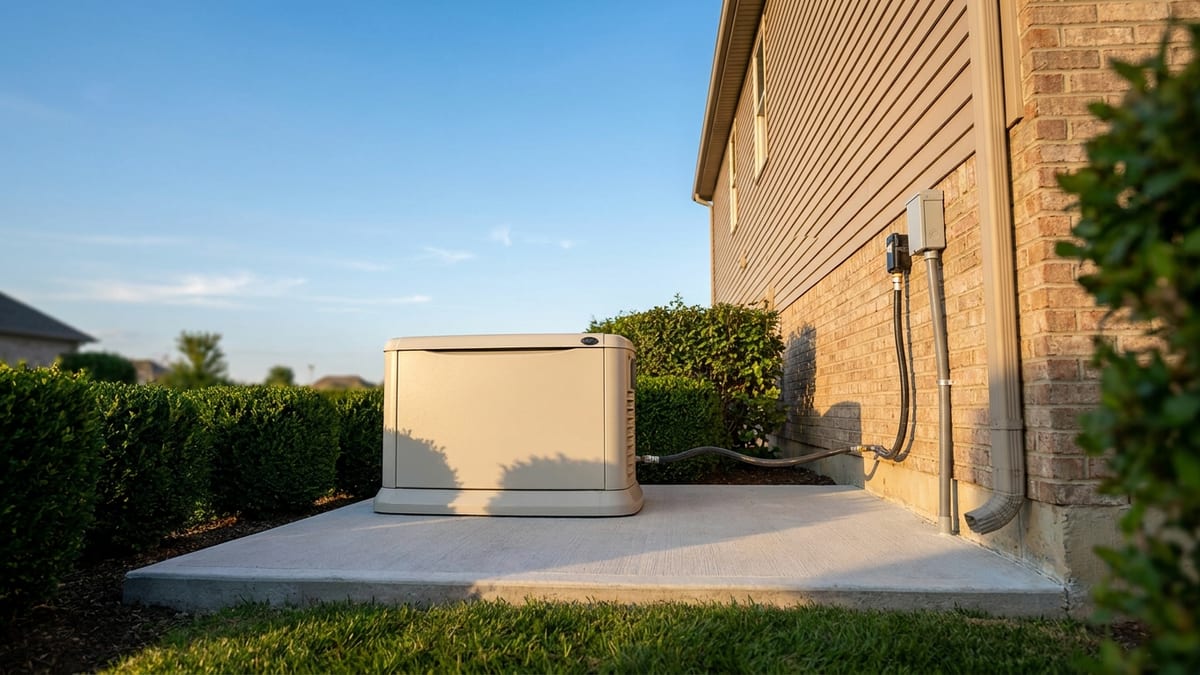
A whole-home standby generator is one of the biggest single tickets in residential electrical. A 22kW air-cooled unit with a transfer switch, pad, gas run, and permit lands somewhere between $12,000 and $18,000 installed in most markets. A liquid-cooled system for a larger home can run past $25,000. One crew, two to three days, plus a maintenance agreement that bills every year afterward.
Now compare that to what most electricians will pay to get one of those homeowners on the calendar. Thirty-five dollars for a shared marketplace lead that four other companies also bought. That mismatch is the whole problem. The ticket supports a lead budget five to ten times bigger than the one most generator installers are actually running, and the companies that figure that out stop competing for scraps after every storm.
Here is the buyer split, the ticket math, and the number you should be willing to pay per lead.
Why do standby generator leads behave differently from other electrical work?
Because there is no emergency version of this job. A homeowner with a dead panel needs somebody today. A homeowner who wants backup power needs somebody eventually, and eventually is a moving target that depends on weather, money, and a spouse.
The outage-triggered buyer
The power has been out for eighteen hours. The freezer is thawing. The sump pump is off and the basement is taking water. This homeowner opens their phone and searches. They call three companies, ask what it costs, and half of them are gone by the time the lights come back on.
This buyer is real and worth chasing, but the volume is spiky and the competition is instant. Every generator installer in the county is bidding the same keywords the same week. Close rates hold up if you answer, but you cannot build a production schedule on a channel that goes dark for eleven months.
The planned resilience buyer
This is the larger and better market. A homeowner who sat through the last outage, decided never again, and is now slowly working toward a decision. They are also the homeowner who just installed a home office, added a well pump, has a family member on medical equipment, bought a house with a propane tank already in the yard, or is watching neighbors put in units and wondering what that costs.
They are not searching. Not yet. They will search eventually, and when they do the ad auction will be crowded and expensive. The contractor who reached them first — with a photo of a finished install and a straight answer on price — is usually the one who ends up quoting. That is why our electrical lead generation service builds generator campaigns as a planning-phase play, not a storm-chase.
What is a standby generator job actually worth in 2026?
You cannot set a lead ceiling until you know your real ticket mix. Fuel type, panel condition, gas run distance, and permit costs move these, but the ranges are typical.
| Scope of work | Typical installed price | Buyer type |
|---|---|---|
| Scope of workTransfer switch and inlet for a portable unit | Typical installed price$1,500-$3,500 | Buyer typeBudget / partial backup |
| Scope of workSmall air-cooled unit (10-14kW), essential circuits | Typical installed price$7,000-$11,000 | Buyer typePlanned |
| Scope of workStandard whole-home air-cooled (18-24kW) | Typical installed price$12,000-$18,000 | Buyer typePlanned / post-outage |
| Scope of workAir-cooled install with panel upgrade included | Typical installed price$15,000-$22,000 | Buyer typePlanned |
| Scope of workLiquid-cooled system (30kW+), large home | Typical installed price$20,000-$30,000 | Buyer typePlanned / high-end |
| Scope of workAnnual maintenance agreement | Typical installed price$200-$500 per year | Buyer typeRecurring |
The recurring line matters more than it looks. Every generator you install is a service customer for the next decade, and every service visit is a chance to be the company they call for the panel, the EV charger, and the kitchen circuit. When you price a lead, you are not just pricing the install. You are pricing a customer relationship with a ten to fifteen year tail.
The formula that sets your ceiling
Run this on your own numbers, per campaign, not per company.
Max cost per lead = (average job value x gross margin x close rate) / 3
Whole-home air-cooled campaign: $14,000 x 0.35 margin x 0.25 close = $1,225, divided by 3 = a $408 maximum cost per lead.
Transfer-switch-only campaign: $2,500 x 0.45 margin x 0.35 close = $394, divided by 3 = a $131 maximum cost per lead.
Those are two different businesses. If you blend them into one campaign and hold the whole thing to a $130 ceiling, you will never outbid anybody for the whole-home buyer. Split the campaigns, split the budgets, and let the high-ticket campaign pay what it can afford to pay.
Most electricians never run this math and instead judge lead cost against a gut feeling formed when they were selling $400 service calls. That is how a company with a $14,000 average ticket ends up refusing to pay $150 for an exclusive lead.
Why is cost per lead the wrong number to judge generator leads on?
Because the invoice price says nothing about how many other companies got the same homeowner's phone number. Cost per acquired job is what your P&L reacts to.
| Channel | Cost per lead | Typical close rate | Cost per acquired job |
|---|---|---|---|
| ChannelReferrals and past service customers | Cost per lead$0 | Typical close rate40-60% | Cost per acquired jobNear $0 |
| ChannelGoogle Business Profile / organic | Cost per lead$0-50 | Typical close rate20-40% | Cost per acquired job$125-250 |
| ChannelShared marketplace leads | Cost per lead$30-80 | Typical close rate5-12% | Cost per acquired job$400-1,500 |
| ChannelGoogle Local Services Ads | Cost per lead$35-110 | Typical close rate15-30% | Cost per acquired job$200-650 |
| ChannelGoogle Search ads (post-storm) | Cost per lead$100-400 | Typical close rate15-30% | Cost per acquired job$500-2,000 |
| ChannelMeta advertising | Cost per lead$25-110 | Typical close rate10-20% | Cost per acquired job$250-1,100 |
| ChannelExclusive leads (performance partner) | Cost per lead$50-200 | Typical close rate20-38% | Cost per acquired job$200-900 |
| ChannelExclusive booked appointments | Cost per lead$200-400 | Typical close rate25-40% | Cost per acquired job$600-1,400 |
Work one line against another. A $40 shared lead closing at 8 percent costs $500 per acquired job. A $150 exclusive lead closing at 30 percent costs $500 per acquired job too — identical CPA, except the exclusive version got you there on a third of the leads, which means a third of the site visits, a third of the quotes, and a third of the fuel. And the exclusive homeowner is not comparing you against four rushed bids, so the ticket usually holds. The full breakdown of that arithmetic lives in exclusive vs. shared leads.
There is a second cost almost nobody tracks on generator work: the site survey. A real generator quote means checking the panel, measuring the gas run, confirming meter capacity, checking setback distance from windows and property lines, and pricing the pad. That is 60 to 90 minutes plus travel. At an 8 percent close rate you are running twelve of those to sell one job. Price that at your estimator's loaded hourly cost and cheap leads stop being cheap.
Want to see the math on your own numbers?
Plug your average generator ticket, close rate, and current lead cost into the ROI calculator, or get started and we will build the campaign split against your real numbers.
How do you reach planning-phase generator buyers before the storm?
The planned buyer does not respond to a keyword. They respond to a picture of a finished install on a house that looks like theirs, plus a number.
- Lead with the finished unit, not the logo. A clean pad, tidy conduit, trimmed hedges. Homeowners are worried a generator will look industrial in the side yard. Show them it does not.
- Put a real price range in the ad. "Whole-home standby from $12,000 installed" filters out the homeowner who thought it was $3,000 and pulls forward the one who was afraid to ask. Vague ads generate vague leads.
- Name the trigger, not the product. "Third outage this year?" outperforms "Generac dealer." The homeowner identifies with the problem long before they identify with the brand.
- Sell the survey, not the quote. The offer is a free on-site assessment of fuel, panel, and placement. That is a sales appointment, and it should be framed as one — the homeowner is meeting someone who will price the job and ask for the order.
- Ask two qualifying questions on the form. Fuel available at the property, and whether they want whole-home or essential circuits. Those two answers alone let your team sort a $16,000 opportunity from a $2,500 one before anyone gets in a truck.
- Run it through your own ad account. The pixel data, the audiences, and the retargeting list stay yours, which means every dollar you spend this year makes next year's campaigns cheaper.
That last point is not a small one. Storm-season Google auctions get expensive precisely because everyone shows up at once. A retargeting audience you built in April costs a fraction of a September click.
What does the seasonal calendar look like for generator leads?
Generator demand is weather-shaped, but the calendar is more predictable than most electricians treat it.
| Period | What is happening | Where the budget goes |
|---|---|---|
| PeriodWinter / early spring | What is happeningIce storm memory is fresh, schedules are open | Where the budget goesHeavy planning-phase Meta spend, lowest costs of the year |
| PeriodLate spring | What is happeningPre-hurricane and pre-derecho awareness building | Where the budget goesScale Meta, warm up search budgets |
| PeriodPeak storm season | What is happeningOutage spikes, crowded auctions, panic calls | Where the budget goesFull search and Local Services Ads plus retargeting to spring audiences |
| PeriodPost-season / fall | What is happeningHomeowners who suffered through an outage now act | Where the budget goesHighest-intent window of the year, keep everything on |
The contractor who only turns campaigns on during a storm pays peak prices for a homeowner who was reachable at a discount six months earlier. And because permits, gas fitting, pad work, and equipment lead times push installs weeks or months out anyway, the urgent caller is usually not an urgent install. You are competing hardest for the buyer with the least advantage.
Build the calendar into your annual number instead of reacting to it. Our guide to setting a contractor marketing budget walks through the target-revenue math for exactly this kind of seasonal channel.
How many generator leads do you need to hit a revenue target?
Work backward from revenue, not forward from budget.
Say the goal is $500,000 in added generator revenue.
- Average installed ticket: $14,000
- Jobs required: 36
- Close rate on exclusive leads: 25 percent
- Leads required: 144 per year, about 12 per month
At an ad-spend cost per lead of $60 to $90 paid directly to Meta out of your own account, that is roughly $720 to $1,080 a month in media, plus per-lead fees on the leads that qualify. Against $500,000 in revenue and a 35 percent gross margin, that is well under the target of keeping acquisition cost below 10 percent of job value.
Now run the same target on shared leads at a 10 percent close rate: 360 leads a year, 30 a month, and roughly 324 dead conversations to produce the same 36 jobs. The media invoice may be smaller. The cost of your estimator's year is not.
What kills generator leads after they come in?
Three things, in this order.
Slow first contact
A homeowner who fills out a generator form at 8pm during an outage will talk to whoever calls first. The five-minute window is not a slogan, it is the difference between a conversation and a voicemail. If you cannot staff it, staff a booking path the homeowner can use themselves. The mechanics are in our breakdown of speed to lead.
Unmanaged approval gates
Generator sales stall on three things: fuel supply, placement, and the second decision maker. If your first call does not confirm natural gas availability or propane tank size, flag the setback and pad question, and ask whether both homeowners will be at the survey, you will produce a quote that sits in an inbox while the buyer collects more bids.
Quoting without a follow-up sequence
This is a five-figure discretionary purchase. Almost nobody signs on the first visit unless the outage is still fresh. A quote with no scheduled follow-up is a quote you paid for and then abandoned. Build a 30-day cadence, and revive the six-month-old quotes every time your area takes a hit — those are the warmest leads you own and they cost nothing.
The short version
A standby generator ticket supports a lead budget most electricians would never approve. Run the ceiling formula, split the whole-home campaign from the transfer-switch campaign, buy exclusivity instead of volume, and advertise in the quiet months so you are not bidding against every competitor in the county the week the lights go out.
If you want generator leads that go to your company only, running through your own ad account so the brand you build is yours, see how the electrical lead system works or get started and we will show you the live numbers on a call.
Frequently asked questions
What should an electrician pay per standby generator lead?
Run the ceiling formula on your own numbers. At a $14,000 average installed ticket, a 35 percent gross margin, and a 25 percent close rate, your maximum cost per lead is roughly $400. Most exclusive generator leads land between $75 and $200, which leaves real room, while shared marketplace leads at $30 to $80 often cost more per acquired job because five companies get the same homeowner.
How many generator leads do I need to add $500,000 in revenue?
At a $14,000 average installed ticket you need about 36 jobs. At a 25 percent close rate on exclusive leads that is roughly 143 leads a year, about 12 a month. At a 10 percent close rate on shared leads the same revenue takes 360 leads a year, about 30 a month, and three times the estimator windshield time.
Is Meta advertising or Google better for standby generator leads?
Both, for different buyers. Google and Local Services Ads capture the homeowner who already decided they want a generator and is searching, which spikes after an outage and disappears between them. Meta reaches the homeowner during the planning phase, before the search happens, which is where the steady month-to-month volume comes from.
Should generator campaigns run year-round or only during storm season?
Year-round, with budget weighted ahead of your local outage season. Post-storm search demand is real but short and crowded, and generator lead times for permits, gas, pad, and equipment mean the homeowner who calls during the outage often installs months later anyway. Contractors who advertise only during storms pay peak prices for the same buyer they could have reached cheaper in the off-season.
Why do generator leads go cold so often?
Because the sale has three approval gates most electricians never manage. Fuel supply and meter capacity, the concrete pad and setback rules, and the second decision maker in the household. If your first call does not surface all three, the quote sits, the homeowner starts collecting more bids, and the deal quietly dies in the follow-up gap.
Frequently asked questions
What should an electrician pay per standby generator lead?
Run the ceiling formula on your own numbers. At a $14,000 average installed ticket, a 35 percent gross margin, and a 25 percent close rate, your maximum cost per lead is roughly $400. Most exclusive generator leads land between $75 and $200, which leaves real room, while shared marketplace leads at $30 to $80 often cost more per acquired job because five companies get the same homeowner.
How many generator leads do I need to add $500,000 in revenue?
At a $14,000 average installed ticket you need about 36 jobs. At a 25 percent close rate on exclusive leads that is roughly 143 leads a year, about 12 a month. At a 10 percent close rate on shared leads the same revenue takes 360 leads a year, about 30 a month, and three times the estimator windshield time.
Is Meta advertising or Google better for standby generator leads?
Both, for different buyers. Google and Local Services Ads capture the homeowner who already decided they want a generator and is searching, which spikes after an outage and disappears between them. Meta reaches the homeowner during the planning phase, before the search happens, which is where the steady month-to-month volume comes from.
Should generator campaigns run year-round or only during storm season?
Year-round, with budget weighted ahead of your local outage season. Post-storm search demand is real but short and crowded, and generator lead times for permits, gas, pad, and equipment mean the homeowner who calls during the outage often installs months later anyway. Contractors who advertise only during storms pay peak prices for the same buyer they could have reached cheaper in the off-season.
Why do generator leads go cold so often?
Because the sale has three approval gates most electricians never manage. Fuel supply and meter capacity, the concrete pad and setback rules, and the second decision maker in the household. If your first call does not surface all three, the quote sits, the homeowner starts collecting more bids, and the deal quietly dies in the follow-up gap.