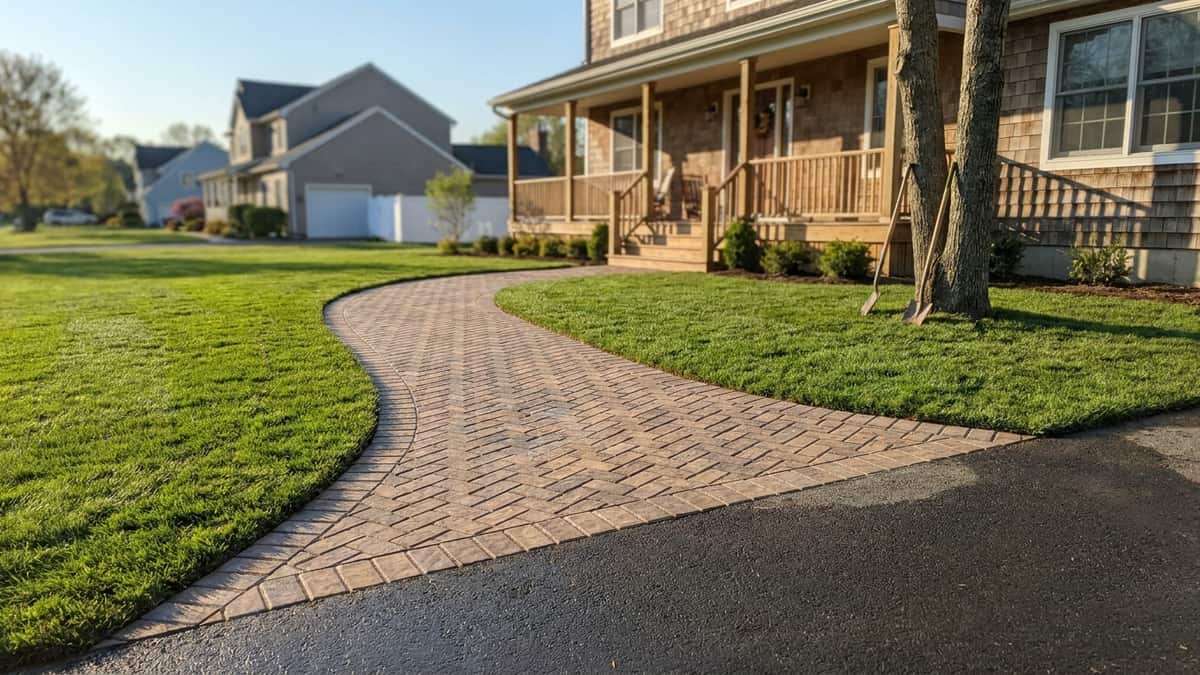
A landscaping company sells a planting and mulch refresh for $2,800 and books three crew days. The same company sells a paver driveway for $22,000 and books four crew days. Same trucks, same labor pool, same service area, same marketing budget. One of those jobs can absorb a $150 lead. The other one cannot absorb a $40 lead without hurting.
That gap is why most landscaping companies that start running paid campaigns never see real money from them. They advertise what they talk about most, which is lawns, beds, mulch and maintenance, and then judge the channel on tickets too small to carry a lead cost. Hardscape is where the margin lives, and paver driveways, walkways and patios are the highest-ticket hardscape most landscapers already have the crews to install.
Why do paver leads outperform planting leads for landscapers?
Three reasons, and none of them are about demand.
First, the ticket. A paver project is measured in thousands of square feet of hardscape at $18 to $35 installed, not in flats of perennials. The gross profit on one paver driveway usually exceeds the gross profit on an entire season of maintenance for one property.
Second, the decision. Planting is a want that gets rescheduled every time money gets tight. A cracked, heaving, oil-stained driveway or a settling front walkway is a visible defect the homeowner is embarrassed by, and embarrassment closes faster than aspiration.
Third, the attach rate. Nobody buys a paver driveway and leaves the beds alone. The hardscape sale pulls lighting, sod, grading, drainage and planting behind it. The reverse almost never happens. Sell the planting job and you sold the planting job.
If you are deciding how to split a landscaping marketing budget across offers, that order matters more than the creative does. Our landscaping lead generation page lays out how the campaigns get structured by offer rather than by trade.
What is a paver job actually worth in 2026?
Price varies by region, base depth, drainage requirements and whether a machine can reach the back yard. These are typical installed ranges, not quotes.
| Project type | Typical size | Typical installed ticket | Crew days | Decision speed |
|---|---|---|---|---|
| Project typeFront walkway | Typical size100 to 300 sq ft | Typical installed ticket$3,000 to $9,000 | Crew days1 to 2 | Decision speedFast |
| Project typePaver patio | Typical size300 to 700 sq ft | Typical installed ticket$8,000 to $25,000 | Crew days2 to 5 | Decision speedMedium |
| Project typePaver driveway | Typical size600 to 1,200 sq ft | Typical installed ticket$15,000 to $40,000 | Crew days3 to 6 | Decision speedMedium to slow |
| Project typeDriveway plus walkway and entry | Typical sizecombined | Typical installed ticket$25,000 to $55,000 | Crew days5 to 8 | Decision speedSlow |
| Project typePlanting and bed refresh | Typical sizen/a | Typical installed ticket$1,500 to $5,000 | Crew days1 to 3 | Decision speedFast |
The column that decides your marketing is the ticket column. A $2,500 average job at a 35 percent gross margin produces $875 of gross profit. A $20,000 job at the same margin produces $7,000. That is the entire argument for running hardscape as its own campaign with its own budget.
Where the add-ons sit
Steps, seating walls, a fire pit, landscape lighting and a drainage correction are not separate sales once a crew is already excavating. They are line items on an estimate the homeowner is already reading. A $14,000 patio with steps, lighting and a seating wall is routinely a $22,000 contract, and the lead cost did not change by a dollar.
Why is cost per lead the wrong number for paver work?
Because cost per lead ignores the two variables that decide whether a lead was profitable: how many of them close, and how big the jobs are.
Take three channels at three prices.
| Channel | Cost per lead | Realistic close rate | Cost per acquired job | Gross profit per job at $16,000 and 35% |
|---|---|---|---|---|
| ChannelShared marketplace lead | Cost per lead$45 | Realistic close rate5% | Cost per acquired job$900 | Gross profit per job at $16,000 and 35%$5,600 |
| ChannelSelf-run Meta campaign | Cost per lead$70 | Realistic close rate12% | Cost per acquired job$583 | Gross profit per job at $16,000 and 35%$5,600 |
| ChannelExclusive lead | Cost per lead$150 | Realistic close rate22% | Cost per acquired job$682 | Gross profit per job at $16,000 and 35%$5,600 |
| ChannelExclusive booked appointment | Cost per lead$325 | Realistic close rate32% | Cost per acquired job$1,016 | Gross profit per job at $16,000 and 35%$5,600 |
The $45 lead is the most expensive job in that table and the $70 and $150 leads are the cheapest. That is the normal result once close rate enters the math, and it is why the per-lead price is the least useful number in any pitch you will hear. The full breakdown of why shared leads cost more than they look like they cost is in our piece on exclusive versus shared leads.
One more note on shared leads specifically for hardscape. A homeowner planning a $20,000 driveway who gets called by four companies in ten minutes does not feel served. They feel sold, and they get cautious. That caution costs you margin on every estimate after it.
What is the most you can pay for a paver lead?
Run this before you look at a single vendor price.
- Pull your real average hardscape ticket from the last 12 months of signed contracts. Not your biggest job, the average.
- Pull your gross margin on that work after materials, labor, equipment, and disposal. Most hardscape crews land between 30 and 45 percent.
- Pull your lead-to-sale close rate. Count every lead that entered the top, not just the ones you quoted.
- Multiply: average ticket times gross margin times close rate. That is gross profit per lead, which is your break-even cost per lead.
- Divide by three. That is your working ceiling, leaving room for overhead and actual profit.
Example: $14,000 average ticket, 35 percent margin, 25 percent close rate. $14,000 x 0.35 = $4,900. $4,900 x 0.25 = $1,225 break-even per lead. Divided by three, a working ceiling near $408 per lead.
Now run the same math on planting. Example: $2,800 average ticket, 30 percent margin, 35 percent close rate. $2,800 x 0.30 = $840. $840 x 0.35 = $294 break-even. Divided by three, a ceiling near $98, and that is before a single truck roll to walk the property.
The two offers do not belong in one campaign. If you want to see what your own numbers do to cost per acquired job, the ROI calculator runs it in about two minutes.
How do you reach paver buyers before they start calling around?
Search catches the homeowner who already decided. By the time somebody types "paver driveway contractor near me," they are shopping, three companies are getting the same query, and you are one bid in a stack.
The paver buyer is reachable months earlier, and this is where Meta advertising does the work search cannot. Homeowners look at their cracked driveway and their mud-rutted side yard every single day without ever typing anything into a search bar. What moves them is seeing a finished project on a house that looks like theirs.
What the creative actually needs
- Real finished projects shot by your own crew. Herringbone and running bond laid clean, a soldier-course border, a crisp edge against fresh sod. Stock photos of resort patios do not convert homeowners in your zip codes.
- Before and after on the same frame. Cracked asphalt on the left, finished pavers on the right. This single format outperforms almost everything else in hardscape.
- A real starting price. "Paver walkways from $3,900 installed" filters out the homeowner who thought it was a weekend project, and it qualifies the one who did not.
- Project scale called out. Say driveway, say patio, say walkway. If the ad says "hardscaping," the form fills with people who want three pavers reset.
- A form that asks the project type and the approximate square footage. Those two fields decide which rep calls and how long you block for the measurement.
Why it should run in your own ad account
When the campaign runs under your company name, the pixel data, the audience lists and the retargeting pool stay with your business. The homeowner who watched 30 seconds of your driveway walkthrough video in March is the one you retarget in May. That compounding only happens if the account is yours.
If you want this built for your market, get started here and we will scope the hardscape campaign against your real ticket and close rate.
When should paver campaigns actually run?
Hardscape has a longer sales cycle than most landscapers plan for. A homeowner who sees an ad in February often signs in April and installs in June.
| Window | What to run | What you are selling |
|---|---|---|
| WindowJanuary to March | What to runHeaviest spend, planning-phase creative | What you are sellingA spring install date and a signed contract |
| WindowApril to June | What to runFull spend, before and after creative | What you are sellingCurrent-season installs |
| WindowJuly to August | What to runSteady spend, backyard patio focus | What you are sellingLate-season installs and fall bookings |
| WindowSeptember to November | What to runReduced spend, driveway and walkway focus | What you are sellingNext-spring contracts with deposits |
| WindowDecember | What to runRetargeting only | What you are sellingWarm list for the January push |
The mistake is turning the budget on in April with everyone else. The auction is most expensive exactly when every competitor wakes up. Buying attention in January and February costs less and puts you in front of the homeowner before the comparison shopping starts.
How many paver leads do you need to hit a revenue target?
Work backward from revenue, never forward from budget.
Example: you want to add $600,000 in hardscape revenue. Average signed ticket $16,000. That is 38 jobs. At a 22 percent close rate on exclusive leads, you need about 173 leads. Across a nine month selling season, that is roughly 19 to 20 leads a month.
At $150 per exclusive lead, 173 leads costs about $25,950 in lead fees. Add the ad spend that sits underneath it, paid directly to Meta out of your own account. Against $600,000 in revenue at a 35 percent gross margin, that is $210,000 of gross profit against a marketing cost in the low five figures plus spend.
Run your own version of that paragraph. If the numbers do not survive it, the problem is your close rate or your ticket, not the lead price.
What kills paver leads after they come in?
Most dead hardscape leads were killed in-house, not delivered broken.
- Slow first contact. Paver buyers contact two or three companies in one sitting. The first company to answer usually sets the scope and the budget everyone else gets compared against. The timing math is in our guide on speed to lead.
- Measurement visits booked a week out. Whoever measures first writes the spec. Get on site inside 72 hours.
- Estimates that take five days. The homeowner's excitement has a shelf life. Deliver a priced estimate with photos of comparable finished projects within 48 hours of the visit.
- No good and better options. Give a concrete paver option and a premium option on the same page. Homeowners who only get one number shop that number. Homeowners who get two choose between them.
- Quitting after three attempts. A homeowner who went quiet in March is often ready in June. A 90 day text and email sequence revives more hardscape jobs than any new campaign you could launch.
- No staged proposal for big driveways. A $38,000 full-front project becomes signable when it is phased into a driveway this year and the walkway and entry next spring.
The short version
Paver driveways, walkways and patios are the highest-ticket work most landscaping companies already have the crews and equipment to install. The ticket supports real paid lead generation and planting work does not, so the two cannot share a campaign or a cost-per-lead ceiling. Run your break-even math, set a hardscape ceiling in the hundreds, advertise finished projects to planning-phase homeowners months before they search, and judge every dollar on cost per acquired job.
If you want a paver campaign built against your real numbers and running in your own ad account, book a call and we will scope it.
Frequently asked questions
What does a paver patio or driveway job cost in 2026?
Installed paver work typically runs $18 to $35 per square foot depending on material, base depth, drainage and site access. That puts a front walkway around $3,000 to $9,000, a backyard patio around $8,000 to $25,000 and a full paver driveway around $15,000 to $40,000, with steps, lighting and seating walls pushing the top end higher.
What is the most a landscaper should pay for a paver lead?
Use average job value multiplied by gross margin multiplied by close rate, then divide by three. Example: a $14,000 average ticket at a 35 percent margin and a 25 percent close rate gives $1,225 of gross profit per lead, so a working ceiling of about $400 per lead. Exclusive leads commonly run $50 to $200, which sits well under that ceiling.
Should paver leads run in the same campaign as planting and maintenance?
No. A $2,500 planting job and a $20,000 paver driveway cannot share a cost-per-lead ceiling without one of them losing money. Run hardscape as its own campaign with its own creative and its own budget, then let the crew quote planting, lighting and sod at the same visit.
When should paver campaigns run during the year?
Start 8 to 12 weeks before your install season opens, which in most northern markets means January through March, and keep spending through early fall when homeowners book for the following spring. Late summer and fall leads often become signed contracts with a spring install date, which is how you protect the front of next season.
Why do paver leads go cold so fast?
Most paver buyers contact two or three companies in the same sitting, and the first contractor to measure the site usually sets the scope and the budget. Slow callbacks, measurement visits scheduled a week out and estimates that take five days to deliver lose jobs the lead never had a quality problem with.