Two homeowners on the same street fill out a form on the same Tuesday. One wants a pressure-treated deck off the back door, 240 square feet, nothing fancy. The other wants composite with aluminum railing, built-in lighting, and a covered section. Same lead form, same ad budget, same salesperson.
The first job is $13,000 and three crew days. The second is $32,000 and six crew days. One produces roughly double the gross profit per day on the calendar.
Most deck builders run one campaign, take whatever fills the form, and then wonder why the average ticket keeps sliding. The leads are behaving exactly the way the campaign told them to behave. If every ad says "free deck estimate," you get the buyer who is shopping estimates. Here is how the two buyers actually differ, what each ticket is worth, and the math for deciding which one your budget should chase.
Why do composite and pressure-treated deck leads behave like two different businesses?
They are two different purchases with two different triggers.
The value buyer
This homeowner has a rotting deck, a deck that failed an inspection during a refinance, or no deck at all and a back door that opens onto a three-foot drop. They want the problem solved at the lowest defensible price. They search "deck builders near me," call two or three companies, and book with whoever answers and can quote the fastest.
Ticket: $8,000 to $18,000. Sales cycle: one appointment, decision within two weeks. Close rate on a good exclusive lead: 25 to 35 percent. Competition: everybody, including the guy with a truck and a nail gun.
This is a volume game. It works when your cost per lead is low, your estimating process is tight, and someone answers on the first ring. Every hour you add to the quote turnaround costs you closes.
The outdoor living buyer
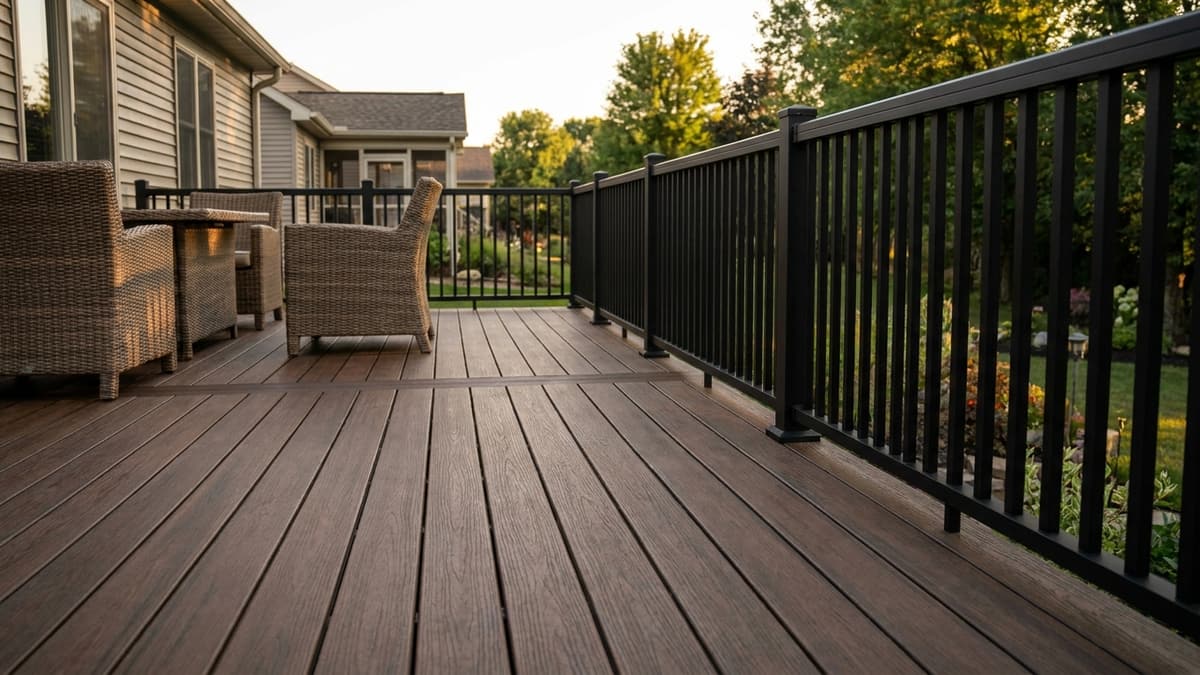
This homeowner is not solving a problem. They are building something. They have been saving photos for eight months, they want composite because they are done staining anything, and they are comparing decking brands before they have talked to a single contractor. The deck is often part of a larger backyard plan with a pergola, lighting, and sometimes an outdoor kitchen.
Ticket: $20,000 to $45,000, and $50,000-plus for multi-level builds with a covered section. Sales cycle: three weeks to four months from first contact to signed contract. Close rate on a well-worked exclusive lead: 20 to 30 percent, with revenue per closed job two to three times the pressure-treated build.
This buyer is almost never searching for a deck builder when a campaign first reaches them. That is why the channel that wins them looks nothing like the channel that wins a pressure-treated rebuild, and why our decking lead generation page builds them as separate campaigns with separate budgets and separate cost ceilings.
What is a deck actually worth in 2026?
You cannot set a lead-cost ceiling until you know your real ticket mix. Regional labor, deck height, railing selection, and permit requirements move these, but the ranges are typical.
| Scope of work | Typical installed price | Buyer type |
|---|---|---|
| Scope of workStaining, sealing, or power wash | Typical installed price$500-$1,500 | Buyer typeMaintenance |
| Scope of workBoard and railing repair | Typical installed price$1,000-$4,000 | Buyer typeForced / urgent |
| Scope of workResurface existing frame with composite | Typical installed price$8,000-$16,000 | Buyer typePlanned upgrade |
| Scope of workNew pressure-treated deck, 200-400 sq ft | Typical installed price$8,000-$18,000 | Buyer typeValue buyer |
| Scope of workNew composite deck, 300-500 sq ft | Typical installed price$20,000-$45,000 | Buyer typeOutdoor living buyer |
| Scope of workMulti-level composite with lighting and cover | Typical installed price$50,000+ | Buyer typeOutdoor living buyer |
The pattern matters more than any single line. Moving one homeowner from a $13,000 pressure-treated build to a $32,000 composite build is worth more than winning two extra pressure-treated jobs, and it costs you one job on the schedule instead of two.
The resurface line is the most underused item on that table. A homeowner with a structurally sound frame and ugly wood boards is a composite buyer who does not know it yet. That job carries composite margins on a fraction of the labor.
The formula that sets your lead ceiling
Run this per campaign, not per company.
Max cost per lead = (average job value x gross margin x close rate) / 3
Pressure-treated campaign: $13,000 x 0.30 margin x 0.30 close = $1,170, divided by 3 = a $390 maximum cost per lead.
Composite campaign: $30,000 x 0.32 margin x 0.25 close = $2,400, divided by 3 = an $800 maximum cost per lead.
Those are ceilings, not targets. Nobody should be paying $800 for a deck lead. The point is the gap: the composite campaign can absorb roughly double the acquisition cost of the pressure-treated campaign and still hit the same return. If you run one blended campaign and hold it to the lower number, you will consistently lose the auction for the buyer worth the most to you.
Why is cost per lead the wrong number for deck builders?
Because the invoice price ignores how many other builders got handed the same homeowner. Cost per acquired job is what pays a crew.
| Channel | Cost per lead | Typical close rate | Cost per acquired job |
|---|---|---|---|
| ChannelReferrals and past customers | Cost per lead$0 | Typical close rate40-60% | Cost per acquired jobNear $0 |
| ChannelGoogle Business Profile / organic | Cost per lead$0-50 | Typical close rate20-40% | Cost per acquired job$100-250 |
| ChannelShared marketplace leads | Cost per lead$25-75 | Typical close rate5-10% | Cost per acquired job$400-1,400 |
| ChannelLocal Services Ads | Cost per lead$25-80 | Typical close rate15-30% | Cost per acquired job$150-500 |
| ChannelMeta advertising | Cost per lead$25-110 | Typical close rate10-20% | Cost per acquired job$250-1,100 |
| ChannelExclusive leads (performance partner) | Cost per lead$50-200 | Typical close rate20-35% | Cost per acquired job$200-1,000 |
| ChannelExclusive booked appointments | Cost per lead$200-400 | Typical close rate25-40% | Cost per acquired job$600-1,400 |
A $40 shared lead closing at 7 percent costs $571 per job. A $140 exclusive lead closing at 28 percent costs $500 per job, and the ticket is usually larger because you are not one of four builders racing each other down on the same set of plans. The full version of that math is in our breakdown of exclusive vs. shared leads.
There is a second cost deck builders almost never track: design time. A composite quote with a layout drawing, a railing and board selection, and a real material takeoff is two to four hours between the site visit, the drive, and the desk work. At a 7 percent close rate you are producing fourteen of those to sell one deck. Price that at your estimator's loaded hourly cost and shared leads stop looking cheap at any price.
How do you reach composite buyers before they start shopping?
The $32,000 build rarely starts with a search. It starts with a homeowner looking at their backyard in April and deciding this is the year. From that moment to the first contractor phone call is often two or three months, and everything that happens in between is scrolling.
That is the window. Three things win it.
Real finished-project photography. Not renders, not stock, not a board sample. Evening shots of completed decks with railing, lighting, and furniture on them. Homeowners are buying the picture of their own backyard in their head, and your ad either matches that picture or it does not. The same logic applies to the rest of your site, which is why what homeowners want from a contractor's website matters more on a high-ticket build than anywhere else.
Material-forward messaging. Composite buyers have already decided they are done with stain and splinters. Lead with the maintenance story and the 25-year board warranty, not with "free estimates." Price-shopping language attracts price shoppers.
Campaigns in your own ad account. When the ads run under your company name, the homeowner who sees you in February remembers you in April. Your pixel data, your audiences, your retargeting list. A homeowner who watched 40 seconds of your deck walkthrough video is a better retargeting target than anyone a marketplace will ever sell you.
Run that as a separate campaign from your repair and pressure-treated work, with its own budget and its own ceiling. Mixing them means the cheaper clicks eat the budget, every time.
If you want the two campaigns built, staffed, and measured separately instead of guessed at, get started here and we will map the ticket mix and the numbers against your market.
What does the deck lead calendar actually look like?
Decking is one of the most seasonal trades in home improvement, and most builders start their marketing exactly one season too late.
- December to February. Composite campaigns launch. You are 8 to 12 weeks ahead of the surge, competition for attention is at its lowest point of the year, and the contracts you sign now fill the April and May build calendar. Permitting and HOA approval take weeks, so the buyer who signs in February is a spring build, not a February build.
- March to May. Peak demand. Both campaigns run. Your schedule fills, and this is where a slow quote turnaround costs the most money because every competitor is also selling.
- June to August. Composite budget holds, pressure-treated budget can flex. Add resurfacing offers targeting homeowners who just spent a weekend staining and hated it.
- September to November. Repair, staining, and off-season pricing. Also the best window to sell next spring's composite builds to homeowners who missed this year.
The details on running this by quarter are in our seasonal marketing guide for contractors.
How many deck leads do you need to hit a revenue target?
Work backward. Say the goal is $600,000 in added deck revenue.
Composite path. $600,000 divided by a $30,000 average ticket equals 20 jobs. At a 25 percent close rate that is 80 leads a year, roughly 7 a month. At $150 per exclusive lead, that is about $1,050 a month in lead fees plus ad spend paid directly to Meta out of your own account.
Pressure-treated path. $600,000 divided by a $13,000 average ticket equals 46 jobs. At a 30 percent close rate that is 154 leads a year, roughly 13 a month. At $100 per lead, about $1,300 a month in lead fees, plus 46 builds on the calendar instead of 20.
Same revenue. Nearly double the lead volume, double the site visits, double the material orders, and double the crew days on the low-ticket path. That is the entire argument for weighting your budget toward composite, and for treating every pressure-treated inquiry as a chance to present a composite option instead of only what was asked for.
What kills deck leads after they come in?
Three things, in order.
Slow response. A deck lead that sits for four hours has already talked to two other builders. Five-minute response is not a nice-to-have on a high-ticket considered purchase, it is the whole game. The research and the systems behind it are in speed to lead.
Quoting by text. A $32,000 composite build quoted as a number in a text message is a price with no story attached, and it gets shopped. Present it. Show the layout, the board and railing selection, the lighting plan, and the payment options at a sit-down appointment.
No follow-up past day three. Composite buyers take weeks. Most builders quote once, follow up twice, and stop. The deals are sitting in the 10-to-45-day window nobody works.
The short version
Pressure-treated deck leads are a speed and volume business with a low cost ceiling. Composite deck leads are a planning-window business with roughly double the ceiling and two to three times the ticket. Build them as two campaigns, judge both on cost per acquired job, and start the composite campaign in late winter rather than the week the weather breaks.
If you want exclusive deck leads running through your own ad account, under your own brand, with the ticket math built in before the first dollar goes out, book a call and we will show you the live numbers.
Frequently asked questions
Should deck builders run separate campaigns for composite and pressure-treated projects?
Yes. A $13,000 pressure-treated deck and a $30,000 composite build have different margins, different sales cycles, and different maximum costs per lead. One blended campaign forces you to judge the high-ticket job by the economics of the low-ticket one, and you end up underbidding for the buyer worth the most.
What do composite decking leads cost in 2026?
Shared marketplace deck leads typically run $25 to $75 each but close at 5 to 10 percent on new construction because three to five builders get the same homeowner. Exclusive deck leads generally run $50 to $200 and close at 20 to 35 percent. Meta advertising usually produces deck leads in the $25 to $110 range in ad spend paid directly to Meta.
How many deck leads do I need to add $600,000 in revenue?
It depends on ticket mix. At a $30,000 composite average and a 25 percent close rate, 20 jobs need roughly 80 leads a year, about 7 a month. At a $13,000 pressure-treated average and a 30 percent close rate, the same revenue needs about 154 leads a year, roughly 13 a month. Same revenue, nearly double the lead volume and double the crew days.
When should deck campaigns start for the spring season?
Late winter, 8 to 12 weeks ahead of your local spring surge. Permitting, HOA approval, material lead times, and crew scheduling all sit between a signed contract and a build date, so composite buyers who convert in February are the ones on the April and May calendar. Waiting until the weather breaks means selling into a fully booked schedule.
Is Meta or Google better for high-ticket composite deck leads?
Meta, for the composite side. Homeowners planning an outdoor living project are not searching for a deck builder yet, they are scrolling and collecting ideas, and Meta reaches them during that window with finished-project photography. Google and Local Services Ads capture the homeowner who already decided, which skews toward repair, staining, and faster pressure-treated builds.
Frequently asked questions
Should deck builders run separate campaigns for composite and pressure-treated projects?
Yes. A $13,000 pressure-treated deck and a $30,000 composite build have different margins, different sales cycles, and different maximum costs per lead. One blended campaign forces you to judge the high-ticket job by the economics of the low-ticket one, and you end up underbidding for the buyer worth the most.
What do composite decking leads cost in 2026?
Shared marketplace deck leads typically run $25 to $75 each but close at 5 to 10 percent on new construction because three to five builders get the same homeowner. Exclusive deck leads generally run $50 to $200 and close at 20 to 35 percent. Meta advertising usually produces deck leads in the $25 to $110 range in ad spend paid directly to Meta.
How many deck leads do I need to add $600,000 in revenue?
It depends on ticket mix. At a $30,000 composite average and a 25 percent close rate, 20 jobs need roughly 80 leads a year, about 7 a month. At a $13,000 pressure-treated average and a 30 percent close rate, the same revenue needs about 154 leads a year, roughly 13 a month. Same revenue, nearly double the lead volume and double the crew days.
When should deck campaigns start for the spring season?
Late winter, 8 to 12 weeks ahead of your local spring surge. Permitting, HOA approval, material lead times, and crew scheduling all sit between a signed contract and a build date, so composite buyers who convert in February are the ones on the April and May calendar. Waiting until the weather breaks means selling into a fully booked schedule.
Is Meta or Google better for high-ticket composite deck leads?
Meta, for the composite side. Homeowners planning an outdoor living project are not searching for a deck builder yet, they are scrolling and collecting ideas, and Meta reaches them during that window with finished-project photography. Google and Local Services Ads capture the homeowner who already decided, which skews toward repair, staining, and faster pressure-treated builds.