Two gutter companies can run the same budget in the same zip codes for a season and end up with completely different P&Ls. One books 120 seamless replacements at $1,700 and calls it a good year. The other books 90 replacements at $1,700 with a guard package attached to sixty percent of them, and finishes with more revenue on fewer crew days and fewer trucks on the road.
The difference is not the crews. It is which lead the campaign was built to buy.
Most gutter marketing runs one generic campaign, takes whatever comes in, and then wonders why the average ticket keeps sliding toward $1,400. The leads are behaving exactly the way the ads told them to behave. Here is what each buyer is actually worth, what you can afford to pay for them, and where the margin really sits.
Why do gutter guard leads and replacement leads behave like two different businesses?
They start from two different moments in a homeowner's year.
The replacement buyer
This homeowner has sagging sections, a leaking seam, or a gutter that pulled off the fascia in a storm. Sometimes it is cosmetic: new siding went on and the old white aluminum looks wrong. They want a number, they want it soon, and they will collect two or three of them because gutters are the one exterior product homeowners believe is a commodity.
Ticket: $1,200 to $2,400 for a typical seamless aluminum run. Copper pushes $25 to $40 per foot and behaves like a different product entirely. Sales cycle: days to two weeks. Close rate on a good exclusive lead: 20 to 35 percent.
This is a fair business. It is not a great business on its own, because the ticket is small enough that one bad measure or one wasted truck roll erases the job's profit.
The guard buyer
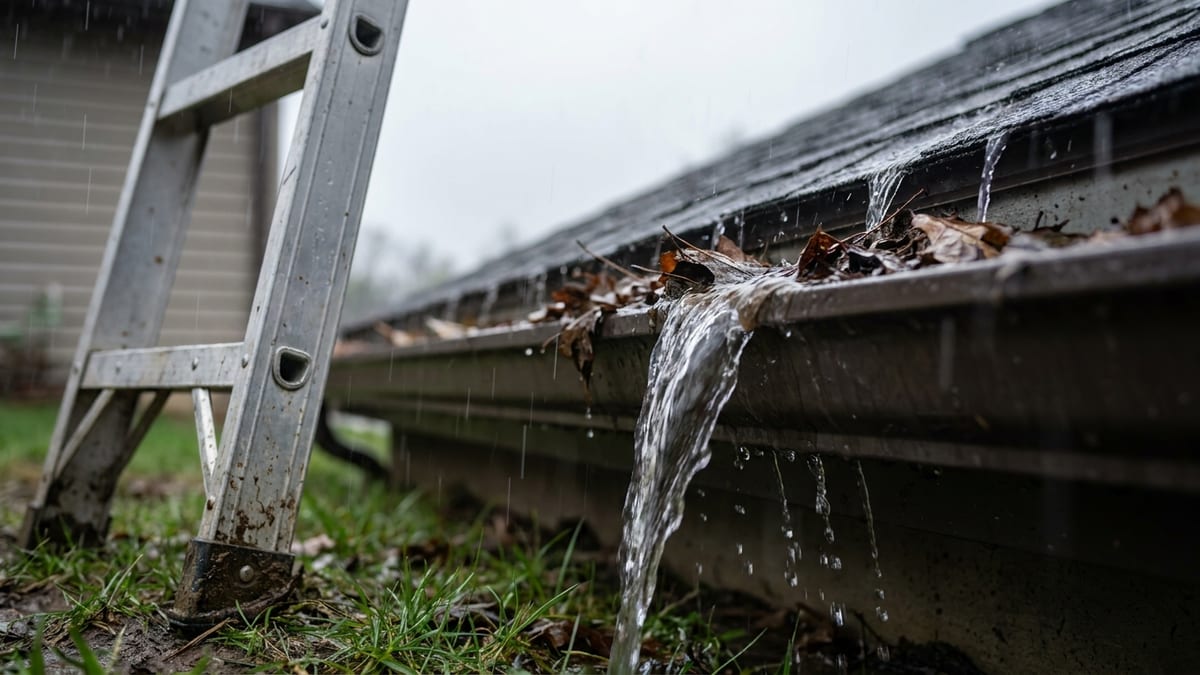
This homeowner is not shopping a product. They are tired of a chore. They cleaned the gutters twice last fall, or they paid someone $250 to do it, or they are sixty-eight years old and their kids told them to stop climbing the ladder. Overflow during a hard rain is what finally moves them.
Ticket: $600 for a light screen retrofit on a small ranch, $4,000 for a premium micro-mesh system on a two-story with complex rooflines. Sales cycle: one visit, often closed at the kitchen table. Close rate on a well-worked exclusive lead: 25 to 35 percent, because there is no comparison spec sheet the way there is with a roof.
The guard buyer also has a hidden feature: they almost always need the gutters underneath the guard to be worth guarding. That is the whole margin story, and it is why our gutter lead generation page treats guards and replacement as two campaigns feeding one quote.
What is a gutter job actually worth in 2026?
You cannot set a lead-cost ceiling until you know your real ticket mix. Regional pricing, roofline complexity, and two-story access move these, but the ranges are typical.
| Scope of work | Typical installed price | Buyer type |
|---|---|---|
| Scope of workCleaning or clog clear | Typical installed price$100-$300 | Buyer typeUrgent chore |
| Scope of workRepair, resealing, refastening | Typical installed price$200-$600 | Buyer typeUrgent |
| Scope of workSeamless aluminum replacement, average home | Typical installed price$1,200-$2,400 | Buyer typePlanned / forced |
| Scope of workOversized 6-inch commercial-profile upgrade | Typical installed price$2,000-$3,500 | Buyer typePlanned |
| Scope of workCopper gutter run | Typical installed price$25-$40 per foot | Buyer typePremium / renovation |
| Scope of workGuard retrofit, screen or foam | Typical installed price$600-$1,800 | Buyer typeChore-driven |
| Scope of workGuard retrofit, micro-mesh premium | Typical installed price$1,800-$4,000 | Buyer typeChore-driven |
| Scope of workReplacement plus guard package | Typical installed price$2,600-$5,500 | Buyer typeBest-margin combination |
Read the last row twice. A replacement and a guard package sold on the same visit uses one measure, one setup, one ladder day, and one drive. The second product attaches to the first at a fraction of the incremental labor. That is the single most profitable configuration in this trade and most gutter companies sell it by accident instead of on purpose.
The formula that sets your lead ceiling
Run this per campaign, not per company.
Max cost per lead = (average job value x gross margin x close rate) / 3
Replacement-only campaign: $1,700 x 0.45 margin x 0.30 close = $230, divided by 3 = a $76 maximum cost per lead.
Guard-first campaign: $2,200 x 0.50 margin x 0.30 close = $330, divided by 3 = a $110 maximum cost per lead.
Combined-ticket campaign where guards attach to most replacements: $3,400 x 0.48 margin x 0.30 close = $490, divided by 3 = a $163 maximum cost per lead.
Those ceilings are not close to each other. If you run one blended campaign and hold it to $76, you will get outbid every time for the guard buyer, who is the higher-margin homeowner. If you hold everything to $163, you will overpay on the low end all season. Splitting the campaigns is the only way to bid correctly on both.
Why is cost per lead the wrong number for gutter contractors?
Because the invoice price of a lead says nothing about how many other companies got the same homeowner's phone number ninety seconds later. Cost per acquired job is what your payroll reacts to.
| Channel | Cost per lead | Typical close rate | Cost per acquired job |
|---|---|---|---|
| ChannelReferrals and past customers | Cost per lead$0 | Typical close rate40-60% | Cost per acquired jobNear $0 |
| ChannelGoogle Business Profile / organic | Cost per lead$0-50 | Typical close rate20-40% | Cost per acquired job$100-250 |
| ChannelShared marketplace leads | Cost per lead$25-75 | Typical close rate5-10% | Cost per acquired job$350-1,200 |
| ChannelLocal Services Ads | Cost per lead$20-65 | Typical close rate15-30% | Cost per acquired job$120-400 |
| ChannelMeta advertising | Cost per lead$25-110 | Typical close rate10-20% | Cost per acquired job$250-1,100 |
| ChannelExclusive leads (performance partner) | Cost per lead$50-200 | Typical close rate20-35% | Cost per acquired job$200-900 |
| ChannelExclusive booked appointments | Cost per lead$200-400 | Typical close rate25-40% | Cost per acquired job$600-1,400 |
A $40 shared lead closing at 7 percent costs $571 per acquired job. On a $1,700 replacement, that is a third of the ticket gone before a single length of coil comes off the truck. A $120 exclusive lead closing at 30 percent costs $400 per job, and the ticket is usually larger because you are not the third estimator in the driveway competing on price alone. The full breakdown of that math is in our guide to exclusive vs. shared leads.
There is a second cost gutter contractors rarely track: the measure. Even a fast gutter quote is a drive, a ladder, a linear-foot count, a downspout plan, and a color match. Call it 45 minutes plus travel. At a 7 percent close rate you are running fourteen of those to sell one $1,700 job. Price that at your estimator's loaded hourly cost and cheap shared leads stop looking cheap.
Where does the margin actually sit, guards or replacement?
On a per-crew-day basis, guards usually win. A guard retrofit is often a half-day to a full day with no tear-off, no fascia repair, and no coil fabrication. A full replacement is a full day with more material, more waste hauling, and more chance of discovering rotten fascia that turns a clean job into a change order conversation.
But the honest answer is that neither wins alone. The margin sits in the attachment rate.
- Quote the guard on every replacement. Not as a line item buried at the bottom. As a second visible option with the maintenance cost of the next ten years spelled out next to it.
- Inspect the gutters on every guard lead. A guard installed over undersized, sagging, or improperly pitched gutters is a callback waiting to happen. If the run needs replacing, say so with photos and quote both.
- Track attachment rate as a KPI. Percentage of jobs that sold both products. If you do not know that number today, it is almost certainly under 25 percent and it should be closer to 50.
- Price the package, not the pieces. A bundled number closes better than two separate numbers that the homeowner adds up and flinches at.
If you want to see what a higher attachment rate does to your cost per acquired job, put your real numbers into the ROI calculator. Raising the average ticket from $1,700 to $3,200 does more for your ability to buy leads than any negotiation over cost per lead ever will.
How do you reach the guard buyer before a competitor does?
The guard buyer is not searching. That is the entire point. Nobody types "micro-mesh gutter guards near me" in July. They type it during the two weeks after their gutters overflowed, and by then four companies are already in the mix.
Meta advertising reaches that homeowner in the window before the search. What works:
- Real finished photography. A clean gutter line on a house that looks like the ones on their street. Not a stock render, not a manufacturer's product shot.
- The chore hook, not the product hook. "Stop cleaning your gutters twice a year" outperforms "premium micro-mesh gutter protection" because it names the problem the homeowner actually has.
- Rain-day and leaf-drop timing. Budget bumps during heavy rain events and the first three weeks of leaf fall get you in front of people at the exact moment the problem is visible from the kitchen window.
- Age and homeownership targeting. Long-tenure homeowners in mature-tree neighborhoods are the guard buyer. Newer subdivisions with saplings are not.
Campaigns run through your own ad account, so the homeowner sees your company name on the ad, your work in the photos, and your name on the door when you show up. The pixel data, audiences, and retargeting lists stay yours. That is the difference between building a brand and renting one from a marketplace.
What does the seasonal calendar look like for gutter campaigns?
Gutters have two demand spikes and most contractors show up late for both.
| Period | Demand driver | What to run |
|---|---|---|
| PeriodLate winter | Demand driverIce dam damage, sagging sections | What to runReplacement campaign, damage-repair messaging |
| PeriodSpring | Demand driverExterior project season, siding and roof jobs | What to runReplacement plus guard package |
| PeriodSummer | Demand driverSlow, storm-dependent | What to runGuard campaign at lower budget, build retargeting audience |
| PeriodLate summer to early fall | Demand driverPre-leaf-drop urgency | What to runGuard campaign at full budget, 6-8 weeks ahead of peak |
| PeriodPeak leaf drop | Demand driverOverflow and cleaning calls | What to runRepair and cleaning capture, upsell to guards on site |
The fall guard window is the one that gets missed. If you start advertising guards the week the leaves are on the ground, you are competing with every cleaning company in town at the most expensive moment of the year. Start six to eight weeks earlier, when the homeowner remembers last October and is not yet in a panic. The broader timing framework is in our guide to seasonal contractor marketing.
How many gutter leads do you need to hit a revenue target?
Work backward from the number instead of guessing at a budget.
Say the goal is $300,000 in added revenue next year, and you commit to selling guards on the replacement quotes.
- Target revenue: $300,000
- Blended ticket with guards attached: $3,200
- Jobs required: 300,000 / 3,200 = 94 jobs
- Close rate on exclusive leads: 30 percent
- Leads required: 94 / 0.30 = 313 leads per year, roughly 26 per month
- At a blended $85 cost per lead: roughly $2,210 per month
Now run it without the guard attachment, at a $1,600 replacement-only ticket. The same $300,000 takes 188 jobs, 627 leads a year, about 52 leads a month, and roughly $4,420 a month in lead cost. Same revenue. Double the leads, double the measures, double the crew days, double the spend.
That is the whole argument for building the guard campaign on purpose.
What kills gutter leads after they come in?
Three things, in order.
Slow response. Gutter work is small-ticket and comparison-shopped, which makes it the most speed-sensitive trade on this list. A homeowner who fills out a form during a rainstorm will call the next company forty minutes later. Five-minute response is not a nice-to-have here, it is the whole game. Our breakdown on speed to lead covers how to staff that without pulling a crew off a roof.
Quoting over the phone. Giving a linear-foot price sight unseen turns you into a number on a list and gives away the guard conversation entirely. Get on site, take photos, quote both options.
No follow-up past day three. Gutter buyers stall. A leaf-drop lead in August is a real buyer in October. If your CRM drops them after two calls, you are handing that job to whoever calls in week six.
The short version
Guards and replacement are two campaigns, two ceilings, and one quote. Build the guard campaign around the chore, not the product. Build the replacement campaign around damage and exterior projects. Quote both on every visit and track your attachment rate like it is a payroll line, because it is.
If you want exclusive gutter leads running through your own Meta ad account, with the guard buyer and the replacement buyer separated on purpose, get started here. Setup is a one-time $2,000, currently discounted from $4,000, and you pay per qualified lead from $50 or per booked appointment from $200. No retainer, and every dollar of ad spend goes directly from you to Meta where you can see it.
Frequently asked questions
Should gutter contractors run separate campaigns for guards and full replacement?
Yes. The two jobs carry different tickets, different margins, and different maximum costs per lead, so blending them forces you to judge a $3,500 guard job by the economics of a $1,600 replacement. Run them as separate campaigns with separate budgets and separate cost-per-lead ceilings, then bundle at the quote.
Are gutter guards higher margin than full gutter replacement?
Usually yes, on a per-crew-day basis. Guard installs are typically a half-day to a day of labor with less fabrication and less tear-off, and they attach to an existing replacement quote without adding much crew time. The best-margin day is a replacement and a guard package sold together on one visit.
What do gutter leads cost in 2026?
Shared marketplace gutter leads typically run $25 to $75 each but close at 5 to 12 percent because three to five companies get the same homeowner. Exclusive gutter leads generally run $50 to $200 and close at 20 to 35 percent. Local Services Ads for repair and cleaning usually land between $20 and $65 per lead with high intent but limited volume.
How many gutter leads do I need to add $300,000 in revenue?
At a $3,200 blended ticket with guards attached and a 30 percent close rate, you need about 94 jobs and roughly 313 leads a year, which is about 26 leads a month. At a $1,600 replacement-only ticket the same revenue takes about 188 jobs and roughly 52 leads a month.
Is Meta advertising or Google better for gutter guard leads?
Meta for guards, Google for urgent repair and cleaning. Homeowners rarely search for gutter guards until something overflows, so Meta reaches them during the planning window at roughly $25 to $110 per lead with finished-work photography. Google and Local Services Ads capture the homeowner who already has water running down the siding and wants someone this week.
Frequently asked questions
Should gutter contractors run separate campaigns for guards and full replacement?
Yes. The two jobs carry different tickets, different margins, and different maximum costs per lead, so blending them forces you to judge a $3,500 guard job by the economics of a $1,600 replacement. Run them as separate campaigns with separate budgets and separate cost-per-lead ceilings, then bundle at the quote.
Are gutter guards higher margin than full gutter replacement?
Usually yes, on a per-crew-day basis. Guard installs are typically a half-day to a day of labor with less fabrication and less tear-off, and they attach to an existing replacement quote without adding much crew time. The best-margin day is a replacement and a guard package sold together on one visit.
What do gutter leads cost in 2026?
Shared marketplace gutter leads typically run $25 to $75 each but close at 5 to 12 percent because three to five companies get the same homeowner. Exclusive gutter leads generally run $50 to $200 and close at 20 to 35 percent. Local Services Ads for repair and cleaning usually land between $20 and $65 per lead with high intent but limited volume.
How many gutter leads do I need to add $300,000 in revenue?
At a $3,200 blended ticket with guards attached and a 30 percent close rate, you need about 94 jobs and roughly 313 leads a year, which is about 26 leads a month. At a $1,600 replacement-only ticket the same revenue takes about 188 jobs and roughly 52 leads a month.
Is Meta advertising or Google better for gutter guard leads?
Meta for guards, Google for urgent repair and cleaning. Homeowners rarely search for gutter guards until something overflows, so Meta reaches them during the planning window at roughly $25 to $110 per lead with finished-work photography. Google and Local Services Ads capture the homeowner who already has water running down the siding and wants someone this week.