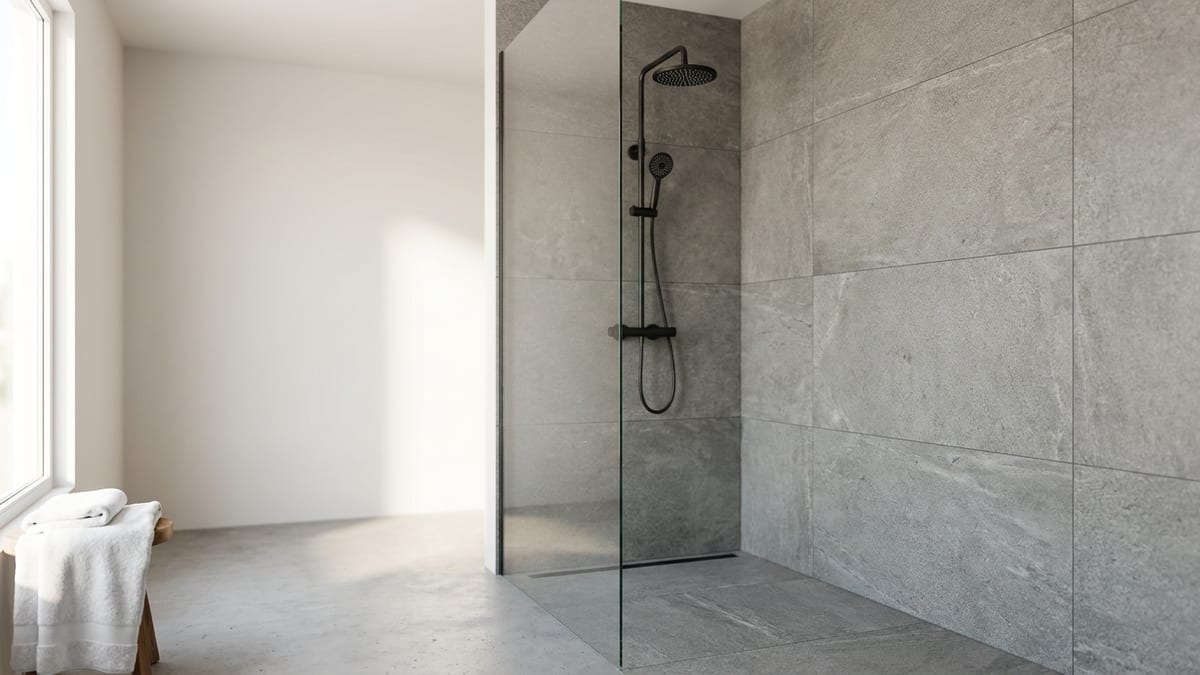
Two homeowners fill out the same bathroom form on the same day. One wants her 1990s fiberglass tub pulled out and a walk-in shower put in. The other wants the whole bathroom torn to the studs, new layout, new tile, new vanity, new plumbing rough-in.
You paid the same price for both leads. One of them will be a signed contract this week at $8,500. The other will take six weeks, three design revisions, two competing bids, and may land at $34,000 or may never land at all.
Same trade. Same form. Completely different economics. If you run them in one campaign with one cost-per-lead target, you are guaranteed to be wrong about both.
Why do shower remodel leads and full bath gut leads behave like two different businesses?
A shower remodel is a replacement decision. The homeowner already knows the outcome she wants: the tub goes, a shower goes in, and the project is done in a few days. She is not designing anything. She is choosing a company, a price, and a start date. That decision can happen in a single in-home appointment.
A full bathroom gut is a design decision. Layout changes, tile selections, vanity and countertop choices, lighting, sometimes moving a drain. The homeowner is not comparing companies yet when she first raises her hand. She is figuring out what the project even is. That takes weeks, usually involves a second decision maker, and almost always involves other bids.
That difference drives everything downstream:
- Close rate. One-visit replacement decisions close far more often than multi-bid design decisions.
- Time to cash. A shower job can be sold Tuesday and installed the following week. A gut job can sit in design for a month before a deposit lands.
- Sales capacity. One rep can run several shower appointments a day. Gut appointments eat two hours plus follow-up.
- Creative. The shower buyer responds to a finished shower and a starting price. The gut buyer responds to before-and-after photography and a design process.
If you want the full three-buyer breakdown of this market, our bathroom remodeling leads page covers how fast-conversion, full-gut, and forced-timeline homeowners each come in and what each one is worth.
What is each bathroom job actually worth in 2026?
These are industry-typical ranges, not quotes. Your market, your material line, and your crew cost move them.
| Job type | Typical installed ticket | Typical decision window | Typical close rate on exclusive leads |
|---|---|---|---|
| Job typeAcrylic or solid-surface shower replacement | Typical installed ticket$5,000 to $12,000 | Typical decision windowSame visit to 2 weeks | Typical close rate on exclusive leads25% to 35% |
| Job typeCustom tile shower | Typical installed ticket$10,000 to $25,000 | Typical decision window2 to 6 weeks | Typical close rate on exclusive leads15% to 25% |
| Job typeFull bathroom gut, secondary bath | Typical installed ticket$18,000 to $35,000 | Typical decision window4 to 10 weeks | Typical close rate on exclusive leads10% to 20% |
| Job typeFull bathroom gut, primary suite | Typical installed ticket$30,000 to $60,000 | Typical decision window6 to 16 weeks | Typical close rate on exclusive leads8% to 15% |
The spread is the point. A shower replacement and a primary suite gut are not variations of one offer. They are two products with a 5x ticket gap and a 10x difference in sales cycle length.
What is the most you can pay for each lead?
Use the same formula for both, then stop comparing the outputs to each other.
Break-even cost per lead equals average job value multiplied by gross margin multiplied by close rate. Your working ceiling is roughly one third of that, which leaves room for profit and for the months your close rate dips.
Example, shower replacement: $9,000 average ticket, 35 percent gross margin, 30 percent close rate. That is $9,000 x 0.35 = $3,150 gross profit per job, multiplied by 0.30 = $945 break-even cost per lead. One third of that is a $315 working ceiling.
Example, full gut: $30,000 average ticket, 32 percent gross margin, 14 percent close rate. That is $30,000 x 0.32 = $9,600 gross profit, multiplied by 0.14 = $1,344 break-even. One third is a $448 working ceiling.
The gut lead supports a higher price. That is the part most bath companies get backwards, because the gut lead feels riskier and slower, so they try to buy it cheap. Cheap is not the problem. Buying it at a shower-campaign price and then giving it shower-campaign follow-up is the problem. Our breakdown of how much you should pay per lead walks through the all-in version of this formula.
Which lead actually costs less to close?
Two different answers depending on which number you care about.
Example: 100 exclusive leads of each type at $120 per lead.
| Measure | Shower remodel | Full bath gut |
|---|---|---|
| MeasureLeads | Shower remodel100 | Full bath gut100 |
| MeasureLead cost | Shower remodel$12,000 | Full bath gut$12,000 |
| MeasureClose rate | Shower remodel30% | Full bath gut14% |
| MeasureJobs signed | Shower remodel30 | Full bath gut14 |
| MeasureCost per acquired job | Shower remodel$400 | Full bath gut$857 |
| MeasureAverage ticket | Shower remodel$9,000 | Full bath gut$30,000 |
| MeasureRevenue produced | Shower remodel$270,000 | Full bath gut$420,000 |
| MeasureAcquisition cost as share of revenue | Shower remodel4.4% | Full bath gut2.9% |
In raw dollars, the shower lead costs less than half as much to close. In percentage of revenue, the gut lead is the cheaper customer by a wide margin.
So the honest answer is that shower leads are cheaper per signed job and gut leads are cheaper per dollar of revenue. Which one you want more of depends on what your business is short of right now:
- Short on cash flow and crew days to fill this month? Weight the shower campaign. The money lands faster and the install is short.
- Short on revenue and you have design and project management capacity sitting idle? Weight the gut campaign. Fourteen jobs beat thirty on the top line.
- Short on sales reps? Weight shower. Gut appointments consume the scarcest resource you have.
- Backlog already full through next quarter? Weight gut and raise your average ticket instead of your job count.
Most bath companies should run both, at a split closer to 60 percent shower and 40 percent gut, and revisit the split every quarter against backlog.
If you want the two campaigns built and managed against those separate ceilings instead of one blended number, that is what our bathroom remodeling lead system is built to do.
How should the two campaigns actually be structured?
Five rules, in order.
- Separate campaigns, separate budgets. One ad set cannot serve a woman replacing a tub and a woman redesigning a primary suite. Separate them so each one gets judged on its own cost per acquired job.
- Separate creative. Shower ads show the finished shower, a real starting price, and a short install timeline. Gut ads show before-and-after pairs, the design conversation, and the scope of what gets replaced.
- Ask a scope question on the form. Shower only, shower plus vanity, or full remodel. That single field tells your office which playbook to run before anyone dials.
- Two follow-up cadences. Shower leads get worked hard for seven to ten days. Gut leads get a cadence that survives twelve weeks, because the homeowner is genuinely still deciding in week eight.
- Two appointment standards. For gut appointments, confirm both decision makers will be home and that the visit runs 90 minutes or more. An on-site estimate is a sales appointment, so set that expectation up front rather than pretending it is a casual look.
Speed matters on both, but it matters in different ways. The shower lead goes to whoever calls first. The gut lead goes to whoever is still there in week six. Our guide to speed to lead covers the first part, and the kitchen and bath comparison in this lead source breakdown covers how the longer remodeling cycle changes what you track.
How many leads do you need to hit a revenue target?
Work backward from revenue, never forward from a budget.
Example, $1,000,000 from shower work: $1,000,000 divided by a $9,000 ticket equals 111 jobs. At a 30 percent close rate that is 370 leads, roughly 31 per month. At $120 per lead, that is $44,400 a year in lead cost against $1,000,000 in revenue.
Example, $1,000,000 from gut work: $1,000,000 divided by a $30,000 ticket equals 34 jobs. At a 14 percent close rate that is 243 leads, roughly 20 per month. At $150 per lead, that is $36,450 a year in lead cost.
Fewer leads, more revenue, but you need design capacity and a sales team that can carry a twelve-week pipeline without letting leads go cold. Lead volume is rarely the constraint on the gut side. Follow-up discipline is.
What kills bathroom leads after they come in?
In rough order of how much money each one costs:
- Slow first contact. The shower buyer calls three companies in an afternoon. If you call back the next morning, you are bidding against two companies that already measured.
- One follow-up cadence for both offers. Gut leads marked dead at day ten are not dead. They are in week two of a ten-week decision.
- Quoting a gut job over the phone. You cannot price a layout change sight unseen. Sell the appointment, not the number.
- No scope qualification. Sending a rep ninety minutes out to quote a $4,500 shower surround insert is how a good lead source gets blamed for a routing problem.
- Blended reporting. One cost-per-lead number across both offers hides which campaign is actually producing contracts. Break the reporting out by offer or you are optimizing blind.
- No proof on the page. Bathroom buyers decide visually. Finished-project photography from your own jobs outperforms any stock image or spec sheet.
What should a bath remodeler do first?
Pull your last 12 months. Split every signed bathroom job into shower replacement and full gut. Calculate the average ticket, gross margin, and close rate for each separately. Run the break-even formula twice. Then look at what you are currently paying per lead and see which of the two campaigns has been quietly subsidizing the other.
After that, split the campaigns and let each one live or die on its own cost per acquired job.
Our bath clients are currently getting leads for as low as $30 through Meta, and that $30 is ad spend paid directly to Meta out of the contractor's own ad account, not a Minyona fee. The number that actually matters is what happens next: the homeowners who book an appointment out of these bath campaigns close at a far higher rate than the leads most bath companies are buying today.
We are open for a few more bath remodeling companies, one per area. Book a call and we will show you the live numbers.
Frequently asked questions
Which bathroom lead is cheaper to close, a shower remodel or a full gut?
A shower remodel lead is cheaper in absolute dollars because the close rate is higher and the decision happens in one appointment, typically landing at $300 to $500 per signed job. A full gut lead usually costs $800 to $1,500 per signed job but represents a smaller share of a much larger ticket, so it is cheaper measured against revenue.
What is the maximum a bath remodeler should pay per lead?
Run average job value multiplied by gross margin multiplied by close rate to get break-even, then target roughly one third of that as your working ceiling. Example: a $9,000 shower at 35 percent margin and a 30 percent close rate breaks even near $945 per lead and gives a working ceiling around $315.
Should shower remodels and full bathroom gut jobs run in the same campaign?
No. The two offers attract different buyers, carry different tickets, and need different cost-per-lead ceilings, so blending them means you either overpay for shower leads or get outbid on gut leads. Separate campaigns, separate creative, separate budgets.
Why do full bathroom gut leads take so long to close?
A full gut is a design decision with tile, vanity, layout, and often plumbing moves, so homeowners collect multiple bids and frequently wait on financing or a schedule window. Expect four to twelve weeks from first contact to signed contract, which means your follow-up has to run for months rather than days.
How many bathroom leads do you need to add $1 million in revenue?
Divide the revenue goal by average job value, then divide by close rate. Example: $1,000,000 at a $9,000 shower ticket and a 30 percent close rate needs about 111 jobs and roughly 370 leads, while the same goal at a $30,000 gut ticket and a 15 percent close rate needs about 34 jobs and roughly 225 leads.