A window company can run one campaign and end up with two completely different businesses. One books 30 jobs a month at $1,800 a ticket, two openings at a time, with an installer burning half a day on travel and setup for a job that barely clears the truck cost. The other books eight jobs a month at $16,000 a ticket, whole houses, one crew, one setup, one permit, one drive.
Same trade. Same budget. Roughly the same lead volume in the second case would produce two and a half times the revenue on a quarter of the calendar chaos.
Most window marketing does not make that choice on purpose. It runs a generic "window replacement" campaign, takes whatever comes in, and then the owner complains the leads are cheap. The leads are not cheap. The campaign asked for cheap.
Here is what each buyer is actually worth, the math that sets your lead ceiling, and how to build a campaign that sorts them before your estimator gets in the truck.
Why do window contractors keep booking two-window jobs?
Because the ad, the landing page, and the form all told the homeowner that a two-window job was welcome.
The offer is priced for the smallest possible purchase
"Windows from $299" and "buy two get one free" pull volume. They also pull the homeowner whose kitchen unit fogged up and who has no intention of touching the other fourteen. That homeowner is not a bad person or a bad lead. They are just a $1,600 job that costs you the same estimator hour, the same drive, and the same follow-up sequence as a $19,000 job.
When price is the first thing in the ad, price is the only thing the homeowner brings to the appointment. Whole-home buyers are not primarily shopping unit price. They are shopping comfort, noise, energy bills, resale, and whether the house will finally look finished. Nothing in a $299 headline speaks to any of that.
The form asks the wrong question
Most contractor window forms collect name, phone, email, zip. That is a contact record, not a lead. If the form never asks how many openings the homeowner is thinking about, your sales team finds out on the phone, or worse, in the driveway.
One dropdown fixes a large portion of this problem: How many windows are you looking to replace? with options for 1-3, 4-9, 10-15, and 16+. It costs you a small amount of form completion rate and it hands your booker the single most important qualifying fact before the first call. That question, plus creative built around finished whole-house work, is how our window lead generation program separates the two buyers instead of blending them.
The creative shows one window
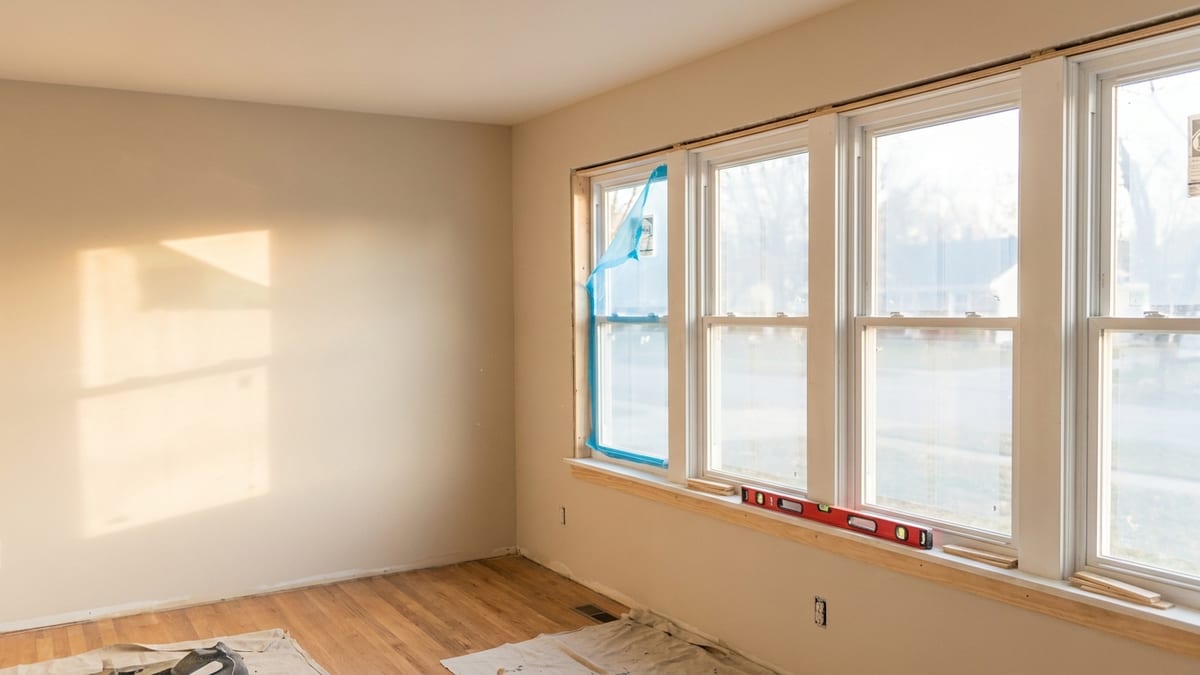
A close-up of a single double-hung communicates "we replace a window." A wide living room shot with a whole wall of matching new units communicates "we replace the house." Homeowners take the campaign literally. Show the outcome you want to sell.
What is a whole-home window replacement actually worth in 2026?
You cannot set a lead-cost ceiling until you know your real ticket mix. Regional labor, frame material, and structural openings move these, but the ranges are typical.
| Scope of work | Typical installed price | Buyer type |
|---|---|---|
| Scope of workSingle unit replacement or glass repair | Typical installed price$400-$900 | Buyer typeForced / urgent |
| Scope of workTwo to three openings | Typical installed price$1,200-$3,000 | Buyer typeFix-the-problem |
| Scope of workFront elevation only (4-6 units) | Typical installed price$3,000-$7,000 | Buyer typeCurb appeal |
| Scope of workWhole-home vinyl, 10-15 units | Typical installed price$7,500-$16,000 | Buyer typePlanned |
| Scope of workWhole-home vinyl or composite, 16-25 units | Typical installed price$12,000-$25,000 | Buyer typePlanned |
| Scope of workFiberglass or wood-clad whole-home | Typical installed price$18,000-$30,000 | Buyer typePremium planned |
| Scope of workWhole-home plus patio or slider package | Typical installed price$15,000-$30,000 | Buyer typePlanned / renovation |
The pattern matters more than any single row. Moving one homeowner from a three-window job to a full-house project is worth more than winning six extra small jobs, and it costs you one estimator visit instead of six.
The formula that sets your cost-per-lead ceiling
Run this per campaign, not per company.
Max cost per lead = (average job value x gross margin x close rate) / 3
Two-window campaign: $1,800 x 0.35 margin x 0.35 close = $220, divided by 3 = a $73 maximum cost per lead.
Whole-home campaign: $16,000 x 0.35 margin x 0.25 close = $1,400, divided by 3 = a $466 maximum cost per lead.
Those numbers are not in the same universe. If you run one blended campaign and hold it to $73, you will never outbid anyone for the whole-home buyer. Hold it to $466 and you will lose money on every small job that slips through. That single gap is the argument for splitting the campaigns, the budgets, and the ceilings.
Why is cost per lead the wrong number to judge window leads on?
Because the invoice price ignores how many other companies were handed the same homeowner, and it ignores what the job was worth when it closed.
| Channel | Cost per lead | Typical close rate | Cost per acquired job |
|---|---|---|---|
| ChannelReferrals and past customers | Cost per lead$0 | Typical close rate40-60% | Cost per acquired jobNear $0 |
| ChannelGoogle Business Profile / organic | Cost per lead$0-50 | Typical close rate20-40% | Cost per acquired job$100-250 |
| ChannelShared marketplace leads | Cost per lead$25-85 | Typical close rate5-12% | Cost per acquired job$350-1,200 |
| ChannelGoogle Ads (search intent) | Cost per lead$100-350 | Typical close rate15-30% | Cost per acquired job$500-2,000 |
| ChannelMeta advertising | Cost per lead$25-110 | Typical close rate10-20% | Cost per acquired job$250-1,100 |
| ChannelExclusive leads (performance partner) | Cost per lead$50-200 | Typical close rate15-25% | Cost per acquired job$200-1,000 |
| ChannelExclusive booked appointments | Cost per lead$200-400 | Typical close rate25-40% | Cost per acquired job$600-1,400 |
A $45 shared lead closing at 8 percent costs $560 per acquired job. A $140 exclusive lead closing at 22 percent costs $636 per acquired job, which looks worse until you notice the first one closed a $2,200 job and the second closed a $15,000 one. Cost per acquired job is the number that matters, and average job value by source is the number that decides which channel you scale. The full breakdown of that comparison is in our guide on exclusive vs. shared leads.
There is a second cost window companies almost never track: in-home time. A proper whole-home consultation is 90 minutes plus travel, and it is a sales appointment, with product samples, financing options, and a price presented at the table. At an 8 percent close rate you are running twelve of those to sell one job. Price that at your estimator's loaded hourly cost and the cheap lead stops being cheap.
How do you reach whole-home buyers before they search?
The whole-house project rarely starts with a search. Nobody types "whole home window replacement near me" the day the idea occurs to them. They sit in a cold living room in February, notice the condensation between the panes, mention it to their spouse, and do nothing for four months. Then a Google search happens, and by then three companies are already in the conversation.
Meta advertising reaches that homeowner during the four months of nothing. That is the entire strategic argument, and it is the same reason Facebook usually beats Google for planned exterior work.
Creative that filters
- Lead with the whole house. Wide interior and exterior shots of finished full-home installs. Matching units, clean trim, no single-window close-ups.
- Sell comfort and cost, not unit price. Drafts, road noise, rooms that never heat, a heating bill that keeps climbing. Those are whole-home problems.
- Use the count as a hook. "Replacing every window in a 1970s split-level" does more sorting than "window specials this month."
- Put financing in the ad, not just the appointment. A monthly payment reframes a $16,000 project as a decision the homeowner can make now. Say the payment range, not a fake price.
- Show real installs. Homeowners are unusually good at spotting a stock photo, and generic template landing pages read as an agency, not a local company. That problem is covered in our post on why templated landing pages hurt your brand.
Qualifying that happens before the truck moves
The project-size dropdown does the first cut. The phone call does the second. Three questions handle it: how many openings, what is driving the project now, and who will be at the appointment. A homeowner answering "sixteen, the upstairs is freezing, my wife and I both" is a different calendar slot than "two, one is fogged, I just need a price."
You still book the small ones. You just book them into a different slot, with a different rep or a lower-cost measure, and you stop letting them consume the hours your whole-home closer needs.
If you want to see what this looks like when it is built as one system instead of a stack of tactics, start here and we will walk your numbers.
How many whole-home window leads do you need to hit a revenue target?
Work backward from revenue, not forward from budget. Here is the framework.
- Set the revenue number. Say $1,000,000 in added window revenue over twelve months.
- Divide by average ticket. At $16,000 whole-home average, that is 63 jobs.
- Divide by close rate. At 25 percent on exclusive leads, that is 250 leads for the year, roughly 21 per month.
- Multiply by cost per lead. At $70 to $90 in Meta ad spend per lead, that is roughly $1,470 to $1,890 per month in ad spend paid directly to Meta out of your own account, plus the per-lead fee on the leads that get delivered.
- Check it against capacity. 63 whole-home jobs is roughly five to six installs a month. If your crews cannot absorb that, either raise the ticket or delay the scale-up.
Now run the same $1,000,000 on two-window work. At $1,800 a ticket that is 556 jobs, and at a 30 percent close rate that is roughly 1,850 leads a year, about 154 a month. Same revenue, seven times the lead volume, seven times the estimator hours, and seven times the scheduling. That comparison is the whole post in one paragraph. For the general version of that math across trades, see our cost per lead guide.
What kills a whole-home window lead after it comes in?
Slow response, mostly. A homeowner who just raised their hand on a $16,000 project is at peak willingness for about fifteen minutes. Call inside five and your odds of getting them qualified go up dramatically. Call the next morning and you are calling somebody who already talked to a competitor and cooled off. The mechanics of building that response as staffed infrastructure rather than good intentions are in our post on speed to lead.
The other killers are predictable:
- One-legger appointments. A whole-home window project is a joint decision. Confirm both decision-makers at booking or expect a "we need to think about it."
- No follow-up past day three. Whole-home buyers routinely take 30 to 90 days. A three-touch sequence loses most of them.
- Pricing on the phone. A per-window number quoted before the measure turns a $16,000 project into a price comparison against a big-box quote.
- No visual proof. If the homeowner cannot see fifteen finished houses that look like theirs, they default to the brand they saw on TV.
What should a window company do first?
Split the campaign. One budget and one creative set for whole-home, one for small and urgent jobs, with separate cost-per-lead ceilings calculated from their own ticket and close rate. Add the project-size question to the form. Move your best closer onto the whole-home appointments only. Then track average job value by source for 90 days and let that number, not the cost per lead, decide where the budget grows.
If you would rather have that built and managed inside your own Meta ad account, so the pixel data, the audiences, and the brand equity stay with your company, book a call and we will show you the live numbers for window campaigns running now.
Frequently asked questions
Why do my window leads keep turning into two-window jobs?
Because the ad and the form asked for a small job. Price-led creative, single-window photos, and a form with no project-size question all sort for the homeowner replacing the two units that fogged up, so the campaign delivers exactly what it advertised.
What does a whole-home window replacement cost in 2026?
Installed vinyl double-hungs typically run $600 to $1,200 per opening and fiberglass or wood-clad runs $1,000 to $2,500, so a 12 to 20 window house usually lands between $9,000 and $25,000, with large or custom projects reaching roughly $30,000.
What should I pay per window replacement lead?
Set the ceiling with average job value times gross margin times close rate, divided by three. A $1,800 two-window ticket supports roughly $60 to $80 per lead, while a $16,000 whole-home ticket supports $400 or more per lead at the same margin and a 25 percent close rate.
Is Meta or Google better for whole-home window leads?
Meta, for the whole-home side. Homeowners planning a full replacement are not searching yet, they are looking at their drafty living room and thinking about it, and Meta reaches them in that window at roughly $25 to $110 per lead. Google captures the homeowner who already decided, which skews toward smaller and more price-shopped jobs.
How many whole-home window leads do I need to add $1 million in revenue?
At a $16,000 average ticket you need about 63 jobs. At a 25 percent close rate on exclusive leads that is roughly 250 leads a year, about 21 a month, which is a very different plan from the 550 plus leads the same revenue would require on two-window work.
Frequently asked questions
Why do my window leads keep turning into two-window jobs?
Because the ad and the form asked for a small job. Price-led creative, single-window photos, and a form with no project-size question all sort for the homeowner replacing the two units that fogged up, so the campaign delivers exactly what it advertised.
What does a whole-home window replacement cost in 2026?
Installed vinyl double-hungs typically run $600 to $1,200 per opening and fiberglass or wood-clad runs $1,000 to $2,500, so a 12 to 20 window house usually lands between $9,000 and $25,000, with large or custom projects reaching roughly $30,000.
What should I pay per window replacement lead?
Set the ceiling with average job value times gross margin times close rate, divided by three. A $1,800 two-window ticket supports roughly $60 to $80 per lead, while a $16,000 whole-home ticket supports $400 or more per lead at the same margin and a 25 percent close rate.
Is Meta or Google better for whole-home window leads?
Meta, for the whole-home side. Homeowners planning a full replacement are not searching yet, they are looking at their drafty living room and thinking about it, and Meta reaches them in that window at roughly $25 to $110 per lead. Google captures the homeowner who already decided, which skews toward smaller and more price-shopped jobs.
How many whole-home window leads do I need to add $1 million in revenue?
At a $16,000 average ticket you need about 63 jobs. At a 25 percent close rate on exclusive leads that is roughly 250 leads a year, about 21 a month, which is a very different plan from the 550 plus leads the same revenue would require on two-window work.