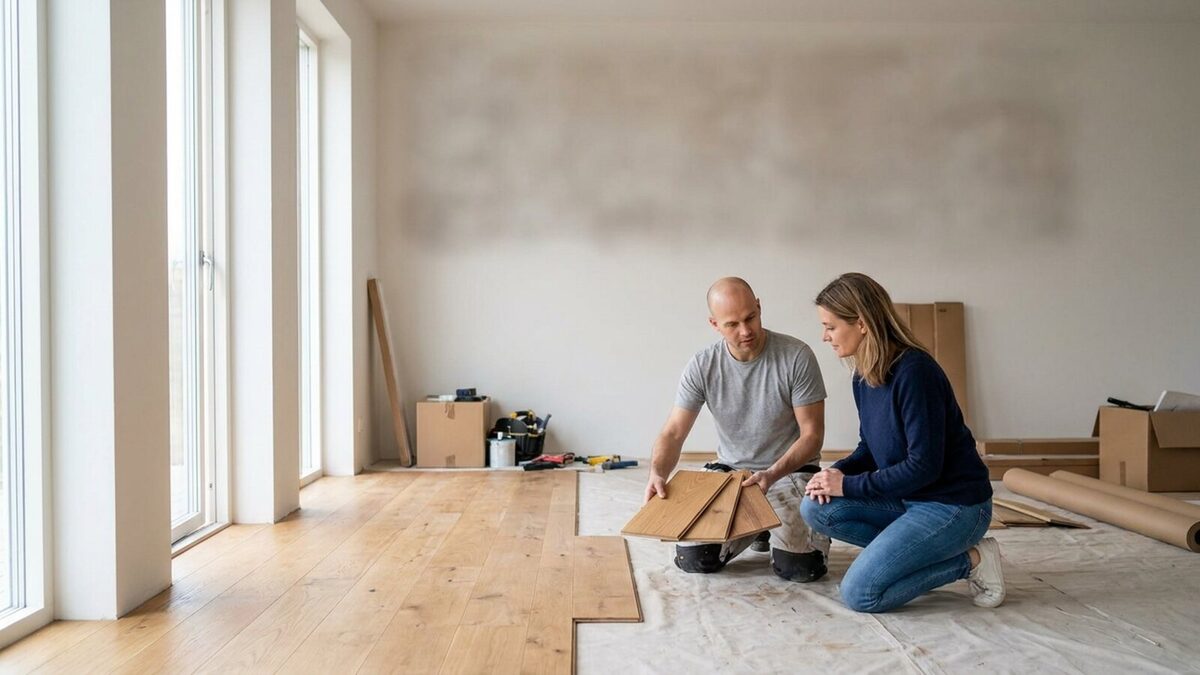
Flooring is one of the few trades where the same homeowner can be worth $1,800 or $28,000 depending on how early you reach them. That gap is the whole story of flooring lead generation. Most installers spend their marketing money in the channels that capture the $1,800 version and wonder why revenue never moves.
This is how the two markets work, what each type of lead actually costs, and the math to size a budget against a revenue target.
Why do flooring leads split into two completely different markets?
Flooring demand comes from two buyers who behave nothing alike.
The urgent replacement buyer. Carpet ruined by a pet or a burst supply line. Water damage in one room. A cracked tile floor that has to go before a family event. This homeowner searches, calls two or three companies, and books the one who answers and can measure this week. Typical ticket: $1,500-$5,000.
The planning buyer. Someone who has decided the house needs new flooring throughout, or is combining flooring with a kitchen or basement remodel. They are looking at samples, comparing luxury vinyl plank against engineered hardwood, and thinking about financing. They are not in a hurry, and they are not searching yet. Typical ticket: $9,000-$30,000, sometimes more on large homes with premium hardwood or tile.
The urgent buyer is a race. The planning buyer is a relationship you start before anyone else knows they exist. You need both channels, and you should never judge them by the same numbers. Our flooring lead generation page breaks down how we build campaigns for each side.
What is a flooring job actually worth per square foot?
Before you can set a cost-per-lead ceiling, you need real ticket math. Installed pricing varies by market, subfloor condition, and material, but these ranges are typical:
| Material | Installed cost per sq ft | 400 sq ft room | 1,800 sq ft whole home |
|---|---|---|---|
| MaterialCarpet | Installed cost per sq ft$3-7 | 400 sq ft room$1,200-$2,800 | 1,800 sq ft whole home$5,400-$12,600 |
| MaterialLuxury vinyl plank | Installed cost per sq ft$4-9 | 400 sq ft room$1,600-$3,600 | 1,800 sq ft whole home$7,200-$16,200 |
| MaterialLaminate | Installed cost per sq ft$4-8 | 400 sq ft room$1,600-$3,200 | 1,800 sq ft whole home$7,200-$14,400 |
| MaterialEngineered hardwood | Installed cost per sq ft$8-14 | 400 sq ft room$3,200-$5,600 | 1,800 sq ft whole home$14,400-$25,000 |
| MaterialSolid hardwood | Installed cost per sq ft$9-16 | 400 sq ft room$3,600-$6,400 | 1,800 sq ft whole home$16,000-$28,000 |
| MaterialTile | Installed cost per sq ft$10-25 | 400 sq ft room$4,000-$10,000 | 1,800 sq ft whole homeUsually partial areas |
The pattern is obvious. Moving one homeowner from a single room to a whole-home scope is worth more than adding four new single-room leads. That is a sales and marketing decision, not a pricing decision.
The number that decides your budget
Use this formula before you spend a dollar:
Max cost per lead = (Average job value × profit margin × close rate) ÷ 3
An installer averaging $8,000 per job at a 35% gross margin and a 25% close rate: $8,000 × 0.35 × 0.25 = $700, divided by 3 = a $233 max cost per lead. Most exclusive flooring leads land well under that. Shared leads look cheaper and often blow past it once close rate is factored in.
Why does cost per lead mislead flooring installers?
Because cost per lead ignores how many other companies got the same homeowner. Cost per acquired job is the only number that pays your crew.
| Channel | Cost per lead | Typical close rate | Cost per acquired job |
|---|---|---|---|
| ChannelReferrals | Cost per lead$0 | Typical close rate40-60% | Cost per acquired jobNear $0 |
| ChannelGoogle Business Profile / organic | Cost per lead$0-50 | Typical close rate20-40% | Cost per acquired job$100-250 |
| ChannelShared marketplace leads | Cost per lead$25-75 | Typical close rate5-12% | Cost per acquired job$400-1,400 |
| ChannelGoogle Ads (search intent) | Cost per lead$80-250 | Typical close rate15-30% | Cost per acquired job$400-1,500 |
| ChannelMeta advertising (self-run) | Cost per lead$25-100 | Typical close rate10-20% | Cost per acquired job$200-900 |
| ChannelExclusive leads (performance partner) | Cost per lead$50-200 | Typical close rate20-35% | Cost per acquired job$200-900 |
| ChannelExclusive booked consultations | Cost per lead$200-400 | Typical close rate25-40% | Cost per acquired job$600-1,400 |
A $40 shared lead that closes at 7% costs you $571 per job. A $110 exclusive lead that closes at 28% costs you $393 per job — and delivers a bigger average ticket because you are not one of four bids racing to the bottom. The full breakdown of that math is in our guide on exclusive vs. shared leads.
How do you reach whole-home flooring buyers before they search?
Whole-home projects rarely start with a search. They start with a homeowner scrolling on a couch, looking at a floor they have hated for three years.
That is why Meta advertising outperforms search for the high-ticket side of flooring:
- Lead with finished-room photography. Real installs, real homes, wide shots that show transitions between rooms. Flooring is a visual purchase and the ad is the sample board.
- Frame the whole house, not the room. "New floors in every room, installed in under a week" pulls a different buyer than "carpet replacement."
- Name the material in the creative. LVP, engineered hardwood, tile. Homeowners self-select by material, and material predicts ticket size.
- Put financing in the ad, not on page four. A $16,000 project reframed as a monthly payment converts homeowners who would otherwise wait a year.
- Target renovation and move-in triggers. New homeowners and remodel-in-progress households are the highest-value flooring audiences in any market.
- Offer a measured in-home estimate. Be honest that it is a sales appointment with samples and a real number, not a drive-by. Set that expectation in the ad and your no-show rate drops.
Run those campaigns through your own ad account so the pixel data, audiences, and retargeting lists stay yours. Every dollar spent builds an asset with your name on it instead of a marketplace's.
How do you win the urgent single-room flooring lead?
Differently. Urgent buyers do not need nurturing; they need a human on the phone.
- Answer live during business hours, every time. Voicemail loses the job outright.
- Keep a review-heavy Google Business Profile with real job photos. Local search decisions get made in the map pack.
- Quote a measure window, not a price. "We can measure Thursday morning" beats a phone number over the phone.
- Text within 60 seconds of the form. A short, human message holds the slot while you dial.
That last point matters more than anything else on the list. Most flooring homeowners contact more than one installer in the same sitting, and the first real conversation sets the scope, the material, and the price frame. Our speed to lead breakdown covers the response system that makes this repeatable instead of luck.
What does the math look like against a revenue goal?
Work backward from revenue, not forward from a budget.
Target: $400,000 in added flooring revenue.
- Average job value: $8,000 → 50 jobs needed.
- Close rate on exclusive leads: 25% → 200 leads for the year.
- Monthly leads needed: 17.
- At $90 per qualified lead: roughly $1,530 per month in lead cost.
- Plus your ad spend paid directly to Meta, plus a one-time setup.
Raise the average ticket to $12,000 by pushing whole-home scopes and the same 200 leads produce $600,000. Raise close rate from 25% to 32% with faster response and a tighter estimate presentation and you get there on 156 leads. Both levers are cheaper than buying more volume. Run your own numbers in the ROI calculator before you commit to a spend level.
Where installers lose the math
- No tracking by source. If you cannot state close rate by channel, you are guessing which spend to cut.
- Quoting rooms instead of homes. Always price the requested room and the adjacent spaces. Half of whole-home jobs start as one room.
- No follow-up past day three. Flooring decisions stall on spouse approval and budget timing. A 30-day cadence recovers jobs your competitors abandoned.
- Judging a channel in three weeks. High-ticket flooring has a longer decision window than roofing. Give a campaign a full 60-90 days before verdict.
How should flooring lead generation be structured?
The model that works: campaigns run through the contractor's own Meta ad account, ad spend paid directly to Meta so every dollar is visible, and a fee only when a qualified exclusive lead or booked appointment is delivered. That is how Minyona installs and manages lead generation systems for flooring installers — from $50 per qualified lead, $200-400 per booked appointment, with a one-time $2,000 setup (normally $4,000) and no monthly retainer.
No shared leads. No one else getting the same homeowner an hour after you do.
If you want to see what that looks like against your own average ticket and close rate, get started here and we will run the numbers on your market instead of talking in generalities. Track-record specifics for flooring and adjacent trades are available on request.
Frequently asked questions
Are exclusive flooring leads worth more than cheap shared leads?
On cost per acquired job, almost always. A $40 shared lead closing at 7% costs $571 per job; a $110 exclusive lead closing at 28% costs $393 per job, and the exclusive job usually carries a higher ticket because you are not bidding against three companies who arrived the same day.
How long before flooring campaigns produce jobs?
Leads typically start within days of launch. Signed whole-home jobs take longer because homeowners compare materials and coordinate schedules. Plan on 60-90 days to judge a channel fairly, with single-room work closing faster than whole-home projects.
What is the best average job value to build a budget around?
Use your trailing 90-day average, not your best job. Most residential installers land between $5,000 and $10,000 blended. Once you know that number, the max-CPL formula tells you exactly how much a lead can cost before it stops making money.
What do flooring leads cost in 2026?
Shared marketplace leads typically run $25-75 each but close at 5-12% because three to five installers get the same homeowner. Exclusive flooring leads generally run $50-200 each and close at 20-35% because one company gets the conversation. Booked in-home consultations usually run $200-400 and close at 25-40%.
Which channel produces the biggest flooring jobs?
Meta advertising produces the largest average ticket because it reaches homeowners in the planning phase, before they narrow the project to one room or a price-shopping search. Local search captures urgent single-room and repair work, which converts fast but at a much smaller job value.
How many flooring leads do I need to add $400,000 in revenue?
At an $8,000 average job you need roughly 50 additional jobs. At a 25% close rate that is about 200 leads a year, or 17 exclusive leads a month. At $90 per lead that is roughly $1,530 a month in lead cost plus your ad spend.
Why do flooring leads go cold so quickly?
Most flooring homeowners request quotes from more than one installer in the same sitting, and the first company to actually speak with them sets the frame for the whole project. If your first call happens hours later, you are following a competitor who already measured the room.
Should flooring installers advertise in the off-season?
Yes. Homeowners plan flooring around holidays, moves, and remodels, so demand builds weeks before installs get scheduled. Running campaigns in slower months fills the calendar ahead of the spring and pre-holiday rushes at lower ad costs.