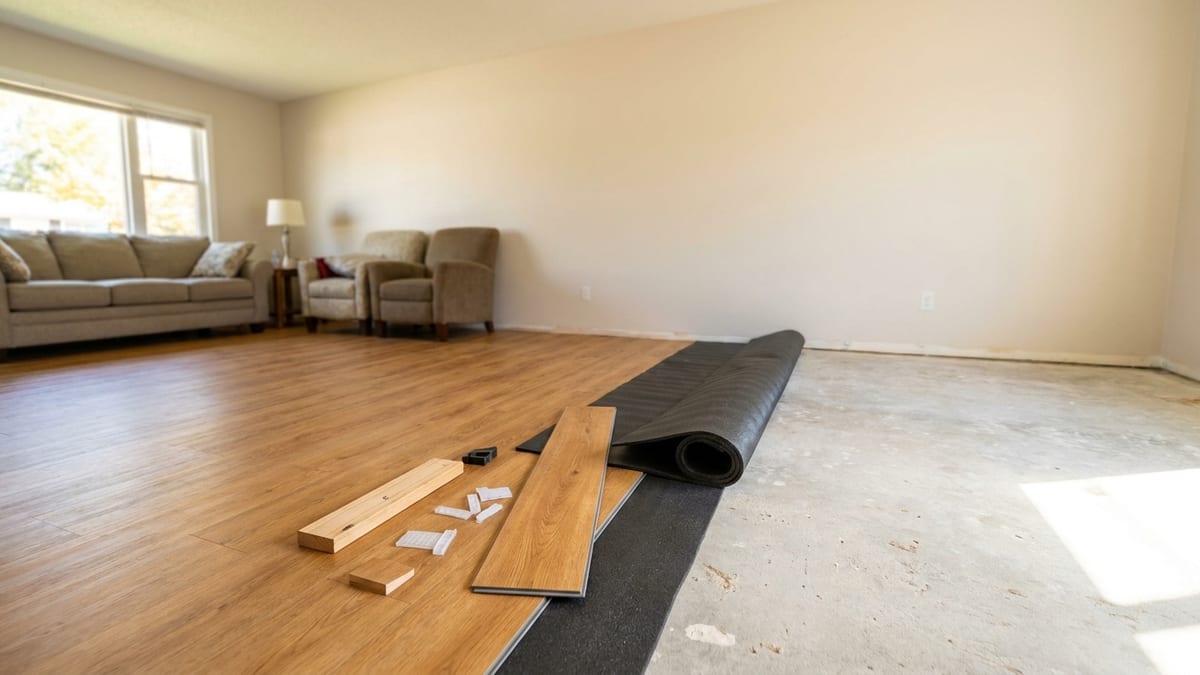
A flooring crew does not care what month it is. There is no frozen ground, no rain delay, no permit window. The subfloor in a January living room is the same subfloor it was in October. And yet most flooring companies watch their schedule go soft for six to eight weeks every winter and treat it like weather.
It is not weather. It is a marketing timing problem, and it costs real money. A two-person install crew producing $7,000 a week at a 40% gross margin generates roughly $2,800 of gross profit per week. Four soft weeks is $11,200 of gross profit gone, while payroll, truck payments, insurance, and shop rent keep running at full price. Two crews, and you are down more than $22,000 before you have made a single mistake on a job.
This post is about the calendar, the campaigns, and the math that keeps those weeks booked.
Why does flooring go slow when the work is indoors?
Because flooring demand follows household budgets and household calendars, not the thermometer.
Three things drive the winter dip:
- Holiday spending hangover. Homeowners spent in November and December. Credit card statements land in January. A $9,000 discretionary interior project is the easiest thing on the list to push to spring.
- The pre-holiday rush pulled demand forward. September through mid-November is peak flooring season precisely because people want new floors before guests arrive. Every job you booked in October was a job that did not need booking in January.
- Nobody is advertising to them. Most flooring companies stop or slash their marketing in the slow season, which is exactly backward. The homeowners are still there. The competition for their attention just left.
That last point is the whole opportunity. A homeowner scrolling on a January evening, looking at a scratched-up hardwood floor or a carpet the dog ruined, is a real buyer. They are just not searching yet. Reaching them at that moment is the entire job of an off-season campaign, and it is the same mechanic that drives whole-home work all year — our flooring lead generation page breaks down how those campaigns get structured by buyer type.
What does a slow week actually cost a flooring company?
Run the number before you decide what an off-season lead is worth. Most owners underprice their own downtime.
| Crew configuration | Typical weekly production | Gross margin | Gross profit lost per idle week |
|---|---|---|---|
| Crew configurationOne 2-person crew | Typical weekly production$6,000-$9,000 | Gross margin35-45% | Gross profit lost per idle week$2,100-$4,050 |
| Crew configurationTwo 2-person crews | Typical weekly production$12,000-$18,000 | Gross margin35-45% | Gross profit lost per idle week$4,200-$8,100 |
| Crew configurationThree crews plus a lead installer | Typical weekly production$20,000-$28,000 | Gross margin35-45% | Gross profit lost per idle week$7,000-$12,600 |
Now compare that to lead cost. If one idle crew week burns $2,800 in gross profit, and 36 exclusive leads at $90 each cost $3,240 and produce nine jobs worth roughly $49,500, the arithmetic stops being a debate. The expensive decision in January is not buying leads. It is not buying them.
Which months are actually slow, and when do you have to start advertising?
The fatal mistake is starting the campaign in the slow month. By then it is too late. Flooring is a considered purchase — homeowners look at samples, get a measure, compare two or three quotes, and often wait for a paycheck cycle. Budget 4 to 8 weeks from first click to signed contract on whole-home work.
| Period | Demand level | What is driving it | When to have ads running |
|---|---|---|---|
| PeriodJanuary - February | Demand levelSlow | What is driving itPost-holiday budgets, no deadline pressure | When to have ads runningStart early December |
| PeriodMarch - May | Demand levelBuilding | What is driving itTax refunds, spring projects, pre-listing prep | When to have ads runningStart early February |
| PeriodJune - August | Demand levelMixed, mid-summer dip | What is driving itVacations, kids home, remodel season | When to have ads runningStart late April |
| PeriodSeptember - mid November | Demand levelPeak | What is driving itPre-holiday deadline, whole-home projects | When to have ads runningStart late July |
| PeriodLate November - December | Demand levelSlowing | What is driving itHolidays, no install windows | When to have ads runningMaintain, do not shut off |
The practical rule: your slow-season pipeline is built 6 to 10 weeks before the slow season starts. If your January calendar is empty, that was a November decision. The same lead-time logic applies across every trade, and we mapped the full year in the guide on seasonal contractor marketing.
How do you fill the slow season without cutting price?
Discounting is the reflex and the worst first move. A 10% cut on a $9,000 job at a 40% margin hands away about a quarter of the profit on that job, and worse, it teaches your repeat and referral buyers to wait for the sale. Use these six levers in order, and only get to price if the first five fail.
- Sell the install date. "Book now and we install in February" is a real benefit during the season when your competitors are quoting April. Scheduling certainty is worth more to a homeowner than 5% off, and it costs you nothing.
- Sell scope instead of discount. The single largest revenue lever in flooring is turning one room into three. A homeowner replacing a living room in the slow season has the time and the empty house to do the hallway and bedrooms too. Quote the whole-home option alongside the single-room option on every estimate.
- Make the measure free, fast, and useful. Bring samples to the house. Show planks against their actual light and their actual furniture. An in-home measure with samples is a sales appointment, and it converts far better than a phone quote.
- Put financing in the ad, not just on the estimate. A $12,000 whole-home install reframed as a monthly payment moves a January buyer who has the desire but not the cash sitting idle.
- Rework the quotes you already lost. Every flooring company has 60 to 200 unsold estimates from the last twelve months. In the slow season those are the highest-ROI list you own. Call them. Not email — call.
- Then, and only then, run a real offer. Free underlayment upgrade, free furniture moving, materials-included pricing. Add value to the package before you subtract from the price.
If you want the schedule filled by February, the campaigns and the follow-up list have to be live in December. Get started here and we will build the off-season plan against your actual crew capacity.
How many leads do you need to fill a slow month?
Work backward from the hole in the calendar, not forward from a budget.
Say you need to add $50,000 in a slow month to keep two crews busy.
- Average job value: $5,500 (a mix of single-room and whole-home work)
- Jobs needed: $50,000 ÷ $5,500 = 9 jobs
- Close rate on exclusive leads: 25%
- Leads needed: 9 ÷ 0.25 = 36 leads
- Lead cost at $90 each: $3,240
- Ad spend to produce them, paid directly to Meta from your own account, typically runs in a similar range depending on market and creative
That is roughly $6,000-$7,000 of total acquisition cost against $50,000 of revenue and about $20,000 of gross profit. Compare that to the $8,000-plus of gross profit two idle crews vaporize in a single week and the decision makes itself.
The ceiling formula that keeps you honest:
Max cost per lead = (average job value × gross margin × close rate) ÷ 3
At $5,500, a 40% margin, and a 25% close rate: $5,500 × 0.40 × 0.25 = $550, divided by 3 = a $183 maximum cost per lead. Almost every exclusive flooring lead lands well under that. Almost every shared lead blows past it once you apply the real close rate.
Why does cost per lead mislead flooring contractors in the off-season?
Because a slow month is exactly when a cheap shared lead looks most attractive and performs worst. Fewer homeowners are shopping, so the same lead gets resold to more contractors, and the price race gets uglier.
| Channel | Cost per lead | Typical close rate | Cost per acquired job |
|---|---|---|---|
| ChannelReferrals and past customers | Cost per lead$0 | Typical close rate40-60% | Cost per acquired jobNear $0 |
| ChannelGoogle Business Profile / organic | Cost per lead$0-50 | Typical close rate20-40% | Cost per acquired job$100-250 |
| ChannelShared marketplace leads | Cost per lead$25-75 | Typical close rate5-12% | Cost per acquired job$400-1,200 |
| ChannelGoogle Ads | Cost per lead$60-200 | Typical close rate15-30% | Cost per acquired job$400-1,300 |
| ChannelMeta advertising | Cost per lead$25-100 | Typical close rate10-20% | Cost per acquired job$250-900 |
| ChannelExclusive leads (performance partner) | Cost per lead$50-200 | Typical close rate20-35% | Cost per acquired job$200-900 |
| ChannelExclusive booked in-home measures | Cost per lead$200-400 | Typical close rate25-40% | Cost per acquired job$600-1,400 |
A $40 shared lead closing at 8% costs $500 per job and delivers a homeowner who is already collecting three bids on price. A $95 exclusive lead closing at 28% costs $339 per job and delivers a homeowner who has spoken to one flooring company: yours. In a slow month, the second one also protects your margin, because you are not the third quote in a bidding war. The full breakdown of that arithmetic lives in exclusive vs. shared leads.
There is a hidden cost in shared leads that flooring companies feel harder than most trades: measure time. An in-home measure with samples is 45 to 75 minutes plus travel. At an 8% close rate you are driving to a dozen houses to sell one job. In a slow month your estimator has the time. In March they do not, and the habit carries over.
What kills off-season flooring leads after they come in?
The same three things, every time.
Slow response
A homeowner who fills out a form on a Sunday evening in January is not in a hurry, which is exactly why contractors let those leads sit. Wrong read. They are not in a hurry to install — they are in a hurry to be answered. The company that calls in five minutes sets the material conversation, the scope, and the price frame, and every quote after that gets compared to yours.
No follow-up past two attempts
Off-season buyers have longer decision cycles by definition. They are planning around a tax refund, a bonus, or a family visit. Two calls and a voicemail is not follow-up. A 30-day cadence of texts, calls, and photo-driven emails is, and it is the difference between a January lead dying and a March install. Steal the sequence from our contractor follow-up system.
Quoting one room when the homeowner would have bought three
The estimator walks into a living room, measures the living room, and quotes the living room. Meanwhile the hallway carpet is destroyed and the two bedrooms match. Always walk the whole floor. Always present the whole-home number next to the single-room number. Let the homeowner shrink it if they want to.
The short version
- Flooring has no weather excuse. The slow season is a demand-timing problem you can advertise your way out of.
- Idle crew weeks cost $2,100-$4,050 of gross profit each. Price your downtime before you argue about lead cost.
- Build the pipeline 6 to 10 weeks ahead. January's calendar is a November decision.
- Sell install dates, scope, samples in the home, and financing before you sell price.
- Judge every channel on cost per acquired job. A $95 exclusive lead at a 28% close rate beats a $40 shared lead at 8%, every time.
- Rework your unsold estimate list. It is the cheapest revenue you will find in February.
Minyona installs and manages the lead generation system for flooring companies through your own Meta ad account, so the ad spend is visible to you and the brand you are building is yours. Pricing is from $50 per qualified lead or from $200 per booked appointment, all 100% exclusive, with a one-time setup fee and no monthly retainer. Book a call and we will map your off-season plan against your crew capacity.
Frequently asked questions
When is the slow season for flooring installers?
For most flooring companies the deepest slow stretch runs from early January through February, after holiday spending dries up, with a second softer dip in mid-summer when families travel. Regional patterns vary, but the pattern is consistent because it is driven by household budgets and calendars, not by weather.
Should flooring contractors discount to fill the off-season?
Discounting is the last lever, not the first. A 10% price cut on a $9,000 whole-home job at a 40% gross margin gives away roughly a quarter of the profit on that job, and it trains repeat and referral buyers to wait for the sale. Sell scheduling certainty, free measure and design help, materials-included pricing, and financing before you touch the price.
How many flooring leads do I need to fill a slow month?
Work backward from revenue. At a $5,500 average job and a 25% close rate, adding $50,000 in a month takes about 9 jobs, which takes roughly 36 leads. At $90 per exclusive lead that is about $3,240 in lead cost that month, plus the ad spend you pay directly to Meta out of your own account.
What should flooring ads say in the off-season?
Sell the install date and the finished room, not the discount. Real before-and-after photography of your own work, a specific offer like a free in-home measure with samples brought to the house, financing framed as a monthly payment, and honest scheduling language such as booking February and March installs now all outperform generic price messaging.
Do flooring leads cost less in the slow season?
Meta advertising costs often soften in January and February because fewer advertisers are bidding after the Q4 retail surge, so cost per lead can improve. Search costs behave differently, since fewer homeowners are actively searching and the clicks that remain stay competitive. The bigger lever is not the lead price, it is reaching planning-phase homeowners before the spring rush starts.