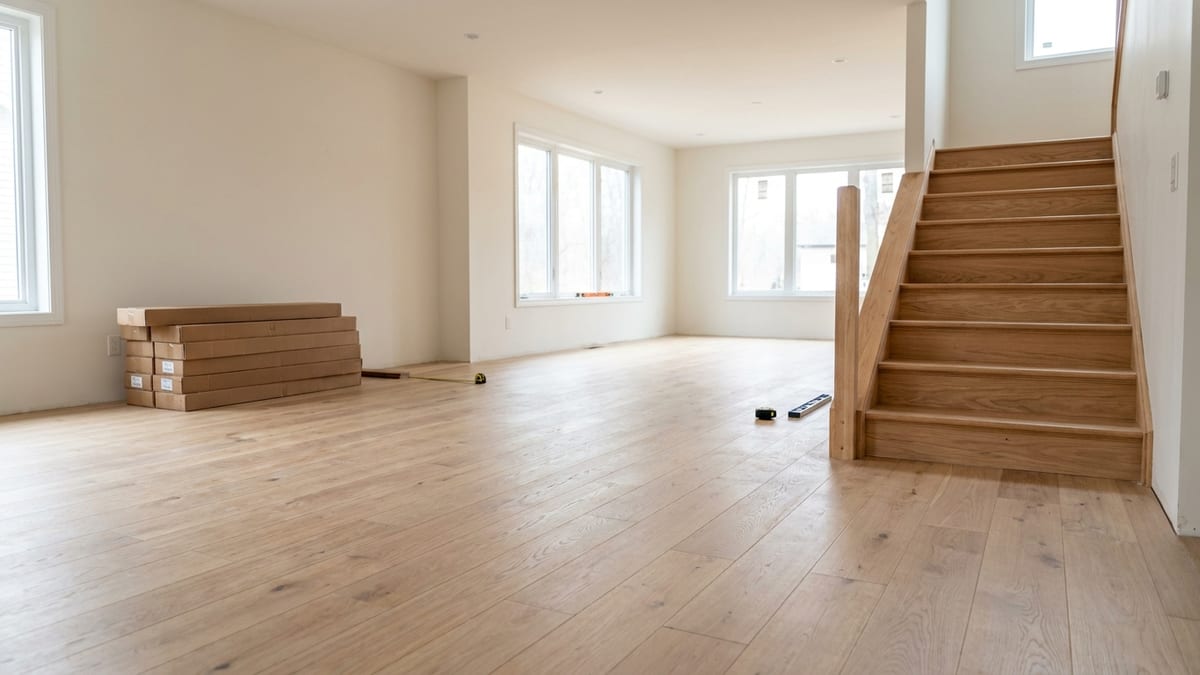
A flooring lead comes in at 7:40 p.m. The form says living room, about 400 square feet, LVP. Your measure tech drives out, measures 400 square feet, quotes $3,600, and wins the job.
Same house had three bedrooms of twelve-year-old carpet, a stained tile entry, and a staircase that is about to look ridiculous next to a brand new floor. None of that got measured, so none of it got quoted. The lead fee, the drive time, the measure hour and the follow-up were identical to the version of this visit that produces an $11,000 contract.
That gap is the entire economics of a flooring company. The lead source did not fail. The measure did.
Why does a flooring lead almost never match the job that gets sold?
Homeowners describe flooring the way they experience it: one room that bothers them. The worn traffic lane in the living room. The bedroom carpet the dog ruined. The cracked tile in the entry. That single complaint is what gets typed into the form, and most flooring contractors treat the form as the scope of work.
It is not the scope. It is the trigger.
Once a homeowner commits to replacing one floor, every adjacent surface becomes a comparison. New wide plank in the living room makes the hallway carpet look dead. A finished staircase landing that dumps onto old builder carpet looks unfinished to anyone standing in it. This is the single biggest advantage flooring has over trades like roofing or water heaters: the product is visible from every room it touches, and the homeowner is standing inside the showroom.
So the job of your campaign is to produce qualified homeowners with a project in motion, and the job of your measure visit is to find every square foot in the house. The channel that produces those homeowners is covered on our flooring leads page, and the rest of this post is about what you do with them once they arrive.
What is each flooring add-on actually worth in 2026?
These are typical installed ranges, and they move with market, material grade and subfloor condition. Use them as a structure, not as your price book.
| Scope | Typical installed range | Notes |
|---|---|---|
| ScopeMain level LVP, 600 to 900 sq ft | Typical installed range$3,500 to $8,000 | NotesThe most common entry point lead |
| ScopeHardwood install or refinish, main level | Typical installed range$10,000 to $25,000 | NotesLonger decision window, higher margin |
| ScopeBedroom carpet, three rooms | Typical installed range$1,500 to $4,000 | NotesCheapest add-on, fastest yes |
| ScopeStair carpet, 13 to 16 treads | Typical installed range$500 to $1,800 | NotesOften priced per tread |
| ScopeHardwood or LVP stair treads and risers | Typical installed range$1,500 to $4,000 | NotesLabor heavy, $100 to $250 per tread |
| ScopeTile entry or mudroom, 60 to 120 sq ft | Typical installed range$900 to $3,000 | NotesHigh visual impact, small footprint |
| ScopeTile bathroom floor | Typical installed range$800 to $2,500 | NotesNatural attachment to hallway work |
| ScopeTransitions, trim, quarter round | Typical installed range$300 to $1,500 | NotesAlmost never optional |
| ScopeSubfloor prep, tear-out, furniture moving | Typical installed range$200 to $1,500 | NotesQuote it, do not absorb it |
Stack the common combinations and a one-room lead becomes a whole-floor contract. Main level LVP plus bedroom carpet plus stairs plus a tile entry plus transitions lands in the $8,000 to $18,000 band without a single upsell that the homeowner did not already want.
Why is cost per lead the wrong number for flooring contractors?
Cost per lead tells you what you paid to get a phone number. It tells you nothing about what the phone number produced. A flooring company that measures one room will conclude leads are too expensive, while the company down the road measuring whole houses off the identical lead source will scale the same channel.
Run break-even first. Break-even cost per lead equals average contract value multiplied by gross margin multiplied by close rate. Then take roughly one third of that as your working ceiling so the job still makes money.
| Scenario | Average contract | Gross margin | Close rate | Break-even CPL | Working ceiling |
|---|---|---|---|---|---|
| ScenarioSingle-room only | Average contract$3,600 | Gross margin35% | Close rate25% | Break-even CPL$315 | Working ceiling$105 |
| ScenarioRoom plus carpet and stairs | Average contract$7,500 | Gross margin35% | Close rate25% | Break-even CPL$656 | Working ceiling$219 |
| ScenarioWhole-floor multi-room | Average contract$11,000 | Gross margin35% | Close rate25% | Break-even CPL$962 | Working ceiling$320 |
Example: at a $105 working ceiling you are shut out of almost every exclusive lead channel and forced into shared marketplace leads that close in the single digits. At a $320 ceiling you can pay for exclusive leads, answer them fast, and still run a healthy cost per acquired job. Nothing changed except what your measure tech put on the quote.
That is why the only number worth reporting weekly is cost per acquired job and average contract value side by side. Our breakdown of how much to pay per lead walks the all-in version of that formula, including ad spend and setup.
How do you turn a one-room lead into a multi-room measure?
This is a process, not a personality. Build it as five steps and make every measure tech run it the same way.
- Confirm the whole house on the booking call. Ask how many rooms have flooring the homeowner is unhappy with, how many bedrooms are carpeted, whether there are stairs, and whether anyone else needs to be there. You are setting the expectation that the visit covers the house, not the one room.
- Measure everything on site, including rooms the homeowner did not mention. It costs ten extra minutes. Tell them plainly that you measure the whole home so they have real numbers if they ever expand, and that there is no obligation on any zone.
- Quote in zones with a price on each. Main level, bedrooms, stairs, entry, baths. One combined number forces a yes or no. Five priced zones turn the conversation into which ones, which is a far easier conversation to win.
- Show the transition problem. Walk them to the doorway where new flooring will meet old carpet and explain the threshold, the height difference and the color mismatch. This is not a pressure tactic, it is the actual outcome of a partial job.
- Price the phase-two penalty honestly. If they do bedrooms next year, there is a second mobilization, a second material order, possibly a dye lot difference, and the install crew comes back through a furnished house. Put a dollar figure on it. Most homeowners expand when they see the premium for waiting.
If your measure techs are also your closers, give them a repeatable structure to run. Our contractor sales process framework covers the in-home sequence that turns a measure into a signed contract the same day.
What should a carpet installation campaign actually say?
Carpet is the cheapest entry point in flooring, which makes it the cheapest lead in flooring. That is an advantage if you use it correctly.
A carpet ad pulls a lower cost per lead than a hardwood ad because the homeowner's mental price tag is lower and the perceived commitment is smaller. Those homeowners are not low value. They are early. Many of them are selling a house, moving into a house, or finally dealing with a floor they have hated for five years, and every one of those situations touches more than one room.
What works in the creative:
- Real finished photography from your own jobs. Full rooms, not product swatches. Stairs in the frame.
- Before and after on a single room, because carpet buyers are motivated by how bad the current floor looks.
- A starting price that is honest. Example: carpet installed from $3.50 per square foot with pad and tear-out included. A real number filters the homeowner who was never going to buy.
- In-home measure as the offer, not a showroom visit. The measure is where the multi-room contract happens, so the ad should sell the measure.
What does not work: discount-only hooks, vague "free quote" copy with no price signal, and stock interior photos that look nothing like the homes in your market.
Run carpet as its own ad set inside the flooring campaign rather than its own budget line. You want the cheaper leads flowing in alongside the LVP and hardwood traffic, with the measure process doing the scope expansion. Because these campaigns run in your own Meta ad account, the pixel data and audiences from every one of those carpet leads stay with your company and make the next campaign cheaper.
If you want the leads to be yours alone rather than sold to three competitors at once, read exclusive versus shared leads before you compare prices from any provider.
How many flooring leads do you need to hit a revenue target?
Work backward from revenue, never forward from budget.
Example: a flooring company wants to add $1,500,000 in contracts over twelve months. At a $11,000 blended average contract, that is 137 jobs. At a 25 percent lead-to-sale close rate, that is 548 leads, or about 46 leads a month. At a $100 per-lead fee, that is roughly $4,600 a month in lead fees plus ad spend paid directly to Meta out of the company's own account.
Now run the same target at a $3,600 single-room average. The same $1,500,000 needs 417 jobs, which needs 1,668 leads, which is 139 leads a month. Three times the lead volume, three times the measure visits, three times the install mobilizations, for the same revenue.
That is the whole argument for the multi-room measure in one comparison. Raising your average contract is the cheapest growth lever a flooring company has, because it costs nothing in ad spend.
What kills multi-room flooring contracts after the lead comes in?
- Slow response. Flooring buyers contact several companies in one sitting and book with whoever gets a measure on the calendar first. Our speed to lead breakdown covers the response window that decides contact rates.
- Measuring only what the form said. The single most expensive habit in the trade.
- Quoting one lump sum. It gives the homeowner one decision instead of five, and one decision is easier to say no to.
- Sending a quote by email instead of presenting it. Multi-room scope needs a person standing in the doorway pointing at the transition.
- Material selection stalls. Homeowners who cannot decide on a color stall for weeks. Bring samples to the measure and narrow to three before you leave.
- No follow-up past two attempts. Flooring decisions often sit for three to eight weeks while the homeowner handles other things. A structured sequence out to 90 days recovers contracts that your competitors have already written off.
If your measure visits are already strong and the only missing piece is a steady flow of homeowners with projects in motion, that is a campaign problem. Get started here and we will walk through your average contract, close rate, and the lead volume your market can actually support.
Frequently asked questions
What is a carpet installation lead actually worth?
On its own, a three-bedroom carpet job usually lands between $1,500 and $4,000 installed, which only supports a modest cost per lead. Attached to LVP or hardwood on the main level plus stairs and a tile entry, the same lead commonly produces a $10,000 to $20,000 contract, which is why carpet leads should be priced against the blended ticket and not the carpet invoice.
Should carpet get its own campaign or ride along with LVP and hardwood?
Run carpet as its own ad set inside the flooring campaign rather than as a separate budget. Carpet pulls cheaper leads because the perceived price is lower, and those homeowners convert into multi-room contracts at a good rate once a measure tech walks the whole house, so the volume is useful as long as the measure process is built to expand scope.
How do you get a homeowner to expand from one room to the whole floor?
Measure every room in the house at the first visit, present the quote in zones with a price on each one, and show the transition problem where new flooring meets old. Homeowners expand when they can see what each additional zone costs and when they understand that doing it in phases means a second mobilization charge and a visible seam.
What is the maximum you should pay for a flooring lead?
Run average contract value multiplied by gross margin multiplied by close rate to get break-even, then target roughly one third of that as your working ceiling. Example: an $11,000 average contract at 35 percent margin and a 25 percent close rate breaks even near $962 per lead, so a working ceiling around $320 leaves real profit in the job.
Do stair jobs sell on their own?
Rarely, and they are usually not worth a standalone campaign. Stairs are a labor-heavy attachment of roughly $500 to $4,000 depending on material and tread count, and they sell best when the homeowner is already replacing the floors the stairs connect to.