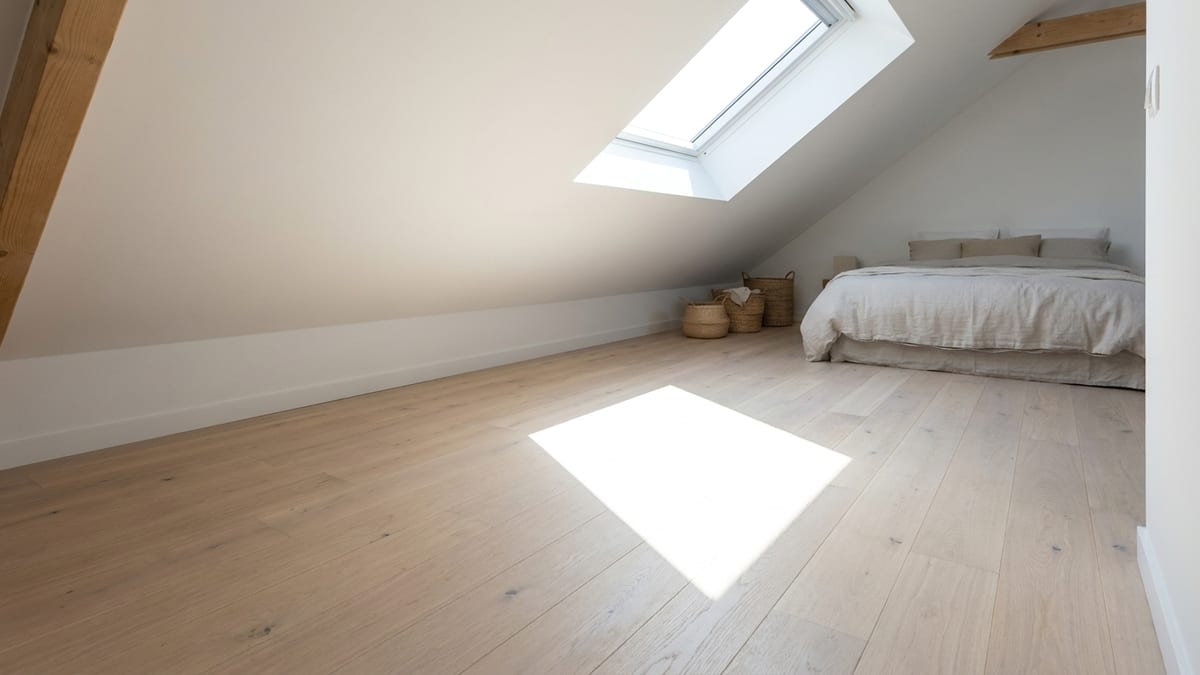
A roofing crew is on the house for two or three days. The tear-off is paid for, the dumpster is paid for, the lead is paid for, and the homeowner has already signed. Every additional dollar sold on that same roof carries almost none of those costs again.
That is the entire argument for skylights and roof ventilation. A fixed skylight installed during a replacement runs roughly $1,500 to $3,000. A venting or solar-powered unit with blinds runs $2,500 to $5,000. A ventilation correction — ridge vent run, soffit baffles, a solar attic fan — runs $400 to $1,500. Attach one of those to a third of your replacements and you have raised your average job value by several hundred dollars without buying a single extra lead.
Most roofing companies treat these as afterthoughts the salesperson mentions if there is time. They should be a priced, photographed, scripted part of every estimate.
Why do skylights and ventilation move the roofing number more than a discount does?
Run it both directions on a 10-job month at a $14,000 average replacement.
Discount 5 percent to win more deals and you are at $13,300 per job. Your close rate might rise, but your gross profit per job just dropped by $700 and nothing else changed.
Attach a $2,400 skylight to three of those ten jobs and a $700 ventilation correction to five of them. That is $7,200 plus $3,500, or $10,700 of additional revenue on the same ten leads. Average ticket moves from $14,000 to $15,070. Same marketing spend. Same crews. Same calendar.
That is why add-on attachment belongs in the lead-gen conversation and not just the sales meeting. Your acceptable cost per lead is a function of average job value. Raise the ticket and the whole budget model loosens. If you are generating replacement demand through exclusive roofing leads, the add-on is the cheapest revenue in the pipeline, because the acquisition cost on it is zero.
What is a skylight or ventilation job actually worth in 2026?
Prices vary by pitch, deck condition, interior finish work, and whether a shaft has to be framed. These are the ranges most roofing companies quote.
| Add-on | Typical installed price | Best moment to sell it |
|---|---|---|
| Add-onSun tunnel / tubular skylight | Typical installed price$750 - $1,800 | Best moment to sell itDark hallway, bath, or closet with no roof access issues |
| Add-onFixed deck-mounted skylight | Typical installed price$1,500 - $3,000 | Best moment to sell itDuring tear-off, when decking is already open |
| Add-onVenting or solar-powered skylight | Typical installed price$2,500 - $5,000 | Best moment to sell itUpstairs bedroom or bath with heat and moisture complaints |
| Add-onReplacing existing skylights | Typical installed price$1,800 - $4,000 each | Best moment to sell itAny replacement where units are 15+ years old |
| Add-onRidge vent run with soffit intake | Typical installed price$400 - $1,200 | Best moment to sell itEvery replacement, as a condition finding |
| Add-onSolar attic fan | Typical installed price$600 - $1,500 | Best moment to sell itHot upstairs rooms, late-summer appointments |
| Add-onBaffle and intake correction | Typical installed price$300 - $900 | Best moment to sell itBlown-in insulation covering the soffit |
Stack two of those and you have added the equivalent of a small bathroom remodel to a job you already sold. On a $14,000 to $25,000 replacement, a $2,400 skylight is a 10 to 17 percent ticket increase from one conversation.
The one to never skip: existing skylights on a roof you are replacing. Flashing around a 20-year-old unit under new shingles is the single most likely future callback on the job. Homeowners understand that argument immediately, and it is true.
Should you run skylight leads as their own campaign or as a roofing add-on?
Start as an add-on. Here is the honest math on why.
A standalone skylight install at $2,400 with a 45 percent gross margin produces about $1,080 of gross profit. If you are paying $50 to $125 for an exclusive lead and closing 20 to 25 percent, your cost per acquired job lands somewhere between $200 and $625. That works — but only if your own crew installs skylights. The moment you sub the work out, the margin thins and the math gets tight fast.
Compare that to a $14,000 replacement where the same lead cost is spread across a much bigger ticket. That is why the sequence matters.
- Attach first. Price skylights and ventilation on every replacement estimate, as standard line items, not as a question.
- Measure attachment rate. Track what percentage of sold roofs include at least one add-on. Under 20 percent is a sales process problem, not a demand problem.
- Add creative to existing campaigns. Put finished skylight interiors into your roofing ad rotation. Daylight in a dark room is the most scroll-stopping image a roofing company owns.
- Then test standalone. Once crews install in-house and attachment rate is above 30 percent, run a separate skylight campaign in the darker months and watch cost per acquired job, not cost per lead.
If you want the broader channel comparison before you build any of this, the complete roofing lead guide breaks down what each source actually costs and closes.
Why shared leads make add-ons harder
When a homeowner's information goes to four companies, every conversation becomes a price comparison on the base scope. Nobody sells a $2,400 skylight into a bidding war — they strip the estimate down to match the cheapest quote. Exclusive leads close at 15 to 25 percent versus 2 to 8 percent on shared, and the ones that do close leave room to sell the full scope. The exclusive versus shared breakdown runs the cost-per-acquisition numbers on that gap.
How do you present the add-on without blowing up the close?
The failure mode is obvious: the homeowner hears a $14,000 roof turn into an $18,000 roof and goes cold. Avoid that with sequencing.
- Document before you price. Photograph the attic, the soffits, the underside of the deck, the existing skylight flashing. Findings sell. Opinions do not.
- Present the roof number alone first. Let them absorb it. Get agreement on the base scope.
- Introduce add-ons as conditions, not products. "Your intake vents are blocked by insulation, which is why the upstairs runs hot and why your last roof aged early."
- Price each one separately with its own yes or no. Three $800 decisions get approved more often than one $2,400 decision.
- Show the alternative cost. Adding a skylight later means opening the new roof. Say the number out loud.
- Put financing on the add-on line. A $2,400 skylight framed as a monthly payment alongside the roof almost never kills the deal.
Remember that an on-site estimate is a sales appointment. The homeowner knows it. Do not pretend the add-on conversation is anything other than part of that visit — just make it a conversation about their house instead of your catalog.
If you want the demand side of this handled while your team works the sales side, get started here and we will scope what a roofing system looks like in your market.
What does the math look like against a revenue target?
Say the goal is $600,000 of added replacement revenue in a year, at a $15,000 average ticket with add-ons attached. That is 40 jobs, or about 3 to 4 per month.
| Close rate on exclusive leads | Leads needed per month | At $125/lead | At $175/lead |
|---|---|---|---|
| Close rate on exclusive leads15% | Leads needed per month23 | At $125/lead$2,875 | At $175/lead$4,025 |
| Close rate on exclusive leads20% | Leads needed per month17 | At $125/lead$2,125 | At $175/lead$2,975 |
| Close rate on exclusive leads25% | Leads needed per month14 | At $125/lead$1,750 | At $175/lead$2,450 |
Those figures are the per-lead fee only. Ad spend is paid directly to Meta out of your own account, and you see every dollar of it.
Now watch what attachment does to the same table. If add-ons lift the average ticket from $14,000 to $15,500, you need roughly four fewer jobs to hit $600,000. That is four fewer months of lead cost, four fewer sales cycles, four fewer crew mobilizations for the same revenue. Run your own numbers through the ROI calculator before you set a budget.
What kills skylight and ventilation leads after they come in?
Three things, in order of frequency.
Slow response. A homeowner who inquires about a leaking skylight has water in a ceiling. That lead is perishable in hours, not days. Whoever inspects first usually writes the job.
No photos of your own work. Skylight buyers are buying an interior result, not a roof component. If your estimate includes a manufacturer brochure instead of a finished room you installed, you are a commodity. Build a library of interior daylight shots.
Subbing without a process. If every skylight requires a call to a sub for availability, your salesperson stops offering them. Attachment rate dies quietly inside scheduling friction.
Seasonal timing worth planning around
Ventilation messaging lands hardest in late-summer heat and at the first ice-dam weather, because the symptom is happening while the homeowner reads the ad. Skylight messaging lands in the short-daylight months and again in early spring, when a dim room is already on the homeowner's mind. Build creative for both windows now rather than reacting to them.
What should a roofing company do first?
Start with the estimate, not the ad account. Add skylight and ventilation line items with real prices to every replacement proposal, train the crew to photograph attic conditions on every inspection, and track attachment rate as a number on the weekly scorecard.
Then fix the top of the funnel. More replacement appointments multiply everything downstream, because every add-on dollar rides on a lead you already paid for. If you want exclusive roofing demand running through your own Meta ad account, under your own brand, with no retainer, see how roofing lead generation works and book a call. Setup is a one-time $2,000, qualified leads run $50 to $200 depending on trade and volume, and booked appointments run $200 to $400. Specifics on our track record are available on request.
Frequently asked questions
Are skylight installation leads worth running as their own campaign?
Usually not at first. A standalone skylight job runs $1,500 to $5,000, which supports an exclusive lead cost in the $50 to $125 range only if you close well and can install without subbing it out. The higher-return move is attaching skylights and ventilation to roofing leads you are already paying for, because the lead cost is already spent and the crew is already on the roof.
How much does a skylight add to a roof replacement ticket?
A fixed deck-mounted skylight typically adds $1,500 to $3,000 installed during a replacement, a venting or solar-powered unit $2,500 to $5,000 with blinds and controls, and a sun tunnel $750 to $1,800. Replacing existing units that are already on the roof is usually the easiest yes, because the homeowner knows that flashing around a 20-year-old skylight is the most likely future leak on the job.
Does roof ventilation actually sell, or is it just a line item?
It sells when it is framed as a condition finding instead of an upsell. Most homes have intake and exhaust that do not match, and that shows up as hot upstairs rooms, ice dams, or heat-cooked shingles. A ridge vent run, soffit baffles, or a solar attic fan generally adds $400 to $1,500 and is far easier to approve than a price increase on the shingle itself.
What should I pay per lead for roofing work that includes add-ons?
Judge it on cost per acquired job, not cost per lead. Exclusive roofing leads typically run $50 to $200 and close in the 15 to 25 percent range, which puts cost per acquired job near $200 to $1,000. If skylight and ventilation attachment raises your average ticket by several hundred dollars, your acceptable cost per lead goes up with it.
When is the best time of year to push skylight and ventilation offers?
Ventilation messaging performs in the heat of late summer and again at the first ice-dam weather, because the symptoms are happening while the homeowner reads the ad. Skylight messaging performs in the darker months and in early spring remodeling season, when daylight in a dim room is the thing the homeowner is already thinking about.