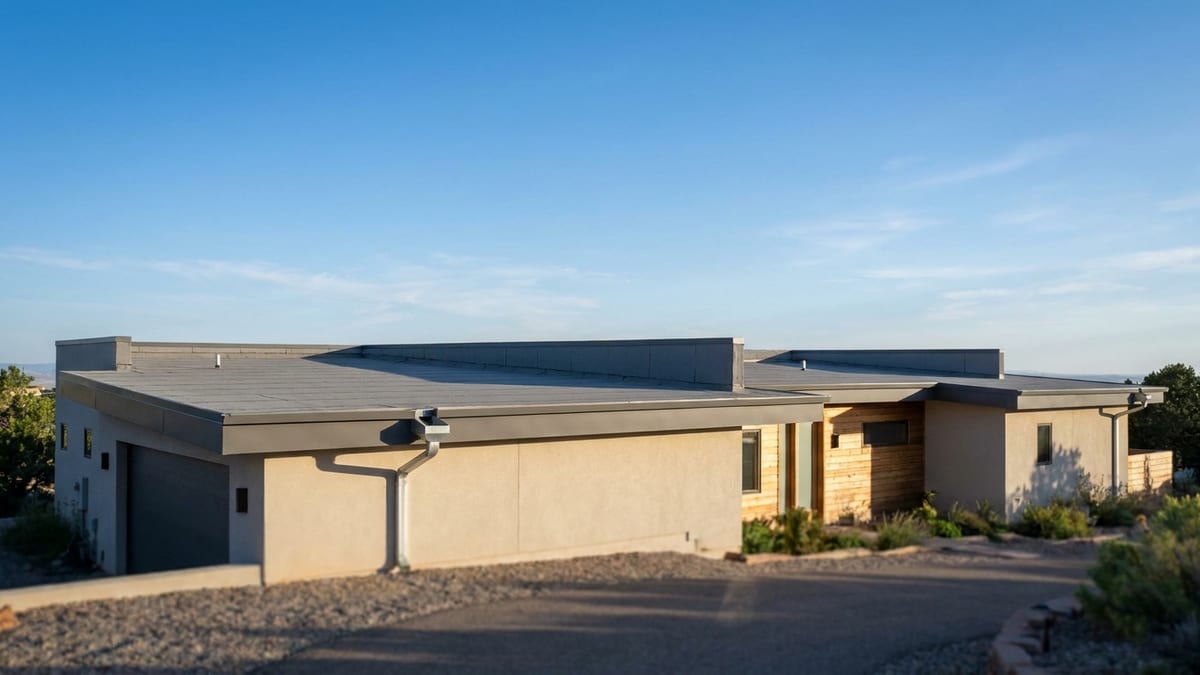
A roofing company runs one lead campaign for everything it sells. Asphalt replacements, repairs, and flat roofs all land in the same inbox at the same cost per lead. The asphalt jobs average $14,000. The flat roof calls come in at two kinds: a $700 patch on a porch deck, and a $22,000 full membrane tear-off with tapered insulation on a mid-century home. All three get the same follow-up, the same ceiling, and the same rep.
That is how companies end up turning down the biggest ticket on the board because it looked like a repair call on the lead form.
Flat and low-slope roofing is the most under-advertised segment in the trade. The search volume is thin, the buyer rarely knows the vocabulary, and most roofers treat it as something they do when asked rather than something they sell. That combination is exactly what makes it worth running as its own campaign.
Why do flat roof leads behave differently from steep-slope roofing leads?
Steep-slope asphalt has a huge pool of homeowners who all know roughly what they own and roughly what it costs. Flat roofs do not. The owner of a low-slope deck usually has no idea whether they have EPDM, TPO, modified bitumen, or a built-up roof with gravel on it. They know there is a stain on the ceiling and water sitting on the roof after it rains.
That changes the lead in two ways.
The leak buyer
Something is dripping. The deck is ponding. There is a bubble in the membrane. This person is not comparing membranes, they are comparing who can be on the roof fastest. The ticket is usually a repair in the $400 to $1,800 range, sometimes a partial section, and the sale is won on the phone by whoever answers and schedules an inspection.
This buyer only pays when your phone coverage is real. If the call goes to voicemail, the job goes to the next number in the search results.
The replacement buyer
This is the one worth building a campaign around. A homeowner with a flat-roofed addition, a porch or garage deck, a modern or mid-century home, or a small mixed-use building that they live above. They have patched it twice. They know the next storm starts the cycle again. They are planning a real replacement and have not called anybody yet.
They are not searching, because they do not have a word for what they want. They are scrolling. That is why this ticket is won months before any search happens, and why our roofing lead generation work for low-slope specialists runs on Meta rather than on search intent alone.
What is a flat or low-slope roof actually worth in 2026?
Price it by scope, not by trade. These are typical installed ranges for residential and light commercial low-slope work.
| Job type | Typical ticket | Decision speed | Who wins it |
|---|---|---|---|
| Job typeLeak repair or patch | Typical ticket$400 to $1,800 | Decision speedSame week | Who wins itWhoever inspects first |
| Job typeCoating or restoration on a sound deck | Typical ticket$1,500 to $5,000 | Decision speed1 to 3 weeks | Who wins itWhoever presents it at the inspection |
| Job typeSmall flat section (porch, dormer, addition, 300 to 800 sq ft) | Typical ticket$3,000 to $9,000 | Decision speed2 to 6 weeks | Who wins itFast quote plus photos |
| Job typeFull residential low-slope replacement with tear-off and insulation | Typical ticket$9,000 to $25,000 | Decision speed1 to 4 months | Who wins itReached during planning |
| Job typeComplex flat-roof home with tapered insulation and parapet detail | Typical ticket$18,000 to $35,000 | Decision speed2 to 6 months | Who wins itReached during planning |
| Job typeLight commercial membrane work | Typical ticketPriced per square foot, commonly $7 to $14 installed | Decision speedBudget cycle driven | Who wins itRelationship plus proof of similar decks |
The spread between the first row and the last row is roughly fifty to one. Any campaign that treats those as one offer is mispriced on both ends.
Why is cost per lead the wrong number for low-slope work?
Because the ceiling is set by the job, not by the market. The formula every roofer should run before shopping channels:
Maximum cost per lead = (average job value x gross margin x close rate) divided by 3
The division by three is what leaves room for overhead and profit instead of breaking even on the job.
Example: a $14,000 membrane replacement at a 40 percent gross margin and a 20 percent close rate. That is $14,000 x 0.40 = $5,600 gross profit, x 0.20 = $1,120 of expected gross profit per lead, divided by 3 = a $373 working ceiling per lead.
Example: a $900 patch at a 45 percent gross margin and a 35 percent close rate. That is $900 x 0.45 = $405, x 0.35 = $141.75, divided by 3 = a $47 ceiling.
Same trade. Same truck. An eight to one difference in what you can pay. That is the entire argument for splitting the campaigns, and it is the same math laid out in our guide to what contractors should pay per lead.
It is also why shared marketplace leads punish low-slope roofers harder than most trades. Across the industry, shared leads commonly run $25 to $75 and close in the 2 to 8 percent range because the same homeowner is handed to several companies. Exclusive leads run $50 to $200 and commonly close at 15 to 25 percent. Run both through the CPA math: a $50 shared lead at a 4 percent close rate is a $1,250 cost per acquired job, while a $150 exclusive lead at a 20 percent close rate is $750. The cheaper lead is the more expensive job. We broke that comparison down in detail in exclusive vs shared leads.
Who actually searches for flat roof work?
Almost nobody, until there is water involved. That is the whole problem and the whole opportunity.
Residential owners
Flat and low-slope sections show up on ranch additions, porch and carport roofs, garage decks, dormers, row homes, mid-century and modern architecture, and anything with a parapet. The owner almost never types "low-slope membrane replacement." They type "roof leak repair near me" or they do not type anything at all and wait for the next storm.
When they do search, they land in the same auction as every asphalt roofer in the county, where roofing clicks are among the most expensive in home services. You pay search prices for a buyer who is not even using the right words.
Light commercial and mixed-use owners
Strip retail, small offices, churches, restaurants, and owner-occupied buildings. These are budget-cycle buyers. They are not reacting to an ad in the moment, but they do remember the company that has been showing finished membrane work on their feed for three months when the board finally approves the capital expense.
What this means for channel mix
Keep a small, tight search presence to capture the leak buyer, because that buyer is in-market right now and will not wait. Put the growth budget on Meta, where you can target by homeowner, by zip, and by age of home, and show the one thing that actually sells this work: finished photos of a clean white membrane with proper drainage. Our full roofing lead playbook covers the channel split in more depth.
How do you reach the low-slope replacement buyer before they search?
Four things do most of the work.
- Lead with the symptom, not the product. Ponding water. Ceiling stain. Blistered membrane. Patched three times. Those phrases get the scroll to stop. "TPO single-ply systems" does not.
- Show the before and after from the roof. A gravel built-up deck with standing water next to a finished white membrane with a clean scupper and new edge metal. This is the trade where the photo does the selling, because the homeowner has never seen their own roof.
- Sell the inspection, not the replacement. A flat roof owner cannot tell you what they need and will not commit to a number sight unseen. Offer a documented roof inspection with photos and a written scope. That is a much easier yes than a replacement quote, and the inspection is where coating versus replacement gets decided.
- Qualify on the deck, not on the budget. Ask approximate square footage, the age of the current roof, how many times it has been patched, and whether water is coming in now. Those four answers sort the $700 patch from the $22,000 replacement before a rep ever gets in the truck.
If you want the ceiling and monthly lead count calculated against your own numbers instead of these examples, run them through the ROI calculator or get started here and we will build the campaign against your average ticket and close rate.
How many flat roof leads do you need to hit a revenue target?
Work backward from revenue, never forward from budget.
Example: a roofing company wants to add $500,000 in low-slope replacement revenue over twelve months at a $14,000 average ticket.
- $500,000 divided by $14,000 = 36 jobs.
- At a 20 percent close rate on exclusive leads, 36 divided by 0.20 = 180 leads.
- 180 divided by 12 = 15 leads per month.
- At $150 per exclusive lead, that is $2,250 per month in lead fees.
- Cost per acquired job: $27,000 of annual lead fees divided by 36 jobs = $750, which is about 5.4 percent of the average ticket.
That is a healthy number. Most roofing companies target a cost per acquisition under 10 percent of average job value, which is $900 to $1,200 on a typical replacement.
Now run the same target at a 12 percent close rate, which is what happens when leads sit for a day before anybody calls. 36 divided by 0.12 = 300 leads, or 25 per month, and the lead bill goes from $27,000 to $45,000 for the same revenue. Nothing changed except response time.
Ad spend sits on top of the lead fee and is paid directly by you to Meta out of your own ad account, so you see every dollar of it. That is a separate line, not a markup buried inside a per-lead price.
When should flat roof campaigns run?
The calendar is tighter than asphalt because membranes care about conditions.
- Late winter and early spring: the leak backlog from winter freeze and thaw surfaces. Repair volume peaks. This is the best window to convert patches into replacement inspections.
- Spring through early fall: the install season. Adhesives and seams generally need dry decks and warmer temperatures, so this is when replacement campaigns should carry the budget.
- Late summer into fall: heavy rain exposes ponding and drainage failures. Strong window for inspection offers.
- Late fall and winter: commercial budget conversations and presold spring installs. Volume drops, auction costs drop with it, and you are buying the pipeline for April.
Run the replacement campaign for ten to eleven months a year rather than turning it on in April when every roofer in the market turns theirs on at the same time.
What kills flat roof leads after they come in?
- Slow response on the leak call. Water on the ceiling is a same-day decision. If you are not answering in minutes, you are paying for leads that another company closes.
- Quoting over the phone. Nobody can price a membrane deck without seeing drainage, insulation condition, flashing, and parapet detail. A phone number is not a scope.
- Not photographing the roof. The homeowner has never been up there. If your inspector comes down with photos of standing water and failing seams, the job closes. If they come down with a verbal summary and a number, it stalls.
- One option on the proposal. Present repair, coating or restoration, and full replacement with the expected life of each. Owners who feel cornered into the biggest number go get two more bids.
- No follow-up past three touches. Planning-phase flat roof buyers move on a budget calendar. A 30 to 90 day sequence recovers jobs that first contact never would have closed.
- Blending the numbers. If repairs and replacements share a report, you will never see which campaign is actually producing profit.
The short version
Flat and low-slope roofing has a thin search market, a wide ticket range, and very little competent advertising behind it. The repair buyer is won on speed. The replacement buyer, worth $9,000 to $35,000, is won months earlier with photos of finished membrane work and an inspection offer that is easy to say yes to.
Set a separate cost-per-lead ceiling for each using average job value times gross margin times close rate, divided by three. Track cost per acquired job. Keep repairs and replacements in separate campaigns and separate reports.
If you want exclusive low-slope leads running under your own company name in your own ad account, get started here and we will build the campaign around your ticket, your service area, and your close rate. One roofing company per market.
Frequently asked questions
What do flat roof leads cost in 2026?
Across the roofing industry, Meta leads commonly run $25 to $110, exclusive leads run $50 to $200, and Google search leads run $100 to $500 or more. Flat and low-slope leads sit at the higher end of those ranges because search volume is thinner, but the replacement ticket absorbs it. What matters is cost per acquired job, which should land under roughly 10 percent of your average job value.
How much can a roofer pay for a low-slope replacement lead?
Run average job value times gross margin times close rate, then divide by three. Example: a $14,000 membrane replacement at a 40 percent margin and a 20 percent close rate produces $1,120 of expected gross profit per lead, so the working ceiling is about $373. A $900 patch call at a 45 percent margin and a 35 percent close rate gives you roughly $47.
Should flat roof work get its own campaign or ride along with asphalt roofing?
Give it its own campaign. Flat roof creative, questions, and cost-per-lead ceiling are all different from steep-slope asphalt work, and a blended campaign hides both numbers. A separate campaign also lets you set budget against a different seasonal curve, since membrane installs depend on dry weather and adhesive temperature minimums.
Do homeowners search for flat roof replacement?
Far fewer than you would expect, and usually only after a leak. Most flat roof owners describe the problem as a stain on the ceiling, standing water, or a bubble in the membrane rather than a product name, which is why search-based channels capture only a thin slice of the market and planning-phase buyers are reached earlier on Meta.
Is a coating or restoration job worth advertising?
Only as an attachment or a fallback offer. Coating and restoration tickets commonly run $1,500 to $5,000, which caps your lead cost in the $50 to $120 range. The better play is to advertise the inspection, then let the inspector present coating or full replacement based on what the deck actually looks like.