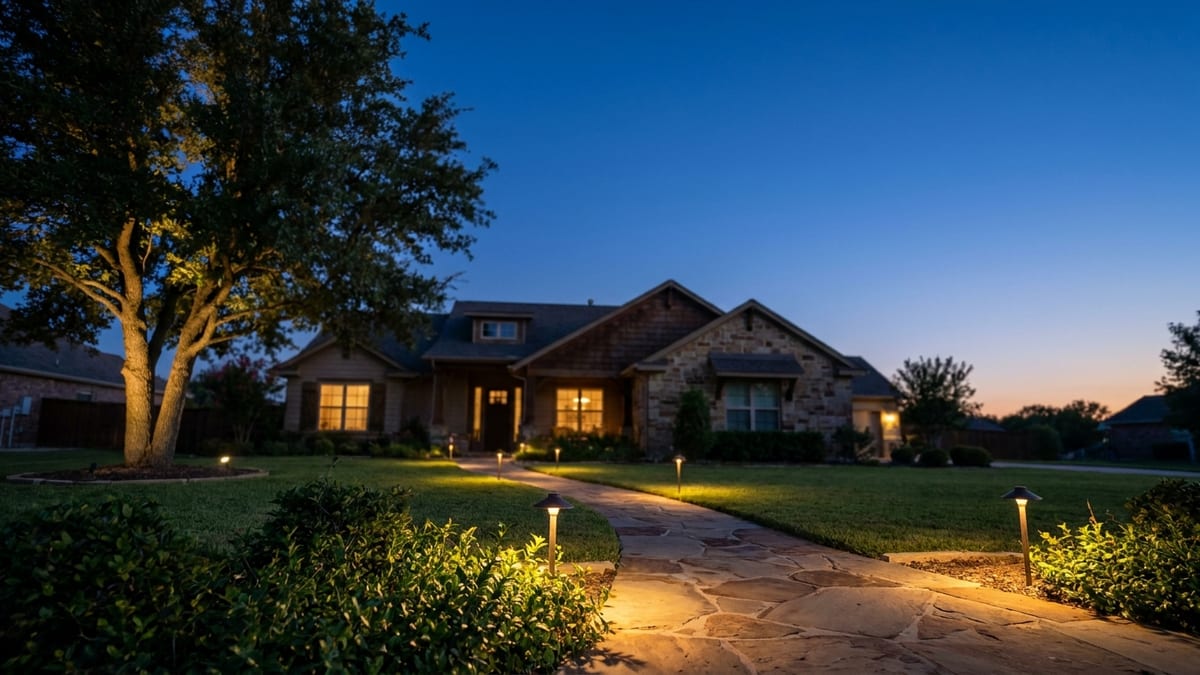
A landscape contractor sells a $22,000 patio and planting job, collects the deposit, finishes the work, and drives away from a yard that goes pitch black at 6 p.m. Nine months later the homeowner writes a $7,000 check to somebody else for lighting. That second check came out of a lead the first contractor already paid for.
That is the entire argument for outdoor lighting. It is not a new trade. It is the highest-margin attachment available to anyone who already sells landscape, hardscape, patio, or pool deck work, and most companies leave it sitting on the table because nobody put it in the proposal.
Why does outdoor lighting raise a landscape ticket more than almost anything else you sell?
Five reasons, and they all come back to cost.
The lead is already paid for. When lighting goes on a proposal for a job you already sold, the acquisition cost of that revenue is zero. You paid for one lead and billed two projects off it.
The mobilization is already paid for. Trenching for a patio, a walkway, or an irrigation zone means the yard is already open. Running low-voltage wire during that window costs a fraction of what it costs to come back in November and cut into finished turf.
The margin is strong. Low-voltage lighting is materials and skilled labor with no permit drama and no heavy equipment. Most contractors who run it well hold gross margins in the 45 to 60 percent range, which is better than planting and usually better than hardscape after material cost.
The install is short. A mid-size package is a one to two day job for two people. That makes it the perfect gap filler between big builds and the perfect thing to schedule in late fall when the dig work is slowing down.
It sells on a demo, not a spreadsheet. You can carry a demo kit, stake four fixtures in the front yard at dusk, and let the homeowner watch their own house light up. No other upsell in landscaping lead generation closes that fast, because there is nothing to imagine.
What is a low-voltage outdoor lighting job actually worth in 2026?
The useful unit of pricing is the installed fixture, which typically lands between $200 and $400 depending on fixture quality, transformer size, wire runs, and how much hardscape has to be drilled or sleeved. From there the package math is simple.
| Job type | Typical fixtures | Installed ticket | Crew time |
|---|---|---|---|
| Job typeEntry curb appeal package | Typical fixtures6 to 10 | Installed ticket$2,000 to $4,000 | Crew time1 day |
| Job typeMid package (front and partial rear) | Typical fixtures12 to 20 | Installed ticket$4,000 to $8,000 | Crew time1 to 2 days |
| Job typeFull property design | Typical fixtures25 to 40 | Installed ticket$8,000 to $18,000 | Crew time2 to 4 days |
| Job typeAttachment to hardscape or pool deck | Typical fixtures4 to 12 | Installed ticket$1,200 to $5,000 | Crew timeSame mobilization |
| Job typeRepair or LED retrofit on existing system | Typical fixturesExisting | Installed ticket$400 to $2,500 | Crew timeHalf a day |
| Job typeAnnual maintenance and re-aim plan | Typical fixturesExisting | Installed ticket$200 to $600 per year | Crew time1 to 2 hours |
Two numbers in that table change how you should market. The $8,000 to $18,000 full property design is a real standalone project worth its own campaign. The $400 to $2,500 repair is not, and it should never share a budget or a cost-per-lead ceiling with the design work, for the same reason nobody runs service calls and full replacements out of one campaign in any other trade.
The maintenance plan line is the quiet one. A few hundred dollars a year per property is not exciting on its own, but it puts your truck back in that yard every spring, which is where add-on fixtures, failed transformers, and referrals come from.
Why is cost per lead the wrong number to judge lighting work on?
Because lighting buyers close at very different rates depending on where you found them, and cost per lead hides all of it.
The formula that actually matters:
Max cost per lead = (average job value x gross margin x close rate) divided by 3
Example: a company averaging $6,000 per lighting package at a 50 percent gross margin, closing 30 percent of its leads, makes $900 of gross profit per lead received. Divide by three and the working ceiling is roughly $300 per exclusive lead. That same company looking at a $120 shared lead that closes at 6 percent is actually paying $2,000 per signed job to produce $3,000 of gross profit, which is not a business.
Now run it the other way. Example: 20 exclusive leads at $150 each is $3,000 spent. At a 30 percent close rate that is 6 jobs. At $6,000 average, that is $36,000 in revenue and $18,000 in gross profit against $3,000 in lead cost. Cost per acquired job is $500. The per-lead price was higher and the outcome was dramatically better, which is the point made at length in our guide on what you should actually pay per lead.
Track three numbers per campaign and nothing else matters as much: cost per lead, close rate, and cost per acquired job. If you only know the first one, you do not know anything.
Should outdoor lighting get its own campaign or ride along with landscape work?
Sequence it. Do not run everything at once.
- Attach first. Put a lighting line item on every landscape, patio, and hardscape proposal for 60 days. Zero marketing cost. Measure your attach rate.
- Add a lighting question to your intake. Every landscape lead gets asked whether the yard has existing lighting. That single question tells your rep whether to bring the demo kit.
- Retarget your own customer list. The cheapest lighting leads you will ever get are past patio and planting customers. They already trust you and they already have a yard worth lighting.
- Then build a standalone campaign. Once your crew can install without subbing it, run lighting as its own Meta campaign with its own creative, its own budget, and its own cost-per-lead ceiling set against the $8,000 to $18,000 full property ticket.
- Keep repairs separate or skip them. Repair leads only pay if you can route them into a retrofit conversation. If your schedule is full of install work, do not buy repair leads at all.
The creative for a standalone lighting campaign is easier than any other trade, because the product photographs itself. Real dusk photos of your own finished properties, shot from the street, beat any stock image or discount offer. Before and after at the same camera angle, daylight on one side and lit on the other, is the single best performing piece of lighting creative most contractors ever run.
If you want exclusive lighting and landscape leads coming into your own ad account with your company name on the ads, see how landscape lead generation works.
When should outdoor lighting campaigns actually run?
Lighting has the opposite calendar of most landscape work, which is exactly why it is useful.
| Window | Demand driver | What to run |
|---|---|---|
| WindowMarch to May | Demand driverDesign season, yards being planned | What to runLighting as a line item inside design and build proposals |
| WindowJune to August | Demand driverLong days, nobody notices the dark | What to runLowest priority, attachment only |
| WindowSeptember to November | Demand driverSun sets early, homeowners notice every night | What to runPeak standalone campaign spend |
| WindowDecember to February | Demand driverEntertaining season, curb appeal, holiday overlap | What to runFront-of-house packages, maintenance plans, next-spring presell |
The fall window is the one most landscape companies miss. Their crews are winding down, their ad spend is winding down, and that is precisely when a homeowner pulls into a black driveway at 5:15 p.m. for the first time all year. Seasonal timing moves cost per lead as much as creative does, which is covered in more depth in our guide to seasonal contractor marketing.
How many lighting leads do you need to hit a revenue target?
Work backward from revenue, never forward from a budget.
Example: a landscape company wants to add $300,000 of lighting revenue in a year.
- Average lighting ticket: $6,000
- Jobs needed: $300,000 divided by $6,000 = 50 jobs
- Close rate on exclusive leads: 30 percent
- Leads needed: 50 divided by 0.30 = 167 leads
- Per month: about 14 leads
- At $150 per exclusive lead: about $2,100 per month in lead cost
- Gross profit at a 50 percent margin: $150,000
That is $25,000 of annual lead cost producing $150,000 of gross profit, before you count a single attachment sold off a landscape job that was already going to happen. Change any input and the plan changes. If your close rate is 18 percent instead of 30, you need 278 leads, not 167, and the fix is almost always the sales process rather than the lead source.
What kills outdoor lighting leads after they come in?
Slow contact. Lighting is an emotional purchase made at night on a phone. The homeowner saw a lit yard, pictured their own, and filled out a form. That feeling has a short shelf life. If the first call happens the next business day, the energy is gone. Our breakdown of speed to lead is the whole fix.
Daytime appointments. You cannot sell lighting at 11 a.m. Book the demo for dusk. Yes, that means evening appointments in October. That is the job.
Quoting by fixture count on the phone. A homeowner who hears a number before they see the effect is comparing you to a box store kit. Give a range, explain what drives it, and get the demo on the calendar.
No photos of your own work. Lighting is judged entirely on how it looks. A portfolio of your own dusk shots closes jobs. Manufacturer brochures do not.
No design. Lighting sold as a quantity of fixtures loses to lighting sold as a plan: which tree gets uplit, where the path lights stop, how the facade reads from the street. Charge for the design, credit it against the install, and the close rate climbs.
Nobody re-aims it. Fixtures shift, plants grow, transformers fail. The company that sold the system and never came back loses the add-on fixtures and the referral to whoever answered the maintenance call.
The short version
Outdoor lighting is the cheapest revenue a landscape or hardscape company can add, because most of it attaches to leads you already paid for. Price it per installed fixture, attach it on the first appointment with a demo kit, and keep repair work on a separate budget from full property design. When you do build a standalone campaign, spend heaviest from September through December, set the cost-per-lead ceiling against a $6,000 to $18,000 ticket rather than a $400 repair, and judge the whole thing on cost per acquired job.
If you want exclusive lighting and landscape leads running through your own Meta ad account, under your company name, with you paying Meta directly and paying for results only when they arrive, get started here.
Frequently asked questions
Are outdoor lighting leads worth running as their own campaign?
Yes, once you have a crew that can install and aim a system in house, because a full-property package of $8,000 to $18,000 supports a real lead cost. Before that, lighting makes more money as an attachment to patio, hardscape, and landscape design jobs you already sold, since the lead is already paid for and the crew is already on site.
What does a low-voltage outdoor lighting job cost in 2026?
Installed low-voltage fixtures typically run $200 to $400 each including transformer, wire, and labor, which puts an entry curb appeal package around $2,000 to $4,000, a mid package around $4,000 to $8,000, and a full property design at roughly $8,000 to $18,000. Repairs and LED retrofits on an existing system usually land between $400 and $2,500.
What is the maximum you should pay for an outdoor lighting lead?
Run the formula average job value multiplied by gross margin multiplied by close rate, then divide by three. Example: a $6,000 ticket at a 50 percent margin and a 30 percent close rate gives $900 of gross profit per lead, so roughly $300 is a workable cost-per-lead ceiling on exclusive leads.
When should outdoor lighting campaigns run?
Late summer through early winter is the strongest window, because the sun sets early enough that homeowners notice a dark yard every single evening. Spring works for design and build packages sold alongside patio and planting projects, and midsummer is the weakest stretch since nobody is home in the dark.
Why do outdoor lighting leads go cold so fast?
Because the purchase is emotional and visual, and the feeling fades. The homeowner saw a lit yard on a phone at 9 p.m., and if nobody calls within minutes and gets an evening demo on the calendar inside a week, the project moves to next year. Speed of contact and an after-dark appointment matter more here than price.