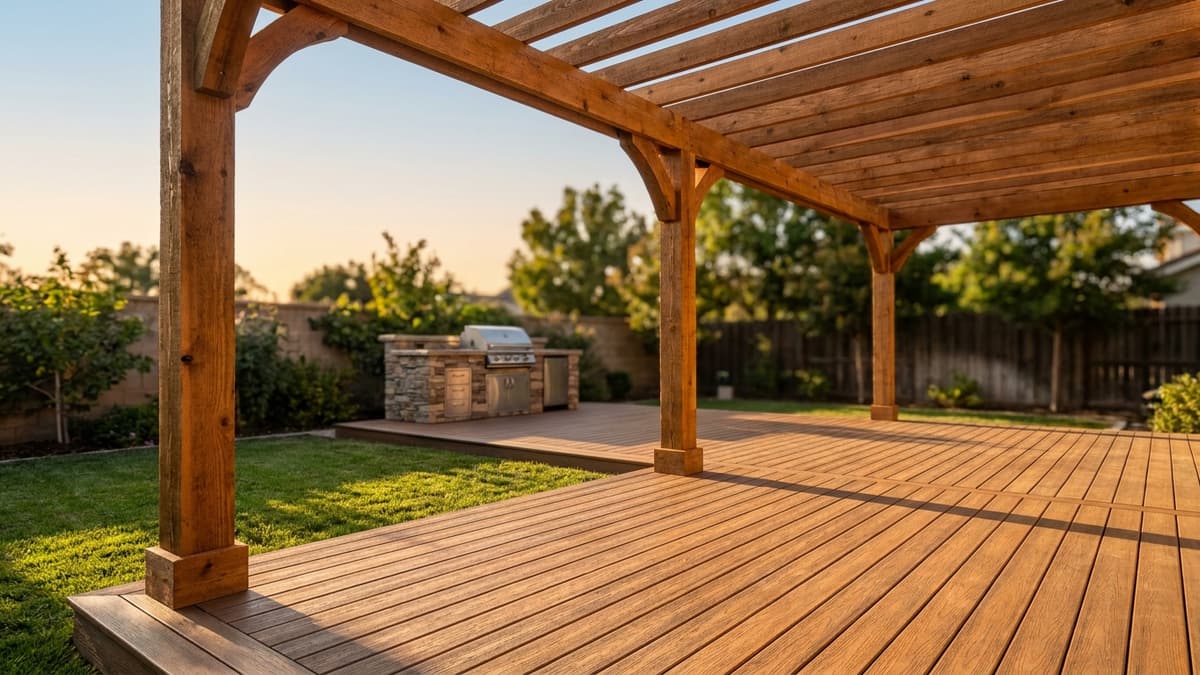
A deck builder quotes 400 square feet of composite at $26,000. Same yard, same permit, same crew mobilization: add a cedar pergola over the dining end and a built-in grill island at the far corner and that contract lands closer to $48,000. The crew is on site an extra five to eight days. The lead cost did not move a dollar.
That is the entire argument for taking pergolas, patio covers and outdoor kitchens seriously as a lead strategy instead of treating them as something you mention if the homeowner brings it up. The add-on is the cheapest revenue a deck builder can book, because the expensive part (acquiring the homeowner) is already paid for.
Most deck companies still run one campaign, one offer, and one conversation about square footage and railing color. The homeowners who wanted a covered outdoor room got a deck quote, said they would think about it, and bought the full build from somebody who showed them a picture of one.
Why does the add-on decide your deck year, not the deck?
A deck business has two levers: how many projects you book and what each one is worth. Lead volume is expensive to move. Average ticket is not.
If you book 40 projects a year at $22,000, that is $880,000. Attach a pergola or a cover to one in three of those at an average of $11,000 and you add roughly $146,000 of revenue without generating a single extra lead. Attach an outdoor kitchen to one in eight at $18,000 and you add another $90,000. Same marketing budget, same sales team, same number of appointments.
That is why deck and outdoor living lead generation should never be built around the word "deck" alone. The homeowner scrolling past your ad is not shopping for joists. They are picturing a place to eat dinner outside in August without cooking in direct sun.
The add-on also changes who responds. Shade, cover and cooking creative pulls a different buyer than framing-and-railing creative: typically an older homeowner with equity, a bigger budget, and a longer planning window. That buyer is worth more per appointment and shops less aggressively on price.
What is each outdoor living add-on actually worth in 2026?
Use these as planning ranges and replace them with your own closed-job averages as soon as you have twenty of them.
| Add-on | Typical installed range | Crew days added | What it does to a $22K deck |
|---|---|---|---|
| Add-onFreestanding wood pergola | Typical installed range$4,000 to $9,000 | Crew days added2 to 4 | What it does to a $22K deckLifts ticket to roughly $28K |
| Add-onAluminum or louvered pergola | Typical installed range$8,000 to $15,000 | Crew days added2 to 4 | What it does to a $22K deckLifts ticket to roughly $33K |
| Add-onAttached solid-roof patio cover | Typical installed range$8,000 to $25,000 | Crew days added4 to 8 | What it does to a $22K deckLifts ticket to roughly $38K |
| Add-onGrill island or basic outdoor kitchen | Typical installed range$10,000 to $20,000 | Crew days added4 to 7 | What it does to a $22K deckLifts ticket to roughly $36K |
| Add-onFull outdoor kitchen with counters, fridge, sink | Typical installed range$20,000 to $40,000+ | Crew days added7 to 12 | What it does to a $22K deckLifts ticket to roughly $52K |
| Add-onScreened-in porch conversion | Typical installed range$20,000 to $45,000 | Crew days added10 to 20 | What it does to a $22K deckBecomes the primary project |
Two things drive the spread. Material is the obvious one: cedar costs less than powder-coated aluminum, and a motorized louvered roof costs more than both. The less obvious one is structural attachment. The moment a cover ties into the house framing, you are into flashing, load path, permits and inspection, and the price step is real rather than a markup.
Outdoor kitchens carry the widest spread because scope is undefined until somebody sits down with the homeowner. A grill cutout in a framed island with stone veneer is one number. That same island with a sink, a run of counter, a refrigerator, a gas line and a dedicated circuit is a different trade mix entirely, and if you are subbing the gas and electrical you need to know your real cost before you quote it.
Why is cost per lead the wrong number for outdoor living leads?
Because a lead that ends in a $48,000 outdoor living build and a lead that ends in a $9,000 deck repair are both one lead in the report.
The number that matters is cost per acquired job, and the ceiling you can afford is set by ticket and margin, not by what a competitor told you a lead should cost.
Use the formula: maximum cost per lead equals average job value multiplied by gross margin multiplied by close rate, then divided by three for a working ceiling.
Example: a builder averaging $35,000 on outdoor living projects at a 35 percent gross margin, closing 20 percent of leads. That is $35,000 x 0.35 x 0.20 = $2,450 at break-even, and roughly $816 as a working ceiling. Exclusive leads in this category do not cost anything close to that.
Example: the same builder running a pressure-treated-only deck campaign at an $11,000 average ticket, a 30 percent margin and a 20 percent close rate. That is $660 at break-even and $220 as a working ceiling. Same company, same crews, a ceiling roughly a quarter the size.
That gap is the whole point. Shared marketplace leads look cheap at $40 and then close in the single digits because four other builders got the same homeowner. Run the arithmetic in exclusive vs shared leads and the cheap lead usually turns out to be the expensive one. For outdoor living specifically, where the sale depends on a design conversation and not a price quote, a shared lead is close to worthless: the homeowner is comparing four bids on a project nobody has designed yet.
If you want to run your own version of this with your real numbers, the ROI calculator does the cost-per-acquired-job math in a couple of minutes.
How do you sell the add-on without losing the deck?
The fastest way to kill a deck sale is to present the add-on as a second decision after the deck has been priced. The homeowner already decided, already braced for a number, and now you have reopened the whole thing.
Run it as one project with phases instead. Here is the sequence that works:
- Ask the use question first. Not "how big a deck are you thinking?" but "what do you want to be doing out there, and in which months?" Dinner for eight in July answers the shade question for you.
- Design the whole yard on the first visit. One plan, with the pergola or cover drawn in and the grill island located. The homeowner sees a finished backyard, not a platform.
- Present one price, then break it into phases. Phase one is the deck and the structural footings for the cover. Phase two is the pergola or cover. Phase three is the kitchen. Give each phase a price and an install order.
- Price the "do it now" difference out loud. Footings, framing for the post loads, and the gas and electrical rough-in are dramatically cheaper before the decking goes down. Say that plainly with a number attached.
- Let them cut scope, not your price. If the budget is short, they remove phase three. They do not negotiate your deck price. That protects margin and still books the job.
This is why the appointment has to be set properly in the first place. A design conversation this long needs both decision makers present, a time slot that is not squeezed between two other stops, and a homeowner who already understands that an on-site estimate is a sales appointment where they will get real pricing. Set that expectation on the booking call and your sat rate stops being a problem.
Speed still decides who gets the appointment at all. Outdoor living buyers submit to two or three companies in an evening, and the one who calls inside five minutes books the design visit. The arithmetic in speed to lead does not change because the ticket got bigger.
Ready to run outdoor living as its own offer instead of an upsell? See how exclusive decking and outdoor living leads are generated through your own Meta ad account, with the leads branded as your company.
Should pergolas and outdoor kitchens get their own campaigns?
In most markets, start with attachment and graduate to separate campaigns.
Phase one: attach inside the deck campaign
Keep one budget, but replace half your creative. Lead with finished outdoor living photography: a pergola casting striped shadows over a dining table, a cover with a ceiling fan running, a grill island with the counter set. Put the words "deck, pergola and outdoor kitchen" in the ad copy. Add one question on the form: "Are you considering shade or cover as part of this project?"
That one question does two jobs. It sorts your leads before anyone calls, and it gives the rep a reason to open the design conversation instead of asking for square footage.
Phase two: split the campaigns
Once you can see that cover-interested leads close at a higher ticket, split them out. The shade and cover campaign gets its own budget and its own cost-per-lead ceiling, because it is selling a $12,000 to $25,000 project to a homeowner who may already have a deck. That last part matters: a patio cover campaign reaches an entirely separate market of homeowners with an existing deck or patio they stopped using in July.
Phase three: outdoor kitchen as a standalone offer
This is the last one to break out, and only if your crews own the build. Standalone outdoor kitchen demand is thin in most metros. The campaign works best as a retargeting layer aimed at everyone who engaged with your deck and cover ads in the last 180 days, which costs very little and reaches people who have already seen your work.
All three phases run on the same pixel and the same audience data, which is why the ad account needs to be yours. Campaigns run in your account keep the pixel history, the retargeting lists and the lead records with your company, and that compounding data is what makes the phase three retargeting cheap.
How many leads do you need to hit a revenue target?
Work backward from revenue, never forward from budget.
Example: a builder wants to add $600,000 in outdoor living revenue next season at a $30,000 average project value. That is 20 projects. At a 20 percent lead-to-sale close rate, that is 100 leads. Spread across a six-month selling window, that is roughly 17 leads a month.
At an exclusive lead cost in the $50 to $200 range plus ad spend paid directly to Meta out of the contractor's own account, the acquisition math on a $30,000 ticket is not close. The constraint is almost never lead cost. It is crew capacity and how many design appointments your sales team can actually run in a week during April and May.
Size the campaign to what you can build. Twenty extra leads a month you cannot quote inside 48 hours is worse than ten you can.
When should these campaigns run?
| Window | What to run | Why |
|---|---|---|
| WindowJanuary to March | What to runFull outdoor living design offer | WhyHomeowners plan spring projects 8 to 12 weeks early and auctions are cheaper |
| WindowApril to June | What to runDeck plus cover, install-date urgency | WhyPeak demand, sell the slot not the discount |
| WindowJuly to August | What to runShade and cover first | WhyThe deck is unusable at 3 p.m. and the homeowner knows it |
| WindowSeptember to October | What to runKitchens, fire features, next-season booking | WhyBuyers who waited now book for spring at a locked price |
| WindowNovember to December | What to runRetargeting and quote revival only | WhyLow volume, cheap impressions, warm list |
The July and August window is the one most deck builders waste. That is the exact moment a homeowner who already owns a deck decides they need a roof over it. Shade creative in the hottest four weeks of the year is the cheapest attention you will buy all season.
What kills outdoor living leads after they come in?
Four things, in order of how often they happen.
Slow quoting. A design project takes real drafting time, and builders let a week pass. By day seven, two other companies have presented. Get a concept and a range in front of the homeowner inside 72 hours, then refine.
Quoting the deck only. The homeowner asked about a deck, so the rep quotes a deck, and the pergola conversation never happens. Make the use question mandatory on every appointment.
No photography of your own work. Nobody buys a $40,000 outdoor room from a stock photo. Make the crew shoot every finished project at golden hour, with the furniture staged and the grill on. That library is the single most valuable marketing asset a deck builder owns.
No follow-up after the first no. Outdoor living buyers often delay a season. A quote from last August is a warm lead in February. Builders who run a 90-day drip and a next-season revival sequence book jobs their competitors wrote off.
The short version
The deck is the entry point. Pergolas, patio covers and outdoor kitchens are where the margin lives, and attaching them costs you nothing in lead spend. Lead with finished outdoor living imagery, ask the use question before the size question, design the whole yard on visit one, and quote it in phases so the homeowner cuts scope instead of cutting your price. Then judge the entire program on cost per acquired job, because a $35,000 outdoor living build supports a lead cost many times higher than a basic deck quote does.
If you want campaigns built around the full outdoor living ticket instead of a deck square-footage offer, running in your own ad account with exclusive leads delivered in real time, get started here and we will walk through the numbers for your market.
Frequently asked questions
What is a pergola or patio cover actually worth in 2026?
A pergola typically runs $4,000 to $15,000 installed depending on span, material and whether it carries a louvered or motorized roof, while a solid-roof patio cover tied into the house usually runs $8,000 to $25,000 because it involves structural attachment, flashing and often permits.
Should outdoor kitchens get their own lead campaign?
Only after your deck campaigns are producing consistently and your crews can build the island without subbing out the masonry and gas work. Until then, outdoor kitchens should ride along as an attachment inside your deck and outdoor living campaigns, because standalone kitchen volume in most markets is too thin to hold a separate budget.
How much can a deck builder pay for an outdoor living lead?
Run average job value multiplied by gross margin multiplied by close rate, then divide by three for a working ceiling. Example: a $35,000 average outdoor living project at a 35 percent margin and a 20 percent close rate gives $2,450 at break-even and roughly $816 as a working ceiling, which is far above what exclusive leads actually cost.
When should pergola and outdoor kitchen campaigns run?
Start 8 to 12 weeks before your local build season opens, which in most markets means January through March, and keep running through midsummer. Shade and cover offers also perform in the hottest weeks of the year, when homeowners are looking at a deck they cannot use between noon and six.
Do add-ons slow down the deck sale?
Only if you present them as a second decision after the deck is priced. Design the full yard on the first visit, present one project with the add-ons visible, then quote it in phases with an install order, so the homeowner is choosing scope rather than reopening a closed sale.