A roofing company quotes an asphalt replacement at $16,000. The homeowner has 22 solar panels on the south slope. The estimator writes "we do not handle solar" on the proposal and the job goes to the one company in the county that does, at $21,000. Same house. Same shingles. The second company collected $5,000 more and had almost nobody bidding against it.
That is the whole opportunity in one sentence. Solar panel removal and reinstall is not a side business. It is a qualifier that thins the bid list on a job you were already going to quote, and most crews hand it away because nobody wants to learn the detach and reset.
Why do roofing companies keep losing solar homes?
Rooftop solar has been going on American homes in volume for more than a decade. Those arrays were mounted on roofs that already had years on them. The shingles underneath are now at the end of their life while the panels have fifteen or twenty years left. Somebody has to pull the array, reroof, and put it back.
Most roofing companies will not, for four reasons, and all four are solvable.
- They do not want the liability of handling someone else's electrical equipment.
- They do not know whether the solar warranty survives a non-authorized crew touching the modules.
- They cannot price it, so they guess high and lose, or guess low and bleed.
- They have no process for the leased systems, where the homeowner does not even own the panels.
Every one of those is a procedure problem, not a trade problem. A roofing company that builds the procedure once gets to quote a job that three of its four competitors will decline. That is a structural advantage, and it is a better use of a dollar than another generic shingle ad. If you are still pricing your main campaign off a blended cost per lead, start with the ticket math on our roofing leads page and then come back to this.
What actually happens on the job
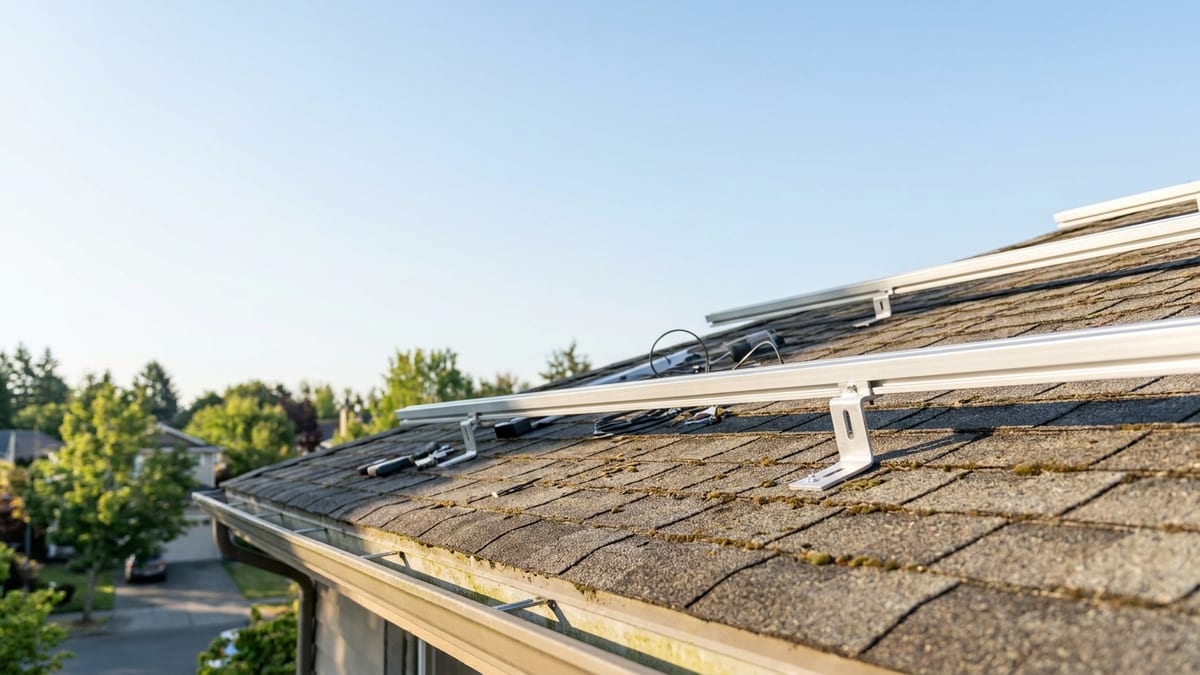
The crew or the solar sub disconnects the system, labels and removes the modules, pulls the racking, stages the panels somewhere safe, and then you reroof normally. New flashings and new mounts go in on the reinstall, not the old ones. The array goes back up, the system gets reconnected and recommissioned, and production is verified. Add a day on each end for a typical residential array.
What does solar removal and reinstall actually pay in 2026?
Price the R and R as its own line item on the proposal, never buried in a square price. Homeowners accept it when they can see what it is. They argue with it when it looks like padding.
| Scenario | Typical installed range | What drives the number |
|---|---|---|
| ScenarioAsphalt replacement, no solar | Typical installed range$9,000 to $18,000 | What drives the numberSquares, pitch, layers, decking |
| ScenarioSolar detach and reset only | Typical installed range$1,500 to $6,000 | What drives the numberPanel count, racking type, electrician, staging |
| ScenarioAsphalt replacement under a 20 panel array | Typical installed range$12,000 to $24,000 | What drives the numberRoof plus R and R plus new mounts and flashings |
| ScenarioPremium or metal roof under solar | Typical installed rangeUp to roughly $35,000 | What drives the numberMaterial upgrade plus R and R on a longer-life roof |
| ScenarioBattery, string inverter move, or conduit rework | Typical installed rangeAdd $500 to $3,000 | What drives the numberElectrical scope beyond the modules |
Typical detach and reset labor runs in the neighborhood of $100 to $300 per panel, which is why panel count is the first number you need on the phone. A 12 panel array and a 36 panel array are not the same job and should never get the same quoted range.
Why is cost per lead the wrong number on a solar roof?
Because a channel that produces fewer, more expensive leads can still be the cheapest way to buy a job. The number that matters is cost per acquired job, and the two inputs that move it are close rate and ticket.
Example: you pay $90 a lead for generic roofing and close 18 percent, so your cost per acquired job is $500 on a $14,000 average ticket, or 3.6 percent of revenue. You pay $180 a lead for solar roof leads and close 30 percent because two of the three competitors declined to bid, so your cost per acquired job is $600 on a $21,000 average ticket, or 2.9 percent of revenue. The expensive lead is the cheaper job.
Run your own ceiling before you argue with anyone's price list:
- Average job value for a solar roof, all in with the R and R.
- Multiply by your gross margin as a decimal.
- Multiply by your realistic close rate on exclusive leads.
- Divide by three. That is your working cost-per-lead ceiling.
Example: $21,000 times 0.30 times 0.25 equals $1,575, divided by three equals a $525 ceiling. Nothing on the market costs that, which tells you the constraint here is not lead price. It is whether you can quote the work at all. If this formula is new to you, our guide on how much to pay per lead walks the full version.
How do you reach a solar homeowner before they search?
You cannot buy a clean "has rooftop solar" audience. What you can do is let the creative do the filtering, which is how every narrow home improvement offer gets bought on Meta.
Let the photo qualify the click
The winning image is not a pretty finished roof. It is panels detached and set aside on shingles, mid-job. A homeowner with an array scrolls past a hundred roofing ads a month and has never seen their exact situation in one. That photo stops them. The copy names the problem in plain language: panels come off, roof goes on, panels go back, one crew, one contract, one warranty conversation.
Sell the sequencing, not the shingle
This buyer's real fear is doing it twice. They are worried that the roof gets replaced now and the panels come off again in four years, or that the solar company and the roofer each blame the other for a leak. Your ad and your landing page should answer that: the panels only come off once, the mounts and flashings are new, and one company owns the result.
Work the planning window
This is not an emergency buyer unless there is active water. Most of them have been thinking about it for a year. They are the same profile as every planning-phase exterior buyer, which means the campaign has to be in front of them months before they ever type anything into a search bar. Our guide to getting roofing leads covers how the planning-phase channel differs from storm and search.
Build the solar installer referral lane at the same time
Local solar companies get this call constantly and most of them do not want to coordinate a reroof. Be the roofer they hand it to. That costs nothing but a conversation and a reliable turnaround.
If you want your own numbers rather than these examples, put your ticket, margin, and close rate into the ROI calculator and look at cost per acquired job instead of cost per lead.
What should intake ask on the first call?
Six questions, every time, before anyone drives out:
- Is the system owned, leased, or on a power purchase agreement? A leased array means a third party has to authorize the work, and that changes the timeline.
- How many panels?
- Who installed it, and roughly what year?
- Microinverters or a string inverter? Is there a battery?
- How old is the roof, and is water coming in right now?
- Is the goal to replace the whole roof or to chase one leak?
Those answers decide the quote range, the lead time, and whether the job is realistically yours. A rep who asks them sounds like the only person in the market who has done this before, which is largely true.
How many of these leads do you need to hit a revenue target?
Work it backward from revenue, never forward from budget.
| Input | Example |
|---|---|
| InputAdded revenue goal | Example$600,000 |
| InputAverage solar roof ticket | Example$21,000 |
| InputJobs needed | Example29 |
| InputClose rate on exclusive leads | Example25% |
| InputLeads needed | Example116 |
| InputLeads per month over 12 months | ExampleAbout 10 |
| InputLead cost at $150 each | Example$17,400 total |
| InputCost per acquired job | ExampleAbout $600 |
Ten qualified leads a month is a real, buildable number in most metros. It is also small enough that speed matters more than volume. One missed callback is 10 percent of your month. Our post on speed to lead is the short version of why the first five minutes decide this.
What kills solar roof leads after they come in?
- The "we do not do solar" reflex. Somebody on your phone still says it out of habit after you have launched the offer. Fix the script first.
- Quoting a per-panel number blind. Get the panel count and the inverter type before any number leaves your mouth.
- Ignoring the lease. A leased or PPA system needs the owner's sign-off, and finding that out at the appointment burns the trip.
- Reusing old flashings and mounts. It saves a few hundred dollars and buys you a callback on a brand new roof.
- No production verification at the end. The homeowner will check the app. Check it first, in front of them, and photograph it.
- Slow scheduling. These jobs need two coordination points instead of one. Build the calendar for it or the signed contract sits for six weeks and the homeowner gets nervous.
The short version
Solar panel removal and reinstall adds roughly $1,500 to $6,000 to a roof replacement and subtracts most of your competition from the bid. The buyer is planning-phase, reachable with creative that shows their exact situation, and worth a higher cost per lead than a generic shingle lead because both the ticket and the close rate are higher. Price it as a line item, qualify ownership and panel count on the first call, replace the mounts and flashings, and verify production before you leave.
If you want this running as its own campaign inside your own Meta ad account, with the leads exclusive to your company, get started here and we will walk the ticket math for your market on the call.
Frequently asked questions
How much does solar panel removal and reinstall cost on a roof replacement?
Industry-typical pricing runs roughly $100 to $300 per panel for detach and reset labor, plus new flashings and mounts and an electrician for disconnect and recommissioning. On a common residential array that lands between $1,500 and $6,000 on top of the roof itself, and more when a battery, a string inverter relocation, or a ground-level staging problem is involved.
Do you need a solar company or an electrician to remove the panels?
It depends on the jurisdiction and on the solar warranty. Many systems require a licensed electrician for the disconnect and reconnect, and some manufacturers or installers require an authorized crew to touch the modules or the warranty is affected. Settle that before you quote, either by training and licensing in house or by lining up a solar subcontractor you can call the same week.
Can you target homeowners with solar panels on Meta?
Not directly and not reliably as a checkbox. What works is creative that self-selects: a photo of panels detached on a shingle roof with copy that names the exact problem, so the only people who stop and fill out the form are the ones with an array over an aging roof. You then qualify ownership, panel count, and installer on the first call.
What should I ask on the very first call about a solar roof?
Ask whether the system is owned, leased, or on a power purchase agreement, how many panels there are, who installed it and when, whether there are microinverters or a string inverter, whether a battery is attached, and whether water is coming in right now. Those six answers decide the price, the lead time, and whether the job is even yours to sell.
Is a solar roof lead worth more than a standard roofing lead?
Usually yes, on two counts. The ticket is larger because the R and R rides on top of the roof, and the close rate is higher because fewer companies in the market will bid the work at all. A higher cost per lead is fine here as long as your cost per acquired job stays under roughly 10 percent of the average ticket.