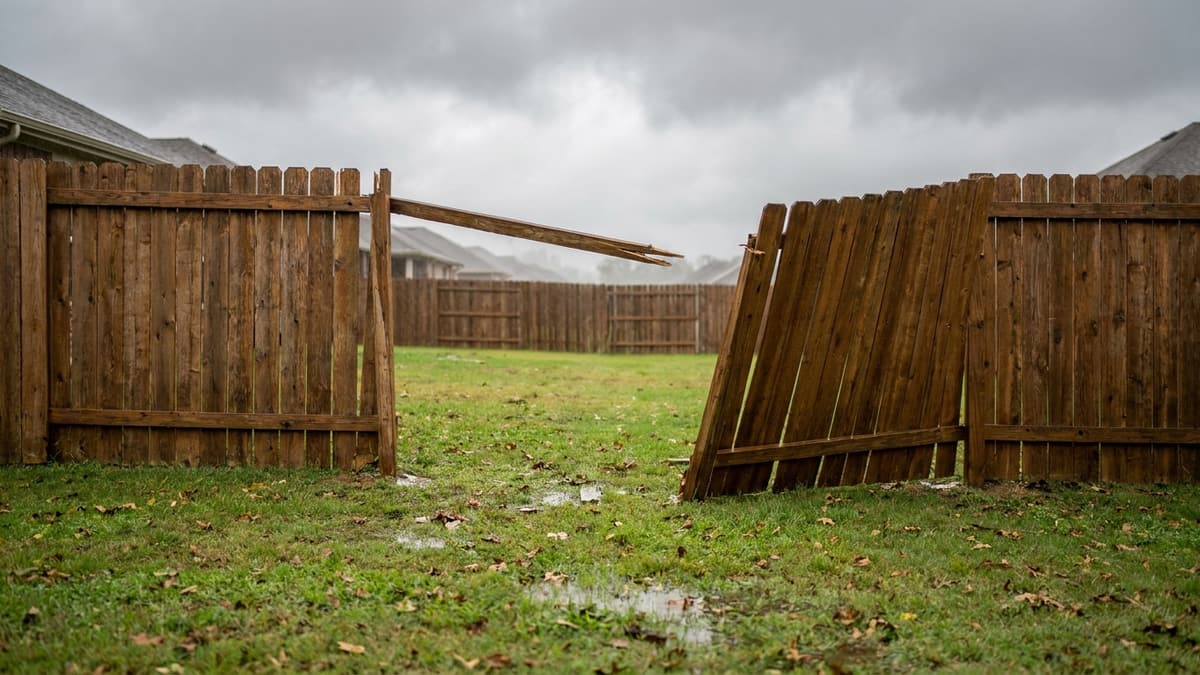
A windstorm rolls through on a Tuesday night. By 7 a.m. Wednesday your voicemail has eleven messages, and nine of them are leaning panels, snapped posts, and a gate that will not latch. Most of those calls are worth $400 to $2,500. The crew was supposed to be setting posts on an $11,000 vinyl install that morning.
That is the real question behind fence repair and storm damage leads. Not whether the calls exist, because they always do. The question is whether you should pay for them, how much you can pay before they lose money, and what they do to the install schedule you already sold.
Why do fence repair leads behave differently from new install leads?
They come from a different homeowner, in a different emotional state, on a different clock.
The repair buyer
Something broke. A post rotted at grade, a panel blew out, a gate sagged until it dragged. The dog can get out, or the pool is no longer enclosed, or the neighbor is already asking about it. This homeowner is not shopping fence styles. They want it fixed this week and they want a number on the phone. They call three companies and hire whoever answers and shows up.
The storm buyer
Same urgency, bigger scope, plus a third party. A storm takes out six panels and two posts, and now there is an insurance claim in the mix. The ticket is larger, the timeline is slower because the adjuster has to come out, and every fence company in the county is running the same ads for the same two weeks.
The install buyer
Nobody made them do anything. They are planning a backyard, enclosing a pool, or finally fencing the property line they bought two years ago. They compare materials, collect bids, and decide over weeks. That buyer carries a $3,500 to $18,000 ticket depending on material, which is why fence lead generation campaigns built for installs can absorb a cost per lead three to six times higher than a repair campaign can.
Three buyers, three price ceilings. Put them in one campaign and the math stops working for all three.
What is each fence job actually worth in 2026?
These are typical installed ranges, not quotes. Your market, your material mix, and your terrain move them.
| Job type | Typical ticket | Decision speed | Who wins it |
|---|---|---|---|
| Job typeGate repair or realign | Typical ticket$200 to $600 | Decision speedSame week | Who wins itWhoever answers first |
| Job typePost reset or two panel repair | Typical ticket$400 to $1,500 | Decision speedSame week | Who wins itWhoever answers first |
| Job typeStorm damage section rebuild | Typical ticket$1,500 to $6,000 | Decision speed1 to 4 weeks | Who wins itWhoever inspects and documents first |
| Job typeChain link install | Typical ticket$2,000 to $4,500 | Decision speed1 to 3 weeks | Who wins itLowest credible bid |
| Job typeWood privacy install | Typical ticket$3,500 to $12,000 | Decision speed2 to 6 weeks | Who wins itFast quote plus proof |
| Job typeVinyl install | Typical ticket$6,000 to $15,000 | Decision speed3 to 8 weeks | Who wins itWhoever reached them during planning |
| Job typeOrnamental aluminum install | Typical ticket$7,000 to $18,000 | Decision speed3 to 8 weeks | Who wins itWhoever reached them during planning |
The spread between a $500 gate repair and a $14,000 aluminum install is roughly 28 to 1. No single cost per lead works across that range, and no single ad works either.
What is the most you can pay for a fence repair lead?
Use the same formula you should be using on every channel: average job value times gross margin times close rate equals break even cost per lead. Then take about one third of that number as your working ceiling so there is profit left.
| Campaign | Avg ticket | Gross margin | Close rate | Break even CPL | Working ceiling |
|---|---|---|---|---|---|
| CampaignSmall repair | Avg ticket$900 | Gross margin40% | Close rate50% | Break even CPL$180 | Working ceiling$25 to $60 |
| CampaignStorm damage | Avg ticket$2,800 | Gross margin40% | Close rate45% | Break even CPL$504 | Working ceiling$120 to $170 |
| CampaignWood install | Avg ticket$7,000 | Gross margin35% | Close rate30% | Break even CPL$735 | Working ceiling$200 to $245 |
| CampaignVinyl or aluminum install | Avg ticket$10,000 | Gross margin35% | Close rate30% | Break even CPL$1,050 | Working ceiling$250 to $350 |
Example: you pay $45 per repair lead, close half of them, and average $900 a ticket at 40 percent margin. That is $90 of lead cost per closed repair against $360 of gross profit, so about $270 left before overhead. Workable. Now pay $150 per lead for that same repair and you have $300 of lead cost against $360 of gross profit. You just worked for $60 and a truck roll.
That second condition is where most fence companies leave money on the table. More on it below.
If you want the general version of this math across channels and trades, how much should you pay per lead walks through the all in cost calculation.
Should fence repair and new install run in the same campaign?
No. Run them separately, for three reasons.
- The ceilings are different. A blended campaign optimizes toward whichever lead is cheapest to generate, which is almost always the repair call. You end up with a calendar full of $600 tickets and an install crew with nothing to do.
- The creative is different. A repair ad shows a leaning fence and says fixed this week. An install ad shows a finished run of vinyl along a clean property line and sells the backyard. One of those is a problem ad and one is a project ad. The same photo cannot do both jobs.
- The follow up is different. A repair lead that is not contacted in an hour is gone. An install lead may take six weeks of nurture. Running them on one cadence means you either smother the planner or lose the emergency.
The practical structure is two campaigns inside the same ad account, each with its own daily budget, its own landing page, and its own cost per lead target. You keep the pixel data, the audiences, and the retargeting lists in one place, and you can shift budget between the two when a storm hits or the install backlog gets thin.
Ready to split your fence campaigns and stop blending two different buyers into one cost per lead? See how our fence lead generation works.
How do you turn a repair call into a replacement quote?
This is the part that decides whether repair leads are a distraction or a feeder. A fence that lost two panels to wind is usually fifteen to twenty five years old, with rot at grade on half the posts and a gate that has been sagging for two seasons. The homeowner called about the two panels. The job in front of you is the whole run.
Inspect the whole line, not the broken part
Walk every post. Push each one. Photograph the rot, the lean, the fasteners, the gate hardware. Five minutes of walking produces the evidence that makes the replacement conversation obvious instead of pushy.
Quote both numbers on the same visit
Give the repair price and the full replacement price side by side, in writing, before you leave. The homeowner is standing in the yard looking at a broken fence. That is the highest intent moment they will ever be in. Making them wait two days for a second quote kills the sale.
Name the repeat cost
Frame it honestly. If six posts are soft, the repair buys two or three years and then the next windstorm takes out a different section. Homeowners can do that arithmetic themselves once somebody shows them the posts.
Follow up on the replacement, not the repair
The repair closes or it does not within days. The replacement quote lives for months. Put it in the CRM with a reminder sequence, and touch it again before the next spring. Our 7 day follow up system is the cadence to copy here.
When are storm damage fence leads worth chasing?
Storm fence work has real money in it, and it has real traps.
What makes it worth it
Tickets run two to five times a standard repair. Several neighbors on the same street usually need the same work, so route density is excellent and your drive time per job collapses. And a damaged fence is visible from the sidewalk, which means the job sells itself to the two houses on either side.
What makes it dangerous
The window is short. Every fence company and a handful of out of market crews turn their budgets on the same week, so auction costs spike and your cost per lead can double for ten days. Insurance slows the close, because the adjuster has to inspect before anything is approved. And if you staff up around a storm month, you own that payroll in the quiet month that follows.
The rules that keep it clean
Document everything with dated photos. Write an itemized estimate an adjuster can actually read, with linear footage, post count, and material spec. Let the homeowner file their own claim and talk to their own carrier. Never tell a homeowner that the claim will be approved, and never offer to cover a deductible. Treat storm work as a layer on top of a steady install base, not as the base itself. The same logic applies in roofing, and storm vs retail roofing leads is a useful parallel if you also run exteriors.
How many fence leads do you need to hit a revenue target?
Work backward from revenue, not forward from a budget.
Example: you want to add $600,000 in fence revenue next year, split 75 percent installs and 25 percent repair and storm work.
- Install side: $450,000 at a $9,000 average ticket is 50 jobs. At a 30 percent close rate that is 167 leads for the year, about 14 a month. At $200 per exclusive lead that is roughly $33,400 in lead cost against $157,500 of gross profit at 35 percent margin.
- Repair and storm side: $150,000 at a $1,400 blended average is 107 jobs. At a 50 percent close rate that is 214 leads, about 18 a month. At $45 per lead that is roughly $9,600 in lead cost against $60,000 of gross profit at 40 percent margin.
Both lines work. They only work because each one is judged against its own ticket. Blend them into one campaign and one cost per lead and you cannot tell which half is carrying the business.
What kills fence repair leads after they come in?
The lead cost is rarely the problem. The handoff is.
- Slow response. A repair caller hires whoever answers. If you are returning calls at the end of the day, you are quoting jobs that are already sold. Speed to lead is not a nice to have on repair work, it is the whole game.
- Refusing to price on the phone. Repair buyers expect a range. Give one, say what moves it, and book the visit. Hiding the number loses the call.
- Shared leads. The same repair request sold to four companies turns a 50 percent close rate into a bidding war at single digit margins. Exclusive vs shared leads runs that math in full.
- No minimum. Driving 40 minutes for a $200 gate adjustment loses money every time. Set a service minimum and a radius, and stick to both.
- Inspecting only the broken panel. The replacement quote you never wrote is the most expensive thing on this list.
The short version
Fence repair and storm damage leads are worth running alongside new installs, on three conditions. They get their own campaign, their own creative, and their own cost per lead ceiling, which for most contractors sits between $25 and $60 on small repairs and $120 to $170 on storm work. Every repair visit is run as a fence inspection with a replacement quote attached. And storm work stays a layer on top of a steady install base instead of becoming the business.
Get those three right and repair calls stop being an interruption to the install schedule and start being the cheapest source of install quotes you have.
Want exclusive fence leads running in your own ad account, split by campaign so you can see exactly what repair work and install work each cost you? Get started here.
Frequently asked questions
Are fence repair leads worth paying for?
They are worth paying for when the ticket math works and the repair visit doubles as a fence inspection that produces replacement quotes. A standalone $600 repair cannot absorb a $150 lead fee plus drive time and crew cost, but the same call on a fifteen year old fence often turns into a five figure replacement quote, which is where the money actually is.
What is the most a fence contractor should pay for a repair lead?
Run average repair ticket times gross margin times close rate, then take about one third of that as your working ceiling. Example: a $900 average repair at 40 percent margin and a 50 percent close rate is $180 of break even, so a working ceiling near $60 per lead, and most contractors should target $25 to $45.
Should fence repair and new install run as one campaign?
No. A repair ticket supports a cost per lead under about $60 and a new install ticket supports $150 to $300, so blending them means you either overpay for repairs or get outbid on installs. Separate campaigns, separate creative, separate ceilings, and judge each one on cost per acquired job.
How should a fence contractor handle storm damage and insurance?
Document the damage with dated photos, write a clear itemized estimate the adjuster can read, and let the homeowner handle the claim with their carrier. Never tell a homeowner their claim will be approved or that insurance will cover the deductible, because neither one is yours to promise.
How many fence repair calls turn into full replacements?
It depends entirely on the age of the fence and whether your crew is trained to inspect the whole run instead of just the broken section. Contractors who photograph every line post, price the repair and the replacement on the same visit, and follow up on the replacement quote convert a meaningful share of their repair calls into install jobs.