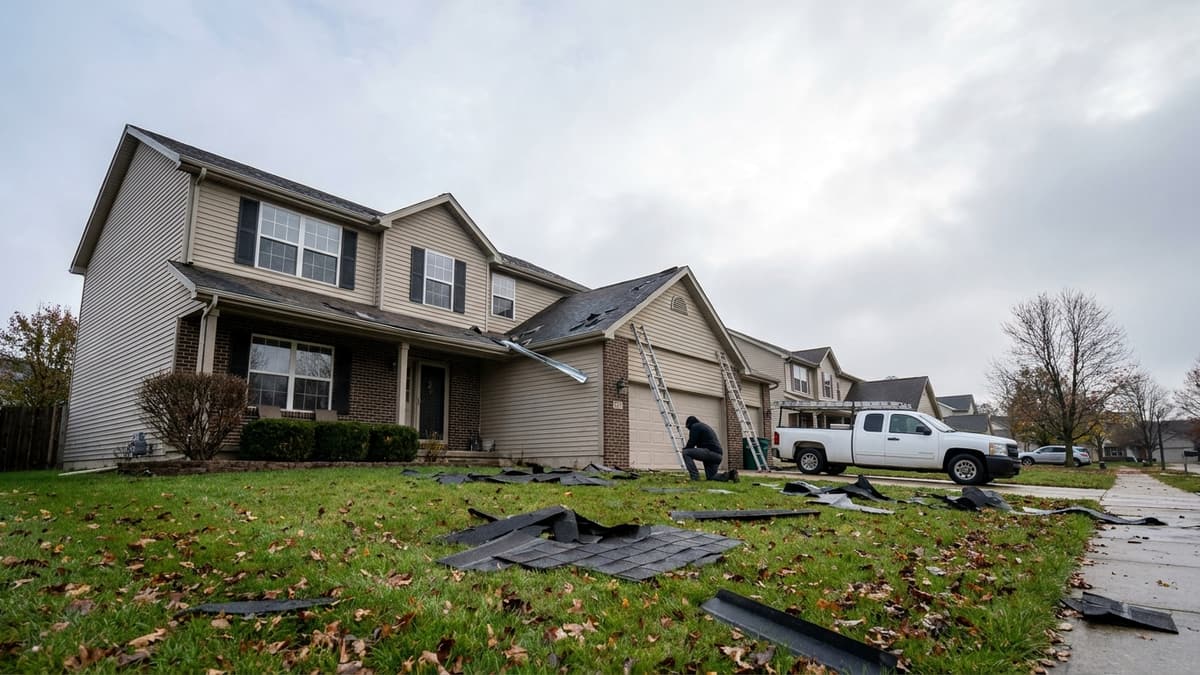
A hailstorm crosses three zip codes on a Tuesday afternoon. By Thursday there are four out-of-state crews knocking doors, two national restoration brands running ads on the same postal codes, and your cost per lead has doubled from what it was on Monday. Six weeks later the storm work is gone and so is the pipeline, because nobody was running anything for the homeowner whose 22-year-old roof is failing quietly and has never filed a claim in her life.
That is the whole problem in one paragraph. Storm and retail are two different buyers, funded two different ways, on two different clocks. Most roofing companies run one budget across both and then wonder why their cost per acquired job swings 300 percent between quarters.
Here is how the two behave, what each one is worth, and how to split the ad budget on purpose instead of by accident.
What is the actual difference between a storm damage lead and a retail roofing lead?
The difference is not the roof. It is who is paying, how fast the homeowner has to move, and how many other companies are standing on the same lawn.
The storm buyer
This homeowner had hail, wind, or a tree limb come through. There is visible damage, or a neighbor already got approved and told them to check. An insurance carrier is going to fund most of the job, so the homeowner's decision is not really about price. It is about trust, speed, and who can handle the claim without making them do paperwork.
Sales cycle: days to a couple of weeks. Close rate on a fast-worked exclusive lead: 20 to 35 percent. Deductible is the only real money objection.
The catch is supply. Every roofer within 200 miles knows a storm hit, because they all watch the same radar and buy the same hail maps. Ad auction costs climb, door knockers arrive, and the homeowner gets six pitches in a week. Whoever inspects first and explains the claim process clearest usually wins.
The retail buyer
This homeowner has a roof at the end of its life. Granules in the gutters, a stain on the bedroom ceiling, a real estate agent telling them it needs to be handled before listing, or a roof that simply looks tired next to the neighbors'. Nobody is funding it but them, which means financing, warranty, and material choice all matter.
Sales cycle: two weeks to three months. Close rate on an exclusive lead: 15 to 25 percent. Price and payment terms are live objections at every appointment.
Retail demand does not spike. It also does not disappear. It is there in February, it is there in a drought year, and it is the only thing that keeps a crew scheduled when the weather cooperates for eighteen straight months. Our roofing lead generation page treats retail and storm as separate campaigns with separate targeting and separate budgets for exactly this reason.
What is each roofing job actually worth?
You cannot set a lead ceiling without knowing what closes on each side. These are typical installed ranges, and they move with region, pitch, material, and layers to tear off.
| Job type | Typical installed price | Who funds it |
|---|---|---|
| Job typeStorm repair, partial slope | Typical installed price$1,500-$5,000 | Who funds itCarrier, minus deductible |
| Job typeFull storm replacement, architectural shingle | Typical installed price$12,000-$25,000 | Who funds itCarrier, minus deductible |
| Job typeStorm replacement with upgrades and code items | Typical installed price$18,000-$30,000 | Who funds itCarrier plus homeowner upgrade |
| Job typeRetail replacement, architectural shingle | Typical installed price$9,000-$18,000 | Who funds itHomeowner, often financed |
| Job typeRetail replacement, premium or metal | Typical installed price$20,000-$35,000 | Who funds itHomeowner, often financed |
| Job typeRetail repair and maintenance | Typical installed price$500-$2,500 | Who funds itHomeowner |
Storm tickets are frequently larger because carrier scopes include items a cash-paying homeowner would decline. Retail tickets are smaller on average but carry no supplement fights, no adjuster reinspections, and no waiting on a check to clear before the crew can be scheduled.
The formula that sets your lead ceiling
Run this per campaign, not per company.
Max cost per lead = (average job value x gross margin x close rate) / 3
Storm campaign: $18,000 x 0.30 margin x 0.30 close = $1,620, divided by 3 = a $540 maximum cost per lead.
Retail campaign: $13,000 x 0.35 margin x 0.20 close = $910, divided by 3 = a $303 maximum cost per lead.
Both ceilings are well above what a good Meta campaign actually costs, which is the point. It also shows why blending them into one number is a mistake. If you hold your storm campaign to the retail ceiling during the two weeks that matter, you get outbid and lose the neighborhood.
Why does cost per lead mislead roofing contractors after a storm?
Because the invoice price of a lead ignores how many other roofers were handed the same homeowner. Cost per acquired job is what your P&L reacts to.
| Channel | Cost per lead | Typical close rate | Cost per acquired job |
|---|---|---|---|
| ChannelReferrals and past customers | Cost per lead$0 | Typical close rate40-60% | Cost per acquired jobNear $0 |
| ChannelSEO and organic | Cost per lead$0-50 | Typical close rate20-40% | Cost per acquired job$100-250 |
| ChannelShared marketplace leads | Cost per lead$25-75 | Typical close rate2-8% | Cost per acquired job$900-3,000+ |
| ChannelMeta advertising | Cost per lead$25-110 | Typical close rate10-20% | Cost per acquired job$250-1,100 |
| ChannelExclusive leads through a performance partner | Cost per lead$50-200 | Typical close rate15-25% | Cost per acquired job$200-1,000 |
| ChannelGoogle search ads | Cost per lead$100-500+ | Typical close rate15-30% | Cost per acquired job$500-2,500 |
| ChannelExclusive booked appointments | Cost per lead$200-400 | Typical close rate25-40% | Cost per acquired job$200-1,200 |
A $50 shared storm lead closing at 4 percent costs $1,250 per job, and you paid for the privilege of racing four other companies to the same driveway. A $130 exclusive lead closing at 25 percent costs $520 per job and your inspector is the only one on the roof. The full math behind that gap is in our breakdown of exclusive vs. shared leads.
There is a second cost almost nobody puts on the board after a storm: inspection time. A roof inspection with photo documentation and a written scope is 60 to 90 minutes plus travel. At a 5 percent close rate you climb twenty roofs to sell one job. Price that at your inspector's loaded hourly cost plus fuel and shared storm leads stop looking cheap in a hurry.
Should you chase the storm or build the retail base?
Both, in this order. Here is the framework.
- Build retail as the base load. Retail campaigns run twelve months and produce a predictable number of appointments per week. That is what your crews and your sales reps are staffed against. If retail alone cannot cover payroll, storm revenue is a bonus you cannot plan around.
- Keep a storm campaign built and paused. Creative approved, audiences saved, landing page live, tracking tested. When the event hits, you turn it on in an hour instead of building it in four days while out-of-town crews knock your neighborhoods.
- Set separate ceilings before the storm. Decide now what you will pay per storm lead and per retail lead. In the middle of a hail event, with your phone ringing and competitors flooding the auction, nobody makes a disciplined bidding decision.
- Staff the phone before you scale spend. A storm lead that sits for two hours is a lead the door knocker already converted. Response time is the whole game here, and our guide on speed to lead covers the four-layer setup that makes a five-minute callback realistic when volume triples.
- Turn storm customers into retail pipeline. Every storm job is a neighborhood, a photo set, and a list of adjacent addresses. Retarget them. That is only possible if the ads ran through your own ad account and your own pixel, which is the difference between building an asset and renting one.
If you want the wider channel picture before you split the budget, our complete guide to getting roofing leads walks through all seven channels and where each one fits.
How do you run a storm campaign without wrecking your cost per acquired job?
Three things matter and everything else is noise.
Geography, tight. Run the affected zip codes and the ring immediately around them, not the whole metro. Wide targeting during a storm event burns money on homeowners with nothing wrong.
Message the claim, not the roof. The storm buyer's real anxiety is the insurance process, not shingle brands. Free inspection, documented report, we handle the carrier paperwork. An on-site inspection is a sales appointment, so say so plainly and set the expectation that a rep will walk the roof and review findings with them.
Cut it off on schedule. Storm campaigns should have a planned end date. When cost per lead climbs past your ceiling for five straight days, the neighborhood is saturated and the money belongs back in retail.
How do you run retail campaigns that fill the off-season?
Retail is a different job entirely. Nobody wakes up wanting a new roof.
Target homeowners by home age and ownership tenure. A 1998 build with the original roof and an owner who has been there twelve years is your buyer. Lead with the symptom, not the product: granules in the gutter, a ceiling stain, a roof that looks a decade older than the neighbors'.
Financing is the retail unlock. A $14,000 number stops most kitchen-table conversations. A monthly payment keeps them going. Put the payment in the ad and again on the landing page.
And run retail hardest in the months your competitors go quiet. Ad costs drop when the storm chasers leave, and the homeowner who calls in January has zero other bids in hand.
If you want to see what your current lead source actually costs you per closed job before you split anything, run your numbers through the ROI calculator and compare it against the exclusive column above.
What budget does each side need?
Work backward from revenue, not forward from what feels comfortable.
Say the goal is $1M in added retail revenue at a $13,000 average ticket. That is roughly 77 jobs. At a 20 percent close rate on exclusive leads, that is 385 leads a year, about 32 a month. At a blended $110 per lead that is roughly $3,500 a month in lead cost plus the ad spend behind it, paid directly to Meta out of your own account.
On the storm side you do not budget monthly. You budget per event. Decide in advance what a single storm response is worth, cap it, and treat overage as a decision rather than a surprise.
Most roofing companies should be running 8 to 12 percent of target revenue on marketing, not a percentage of last year's actual. Budgeting off last year is how a company stays exactly the size it was last year.
The short version
Storm work is a windfall you should be built to catch. Retail work is the business. Run retail as the standing campaign, keep a storm campaign loaded and paused, set separate cost-per-lead ceilings for each, and judge both on cost per acquired job instead of the invoice price on the lead.
Exclusive leads generally run $50 to $200 depending on trade and volume, booked appointments from $200 to $400, with a one-time setup and no monthly retainer. Campaigns run through your own Meta ad account, so the pixel, the audiences, and the storm-neighborhood retargeting lists stay yours when the season ends.
If you want to see what that split looks like against your market, your average ticket, and your close rate, get started here and we will build the math with you.
Frequently asked questions
Are storm damage roofing leads cheaper than retail roofing leads?
Cost per lead is usually lower in the first days after a storm because homeowner intent is high and demand is obvious, then it climbs fast as every roofer in the county floods the same zip codes. Retail leads cost more per lead but are available every month of the year. Judge both on cost per acquired job, not the invoice price.
How long does a storm roofing lead window actually stay open?
Most of the volume lands in the first two to six weeks after the event, and claim filing deadlines in many policies push homeowners to act within a year. The competitive window, meaning the period when you can still book jobs at reasonable cost, is usually shorter than the claim window because out-of-town crews arrive within days.
Should a roofing company build its business on storm work?
Not as the foundation. Storm work is real revenue and worth chasing when it hits, but it is weather-dependent, cyclical, and staffed up by out-of-town competition the moment it happens. Retail replacement demand runs every month and holds margin, so it should be the base with storm layered on top.
What close rate should I expect on storm damage leads versus retail leads?
Shared storm leads typically close in the 5 to 12 percent range because three to five contractors get the same homeowner. Exclusive storm leads generally close at 20 to 35 percent when an inspector gets on the roof fast. Exclusive retail replacement leads typically close at 15 to 25 percent with a longer sales cycle.
How much should a roofing company budget for lead generation?
Start from your target revenue rather than last year's. Most contractors run 8 to 12 percent of target revenue on marketing. Then set a per-campaign lead ceiling with the formula average job value times gross margin times close rate, divided by three, and hold storm and retail campaigns to separate ceilings.
Frequently asked questions
Are storm damage roofing leads cheaper than retail roofing leads?
Cost per lead is usually lower in the first days after a storm because homeowner intent is high and demand is obvious, then it climbs fast as every roofer in the county floods the same zip codes. Retail leads cost more per lead but are available every month of the year. Judge both on cost per acquired job, not the invoice price.
How long does a storm roofing lead window actually stay open?
Most of the volume lands in the first two to six weeks after the event, and claim filing deadlines in many policies push homeowners to act within a year. The competitive window, meaning the period when you can still book jobs at reasonable cost, is usually shorter than the claim window because out-of-town crews arrive within days.
Should a roofing company build its business on storm work?
Not as the foundation. Storm work is real revenue and worth chasing when it hits, but it is weather-dependent, cyclical, and staffed up by out-of-town competition the moment it happens. Retail replacement demand runs every month and holds margin, so it should be the base with storm layered on top.
What close rate should I expect on storm damage leads versus retail leads?
Shared storm leads typically close in the 5 to 12 percent range because three to five contractors get the same homeowner. Exclusive storm leads generally close at 20 to 35 percent when an inspector gets on the roof fast. Exclusive retail replacement leads typically close at 15 to 25 percent with a longer sales cycle.
How much should a roofing company budget for lead generation?
Start from your target revenue rather than last year's. Most contractors run 8 to 12 percent of target revenue on marketing. Then set a per-campaign lead ceiling with the formula average job value times gross margin times close rate, divided by three, and hold storm and retail campaigns to separate ceilings.