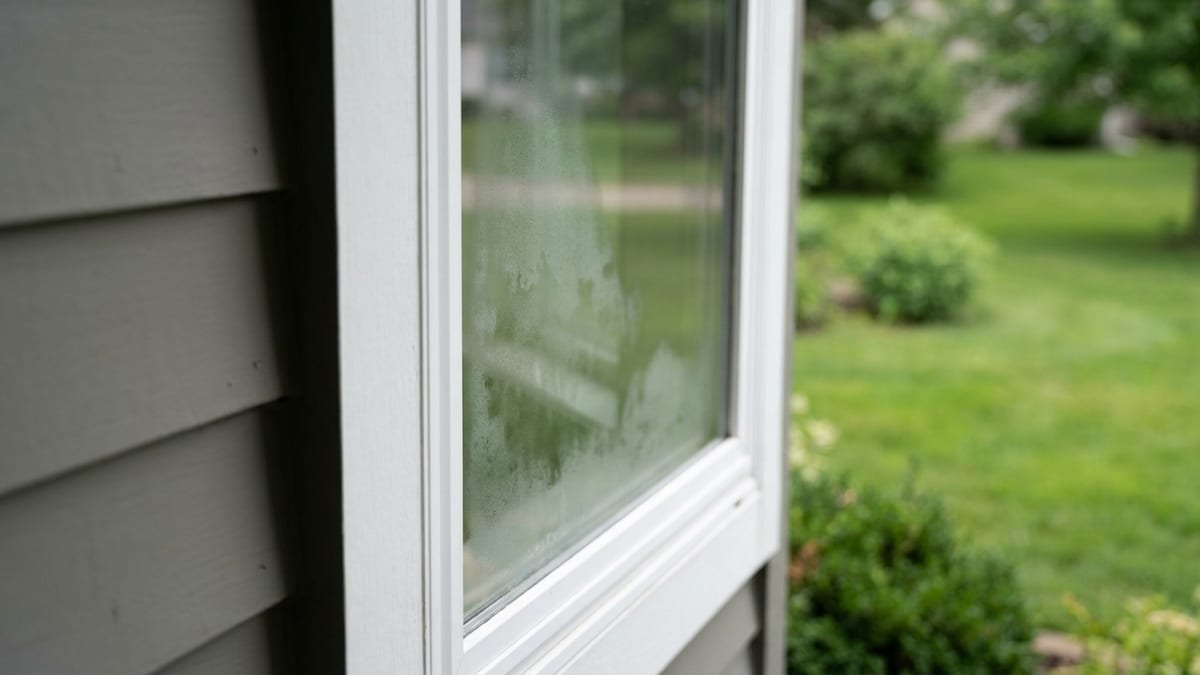
A homeowner calls on a Tuesday. One foggy pane in the dining room, one torn screen on the slider. The whole ticket is $385. Your installer burns ninety minutes including drive time, and you paid $90 for the lead that produced it.
That math does not work. It is exactly why most window companies either refuse glass and screen work outright or run it at a quiet loss nobody in the office has ever actually measured.
It can work. It just cannot work the way most companies run it, which is as an afterthought bolted onto a replacement campaign priced against a completely different ticket.
Are glass and screen replacement leads actually worth paying for?
On the repair invoice alone, no. A $385 call cannot absorb a $90 lead fee, a loaded labor hour, and a truck. That is not a lead quality problem. That is arithmetic.
On blended revenue, the answer flips. A foggy insulated glass unit is a seal failure, and seal failures do not happen to one window in a house full of healthy windows. They happen to windows of the same age, installed on the same day, by the same crew, facing the same sun. The homeowner who calls about one fogged pane usually owns eight to twenty windows that are all inside the same failure window.
That is the entire case for running these campaigns. You are not selling a glass swap. You are buying a scheduled, invited, paid visit to a house full of aging windows, which is a far better position than a cold window replacement appointment where you are one of three bids on a price-shopped project.
The companies that lose money here treat the call as a repair. The companies that make money treat the call as a measured inspection that happens to include a repair.
What is a glass or screen job actually worth in 2026?
Price the work honestly before you decide what you can pay to get it. These are typical installed ranges, not quotes.
| Job type | Typical installed ticket | Decision speed | What it feeds |
|---|---|---|---|
| Job typeRescreen existing frame | Typical installed ticket$25 to $75 per screen | Decision speedSame week | What it feedsAlmost nothing on its own |
| Job typeNew screen or full-frame screen | Typical installed ticket$75 to $200 per opening | Decision speedSame week | What it feedsLow, unless bundled |
| Job typeSingle-pane glass replacement | Typical installed ticket$150 to $400 per lite | Decision speedDays | What it feedsModerate on older homes |
| Job typeInsulated glass unit (foggy pane) | Typical installed ticket$200 to $600 per sash | Decision speedDays to weeks | What it feedsHigh, this is the one |
| Job typePatio door glass panel | Typical installed ticket$400 to $900 | Decision speedWeeks | What it feedsModerate to high |
| Job typeFull-frame window replacement | Typical installed ticket$600 to $1,500 per window | Decision speedWeeks to months | What it feedsThe actual revenue |
| Job typeWhole-home replacement project | Typical installed ticket$12,000 to $30,000 | Decision speedMonths | What it feedsThe reason to run the campaign |
The gap between the top of that table and the bottom is the whole business case. A rescreen is a favor. A fogged insulated glass unit on a 1998 build is a qualified whole-home prospect who called you first and let you inside.
Why does cost per lead break down on a $200 ticket?
Use the standard ceiling formula: average job value multiplied by gross margin multiplied by close rate, divided by three.
Example: a $350 average repair ticket at a 50 percent gross margin, closing 40 percent of the calls you quote. That is $350 x 0.50 x 0.40 = $70 of gross profit per lead at break-even, and a working ceiling of roughly $23 per lead. At $90 a lead you are underwater before the van leaves the yard.
Now run the same leads with the inspection attached. Example: 20 service calls at $350 each is $7,000 in repair revenue. Say 10 percent of those visits produce a full-frame project at $14,000. That is two jobs, $28,000, for a blended total of $35,000 across 20 calls, or $1,750 of revenue per service call. At a 35 percent blended gross margin that is roughly $612 of gross profit per call, and a defensible ceiling near $200 per lead.
Same leads. Same price list. The only variable is whether your installer measured every opening and left a written number, or swapped the sash and drove away.
This is the same reason cost per lead is a misleading comparison metric across any channel. The number that decides whether a campaign lives is cost per acquired job, and on this type of work you have to calculate it blended or you will kill a profitable campaign by week three.
How do you turn a glass call into a full-frame window job?
This is a process problem, not a marketing problem. Four steps, run the same way every time.
- Quote the repair on the phone with a range, then book the visit. Do not refuse to give a number. A homeowner asking what a foggy pane costs is testing whether you are straight with them. Give a real range, say what changes it, and book the appointment.
- Measure every opening in the house, not just the broken one. Twelve minutes with a tape and a phone camera. Photograph every failed seal, every rotted sill, every sash that will not stay up. You are building evidence, not a pitch.
- Show the age math out loud. Tell them the truth: these units were installed the same year, this one failed first, and the rest are on the same clock. No pressure language. Just the sequence.
- Leave two written numbers. Today's repair invoice and a whole-home replacement range with a per-window figure. The second number is the one that comes back in four months.
That fourth step is where most companies quit. A verbal "we can do the whole house too" is not a quote. A written range with photos is a document the homeowner keeps on the counter and shows their spouse.
If the homeowner wants a formal measured proposal, book it as a separate in-home appointment and be clear that it is a sales appointment with pricing at the end of it. Setting that expectation is what keeps the second visit from turning into a no-show.
If you are running Meta campaigns and want help sizing what a glass and screen offer should cost against your replacement numbers, get started here and bring your average ticket and close rate to the call.
When should a window company actually run these campaigns?
Not always, and not as your primary offer. Run glass and screen when at least three of these are true.
- You have a dedicated service tech or a crew with real gaps in the schedule. If this work pulls installers off a replacement job, the opportunity cost eats the margin.
- Your market has housing stock in the 15 to 30 year range, which is the heart of the seal failure window.
- You can answer the phone inside a few minutes during business hours. Repair callers hire whoever picks up, which is why speed to lead decides this category more than price does.
- You have a written inspection process and a quote template your tech will actually use.
- You can run it as its own campaign with its own budget and its own ceiling.
Seasonality helps here too. Screen demand clusters in spring and early summer when windows start opening. Foggy glass complaints spike in fall and winter, when condensation becomes obvious against cold outdoor air. Those two peaks sit on either side of the shoulder months when full-frame replacement demand usually softens, so the service campaign fills schedule gaps instead of competing with your best work.
Why this cannot share a campaign with replacement
A whole-home campaign is priced against a $12,000 to $30,000 project and can carry a $150 to $250 lead. A repair campaign is priced against a few hundred dollars. Blend them into one budget and one of two things happens: Meta optimizes toward the cheaper, easier repair form fills and starves your replacement pipeline, or you set the ceiling high enough for replacement and quietly overpay for rescreens all quarter.
Separate campaigns. Separate creative. Separate ceilings. Separate reporting. The deeper breakdown of how replacement buyers should be targeted sits in our guide to window replacement leads.
How many service calls does it take to produce real pipeline?
Work it backward from a revenue number instead of guessing at a budget.
| Input | Example value |
|---|---|
| InputFull-frame revenue target from this channel | Example value$280,000 |
| InputAverage full-frame project | Example value$14,000 |
| InputFull-frame jobs needed | Example value20 |
| InputService call to full-frame conversion | Example value10 percent |
| InputService calls needed | Example value200 |
| InputRepair revenue at $350 average | Example value$70,000 |
| InputLead to booked service call rate | Example value60 percent |
| InputLeads needed | Example value334 |
| InputLeads per month over 12 months | Example value28 |
At a $75 blended cost per lead, that is roughly $2,100 a month in lead cost against $350,000 of blended revenue. Move the conversion rate to 5 percent and you need 400 service calls for the same 20 jobs, which doubles everything. Move it to 15 percent and the channel becomes the best-performing line in your marketing plan.
The conversion rate is the lever, and it is entirely inside your building. Nobody outside your company controls whether your tech measures the other eleven windows.
What kills these leads after they come in?
- Treating them as interruptions. If the office tone says "we do not really do that," the homeowner hears it and the full-frame quote never happens.
- Dispatching without an inspection sheet. No sheet, no measurements, no second number, no pipeline.
- No follow-up on the written range. The replacement sale on these usually lands 60 to 180 days later. If nobody touches that record again, the campaign looks like a loss in your reporting when it was actually a win you abandoned.
- Tracking repair revenue separately from replacement revenue. If the signed whole-home job gets attributed to "referral" or "past customer" instead of back to the glass lead, you will cancel a profitable campaign on bad data.
- Quoting the repair too high to protect replacement. Homeowners price-check glass. Overcharge and you lose the visit and the relationship.
The short version
Glass and screen replacement leads are not a nuisance and they are not a business. They are an entry point. Priced as repair work they lose money every time. Priced as a paid in-home inspection of a house full of aging windows, with a written whole-home number left behind, they can carry a cost per lead several times higher than the repair invoice alone could ever justify.
Run them as their own campaign, set the ceiling on blended revenue, and measure cost per acquired full-frame job. If you want the campaign structure and the ceiling math run against your own ticket and close rate, book a call and we will walk through the numbers.
Frequently asked questions
Are window glass and screen replacement leads worth paying for?
They are worth paying for only if the service call is built as a measured whole-home inspection that produces full-frame replacement quotes. On the repair invoice alone, a $75 to $600 ticket cannot absorb a $50 to $200 lead fee plus drive time and labor. On blended revenue including the replacement jobs those visits create, the same lead can be one of the cheapest acquisitions in a window company.
What should a window company pay for a glass or screen lead?
If you judge the lead on the repair invoice alone, the ceiling is roughly $20 to $40. If you track blended revenue and a reliable share of those visits turn into full-frame projects, the defensible ceiling moves into the $100 to $200 range. Run the number yourself with average job value multiplied by gross margin multiplied by close rate, divided by three.
Should glass repair run in the same campaign as window replacement?
No. A whole-home window campaign is priced against a $12,000 to $25,000 ticket and a glass repair campaign is priced against a few hundred dollars, so blending them means you either overpay for repairs or get outbid on replacement buyers. Separate campaigns, separate budgets, separate cost-per-lead ceilings, separate creative.
How often does a foggy glass call turn into a full window replacement?
Industry-typical conversion from repair call to full-frame project runs in the 5 to 15 percent range for companies that inspect every opening and leave a written whole-home quote. Companies that swap the sash and drive away convert close to zero, which is why the inspection process matters more than the lead source.
Is seasonality different for glass and screen leads?
Yes. Screen work clusters in spring and early summer when windows open, and foggy glass complaints spike in fall and winter when condensation becomes visible against cold outdoor air. Those two seasons sit on either side of the shoulder months when full-frame replacement demand usually softens, which is part of their value.