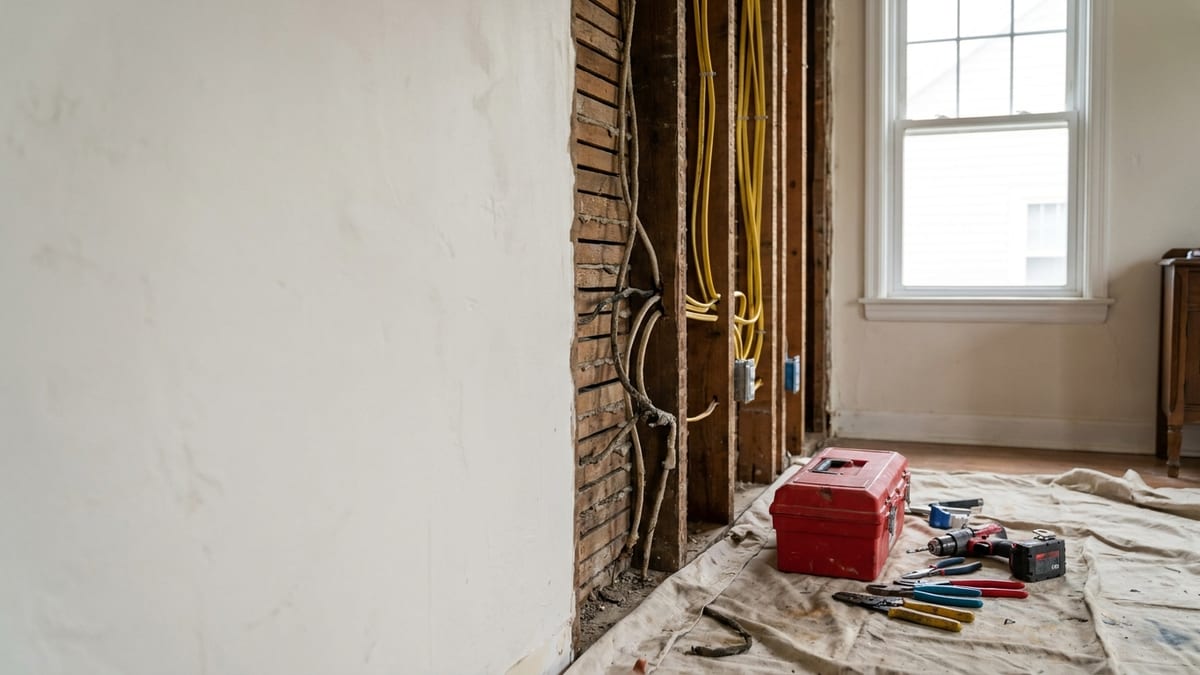
A homeowner in a 1948 house gets a letter from their insurance carrier. Knob-and-tube wiring, non-renewal in 60 days unless it is removed and certified. That homeowner is going to spend between $8,000 and $25,000 in the next two months, and they have no idea who to call.
That is the easy one. For every homeowner with a letter in hand, there are ten more living on cloth-wrapped wire with two outlets per room, tripping a breaker every time the microwave and the space heater run together, who will not do anything about it for two more years unless somebody reaches them first.
Whole-house rewires are one of the highest-ticket jobs in residential electrical. They are also one of the hardest to generate leads for, because almost nobody wakes up wanting one. Here is how the money math works and how the leads actually get produced.
Why do rewire leads behave differently from other electrical work?
Most residential electrical lead generation is a speed game. The power is out, the panel is buzzing, the outlet is scorched. Whoever answers the phone and can roll a truck gets the job, and the ticket is $300 to $900.
Rewires are the opposite. There is no emergency. The house has been wired that way for 70 years. The homeowner has adapted to it with power strips and a habit of not running the toaster and the coffee maker at once. Nothing forces the decision until something external does.
That means rewire leads split into two populations that need two completely different approaches.
The forced-timeline buyer
A home sale falls apart over an inspection report. An insurance carrier threatens non-renewal. A permit office flags the panel during a remodel. A finance contingency requires certification. These homeowners have a deadline and they are searching right now. They go to Google, they call three electricians, and they hire whoever can get an inspector out this week. The money page for this traffic is your electrical lead generation presence in local search plus a phone that gets answered.
This group is real, it is profitable, and it is small. You cannot build a rewire division on it alone.
The planning-phase buyer
This is the larger group by a wide margin. They own a home built before 1960. They know the wiring is old. They are thinking about it in the background, usually alongside a kitchen remodel, a basement finish, a heat pump install, or an EV charger they cannot add because the service is 100 amps of fuses.
They are not searching. They will not search for another year or two. But they will stop scrolling for a photo of an opened wall showing cloth wire next to fresh copper, because that is their house, and they have never seen what the inside of their walls looks like.
What is a whole-house rewire actually worth in 2026?
Ticket size drives everything downstream, including what you can afford to pay for a lead. These are industry-typical ranges and they move with region, access, and finish requirements.
| Job type | Typical ticket | What triggers it |
|---|---|---|
| Job typePartial knob-and-tube removal, 1-2 circuits | Typical ticket$1,500 - $4,000 | What triggers itInsurance letter, single-room remodel |
| Job typeService and panel upgrade only | Typical ticket$1,800 - $4,500 | What triggers itEV charger, heat pump, added load |
| Job typeWhole-house rewire, 1,200-1,800 sq ft | Typical ticket$8,000 - $18,000 | What triggers itSale, insurance, major renovation |
| Job typeWhole-house rewire, 2,500+ sq ft or plaster and lath | Typical ticket$18,000 - $25,000+ | What triggers itFull gut, historic home restoration |
| Job typeRewire plus service entrance, panel, and code corrections | Typical ticket$20,000 - $30,000 | What triggers itFailed inspection, flip, long-term owner |
The spread between a $2,000 partial and a $22,000 full package is the entire opportunity. The same lead can become either one depending on how the inspection is run and how the proposal is presented.
Why is cost per lead the wrong number to judge rewire leads on?
Electricians shop for leads by price. That is a mistake on a job this size, because the lead price is the smallest variable in the equation. Close rate is the big one.
Run 100 leads through four channels at a $14,000 average rewire ticket.
| Source | Cost per lead | Close rate | Leads per job | Cost per acquired job |
|---|---|---|---|---|
| SourceShared marketplace leads | Cost per lead$40 - $90 | Close rate5 - 10% | Leads per job10 - 20 | Cost per acquired job$600 - $1,400 |
| SourceGoogle search and Local Services Ads | Cost per lead$35 - $95 | Close rate15 - 25% | Leads per job4 - 7 | Cost per acquired job$280 - $600 |
| SourceExclusive leads through your own ad account | Cost per lead$50 - $200 | Close rate20 - 35% | Leads per job3 - 5 | Cost per acquired job$200 - $800 |
| SourceReferrals | Cost per lead$0 | Close rate40 - 60% | Leads per job2 | Cost per acquired jobNear $0 |
The $45 shared lead that closes at 6 percent costs you $750 per job and roughly eight wasted conversations with homeowners who already talked to three other electricians. The $150 exclusive lead that closes at 28 percent costs $536 per job and your name is the only one the homeowner heard. The cheap lead is the expensive customer. We walked through that math in detail in exclusive vs shared leads.
The target to hold yourself to: cost per acquired rewire job under 8 to 10 percent of ticket. On a $14,000 average, that is $1,120 to $1,400 of all-in acquisition cost. Every channel in the table above can hit that. Only one of them hits it while building your brand instead of a marketplace's.
If you want the number for your own ticket and close rate, run it through the ROI calculator before you sign anything.
How should electricians price a knob-and-tube or rewire job?
The single biggest pricing mistake is quoting one number for the whole house. A $19,000 figure in a text message kills more rewire deals than any competitor does. Price it as a sequence instead.
- Charge for the inspection. $150 to $400 for a documented walkthrough — panel photos, attic and crawl space access, junction box count, circuit map, code violations listed with the relevant article. Credit it toward the job. The fee screens out shoppers and makes the visit feel like engineering, not sales.
- Scope in zones, not as a monolith. Break the house into attic circuits, first floor, second floor, kitchen and bath, service and panel, and exterior. Each zone gets a line item.
- Present three packages. Code-minimum compliance, full rewire with modern circuit counts, and full rewire with panel, surge, EV-ready capacity, and smart devices. Most homeowners buy the middle. Some buy the top, and they never would have if it had not been on the page.
- Quote restoration explicitly. Drywall patching, plaster repair, and paint is where rewire bids go to die. Either price it in or name the exclusion in writing. Never leave it ambiguous.
- Attach financing to every proposal. A $19,000 number becomes a monthly payment the homeowner can compare to their current power bill and insurance premium. Monthly framing closes high-ticket electrical work that lump-sum framing does not.
- Give them a phased option. If they cannot do the whole house, sell the panel and the two worst circuits now with a documented plan for the rest. A $4,500 job today and a $12,000 job in eighteen months beats a $19,000 no.
How do you reach planning-phase rewire buyers before they search?
Search only captures demand that already exists. For rewires, most of the demand is latent, so you have to go create the moment of recognition.
Target the house, not the keyword
Meta lets you reach homeowners by geography and by the audience signals that correlate with old housing stock — historic neighborhoods, pre-1960 zip codes, homeowners in renovation and home-improvement interest sets. Your property data should tell you year built on every lead that comes in, so you can see immediately whether a lead is a 1952 bungalow or a 2015 build.
Lead with the wall, not the service
The highest-performing creative for this trade is not a logo or a truck. It is a photo of an opened wall: black cloth wiring, crumbling insulation, a bare splice with no box, and new copper running beside it. Caption it with the age of the home. Homeowners in similar houses stop scrolling because they are looking at their own walls for the first time.
Use the trigger, not the fear
Insurance non-renewal, two-prong outlets, flickering lights, breakers that trip, a home purchase inspection, an EV charger they cannot install. Each of those is an ad angle that maps to a real conversation the homeowner is already having. Fear-only messaging produces calls from people who will not spend money.
Offer the inspection, not the rewire
Nobody converts on "Get a whole-house rewire." They convert on "Find out what is actually in your walls — documented electrical safety inspection." The inspection is the offer. The rewire is what the inspection sells. Keep the form short, land the lead in your CRM in real time, and call it inside five minutes.
If you want a lead system that runs under your own company name, through your own Meta ad account, with the property data attached to every lead, get started here and we will map the market against your service area.
How many rewire leads do you need to hit a revenue target?
Work backward. Say the goal is $500,000 in added rewire revenue over twelve months at a $14,000 average ticket.
- $500,000 ÷ $14,000 = 36 jobs
- At a 25 percent close rate on exclusive leads: 36 ÷ 0.25 = 144 leads for the year
- 144 ÷ 12 = 12 leads per month
- At $150 per qualified lead: roughly $1,800 per month in lead cost, plus ad spend paid directly to Meta from your own account
Twelve leads a month. That is the entire ask. Most electricians overestimate the volume required for high-ticket work and underestimate the discipline required to work twelve leads properly. Thirty poorly handled leads produce fewer jobs than twelve well-handled ones.
Now run the same math with shared leads at a 7 percent close rate: 36 ÷ 0.07 = 514 leads, or 43 per month. Same revenue, nearly four times the conversations, every one of them already quoted by somebody else.
What kills rewire leads after they come in?
Slow first contact
A homeowner with an insurance deadline calls three electricians in ten minutes. Response inside five minutes is the difference between an inspection on the calendar and a lead you paid for and lost. The research on this is not ambiguous, and we broke it down in speed to lead.
Quoting a price over the phone
An electrician who says "rewires usually run fifteen to twenty grand" before seeing the attic has ended the conversation. Give a range only with a reason and an immediate pivot to the inspection: the number depends on access, plaster versus drywall, and circuit count, which is exactly what the inspection determines.
No follow-up past three touches
Rewire decision cycles run 30 to 180 days. A homeowner who says "not right now" in March is often a signed job in September, but only if you are still in their inbox. Most electricians stop at two calls and a voicemail, and then blame lead quality.
Treating the inspection like a free estimate
An on-site inspection is a sales appointment. Both decision makers should be home, the visit should be scoped at 60 to 90 minutes, and the homeowner should know a documented proposal comes out of it. Setting that expectation when you book is what separates a 30 percent close rate from a 12 percent one.
The short version
Rewires are a two-market trade. Capture the forced-timeline homeowner with fast local-search response and a phone that gets answered. Create the planning-phase homeowner with Meta advertising that shows them what is inside their own walls, months before an insurance letter does it for you. Price in zones with three packages and financing. Judge every channel on cost per acquired job, not cost per lead.
Twelve exclusive leads a month, worked properly, is a half-million-dollar rewire division. Ready to build it under your own brand? Start here and we will show you the live numbers for your market.
Frequently asked questions
How much does a whole-house rewire cost in 2026?
Typical whole-house rewires run $8,000 to $18,000 on a 1,200 to 1,800 square foot home and $18,000 to $25,000 or more on larger homes, plaster-and-lath construction, or homes needing a service entrance and panel replacement at the same time. Partial knob-and-tube removal of one or two circuits usually lands between $1,500 and $4,000.
How do electricians get knob-and-tube and whole-house rewire leads?
Two channels cover both buyers. Local search and Google Local Services Ads capture the homeowner with a forced timeline from a sale, an insurance letter, or a failed inspection, and Meta advertising targeting owners of older homes reaches the much larger group still in the planning phase months before they search. Exclusive leads from your own ad account outperform shared marketplace leads on cost per acquired job.
Should electricians charge for a whole-house rewire inspection?
Charging $150 to $400 for a documented inspection filters out tire-kickers, pays for the technician's time, and turns the visit into a deliverable the homeowner keeps. Credit the fee toward the job if they move forward. Free walkthroughs are fine when volume is high and the appointment converts well, but a paid, scoped inspection generally produces a higher close rate on $15,000-plus work.
How many rewire leads do you need to close one job?
At a 20 to 35 percent close rate on exclusive leads, expect three to five leads per closed rewire. Shared marketplace leads closing at 5 to 10 percent require ten to twenty leads for the same job, which is why the cheaper lead is usually the more expensive customer.
Are shared leads worth it for whole-house rewire work?
Rarely. A rewire is a considered purchase where the homeowner collects multiple bids anyway, so handing the same homeowner to three or four electricians turns a high-ticket job into a price-shopping contest before anyone has seen the attic. Exclusive leads cost more per lead and close at two to four times the rate, which is what actually moves cost per acquired job.