A plumbing company that runs on emergency calls has a revenue problem it cannot see. The tickets are small, the hours are terrible, and the schedule is written by other people's burst pipes. A $400 drain call at 11 p.m. does not build a business. It just keeps it busy.
Water treatment is the opposite. A softener or a whole-home filtration system is a planned purchase on a $1,500 to $8,000 ticket, booked during business hours, installed by one tech in half a day, and followed by years of salt, filters, and service calls. It is the work that fills the gaps between emergencies, and almost nobody advertises for it properly.
Why is water treatment the steadiest work a plumbing company can sell?
Every other lead a plumber pays for is triggered by a failure. The water heater died. The sewer backed up. The toilet overflowed. Failure-driven demand is unpredictable by definition, and it puts you in a race against whoever answers the phone first.
Water treatment demand is triggered by annoyance, not failure. Spotted glassware. Orange staining in the toilet tank. A rotten egg smell on the well. Skin that feels dry after a shower. Scale on the shower door that will not come off. None of that forces a call today, which is exactly why the buyer has time to research, compare, and schedule a real appointment.
That changes the economics in three ways that matter:
- The job is scheduled, not dispatched. No overtime, no night rate, no truck sitting in traffic because a homeowner is panicking.
- The ticket is three to ten times a service call, and the install is usually a single tech for three to five hours.
- The customer continues buying. Salt, cartridge changes, resin bed service, and annual sanitizing turn one install into a decade of revenue.
If your company already pays for plumbing leads and spends most of that budget on emergency work, you are buying the lowest-margin, highest-stress jobs in your own price book. A water treatment campaign running next to it changes the mix without changing the crew.
What is a water softener or filtration job actually worth in 2026?
Ranges vary by water chemistry, local plumbing codes, and whether the house already has a treatment loop. These are typical installed ranges for residential work.
| Job type | Typical installed ticket | Install time | Follow-on revenue |
|---|---|---|---|
| Job typeUnder-sink reverse osmosis | Typical installed ticket$400 to $1,200 | Install time1 to 2 hours | Follow-on revenueFilter changes yearly |
| Job typeWhole-home carbon or sediment filtration | Typical installed ticket$1,500 to $4,000 | Install time3 to 4 hours | Follow-on revenueMedia swap every 3 to 7 years |
| Job typeStandard whole-home softener | Typical installed ticket$1,500 to $4,500 | Install time3 to 5 hours | Follow-on revenueSalt, service, resin |
| Job typeWell treatment (iron, sulfur, UV, pH) | Typical installed ticket$3,000 to $8,000 | Install time5 to 8 hours | Follow-on revenueUV lamps yearly, media, service |
| Job typeCombined softener plus RO plus filtration | Typical installed ticket$4,000 to $9,000 | Install timeFull day | Follow-on revenueHighest recurring value |
Compare that to the service call it usually sits next to. A drain clear or a fixture repair commonly runs $200 to $600. A water heater swap runs $1,200 to $3,500. A softener install lands in the same range as the heater, takes less diagnostic work, and does not require anyone to be home at 7 a.m. because there is no hot water.
The gross margin is also friendlier than most plumbers assume. Equipment cost is known in advance, there is no demolition surprise, and the labor is predictable. Most companies run 40 to 55 percent gross margin on treatment installs once they have standardized on two or three units.
Why is cost per lead the wrong number to judge water treatment leads on?
Cost per lead is the number every vendor leads with because it is the number that makes them look good. It tells you nothing about whether the channel made money.
The number that decides it is cost per acquired job, which is cost per lead divided by your close rate.
- Example: a $40 shared marketplace lead that closes at 5 percent produces an $800 cost per acquired job on a $2,800 softener. That is 29 percent of the ticket, and it loses money after equipment and labor.
- Example: a $120 exclusive lead that closes at 25 percent produces a $480 cost per acquired job on the same $2,800 ticket. That is 17 percent, and it works.
- Example: a $120 exclusive lead that closes at 25 percent on a $6,000 well treatment system produces the same $480 against a much larger ticket. That is 8 percent, and it is excellent.
The cheap lead costs more. That is the whole argument, and it is spelled out in detail in exclusive vs shared leads.
Set your own ceiling before you shop channels
Use the standard formula rather than a benchmark someone posted online:
Max cost per lead = (average job value x gross margin x close rate) divided by 3
Example: $3,200 average ticket x 45 percent margin x 30 percent close rate = $432 of gross profit per lead. Divide by three and your working ceiling is about $144. Anything under that is worth testing. Anything over it needs a higher ticket or a better close rate to justify.
Most plumbing companies end up with a $60 to $150 ceiling on exclusive water treatment leads, which is far above what a $400 drain call can support. That gap is the entire reason these two offers should never share one campaign or one budget. If you want the arithmetic broken down further, how much should you pay per lead walks through the all-in version.
How do you reach the water treatment buyer before they search?
Here is the part most plumbers miss. Very few homeowners search for "water softener installation." They search for it only after they have already decided they need one, and that is a thin slice of the market.
The much larger group knows something is wrong with their water but has never named the product. They describe symptoms:
- Orange or brown staining in sinks, tubs, and toilet tanks
- Rotten egg smell, especially on well water
- White scale on faucets, shower doors, and the coffee maker
- Soap that will not lather and laundry that comes out stiff
- A water heater that failed early, twice
- A new well, or a house they just bought with a well
Meta advertising reaches those homeowners because it does not require them to search. You target the zip codes you serve, show a photo of a clean, finished install in a real basement, and lead the ad with the symptom instead of the product name. The homeowner recognizes their own bathroom in the copy, and the offer is a free in-home water test rather than a quote.
That free test is the strongest offer in this trade. It is low commitment, it is genuinely useful, and it puts a tech in the utility room with a test kit and a price book. Be straight about what it is: an in-home test is a sales appointment where you will present a recommendation and a price. Say so, and the homeowners who book will still book.
Well water markets deserve their own ad set. Iron, sulfur, bacteria, and pH problems are a different conversation than city water hardness, the tickets are larger, and the homeowner is usually far more motivated.
If you want this running in your own Meta ad account with your company name on every ad, get started here and we will scope the campaign against your actual service area.
What should a water treatment campaign actually say?
Three rules, and they are not complicated.
Lead with the symptom, not the equipment
"Orange stains in your sink and tub?" outperforms "Whole-home water softener systems" almost every time, because the first one describes what the homeowner sees every morning and the second one describes what you sell.
Show a real install
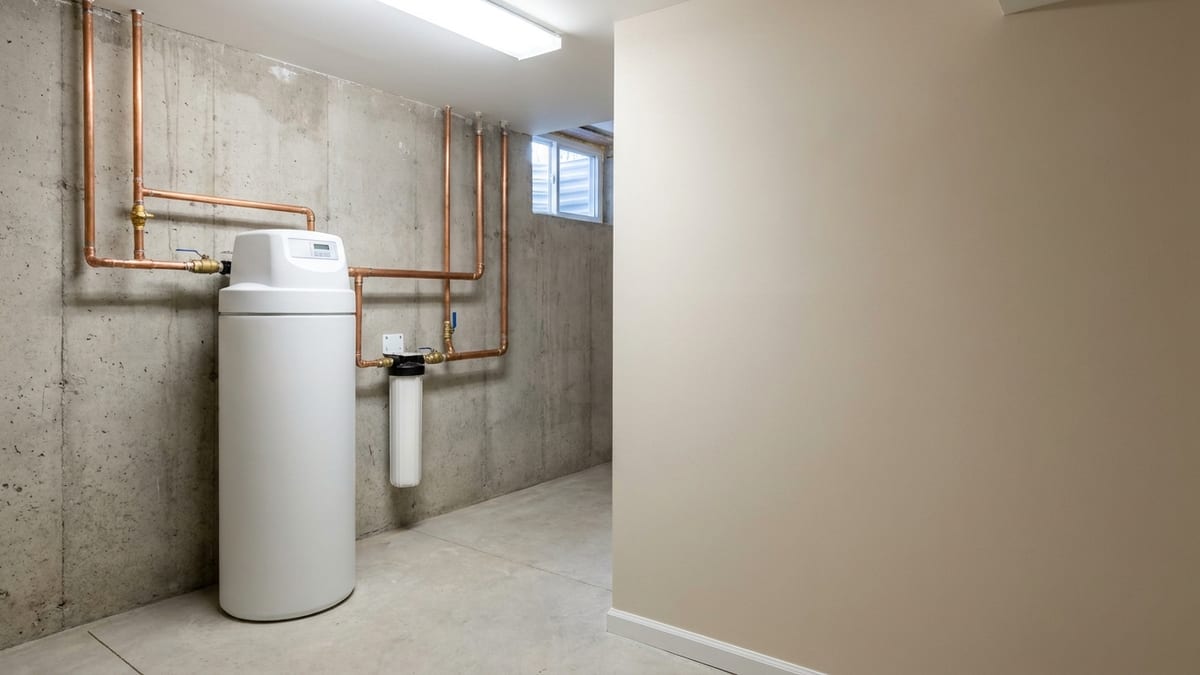
Photography of your own finished work in a real basement or garage beats stock equipment shots. Homeowners are trying to picture the thing in their house. Show them tanks plumbed neatly to copper, a clean concrete floor, and a labeled bypass. Neat work sells.
Name a starting price
A real starting price filters out the homeowner who thought this was a $300 purchase. Something like "systems from $1,895 installed" costs you some volume and gains you appointments that sit. Keep financing language off the ad itself and put it on the landing page and in the conversation.
How many water treatment leads do you need to hit a revenue target?
Work backward. Always backward, never forward from a budget.
Example: you want to add $250,000 in water treatment revenue over twelve months at a $3,200 average ticket.
- Jobs needed: $250,000 divided by $3,200 = 79 jobs.
- Leads needed at a 25 percent close rate: 79 divided by 0.25 = 316 leads.
- Monthly leads: 316 divided by 12 = roughly 27 leads a month.
- Lead cost at $110 per exclusive lead: about $2,970 a month.
- Gross profit at a 45 percent margin: $112,500 across those 79 jobs.
That is before the salt, filters, and service calls those 79 households produce for the next decade. Treatment customers are the single most repeatable base a plumbing company can build, and the acquisition cost is paid once.
If your close rate is 15 percent instead of 25, the lead requirement jumps to 527 and the monthly spend nearly doubles. That is why the follow-up system matters more than shaving $20 off the lead price.
What kills water treatment leads after they come in?
The leads are rarely the problem. The handoff is.
Slow first contact. These buyers are not in a panic, but they are comparing. The first company to offer a free water test usually gets the appointment. Call in under five minutes and text at the same time. Speed to lead covers the full protocol.
Quoting a price over the phone. Water chemistry decides the system. Quoting before you test either underprices the job or scares off a homeowner who needed a $5,000 well system. Sell the test, not the softener.
Sending the wrong tech. Treatment is a consultative sale. The person in the utility room needs to explain hardness, iron, and grain capacity in plain language and present a written recommendation on the spot. A service tech who hands over a card and says the office will call back loses the job.
No follow-up after the test. Treatment buyers frequently think it over for a week or two. Three touches is not enough. Run a 30-day sequence with the test results attached, then a 90-day revival sequence for anyone who went quiet.
Treating it as an upsell instead of a campaign. Mentioning softeners during a water heater call is fine. It is not a lead strategy. The campaign needs its own budget, its own creative, and its own number.
The short version
Water treatment is the planned, daytime, repeat-revenue half of plumbing that most companies never advertise. Tickets run $1,500 to $4,500 for a softener and $3,000 to $8,000 for well treatment, margins hold at 40 to 55 percent, and the customer keeps buying salt and filters long after the install.
Set your cost-per-lead ceiling with the formula instead of a benchmark. Run the campaign separately from emergency work so the small-ticket ceiling never caps your treatment bids. Lead with symptoms, show your own installs, offer a free in-home water test, and judge the whole thing on cost per acquired job.
If you want exclusive water treatment leads running through your own Meta ad account with your company name on every ad, book a call and we will build the campaign against your service area and your real ticket.
Frequently asked questions
What is a water softener installation worth in 2026?
A standard whole-home softener install typically runs $1,500 to $4,500 depending on grain capacity, plumbing complexity, and whether a bypass loop already exists. Well water systems that add iron, sulfur, sediment, or UV treatment commonly run $3,000 to $8,000, and a combined softener plus reverse osmosis package often lands between $4,000 and $9,000.
What should a plumber pay for a water treatment lead?
Run the formula: average job value multiplied by gross margin multiplied by close rate, then divide by three. Example: a $3,200 ticket at a 45 percent margin and a 30 percent close rate gives $432 of gross profit per lead, so roughly $144 is a workable ceiling. Most plumbing companies land somewhere between $60 and $150 per exclusive water treatment lead.
Are water treatment leads better than emergency plumbing leads?
They are different, not better. Emergency calls convert fastest but carry small tickets and burn your crew at night. Water treatment jobs carry three to ten times the ticket, schedule during normal hours, and create recurring salt, filter, and service revenue, which is why they belong on their own campaign and their own cost-per-lead ceiling.
Do water treatment leads work on Meta or only on search?
Search captures the small share of homeowners who already decided to buy a softener. Meta reaches the far larger group who only know their water smells, stains fixtures, or leaves spots, which is where most of the volume lives. Run both if you can, and judge each on cost per acquired job.
How fast do you have to call a water treatment lead?
Call within five minutes and text immediately. These are planned purchases, so the homeowner will not disappear in an hour the way an emergency caller will, but they are actively comparing companies and the first plumber who offers a free in-home water test usually wins the appointment.