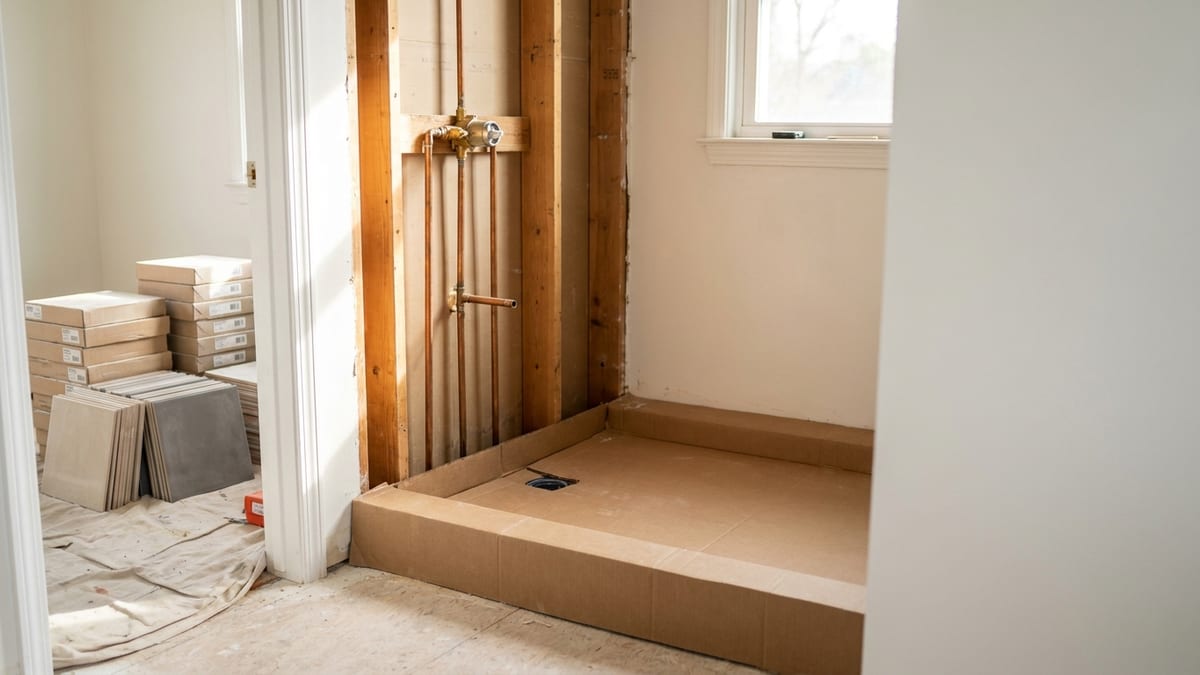
A tub-to-shower conversion is the closest thing bath remodeling has to a same-week revenue event. One in-home visit. One decision. One to five days of install. A ticket that usually lands between $5,000 and $15,000, with margins that hold because there is no cabinetry order, no six-week tile lead time, and no design revision cycle.
Most bath companies treat it as a downsell off the full remodel. That is backwards. Handled as its own campaign, with its own budget and its own lead ceiling, the conversion is the job that keeps crews booked between the big gut jobs and keeps cash moving while the $30,000 projects sit in design.
Here is the buyer, the ticket math, and the campaign structure that actually books them.
Why is a tub-to-shower conversion the easiest bathroom job to sell?
Because the homeowner is not shopping for a bathroom. They are solving a specific, physical problem, and they already know the answer.
The trigger is almost never aesthetic
The calls come from a short list of events:
- A parent moved in, or is about to, and cannot step over a 15-inch tub wall.
- A hip replacement, a knee replacement, or a fall in the last year.
- A physical therapist or a home health aide told them the tub has to go.
- The kids are grown and the guest tub has not been used in six years.
- A leaking tub surround finally rotted the wall and forced the issue.
Every one of those is a deadline. That is what separates this buyer from the full-remodel buyer who has been collecting inspiration photos for eight months. The conversion buyer wants a measurement this week and a crew this month.
One visit, one decision
There is no design phase. The footprint is fixed, the plumbing is mostly staying, and the choices are base color, wall panel or tile, door style, and grab bar placement. A trained rep can scope it, price it, and sign it in one appointment. Close rates on well-worked exclusive conversion leads typically run 20 to 35 percent, higher than full-gut leads, because the homeowner has already made the hard decision before you walked in.
That behavior is the whole reason conversions get built as their own campaign on our bathroom remodeling lead generation page instead of getting blended into a generic "bathroom remodel" ad set that attracts tire-kickers pricing a master suite.
What is a tub-to-shower conversion actually worth in 2026?
You cannot set a lead-cost ceiling until you know your real ticket mix. Regional labor and plumbing relocation move these, but the ranges are typical.
| Scope of work | Typical installed price | Install time |
|---|---|---|
| Scope of workAcrylic or solid-surface conversion, existing alcove | Typical installed price$5,000-$9,000 | Install time1-2 days |
| Scope of workConversion with low-threshold base, glass door, grab bars | Typical installed price$9,000-$15,000 | Install time2-3 days |
| Scope of workBarrier-free or curbless accessible shower | Typical installed price$12,000-$20,000 | Install time3-5 days |
| Scope of workCustom tile shower with new pan and niche | Typical installed price$10,000-$25,000 | Install time5-10 days |
| Scope of workConversion plus vanity, flooring, and fixtures | Typical installed price$14,000-$28,000 | Install time5-10 days |
| Scope of workFull gut bathroom remodel | Typical installed price$18,000-$40,000 | Install time3-6 weeks |
The useful comparison is not conversion versus gut remodel. It is revenue per crew day. A $9,000 conversion that installs in two days produces more gross profit per crew day than a $28,000 remodel that ties up a crew for four weeks and absorbs three change orders.
The formula that sets your lead ceiling
Run this per campaign, not per company.
Max cost per lead = (average job value x gross margin x close rate) / 3
Conversion campaign: $8,500 x 0.45 margin x 0.25 close = $956, divided by 3 = a $318 maximum cost per lead.
Full-gut campaign: $26,000 x 0.38 margin x 0.15 close = $1,482, divided by 3 = a $494 maximum cost per lead.
Both ceilings are far above what exclusive bath leads actually cost. That is the point. The ceiling is not the target, it is the line you should never cross. Most conversion programs should operate at a fraction of it, and the difference between the two numbers is why one blended campaign always misprices one of the two jobs.
Why is cost per lead the wrong number to judge conversion leads on?
Because the invoice price ignores how many other companies got handed the same homeowner. Cost per acquired job is what pays the crew.
| Channel | Cost per lead | Typical close rate | Cost per acquired job |
|---|---|---|---|
| ChannelReferrals and past customers | Cost per lead$0 | Typical close rate40-60% | Cost per acquired jobNear $0 |
| ChannelGoogle Business Profile / organic | Cost per lead$0-50 | Typical close rate20-40% | Cost per acquired job$100-250 |
| ChannelShared marketplace leads | Cost per lead$25-85 | Typical close rate5-12% | Cost per acquired job$350-1,400 |
| ChannelLocal Services Ads | Cost per lead$30-90 | Typical close rate15-30% | Cost per acquired job$200-550 |
| ChannelMeta advertising | Cost per lead$25-110 | Typical close rate10-20% | Cost per acquired job$250-1,100 |
| ChannelExclusive leads (performance partner) | Cost per lead$50-200 | Typical close rate20-35% | Cost per acquired job$250-1,000 |
| ChannelExclusive booked appointments | Cost per lead$200-400 | Typical close rate25-40% | Cost per acquired job$600-1,400 |
A $45 shared lead closing at 8 percent costs $563 per signed job, and you split every one of those homeowners with three or four competitors who are all quoting the same alcove. A $140 exclusive lead closing at 28 percent costs $500 per job, and the ticket usually holds higher because nobody is racing you to the bottom on price. The full breakdown of that math is in our guide on exclusive vs. shared leads.
There is a second cost almost nobody tracks in bath: measurement time. An in-home conversion appointment with a measure, a demo of the panel and base samples, and a priced proposal is 60 to 90 minutes plus drive time. At an 8 percent close rate you are running twelve appointments to sell one job. Price that at your rep's loaded hourly cost and shared leads stop looking cheap.
If you want to run your own numbers against your current source before changing anything, the ROI calculator will show cost per closed job in about two minutes. Or go straight to get started and we will build the math against your actual ticket and close rate.
How do you reach the conversion buyer before they search?
Most of these homeowners are not typing "tub to shower conversion near me" yet. They are watching a parent struggle with a tub wall and thinking about it. Search captures the ones who already decided. Meta reaches the much larger group still deciding.
Creative that does the work
- Real finished-project photos. A completed low-threshold shower with a bench and grab bars in a normal-sized bathroom. Not a showroom. Not a rendering. Homeowners can tell.
- Before-and-after of the same alcove. The old tub, then the finished shower. This is the single highest-performing creative format in bath.
- Safety language, not medical language. "Step in, not over" beats clinical framing. Nobody wants an ad that says they are old.
- Timeline as the hook. "Most conversions are finished in two days" removes the biggest objection to remodeling anything.
- Financing framed monthly. A $9,000 project is a real decision. A monthly payment is a smaller one.
The offer
Offer a free in-home measurement and price. Say in-home. An on-site estimate is a sales appointment and pretending otherwise poisons the appointment before your rep arrives. Set the expectation in the ad, confirm it in the text, and your no-show rate drops.
Seasonality
Conversions run more evenly than exterior trades, but there are two reliable surges: January through March, when indoor projects get attention and holiday visits expose a parent's mobility problem, and September through October, when homeowners want work finished before the holidays. Build budget ahead of both rather than reacting to them. Our seasonal marketing guide maps that calendar for remodeling trades.
How many conversion leads do you need to hit a revenue target?
Work backward. Do not start from a budget.
- Pick the revenue number. Say $600,000 in added conversion revenue.
- Divide by average ticket. $600,000 / $8,500 = 71 jobs.
- Divide by close rate. 71 / 0.25 = 284 leads per year, roughly 24 per month.
- Multiply by cost per lead. 24 leads x $150 = $3,600 per month in lead cost.
- Check it against revenue. $3,600 per month buys roughly $50,000 per month in signed work. That is about 7 percent of revenue, inside the 8 to 12 percent marketing range most contractors should be running.
Change any input and the answer changes. Raise the close rate from 25 to 32 percent by answering faster and you need 222 leads instead of 284 for the same revenue. Lead volume is the expensive lever. Close rate is the cheap one.
What kills tub-to-shower leads after they come in?
The campaign is rarely the problem. The handoff is.
- Slow first call. This buyer is often contacting two companies in one sitting. Five minutes is the standard, and the math behind it is in our breakdown of speed to lead.
- No same-week appointment slot. "Our next opening is the 19th" loses the job to whoever can come Thursday.
- Quoting over the phone. An alcove conversion has too many variables. Quote it in the home, or expect to be shopped as a number.
- Treating it as a downsell. Reps who push every conversion buyer toward a full remodel lose both jobs.
- Dropping the lead after one unanswered call. A large share of these homeowners are coordinating with a spouse or an adult child. Two calls is not follow-up.
What budget should a conversion campaign run?
| Monthly lead cost | Expected leads/mo | Signed jobs at 25% | Revenue at $8,500 |
|---|---|---|---|
| Monthly lead cost$1,500 | Expected leads/mo~10 | Signed jobs at 25%2-3 | Revenue at $8,500$17,000-$25,500 |
| Monthly lead cost$3,000 | Expected leads/mo~20 | Signed jobs at 25%5 | Revenue at $8,500$42,500 |
| Monthly lead cost$5,000 | Expected leads/mo~33 | Signed jobs at 25%8 | Revenue at $8,500$68,000 |
| Monthly lead cost$8,000 | Expected leads/mo~53 | Signed jobs at 25%13 | Revenue at $8,500$110,500 |
Do not buy more volume than your install calendar can absorb. A conversion lead that sits four days while you catch up is worth a fraction of one called in five minutes, and the crew capacity conversation should happen before the budget conversation.
The short version
Tub-to-shower conversions sell in one visit because the homeowner already made the decision. They install in days, not weeks. They produce more gross profit per crew day than most full remodels. They deserve their own campaign, their own creative, their own ceiling, and a phone answered on the first ring.
Our bath clients are currently getting leads for as low as $30 through Meta. That $30 is ad spend paid directly to Meta out of the contractor's own ad account, not a per-lead price, and it moves by market and season. The more important number is what happens after the appointment gets set: the homeowners who book out of these bath campaigns close at a far higher rate than the leads most bath companies are working today. That is the part worth a conversation.
We are open for a few more bath remodeling companies. One per area. Book a call and we will show you the live numbers, then build the math against your ticket, your close rate, and your install capacity. Start at get started, or read the wider category breakdown in our bathroom remodeling leads guide.
Frequently asked questions
What does a tub-to-shower conversion cost a homeowner in 2026?
A basic acrylic or solid-surface conversion in the existing alcove typically runs $5,000 to $9,000 installed. Upgraded systems with a low-threshold base, glass door, and grab bars usually land between $9,000 and $15,000, and a custom tile build with a new pan and niche commonly runs $10,000 to $25,000 depending on tile selection and plumbing changes.
How much should a bath remodeler pay per tub-to-shower conversion lead?
Use max cost per lead equals average job value times gross margin times close rate, divided by three. At an $8,500 ticket, a 45 percent margin, and a 25 percent close rate, that is roughly $318 per lead as a ceiling. Most conversion campaigns should be running well under that, which is why exclusive leads at $50 to $200 still clear the math when they actually close.
Are tub-to-shower conversion leads better than full bathroom remodel leads?
They are different, not better. Conversions close faster, install in one to five days, and turn cash quickly at a $5,000 to $15,000 ticket. Full gut remodels carry a much larger ticket but a longer design and decision cycle. Most bath companies should run both as separate campaigns with separate budgets and separate cost-per-lead ceilings.
Which channel produces the most tub-to-shower conversion leads?
Meta advertising produces the volume, because most conversion buyers are thinking about a parent aging in place or a tub they no longer step over safely and have not started searching yet. Google and Local Services Ads capture the homeowner who already decided, which is higher intent but far thinner volume in this category.
How fast do you have to follow up on a tub-to-shower lead?
Five minutes. Response speed research shows a roughly 21x improvement in qualification when the first call goes out inside five minutes versus thirty, and conversion buyers are usually contacting more than one company in the same sitting. The company that gets the in-home measurement scheduled first usually writes the contract.