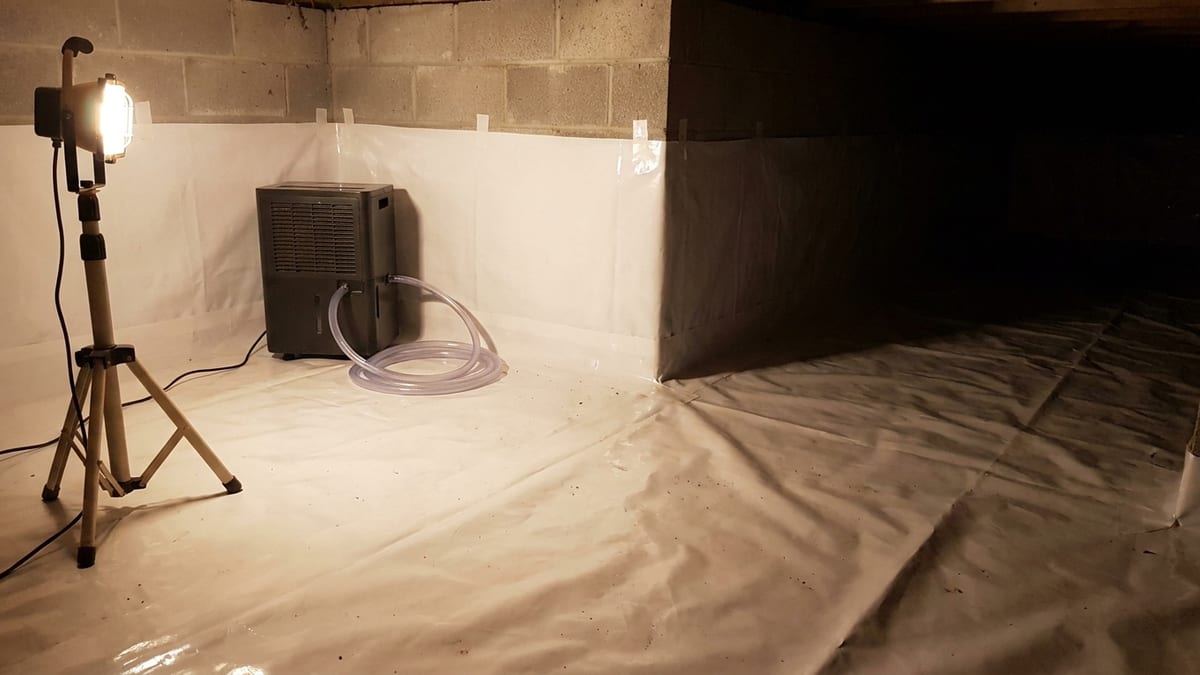
A crawl space encapsulation contractor and a basement waterproofing contractor can spend the same money on the same channel in the same market and get completely different results. The waterproofer is catching demand. Homeowners with two inches of water on a finished basement floor search, call three companies, and buy that week.
The crawl space contractor has no such luxury. The homeowner with 78 percent relative humidity under the floor, mold on the joists, and a house that smells like the dirt beneath it is not searching for anything. She thinks the smell is the dog. She thinks the cold floors are just how old houses are. She has never typed the word encapsulation in her life.
That is a $12,000 job sitting under a house, and the only reason it is not sold is that nobody told her it existed. Here is the math on that job and the campaign structure that gets it sold.
Why does nobody search for crawl space encapsulation?
Because the homeowner does not have a crawl space problem. She has a smell problem, a comfort problem, or a bug problem, and none of those searches lead to your service page.
Run the language gap side by side.
| What the homeowner says | What you call it | Do they search for it? |
|---|---|---|
| What the homeowner saysThe house smells musty | What you call itElevated crawl space humidity and microbial growth | Do they search for it?Rarely |
| What the homeowner saysThe floors are freezing in winter | What you call itNo subfloor insulation, open vents, stack effect | Do they search for it?No |
| What the homeowner saysWe keep getting spiders and camel crickets | What you call itOpen vents and exposed soil | Do they search for it?Sometimes, for a pest company |
| What the homeowner saysThe upstairs AC can never keep up | What you call itMoisture load pulled up through the floor | Do they search for it?No |
| What the homeowner saysThe floor by the kitchen feels bouncy | What you call itRotted girder or failing pier | Do they search for it?Yes, but they search for a carpenter |
| What the homeowner saysThere is standing water under the house | What you call itDrainage failure | Do they search for it?Yes, urgently |
Only the last row behaves like a search-driven trade. Everything above it is demand you have to create. That is the single most important fact about this market, and it is why our waterproofing lead generation campaigns for crawl space work are built around symptom hooks and inspection offers rather than product keywords.
The contractors who only run search are fighting over one row of that table and calling it the whole market.
What is a crawl space encapsulation job actually worth in 2026?
You cannot set a cost-per-lead ceiling until you know your real ticket mix. Crawl height, standing water, debris and old batt removal, and access all move these, but the ranges are typical.
| Scope of work | Typical installed price | How it gets sold |
|---|---|---|
| Scope of workDebris and failed insulation removal | Typical installed price$800-$2,500 | How it gets soldAdd-on line item |
| Scope of workVapor barrier only, loose laid | Typical installed price$2,000-$4,500 | How it gets soldPrice-shopped, fast close |
| Scope of workFull encapsulation, sealed and taped, wall wrap | Typical installed price$6,000-$11,000 | How it gets soldInspection with photos |
| Scope of workFull encapsulation plus dedicated dehumidifier | Typical installed price$8,000-$15,000 | How it gets soldInspection with photos |
| Scope of workAdd interior drainage and sump | Typical installed price$3,000-$7,000 on top | How it gets soldSame appointment |
| Scope of workStructural pier, girder, or joist repair | Typical installed price$2,500-$12,000 on top | How it gets soldSame appointment |
| Scope of workSubfloor or crawl wall insulation | Typical installed price$1,500-$5,000 on top | How it gets soldSame appointment |
The pattern matters more than any single line. A cheap vapor barrier install is a $3,000 ticket that a homeowner will price against two other companies. The same house, inspected properly, is frequently an $11,000 to $15,000 ticket because the dehumidifier, the drainage, and the rotted girder are all part of the same conversation.
That is why the inspection is the product. You are not selling plastic sheeting. You are selling the diagnosis, and the diagnosis is what raises the average ticket.
The formula that sets your lead ceiling
Run this per campaign, not per company.
Max cost per lead = (average job value x gross margin x close rate) / 3
Vapor barrier campaign: $3,000 x 0.45 margin x 0.30 close = $405, divided by 3 = a $135 maximum cost per lead.
Full encapsulation campaign: $10,000 x 0.45 margin x 0.25 close = $1,125, divided by 3 = a $375 maximum cost per lead.
Those two numbers are almost three times apart. If you run one blended campaign and hold it to $135, you will never outbid anyone for the homeowner who needs the full system. If you hold it to $375 and your creative attracts barrier shoppers, you will lose money on every job you book. Split the campaigns, or accept that your economics are an average of two businesses you never chose to be in.
Why is cost per lead the wrong number for crawl space contractors?
Because the invoice price of a lead says nothing about how many other companies were handed the same homeowner. Cost per acquired job is what a crew gets paid out of.
| Channel | Cost per lead | Typical close rate | Cost per acquired job |
|---|---|---|---|
| ChannelReferrals and past customers | Cost per lead$0 | Typical close rate40-60% | Cost per acquired jobNear $0 |
| ChannelGoogle Business Profile / organic | Cost per lead$0-50 | Typical close rate20-40% | Cost per acquired job$100-250 |
| ChannelShared marketplace leads | Cost per lead$35-90 | Typical close rate5-12% | Cost per acquired job$400-1,500 |
| ChannelLocal Services Ads | Cost per lead$35-110 | Typical close rate15-30% | Cost per acquired job$200-600 |
| ChannelMeta advertising | Cost per lead$40-110 | Typical close rate10-20% | Cost per acquired job$300-1,100 |
| ChannelExclusive leads (performance partner) | Cost per lead$50-200 | Typical close rate20-38% | Cost per acquired job$200-900 |
| ChannelExclusive booked inspections | Cost per lead$200-400 | Typical close rate25-40% | Cost per acquired job$600-1,400 |
A $50 shared lead closing at 8 percent costs $625 per acquired job. A $150 exclusive lead closing at 30 percent costs $500 per acquired job, and the ticket is usually larger because you are not one of four companies racing each other to the cheapest vapor barrier on the same house. The full version of that math is in our breakdown of exclusive vs. shared leads.
Crawl space work also carries a hidden cost almost nobody tracks: the inspection itself. Suiting up, crawling 40 feet on your elbows, shooting a photo set, taking humidity and moisture readings, and writing a scope is 60 to 90 minutes plus travel, and it is physically taxing work your best estimator can only do a few times a day. At an 8 percent close rate you are crawling under twelve houses to sell one job. Price that at your estimator's loaded hourly cost and shared leads stop looking cheap in a hurry.
How do you reach a homeowner who has never heard the word encapsulation?
You stop advertising the product and start advertising the symptom. The homeowner cannot search for a solution she has no name for, but she can absolutely recognize her own house in an ad.
The four hooks that actually pull
- Smell. "If your house smells musty no matter how much you clean, the problem is usually under the floor." This is the highest-volume hook and the one homeowners find most personally accurate.
- Comfort. "Cold floors every winter? Your crawl space is pulling outside air straight into your living room." Runs best from October through February.
- Pests. "Camel crickets and spiders keep coming back because your crawl space gives them soil, moisture, and an open door." Strong in the Southeast.
- Structure. "Bouncy or sagging floors are usually a moisture problem before they are a framing problem." Lower volume, highest average ticket, and the fastest close because the homeowner is already worried.
Every one of those ends in the same offer: a free crawl space inspection with photos the homeowner gets to keep. Not a quote over the phone. Not a price range. An inspection, because 90 percent of homeowners have never seen under their own house and the photo set does more selling than any brochure you will ever print.
Be straight in the ad about what happens next. The inspection is an on-site appointment where you diagnose the crawl space and present a scope and a price. Homeowners resent surprises, not salespeople.
The three trigger events worth targeting
- A new purchase. The inspection report flagged moisture, mold, or inadequate vapor barrier, and the homeowner has a written reason to act. New-homeowner status is one of the strongest signals in this trade.
- A pending sale. A buyer's inspector just wrote up the crawl space and the deal is contingent on it. These close fast and rarely price shop.
- A remodel or HVAC replacement. Someone with a flashlight just told them the ductwork is sitting in a swamp. This buyer is already spending money and already has a contractor in the house.
If you want to see what your current channel is really costing you against these numbers, run it through the lead ROI calculator before you change a dollar of budget.
How many crawl space leads do you need to hit a revenue target?
Work backward from revenue, not forward from a budget. Here is $500,000 in added encapsulation revenue, modeled at two close rates.
| Input | Exclusive leads | Shared leads |
|---|---|---|
| InputAverage job value | Exclusive leads$10,000 | Shared leads$10,000 |
| InputClosed jobs needed | Exclusive leads50 | Shared leads50 |
| InputClose rate | Exclusive leads25% | Shared leads10% |
| InputLeads needed per year | Exclusive leads200 | Shared leads500 |
| InputLeads needed per month | Exclusive leads17 | Shared leads42 |
| InputInspections crawled per year | Exclusive leads200 | Shared leads500 |
Same revenue. Two and a half times the lead volume, two and a half times the crawling, and two and a half times the estimator payroll on the right-hand column. On the left, 17 exclusive leads a month at a typical $50 to $110 Meta cost per lead is roughly $850 to $1,900 a month in ad spend paid directly to Meta from your own ad account, plus the per-lead fee for the work of generating them.
That is the entire argument for exclusivity in this trade. It is not about lead quality in the abstract. It is about how many times a human being has to crawl under a house to hit the same number.
What kills crawl space leads after they come in?
Three things, in order.
Slow response. A homeowner who just watched an ad about musty air is curious, not urgent. Curiosity has a shelf life measured in minutes. Call inside five minutes and you are 21 times more likely to qualify the lead than at 30 minutes. Our speed to lead guide covers the staffing side of that, because it is an infrastructure problem, not a discipline problem.
Quoting on the phone. "About how much does that run?" is the question that kills the most crawl space deals. Any number you say out loud becomes the ceiling, and you have not been under the house yet. The answer is always the inspection.
Skipping the photo handoff. The homeowner is not going down there. If she does not see the standing water, the sagging batts hanging off the joists, and the humidity reading, she is deciding on a price alone. Contractors who leave the photo set behind close at a materially higher rate than contractors who leave a number behind.
What should you run first?
- Split the campaigns. One for full encapsulation at a high lead ceiling, one for barrier and repair work at a low one. Never blend them.
- Write to symptoms. Smell, cold floors, pests, sagging floors. The word encapsulation appears after the click, not before it.
- Make the inspection the offer. Free, on-site, with photos the homeowner keeps, and be clear it ends in a scope and a price.
- Staff the phone. Five-minute callback or the campaign math never materializes.
- Track cost per acquired job by channel. Monthly. Cut on CPA, never on CPL.
- Run the season. Cold floors from October to February, humidity and mold from May to August, real estate triggers year round.
Crawl space encapsulation is one of the few high-ticket trades where demand has to be created rather than captured, which means the contractor who reaches the homeowner first usually wins without a bidding war. That advantage only exists if someone is actually running the campaign.
If you want exclusive crawl space and waterproofing leads running through your own Meta ad account, with your company name on the ads, get started here and we will show you the live numbers for your market.
Frequently asked questions
How much does crawl space encapsulation cost a homeowner in 2026?
A vapor barrier only install typically runs $2,000 to $4,500, a full encapsulation with sealed seams and a dedicated dehumidifier generally lands between $8,000 and $15,000, and adding drainage, a sump, or structural joist and girder repair can push the ticket past $18,000. Regional labor, crawl height, standing water, and debris removal move those numbers more than anything else.
Why do crawl space encapsulation leads cost more than basement waterproofing leads?
Because there is far less search demand to capture. Homeowners with water in a basement search for a fix that day, while homeowners with a damp crawl space describe musty air or cold floors and often do not know encapsulation exists. You have to create the demand instead of catching it, which means paying for reach rather than clicks.
What should crawl space encapsulation ads actually say?
Lead with the symptom the homeowner already notices, not the product name. Musty smell in the house, cold floors in winter, high humidity upstairs, sagging floors, insects or rodents. Then offer a free crawl space inspection with photos. Never open with the word encapsulation, because most homeowners cannot connect it to their problem.
How many crawl space leads do I need to add $500,000 in revenue?
At a $10,000 average ticket you need 50 closed jobs. At a 25 percent close rate on exclusive leads that is about 200 leads a year, roughly 17 a month. At a 10 percent close rate on shared leads the same revenue needs 500 leads a year, about 42 a month, and five times the estimator hours under houses.
Is Meta advertising or Google better for crawl space encapsulation leads?
Meta for full encapsulation, Google and Local Services Ads for the urgent repair calls. Search only reaches homeowners who already know what to type, and that is a small group for crawl space work. Meta reaches the much larger group who know their house smells and their floors are cold but have never heard the word encapsulation.
Frequently asked questions
How much does crawl space encapsulation cost a homeowner in 2026?
A vapor barrier only install typically runs $2,000 to $4,500, a full encapsulation with sealed seams and a dedicated dehumidifier generally lands between $8,000 and $15,000, and adding drainage, a sump, or structural joist and girder repair can push the ticket past $18,000. Regional labor, crawl height, standing water, and debris removal move those numbers more than anything else.
Why do crawl space encapsulation leads cost more than basement waterproofing leads?
Because there is far less search demand to capture. Homeowners with water in a basement search for a fix that day, while homeowners with a damp crawl space describe musty air or cold floors and often do not know encapsulation exists. You have to create the demand instead of catching it, which means paying for reach rather than clicks.
What should crawl space encapsulation ads actually say?
Lead with the symptom the homeowner already notices, not the product name. Musty smell in the house, cold floors in winter, high humidity upstairs, sagging floors, insects or rodents. Then offer a free crawl space inspection with photos. Never open with the word encapsulation, because most homeowners cannot connect it to their problem.
How many crawl space leads do I need to add $500,000 in revenue?
At a $10,000 average ticket you need 50 closed jobs. At a 25 percent close rate on exclusive leads that is about 200 leads a year, roughly 17 a month. At a 10 percent close rate on shared leads the same revenue needs 500 leads a year, about 42 a month, and five times the estimator hours under houses.
Is Meta advertising or Google better for crawl space encapsulation leads?
Meta for full encapsulation, Google and Local Services Ads for the urgent repair calls. Search only reaches homeowners who already know what to type, and that is a small group for crawl space work. Meta reaches the much larger group who know their house smells and their floors are cold but have never heard the word encapsulation.