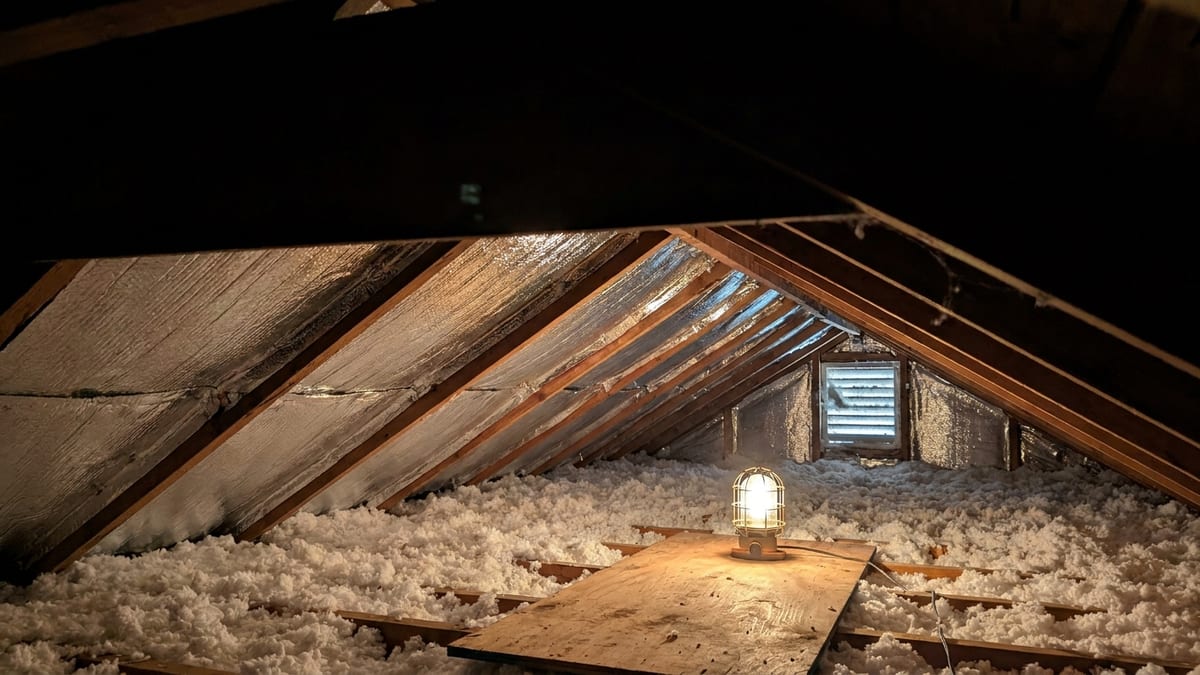
An insulation crew spends three hours in a 1,400 square foot attic, blows in R-49, and leaves with a $1,400 invoice. The same crew, in the same attic, on the same trip, could have sealed the top plates, the chases, the bath fans, and the can lights for another $900, and stapled radiant barrier to the rafters for another $1,600.
Same lead. Same drive. Same ladder. Roughly double the ticket.
That is the whole argument for treating attic air sealing and radiant barrier as a deliberate second sale instead of a line item your estimator mentions when he remembers to. The lead cost does not move. The attachment rate does. And the attachment rate is what sets the maximum you can afford to pay for an attic lead in the first place.
Why is attic air sealing the most under-sold line item in insulation?
Because nobody asks for it by name. Homeowners do not call and say they want a blower door test and a day of foam and caulk around top plates. They call because the upstairs bedroom is ten degrees hotter than the living room, because the floors are cold in January, or because a utility bill crossed a number that made them angry.
Then they describe the fix in the only vocabulary they have: "I think I need more insulation."
So the contractor quotes more insulation. Blown-in over the existing batts, done in a morning, $1,200 to $2,000. The homeowner accepts, the crew installs, and the air leaks that were moving conditioned air into the attic in the first place are still there, now buried under fourteen inches of fresh cellulose.
That is a lost second sale and a future callback in one visit. It is also why insulation campaigns that lead with product language underperform campaigns that lead with symptoms. The buyer for insulation leads is describing a comfort problem, not shopping an R-value, and the company that reframes the attic as a system during the inspection is the one that sells the bigger scope.
The two buyers inside one attic lead
- The rebate buyer. Found a utility program, wants the top-off, price shops three quotes, decides in days. Small ticket, fast close.
- The comfort buyer. Hot room, cold floors, dust, ice dams, or a bill that keeps climbing. Has no idea what the fix is called. Slower decision, far bigger scope, and almost always the one who buys sealing and barrier when somebody actually shows them the attic.
Both come in through the same form. Your inspection is what separates them.
What is each attic add-on actually worth in 2026?
Use your own numbers once you have them, but these are the ranges most attic contractors are working inside.
| Attic scope | Typical installed ticket | Crew time | Why it sells |
|---|---|---|---|
| Attic scopeBlown-in top-off (fiberglass or cellulose) | Typical installed ticket$800 to $3,000 | Crew timeHalf day | Why it sellsRebates, visible depth, easy yes |
| Attic scopeAttic air sealing (penetrations, top plates, chases, can lights) | Typical installed ticket$400 to $2,500 | Crew time2 to 6 hours | Why it sellsDrafts, dust, uneven temperatures |
| Attic scopeRadiant barrier (stapled or over-joist, hot climates) | Typical installed ticket$1,100 to $3,000 | Crew timeHalf to full day | Why it sellsUpstairs heat, cooling cost |
| Attic scopeVentilation correction (baffles, soffit, ridge) | Typical installed ticket$400 to $1,500 | Crew time2 to 4 hours | Why it sellsMoisture, ice dams, warranty compliance |
| Attic scopeAttic cleanout and removal before reinstall | Typical installed ticket$1,000 to $3,500 | Crew timeHalf to full day | Why it sellsRodents, mold, contamination |
| Attic scopeFull attic package (seal, insulate, ventilate, barrier) | Typical installed ticket$4,000 to $9,000 | Crew time1 to 2 days | Why it sellsOne scope, one crew, one visit |
The spread between a $1,400 top-off and a $5,500 attic package is not a different lead. It is a different conversation inside the same attic.
Why does the second sale change what you can pay per lead?
Most insulation contractors set their lead budget against the ticket they usually sell, not the ticket they could sell. That one habit caps the whole company.
The formula does not change by trade:
Maximum cost per lead = (average job value x gross margin x close rate) divided by 3
Example: a contractor selling top-offs only, $1,400 average ticket, 45 percent gross margin, 30 percent close rate. That is 1,400 x 0.45 = $630 of gross profit per job, times 0.30 = $189 of gross profit per lead, divided by 3 for a working ceiling of roughly $63 per lead.
Example: the same contractor attaches sealing or barrier on half of attics and lifts the blended ticket to $2,800. Now it is 2,800 x 0.45 = $1,260, times 0.30 = $378, divided by 3 for a ceiling near $126 per lead.
Nothing about the ad changed. The contractor can now outbid every competitor in the auction, buy exclusive leads instead of shared scraps, and still hold margin. That is why the attachment rate is a marketing number, not just a sales number. If you have never run this math for your own company, the walkthrough in how much you should pay per lead covers the all-in version, including ad spend and fees, not just the invoice from a lead source.
What the blended ticket does to a year
Example: 40 attic leads a month, 30 percent close rate, 12 jobs a month, 144 jobs a year.
- At $1,400 average: $201,600 in revenue.
- At $2,800 average: $403,200 in revenue.
Same leads. Same close rate. Same crews. The difference is what happened during the inspection.
Should attic air sealing get its own campaign or ride along?
Ride along, in almost every market.
Search volume for "attic air sealing" and "radiant barrier" is thin because homeowners do not know the words. A standalone campaign on those terms either starves for volume or fills with researchers who found the phrase in an energy blog. Meanwhile the symptom language (hot upstairs, cold floors, high summer bills, attic full of old insulation) has real demand and brings in the buyer who will pay for all three line items at once.
So the structure that works looks like this:
- One attic campaign, symptom-led. The ad names the problem, shows a real attic before and after, and offers an attic inspection.
- Qualify for scope on the form. Age of home, square footage, whether anyone has been in the attic in the last ten years, and what the homeowner has noticed.
- Sell the package at the inspection. Photos from the attic, three priced tiers, one decision.
- Separate campaign only for the cleanout or rodent job, because that is a different emotional buyer and a different ad.
- Radiant barrier as a creative variant, not a campaign, and only in hot-climate markets where it actually performs.
If you want to see what the ceiling and budget look like against your own ticket before you commit to anything, run your numbers through the lead ROI calculator and compare your current cost per closed attic job to what it would be at a blended ticket.
How do you actually attach the second sale during the inspection?
An attic inspection is a sales appointment. Treat it like one and the attachment rate stops being luck.
- Go into the attic every time. No photos from the hatch. The sale is made by what you bring down from up there.
- Take five photos minimum. Open top plates, a can light with daylight showing, compressed or displaced batts, a bath fan dumping into the attic, and the current depth against a ruler.
- Show the air first, the insulation second. Insulation slows heat. It does not stop air. Say it in that order and the sealing line item stops sounding optional.
- Price in tiers, not as upsells. Good is the top-off. Better is seal plus insulate. Best adds ventilation correction and barrier where climate justifies it. Put a number on all three on the same page.
- Quantify what you can honestly quantify. Crew hours, square footage, number of penetrations, depth before and after. Never promise a dollar figure of savings you cannot support.
- Close on the visit. Attic scopes go stale fast because the homeowner cannot see the problem once you leave. Present, price, and ask the same day.
How many leads do you need to hit a revenue target?
Example: a contractor wants to add $600,000 in attic revenue.
- Blended attic ticket: $2,800
- Jobs required: 600,000 divided by 2,800 = 214 jobs
- Close rate: 30 percent
- Leads required: 214 divided by 0.30 = 714 leads, roughly 60 per month
- At an exclusive lead cost around $75, that is about $4,500 a month in lead fees against $50,000 a month in revenue
Run the same math at a $1,400 ticket and the same 714 leads produce $300,000. The lead plan did not change. The attic conversation did.
What kills attic air sealing and radiant barrier leads after they come in?
Slow first contact
Comfort complaints are mood-driven. A homeowner who filled out a form on the first ninety degree day of the year is motivated for about forty eight hours. Call in minutes, not hours. The economics of that gap are laid out in speed to lead, and they are worse in insulation than most trades because the pain fades with the weather.
Quoting over the phone
Nobody can price an attic from a phone call. A phone number thrown at a homeowner becomes the number every competitor underbids. Book the inspection.
Inspecting from the hatch
If the rep does not go in, there are no photos, and without photos there is no second sale. This single habit separates a $1,400 company from a $2,800 company.
Selling barrier where it does not belong
Radiant barrier performs in hot, sunny markets. In cold northern markets, sealing and depth matter far more. Selling the wrong product into the wrong climate buys you a refund request and a review you will be answering for two years.
No follow-up on the unsold tier
A homeowner who bought the top-off and declined sealing is a warm lead in six months, especially after one bad season. Put them in a sequence. That revenue costs you nothing to generate.
The short version
Attic air sealing and radiant barrier are not products you advertise. They are margin you capture on a lead you already paid for. Run one symptom-led attic campaign, get a rep physically into every attic, present three priced tiers from photos, and watch the blended ticket pull your maximum cost per lead up with it. The contractor who can pay $126 for an exclusive attic lead will always have more volume than the one capped at $63, and the only thing separating them is what happens in the thirty minutes between the ladder going up and the proposal going down.
If you want exclusive attic and insulation leads delivered into your own ad account, with the homeowner's property data attached before your rep calls, get started here and we will show you what the numbers look like in your market.
Frequently asked questions
What is attic air sealing worth as an add-on?
Attic air sealing typically adds $400 to $2,500 to an attic job depending on how many penetrations, top plates, chases, and can lights need treatment. It is performed on the same visit as the insulation install, so it carries almost no additional lead cost and usually holds a better gross margin than the blown-in work it sits under.
Should attic air sealing get its own Meta campaign?
In most markets no. Homeowners do not search for air sealing by name, they describe cold floors, hot upstairs rooms, and high utility bills, so the campaign should sell a comfort problem and an attic inspection. Air sealing and radiant barrier are sold at the inspection, not in the ad.
What should an insulation contractor pay for an attic lead?
Run the formula average job value times gross margin times close rate, divided by three. A contractor selling $1,400 top-offs alone lands near a $60 ceiling, while a contractor whose blended attic ticket is $2,800 lands closer to $125, which is why the attachment rate decides the budget more than the ad does.
Does radiant barrier sell outside hot climates?
It sells well in hot, sunny markets where attic heat gain drives cooling cost, and poorly in cold northern markets where air sealing and added depth matter more. Do not force the product into a climate it does not fit, because one bad attic sale costs more in reviews and callbacks than the ticket was worth.
How do you present air sealing without losing the insulation sale?
Present the attic as one scope with priced tiers rather than a base price plus upsells. Show the photos you took in the attic, name the good, better, and best packages with a price on each, and let the homeowner pick a level instead of defending a surprise.