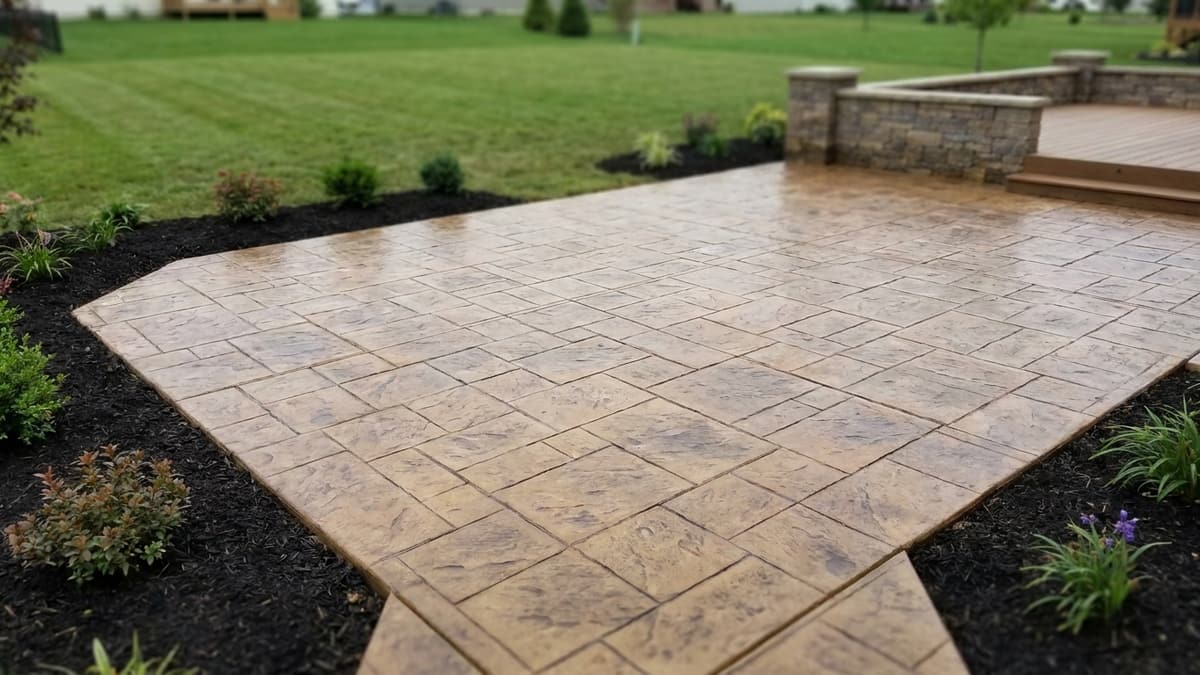
Two contractors walk the same backyard on the same Tuesday. Both measure 600 square feet. One quotes a broom finish slab at $8 a foot and writes $4,800. The other quotes a stamped ashlar slate patio with a contrasting border at $19 a foot and writes $11,400.
Same crew size. Roughly the same excavation, the same base, the same number of days on site plus one. The second contractor is carrying more than double the revenue off the same lead, the same drive, and the same sales appointment.
That gap is the entire argument for running decorative concrete as its own offer instead of treating stamping as an upsell you mention at the end of the walkthrough. The problem is that most concrete contractors lose that bid, not because the price is wrong, but because the homeowner was never shown what she was paying for.
Why does the decorative upsell decide your year, not your lead count?
Most concrete companies try to grow by adding leads. More leads, more pours, more revenue. That works until your crew hits capacity in July and you are turning work away while still paying for leads.
Decorative work grows revenue without adding a single crew day in most cases. A stamped patio takes one extra day over a broom finish, sometimes two with a sealer return trip. The material cost goes up by color hardener, release, stamp rental or amortization, and sealer. The price goes up by far more than that.
Example: a 600 square foot patio at $8 per foot is $4,800 in revenue. At a 30 percent gross margin that is $1,440 of gross profit. The same slab stamped at $19 per foot is $11,400. Decorative work typically carries a higher margin because the price premium outruns the material premium, so call it 35 percent. That is $3,990 of gross profit. One extra crew day produced $2,550 more gross profit from a lead you already paid for.
Now run that across 40 patios a year. Converting even half of them from gray to decorative is six figures of gross profit that never required a bigger ad budget.
What is a stamped or decorative concrete job actually worth in 2026?
Here are typical installed ranges contractors quote in most US markets. Your region, your base prep, and your pattern complexity move these.
| Finish type | Typical installed price per sq ft | Typical 500 to 700 sq ft project | Decision speed |
|---|---|---|---|
| Finish typeBroom finish flatwork | Typical installed price per sq ft$6 to $12 | Typical 500 to 700 sq ft project$3,500 to $8,000 | Decision speedDays, heavily price shopped |
| Finish typeExposed aggregate | Typical installed price per sq ft$10 to $18 | Typical 500 to 700 sq ft project$6,000 to $12,000 | Decision speedWeeks |
| Finish typeSingle-color stamped | Typical installed price per sq ft$12 to $18 | Typical 500 to 700 sq ft project$7,000 to $12,500 | Decision speedWeeks to months |
| Finish typeMulti-color stamped with border | Typical installed price per sq ft$16 to $25 | Typical 500 to 700 sq ft project$10,000 to $17,000 | Decision speedMonths, planning phase |
| Finish typeDecorative overlay on sound slab | Typical installed price per sq ft$8 to $15 | Typical 500 to 700 sq ft project$5,000 to $10,000 | Decision speedWeeks |
| Finish typeStained and polished interior | Typical installed price per sq ft$7 to $15 | Typical 500 to 700 sq ft project$4,000 to $10,000 | Decision speedWeeks |
The pattern is simple. The further you move from gray, the bigger the ticket and the longer the homeowner takes to decide. That second half matters more than the first, because it changes where the lead has to come from. Price-shopped flatwork goes to whoever answers and quotes fast. The $14,000 stamped patio goes to whoever got in front of the homeowner while she was still scrolling backyard photos, which is exactly what a concrete and patio lead campaign is built to do.
What can you actually pay for a stamped concrete lead?
Stop comparing lead prices across channels. Start with your own ceiling.
The formula: average job value multiplied by gross margin multiplied by close rate, divided by three. The divide-by-three leaves room for overhead, sales cost, and actual profit instead of breaking even.
| Offer | Avg job | Margin | Close rate | Expected GP per lead | Working CPL ceiling |
|---|---|---|---|---|---|
| OfferPlain flatwork | Avg job$5,000 | Margin30% | Close rate25% | Expected GP per lead$375 | Working CPL ceiling$125 |
| OfferSingle-color stamped | Avg job$9,500 | Margin35% | Close rate25% | Expected GP per lead$831 | Working CPL ceiling$277 |
| OfferMulti-color stamped patio | Avg job$12,000 | Margin35% | Close rate25% | Expected GP per lead$1,050 | Working CPL ceiling$350 |
| OfferOverlay / resurfacing | Avg job$7,000 | Margin38% | Close rate22% | Expected GP per lead$585 | Working CPL ceiling$195 |
Example: at a $350 ceiling, paying $150 for an exclusive decorative lead is not expensive. It is roughly 43 percent of your ceiling, which leaves real room. Paying $60 for a shared flatwork lead that four other contractors also received, and closing it at 5 percent, costs you $1,200 per acquired job on a $5,000 ticket. That is the trade most contractors get backwards, and it is laid out in detail in exclusive versus shared leads.
If you want to run your own numbers against your current source instead of these examples, the ROI calculator does the cost-per-acquired-job math in about two minutes.
Why do decorative bids get lost even when the price is fair?
Four reasons, in order of how often they show up.
The homeowner never saw the finished product
"Stamped ashlar slate, two colors, integral border" is a line item, not an image. Next to a competitor's $4,800 it reads like an upcharge for words. Homeowners buy decorative concrete with their eyes, and if the only visual in the conversation is a price sheet, the cheaper number wins by default.
The quote is a lump sum instead of a difference
$11,400 against $4,800 feels like a different universe. "The slab is $4,800. The stamped version of the same patio is $11,400, so the finish is $6,600" is a decision she can actually make, especially once the finish is framed against what it does to the back of the house for the next twenty years.
The scope was never defended
A cheap bid is usually a thinner slab, less base, no fiber or mesh, no control joint plan, and no sealer. If you do not say that out loud with numbers, the homeowner assumes both quotes describe the same patio.
Nobody followed up
Decorative projects take weeks to decide. Most contractors quote once and go quiet. The homeowner was not rejecting you, she was waiting for her spouse to get back from a trip. A real follow-up system recovers a meaningful share of these without any new ad spend.
How do you reach the decorative buyer before she collects three gray bids?
The homeowner planning a stamped patio does not start by searching "concrete contractor near me." She starts by looking at backyards. Months out. On her phone. That is why search-only strategies capture the flatwork buyer and miss the high-ticket one, and why real finished-project photography on Meta reaches her while the project is still an idea.
What the creative needs:
- Your own finished work. Not stock, not supplier catalog shots. Wide shot of the full patio, one tight shot of the texture and joint line, one before and after from the same angle.
- A pattern name and a real starting price. "Stamped patios from $14 per square foot installed" filters out the homeowner shopping a $4,000 slab before she ever becomes a lead you pay for.
- Neighborhood proof. Same elevation, same housing stock, same region. Homeowners trust a patio that looks like it could be two streets over.
- A qualifying question on the form. Approximate square footage and whether the area is new construction or an existing slab. Those two answers tell your estimator whether this is a pour or an overlay before anyone picks up the phone.
- A real timeline ask. "This spring" versus "sometime next year" decides who your estimator calls first on a Monday morning.
If you want this running under your own company name, in your own ad account, with the pixel and audiences staying with you, that is exactly how a Minyona concrete and patio system is set up. Ad spend goes from your account directly to Meta, so you see every dollar of it.
How do you present the upgrade without losing the bid?
Bring three things to every decorative appointment.
Physical samples. Four to six cast samples, two patterns, two color schemes each. A homeowner holding a sample is no longer comparing two numbers, she is choosing a finish.
A photo book on a tablet, organized by pattern. Not a website gallery she has to scroll. Six to eight projects, each with the square footage and the pattern named. Jobs within fifteen miles if you have them.
A two-line quote. Base scope on one line, decorative finish as a separate line. Let her see the difference, not just the total.
Then handle the sealer conversation at the table instead of a year later. Decorative concrete needs resealing every two to three years. Say it, price it, and offer the maintenance plan. Contractors who hide it lose the referral when the color flattens out.
Quote the border and the accent as options
A contrasting band around the perimeter, a saw-cut pattern, a stained accent inside a seating area: price each one so the homeowner can add without renegotiating the whole project. Most of them add at least one. Example: a $300 border on a $10,000 patio carries a higher margin than the field, and three out of ten buyers taking it adds real gross profit across a season at zero extra lead cost.
How many stamped concrete leads do you need to hit a revenue target?
Work backward from revenue, never forward from budget.
Example: you want to add $600,000 in decorative revenue. At a $12,000 average decorative ticket that is 50 jobs. At a 25 percent lead-to-sale close rate that is 200 leads. Divided across a nine month pour season, that is roughly 22 leads a month.
At $150 per exclusive lead, 200 leads costs $30,000 in lead fees. Against $600,000 in revenue that is 5 percent of top line, comfortably under the 10 percent target most contractors use for acquisition cost.
Now the flatwork version. $600,000 at a $5,000 ticket is 120 jobs, 480 leads at the same close rate, and more than twice the crew days. Same revenue, far more work, far more lead cost. That is the real argument for building the decorative campaign first.
What kills decorative concrete leads after they come in?
Slow response. A homeowner who filled out a form on Sunday night and heard nothing until Wednesday has already booked two other estimates. The speed-to-lead math is brutal and it applies the same to a $12,000 patio as to a service call.
Measuring without photographing. Your estimator should leave every appointment with photos of the existing space. That is the before shot for your next campaign, and it is free.
Quoting by email with no visuals. A PDF with a number on it loses to a competitor who sat at the kitchen table with samples.
Letting weather kill the follow-up. Rained-out weeks are when quotes go cold. The estimator who texts during a wet stretch ("we are pushing the schedule, your slot in May is still open") keeps projects alive that competitors drop.
No seasonal plan. Decorative demand is decided in winter and installed in summer. Start spending in January and February, not April when every concrete company in your county turns their budget on at once and bids the auction up.
The short version
Decorative concrete is the highest-leverage change most concrete contractors can make, because it raises revenue per crew day without raising lead volume. Run it as its own campaign with its own cost-per-lead ceiling, built on your own finished-project photography. Set the ceiling from your ticket and margin, not from what a lead vendor charges. Bring samples and photos to the table so the homeowner is choosing a finish rather than comparing two numbers. Then judge the whole thing on cost per acquired job.
If you want exclusive decorative and patio leads running under your company name in your own ad account, with property data attached and a one-click dispute window on anything that does not qualify, get started here and we will show you the live numbers for your market.
Frequently asked questions
What does stamped concrete cost per square foot in 2026?
Stamped concrete commonly runs $12 to $25 per square foot installed depending on pattern complexity, number of colors, site prep, and region, against roughly $6 to $12 for a plain broom finish slab. Multi-color stamping, hand-detailed borders, and integral color with a stain accent sit at the top of that range, and a decorative overlay on sound existing concrete usually lands between $8 and $15.
Should stamped concrete leads run in the same campaign as flatwork?
No. A $5,000 broom finish patio and a $14,000 stamped patio support completely different cost-per-lead ceilings, so blending them into one campaign means you either overpay for cheap flatwork leads or get outbid on the decorative ones. Run a decorative campaign with finished-project photography and a separate flatwork campaign, then set a cost-per-lead ceiling for each from its own ticket and margin.
What can a decorative concrete contractor pay per lead?
Use average job value multiplied by gross margin multiplied by close rate, then divide by three. Example: a $12,000 stamped patio at a 35 percent margin and a 25 percent close rate gives $1,050 of expected gross profit per lead, so roughly $350 is a defensible working ceiling. The same formula on a $5,000 plain pour caps you nearer $125.
Why do homeowners pick the cheaper gray concrete bid?
Usually because nobody showed them the difference. A line item that reads stamped ashlar slate with two colors means nothing next to a number, so the homeowner defaults to the lower price. Contractors who bring sample boards, show finished patios from the same neighborhood, and quote the upgrade as a dollar difference per month rather than a lump sum lose far fewer of those bids.
When should decorative concrete campaigns run?
Start advertising 8 to 12 weeks before your pour season opens, which in most markets means January through March, because homeowners decide on a backyard project months before they call anyone. Keep spending through the season, then push resurfacing and overlay offers in late summer and fall when new patio demand softens.