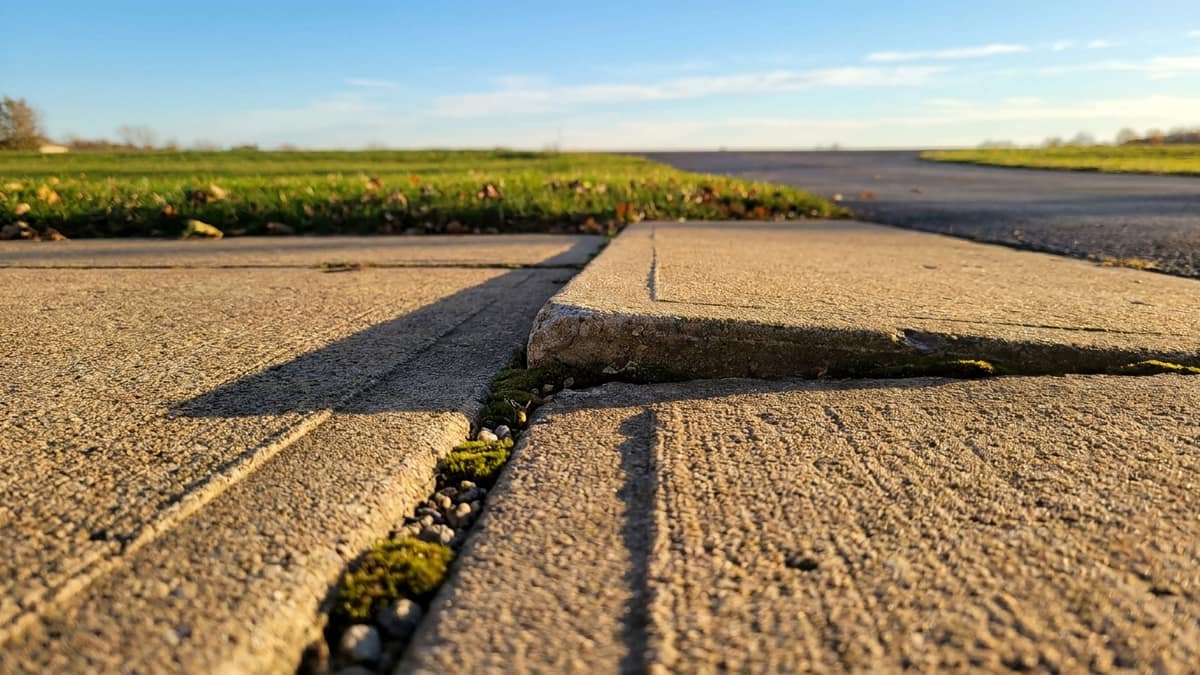
A mudjacking crew can lift four sunken walkway slabs, be off the property in ninety minutes, and invoice $900. That is a real, profitable job. It is also a job that cannot carry a $150 lead fee, a truck roll, and a sales visit without the margin disappearing.
That is the whole tension in concrete leveling lead generation. The work is fast, the equipment is paid for, and the phone can be filled with it. But the ticket is small enough that the standard contractor math breaks. Pay what an exclusive lead normally costs in this trade and you can run a busy month that produces almost no profit.
The contractors who make leveling campaigns work do one of two things: they drive the lead cost down hard, or they stop treating the lift as the end of the sale and start treating the visit as a slab inspection that regularly uncovers replacement work worth ten times more.
Why do concrete leveling leads break the usual cost-per-lead math?
Most concrete content assumes a five-figure patio or a $9,000 driveway. At that ticket, a $150 exclusive lead is cheap. Leveling does not live there.
Three things make the leveling lead different:
- The ticket is small. A single visit usually lands between $600 and $2,500.
- The urgency is real but shallow. A homeowner notices a trip hazard or a slab pulling away from the stoop, gets annoyed, and looks for a fix. They are not planning a project for next spring.
- The decision is fast and the price is shopped. Two quotes is common, three is not unusual, and the spread between companies on a four-slab lift is small enough that speed often decides it.
Those three facts point the same direction. Leveling leads have to be cheap, worked fast, and either sold at a decent ticket or expanded into a bigger scope. If you are running leveling alongside pours and decorative work, our concrete and patio lead generation page breaks down how the higher-ticket side of the trade prices out, which is the comparison that decides how much of your budget should sit on leveling at all.
What is a concrete leveling job actually worth in 2026?
Use typical market ranges rather than a single number, because lift height, void volume, access, and material choice move the price more than anything else.
| Job type | Typical ticket | Decision speed | Notes |
|---|---|---|---|
| Job typeSingle slab lift (walkway, step) | Typical ticket$300 to $1,200 | Decision speedDays | NotesOften a trip hazard or an insurance or HOA notice |
| Job typeMulti-slab walkway or patio lift | Typical ticket$900 to $2,500 | Decision speedDays to two weeks | NotesThe core mudjacking job |
| Job typeDriveway apron or garage slab lift | Typical ticket$1,200 to $3,500 | Decision speedOne to three weeks | NotesAccess and void volume drive the number |
| Job typePolyurethane foam injection | Typical ticket$1,000 to $3,500 | Decision speedDays to two weeks | NotesPrices above mudjacking, cures in minutes |
| Job typeSlab replacement (walkway or small pad) | Typical ticket$1,500 to $4,500 | Decision speedTwo to six weeks | NotesWhere leveling is no longer viable |
| Job typeDriveway replacement | Typical ticket$5,000 to $12,000 | Decision speedThree weeks to three months | NotesUsually found during a leveling inspection |
| Job typePatio tear out and new pour | Typical ticket$8,000 to $20,000 | Decision speedOne to four months | NotesPlanning-phase buyer, different campaign |
The gap between row two and row seven is the entire argument of this article. Same homeowner, same property, same truck in the driveway. The difference is whether anybody looked at the rest of the concrete.
What is the most you can pay for a leveling lead?
Run the break-even formula before you argue about whether a lead price is fair:
Average job value x gross margin x close rate = break-even cost per lead. Divide by three for a working ceiling.
Leveling as the whole sale
Example: a $1,400 average leveling ticket, 40 percent gross margin, 35 percent close rate on exclusive leads.
1,400 x 0.40 = $560 gross profit per sold job. 560 x 0.35 = $196 break-even cost per lead. 196 / 3 = roughly $65 as a working ceiling.
So a leveling-only campaign needs leads in the $40 to $80 range. That is achievable on Meta in most markets, where contractor cost per lead commonly runs $25 to $110, but it leaves no room for a $150 exclusive lead, a shared marketplace lead that closes in single digits, or a Google search click at $15 a piece in a competitive metro. If the formula is new to you, the cost per lead guide walks through the all-in version, including the fees most contractors forget to add.
Leveling as the front door
Now run the same 100 leads with attachment included.
Example: 100 exclusive leveling leads.
- 35 leveling jobs sold at $1,400 average = $49,000 revenue, $19,600 gross profit at 40 percent.
- 12 of those inspections find slabs past saving. 4 of them buy replacement or a new pour at a $7,500 average = $30,000 revenue, $10,500 gross profit at 35 percent.
- Total gross profit from 100 leads: $30,100, or $301 per lead.
- Working ceiling at one third: roughly $100 per lead.
The attachment rate in that example is modest. Four replacement sales out of a hundred leveling calls is not an aggressive assumption on older housing stock. And it moved the lead ceiling from $65 to $100, which is the difference between a campaign you have to throttle and a campaign you can scale.
How do you turn a leveling call into replacement work without running a bait and switch?
The honest version is simple: you inspect everything, you document what you find, and you give the homeowner both numbers. Nothing about that is a trick. It is what a competent concrete contractor should do anyway.
Inspect the whole property, not the four slabs they pointed at
When your tech arrives, the scope is every exterior slab plus the garage floor. Walkway, stoop, apron, patio, pool deck, steps. Five extra minutes.
Photograph the failures
Spalling, map cracking, slabs that have broken into more than three pieces, sections where the base has washed out, slabs sitting against a foundation and pitching water back toward the house. Pictures on a phone, shown to the homeowner at the tailgate.
Give two numbers, not one
"We can lift these four for $1,150 and they will be level and safe. These two by the garage are cracked through and the base under them is gone, so lifting them buys you maybe two years. Replacing that section is $3,400. If you want, we do the lift now and I will leave the replacement quote with you."
That is not upselling. That is the only answer that does not get you a callback in eighteen months from an angry homeowner.
Let them buy the small thing today
The lift is the easy yes. Take it. A homeowner who just watched your crew fix a trip hazard in ninety minutes is a vastly warmer prospect for a $7,500 driveway than a cold lead ever was, and you now have their trust, their photos, and a reason to call back in the spring.
If you want to see what a concrete campaign looks like when the leveling offer and the replacement offer are structured as separate funnels into the same calendar, start with the concrete and patio lead system and ask for the live numbers rather than a deck.
Who actually calls for concrete leveling?
Four buyers, and they do not behave the same way.
| Buyer | Trigger | Urgency | Likely attachment |
|---|---|---|---|
| BuyerTrip hazard homeowner | TriggerSomeone stumbled, or a guest complained | UrgencyHigh | Likely attachmentLow to moderate |
| BuyerSelling or closing homeowner | TriggerInspection report or agent note | UrgencyVery high, deadline driven | Likely attachmentLow, they want the cheapest pass |
| BuyerWater intrusion homeowner | TriggerSlab pitched toward the foundation | UrgencyModerate to high | Likely attachmentHigh, often basement or drainage scope |
| BuyerDeferred maintenance homeowner | TriggerFinally got tired of looking at it | UrgencyLow | Likely attachmentHighest, they are already considering replacement |
The water intrusion caller and the deferred maintenance caller are the two worth paying up for. The closing-deadline caller is the one that teaches contractors to hate leveling leads, because they want the lowest number on the shortest timeline and they will never buy anything else from you.
You cannot filter those apart perfectly on a form. You can ask one qualifying question that gets you most of the way there: "What made you look at this now?" The answer sorts the four buyers in one sentence.
How should a concrete leveling campaign be structured?
Run leveling as its own campaign. Not a line item inside your patio ads, not an afterthought in a general concrete campaign.
Separate creative
Leveling creative is problem imagery: the raised lip at a slab joint, a chalk line showing the drop, a before and after of a stoop that stopped pulling away from the house. Patio and driveway creative is finished work. Mixing them into one ad set trains the algorithm toward whichever audience is cheaper to reach, which is almost always the small ticket.
Separate budget and separate ceiling
Leveling gets a cost-per-lead cap in the $40 to $80 range if you are running it standalone, or up to roughly $100 if you are tracking replacement attachment and the attachment is real. Replacement and new pour campaigns get their own, much higher, ceiling. One blended number hides both.
Exclusive matters more at a small ticket, not less
This is the part contractors get backward. On a $900 job you have almost no margin to lose a race. A shared lead sold to four companies forces you into a price fight on a ticket that cannot survive one. The exclusive versus shared comparison runs the close-rate math, and the smaller the ticket, the more brutal the shared version looks.
Cap by capacity, not by ambition
Leveling is equipment bound. One rig, one crew, a realistic number of visits per day. There is no reason to pay for leads beyond that number. Set the daily budget against crew days, not against a revenue fantasy.
What does the seasonal calendar look like?
Leveling has a longer usable season than pouring does, which is exactly why it is useful.
| Period | What to run | Why |
|---|---|---|
| PeriodLate winter | What to runLeveling, trip hazard angle | WhyFreeze and thaw just finished moving slabs, crews are idle |
| PeriodSpring | What to runLeveling plus replacement quoting | WhyPeak discovery season, highest attachment |
| PeriodSummer | What to runReplacement and new pour primary, leveling secondary | WhyHigher ticket work should own the crew days |
| PeriodEarly fall | What to runLeveling heavy | WhyHomeowners want it fixed before winter, pour windows closing |
| PeriodLate fall and winter | What to runLeveling where ground conditions allow | WhyFills weeks when you cannot pour |
The strategic value of leveling is that it produces billable crew days in the months your pour schedule cannot. That alone justifies running the campaign even in a year where attachment is weak.
How many leveling leads do you need to hit a number?
Work backward. Say the goal is $250,000 in leveling revenue plus whatever replacement attaches.
- $250,000 divided by a $1,400 average ticket = 179 leveling jobs.
- 179 jobs divided by a 35 percent close rate = 511 leads.
- 511 leads over 12 months = roughly 43 leads per month.
- At a $70 cost per lead, that is about $3,000 per month in lead and ad cost combined.
- At the attachment rate in the earlier example, those 511 leads also produce roughly 20 replacement sales at $7,500, or $150,000 in additional revenue.
That last line is the one to put in front of yourself before deciding leveling is too small to bother with. The leveling campaign booked $250,000 of filler work and surfaced $150,000 of real concrete. Run your own version of that math with your ticket and your close rate using the ROI calculator before you set a budget.
What kills concrete leveling leads after they come in?
Slow callbacks
These homeowners are annoyed right now. Whoever answers and puts a date on the calendar usually wins, and the race is often decided inside the first hour. The speed to lead breakdown covers what a one-hour delay does to contact rate, and small-ticket work punishes delay harder than anything else because the homeowner has no reason to wait for you.
Quoting a lift over the phone
You do not know the void volume from a description. A number given blind is either too low to cover the job or too high to win it. Give a visit range and book the inspection.
Sending a salesperson instead of a tech
On a $1,100 ticket, a separate sales visit destroys the margin. The person who looks at the slabs should be able to price it, sell it, and in many cases do it that day.
Never looking at the rest of the concrete
The most expensive mistake in this trade. Every leveling visit where nobody walked the driveway is a replacement quote that went to whoever did.
Letting the replacement quote die in a truck
The homeowner who said no to a $7,500 driveway in March is a real prospect in September. If that quote is not in a CRM with a follow-up date attached, it is gone.
The short version
Concrete leveling will not carry a company on its own. The ticket is too small and the ceiling on what you can pay for the lead is too low for most exclusive lead pricing to make sense if the lift is the entire sale.
It earns its place two other ways. It fills crew days in months when pouring is not an option, and it puts your people in front of concrete that nobody else is looking at. Run it as its own campaign with its own ceiling, inspect everything, quote both options honestly, and measure the channel on blended gross profit per call.
If you want a concrete campaign built so the leveling offer and the replacement offer are tracked separately instead of blended into one misleading cost per lead, get started here. Campaigns run inside your own Meta ad account, leads come in exclusive, and you see every dollar of ad spend because you pay Meta directly.
Frequently asked questions
Are concrete leveling leads worth paying for?
They are worth paying for when the leveling visit is run as a slab inspection that can turn into replacement work, and they are usually a loser when leveling is treated as the entire sale. A standalone $900 lift cannot absorb a $150 exclusive lead plus mobilization and crew time, but a blended book where a portion of those calls become $5,000 to $15,000 replacement jobs supports a far higher lead cost.
What does concrete leveling cost a homeowner in 2026?
Typical residential leveling runs about $600 to $2,500 for a whole visit, with per-slab pricing often between $300 and $1,200 depending on lift height and void volume. Polyurethane foam injection generally prices higher than traditional mudjacking because of material cost and cure speed, and large garage or basement slabs can push a single visit past $3,000.
What is the most a concrete contractor should pay for a leveling lead?
Run average job value multiplied by gross margin multiplied by close rate, then divide by three. Example: a $1,400 average leveling ticket at 40 percent margin and a 35 percent close rate gives a break-even of $196 and a working ceiling near $65 per lead. Once replacement attachment is included in the same math, that ceiling commonly moves into the $90 to $120 range.
Should concrete leveling run as its own campaign or inside a patio and driveway campaign?
Run it as its own campaign with its own budget and its own cost-per-lead ceiling. Leveling buyers respond to settled slab and trip hazard imagery, while patio and driveway buyers respond to finished project photography, and blending them hides which half is actually paying. Separate campaigns also let you cap leveling spend the moment the schedule fills.
What is the fastest way to lose a concrete leveling lead?
Calling back the next day. These homeowners are reacting to a trip hazard or a settling slab they just noticed, and the first company that answers and puts a date on the calendar usually gets the job. The second most common killer is quoting a lift over the phone without seeing the slab, which either prices you out or locks you into a number that does not cover the void.