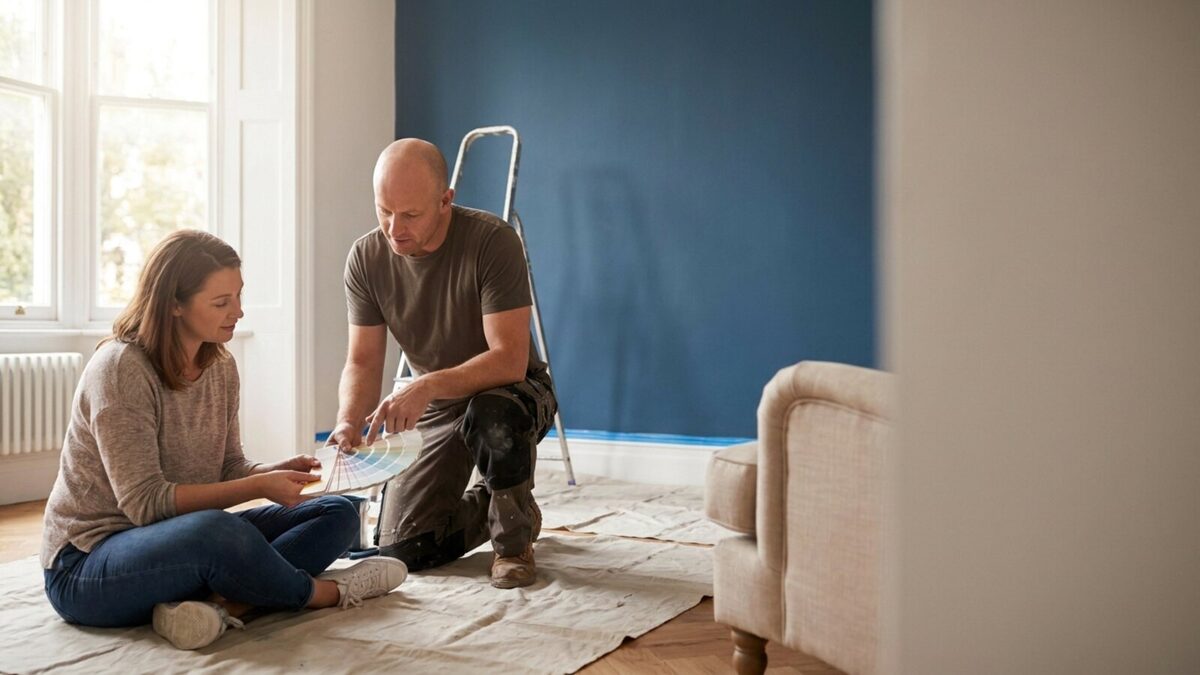
Two homeowners on the same street contact you the same week. One wants a bedroom repainted before family visits: $650, two days, done. The other is quoting a full interior plus cabinet refinishing before listing the house: $11,000, three weeks, and she is talking to two other painters. Same trade, same crew, seventeen times the revenue.
Most painting companies market to both with one ad, one message, and one follow-up process. Then they wonder why the average ticket keeps sliding and every estimate turns into a negotiation over $400. The problem is almost never the pricing. It is the lead source, and the fact that the homeowner already had two other quotes in hand before you ever rang the doorbell.
Why do painting leads split into two completely different buyers?
Painting looks like one service. It behaves like two businesses.
The fast repaint buyer
A room that got scuffed. A rental turning over. A ceiling stained by an old roof leak. A wall color the new owner hates. This homeowner has a date on the calendar and wants it handled. They search on their phone, call two or three painters, and book whoever answers and can start within a week or two. Typical ticket: $400 to $2,500.
This buyer is a race. Speed and availability win the job. Price matters, but it matters less than showing up.
The planned project buyer
A whole-house exterior repaint that has been on the list for three summers. A full interior refresh before a graduation party. Cabinet refinishing instead of a $20,000 kitchen tear-out. This homeowner has been thinking about it for months, is looking at color palettes, and will collect two or three quotes before deciding. Typical ticket: $4,000 to $15,000.
This buyer is a conversation, not a race. Whoever gets in front of them during the thinking phase sets the scope, the prep standard, and the price frame. Everyone who shows up later is bidding against that.
The mistake is judging both buyers against the same cost-per-lead target. A $60 lead is expensive for a $600 touch-up and cheap for a $9,000 exterior. Our painting lead generation page covers how campaigns get built separately for each side.
What is a painting job actually worth in 2026?
You cannot set a lead-cost ceiling until you know your real ticket mix. Regional labor rates, surface condition, and height access move these numbers, but the ranges are typical.
| Scope of work | Typical installed price | Buyer type |
|---|---|---|
| Scope of workSingle room repaint | Typical installed price$400-$900 | Buyer typeFast repaint |
| Scope of workCeiling or trim only | Typical installed price$300-$1,200 | Buyer typeFast repaint |
| Scope of workFull interior repaint (whole home) | Typical installed price$4,000-$10,000 | Buyer typePlanned project |
| Scope of workWhole-house exterior repaint | Typical installed price$4,500-$14,000 | Buyer typePlanned project |
| Scope of workCabinet refinishing | Typical installed price$3,000-$9,000 | Buyer typePlanned project |
| Scope of workDeck or fence staining | Typical installed price$500-$2,500 | Buyer typeEither |
| Scope of workDrywall repair and prep add-on | Typical installed price$300-$2,000 | Buyer typeAdd-on to either |
The pattern matters more than any single line. Moving one homeowner from a $700 room to a $9,000 whole-interior project is worth more than winning ten extra touch-ups. That is a lead-source decision and a sales-process decision, not a pricing decision.
The formula that sets your budget
Run this before you spend a dollar.
Max cost per lead = (average job value x gross margin x close rate) / 3
A painting company averaging $4,500 per job at a 45% gross margin and a 30% close rate: $4,500 x 0.45 x 0.30 = $607, divided by 3 = a $202 maximum cost per lead. Most exclusive painting leads land well under that. Shared marketplace leads look cheaper on the invoice and blow past it the moment close rate is applied.
Why is cost per lead the wrong number for painters?
Because cost per lead ignores how many other painters were handed the same homeowner. Cost per acquired job is the only number that pays a crew.
| Channel | Cost per lead | Typical close rate | Cost per acquired job |
|---|---|---|---|
| ChannelReferrals | Cost per lead$0 | Typical close rate40-60% | Cost per acquired jobNear $0 |
| ChannelGoogle Business Profile / organic | Cost per lead$0-50 | Typical close rate20-40% | Cost per acquired job$100-250 |
| ChannelShared marketplace leads | Cost per lead$15-60 | Typical close rate5-12% | Cost per acquired job$250-1,000 |
| ChannelGoogle Ads and Local Services Ads | Cost per lead$40-150 | Typical close rate15-30% | Cost per acquired job$250-900 |
| ChannelMeta advertising | Cost per lead$20-90 | Typical close rate10-20% | Cost per acquired job$150-800 |
| ChannelExclusive leads (performance partner) | Cost per lead$50-200 | Typical close rate20-35% | Cost per acquired job$200-900 |
| ChannelExclusive booked estimates | Cost per lead$200-400 | Typical close rate25-40% | Cost per acquired job$500-1,400 |
A $30 shared lead closing at 8% costs $375 per acquired job. A $90 exclusive lead closing at 30% costs $300 per acquired job, and the average ticket is usually higher because you are not one of four painters racing each other to the bottom on the same house. The full breakdown of that math lives in our guide on exclusive vs. shared leads.
There is a second cost buried in shared leads that painters rarely track: estimate time. A real painting estimate is not a phone quote. It is 30 to 60 minutes on site measuring, checking substrate condition, and talking through colors, plus travel. Fifteen shared leads at an 8% close rate means roughly a dozen estimates to sell one job. Price that at your estimator's loaded hourly cost and the cheap lead stops being cheap.
How do you reach planning-phase homeowners before they start calling around?
The $9,000 exterior almost never starts with a search. It starts with a homeowner standing in the driveway looking at chalky, faded siding, then scrolling on a phone that night. That is why Meta advertising outperforms search on the high-ticket side of painting.
- Lead with real before-and-after photography. Peeling exterior to crisp finished siding. Dated oak cabinets to a clean painted kitchen. Painting is a visual purchase, and homeowners buy the outcome in the photo, not the coating spec. Use your own completed jobs.
- Sell the transformation, not the labor. "Make the house look new without a renovation budget" pulls a bigger buyer than "affordable house painting."
- Use condition hooks. Peeling and blistering paint. Faded south-facing walls. Cabinets you hate but cannot afford to replace. Chalky siding that rubs off on your hand. Homeowners recognize symptoms before they recognize scopes of work.
- Name the trigger events. Listing the house, hosting a graduation or wedding, a new baby's room, moving into a home with someone else's color choices, an HOA notice about exterior condition.
- Put color consultation in the offer. Color paralysis is the single biggest reason interior projects stall. A free consultation is a low-friction reason to let you in the door, and it is a sales appointment.
- Show prep, not just paint. Taped edges, drop cloths, caulked seams, sanded surfaces. Prep is where the price difference between you and the low bidder lives. Show it in the ad and you pre-frame the objection before the estimate.
When those campaigns run through your own ad account, the pixel data, the audiences, and the retargeting lists stay with you, and the homeowner remembers your company name instead of a directory. That is the entire argument for running lead generation under your own brand rather than renting someone else's.
How do you win the fast repaint call without dropping your price?
Speed. Not discounts.
The homeowner who wants a bedroom done before Thanksgiving is calling three painters in one sitting. Two of them will not pick up. If you answer live, quote a realistic start window, and confirm in writing the same day, price becomes the third thing they compare instead of the first.
Three rules that decide these jobs:
- Answer inside five minutes or have someone who will. Response time drives qualification rates harder than any script change. The mechanics are in our breakdown of speed to lead.
- Never quote a full interior over the phone. Quote a range, book the walkthrough. Phone quotes turn every conversation into a price shootout.
- Bundle upward on site. The homeowner who called about one room is standing in a house with tired trim, a scuffed hallway, and a front door that needs refinishing. Walk the whole home during the estimate. Half your ticket growth is already inside the house.
How many painting leads do you need to hit a revenue target?
Work backward from the revenue number, not forward from a budget you guessed at.
| Added revenue goal | Average job | Jobs needed | Leads at 30% close | Exclusive leads per month |
|---|---|---|---|---|
| Added revenue goal$150,000 | Average job$4,500 | Jobs needed34 | Leads at 30% close113 | Exclusive leads per month10 |
| Added revenue goal$300,000 | Average job$4,500 | Jobs needed67 | Leads at 30% close223 | Exclusive leads per month19 |
| Added revenue goal$600,000 | Average job$5,500 | Jobs needed110 | Leads at 30% close367 | Exclusive leads per month31 |
At roughly $90 per exclusive lead, the $300,000 target costs about $1,700 a month in lead fees, plus the ad spend you pay directly to Meta out of your own account. Against $300,000 in added revenue at a 45% gross margin, that is a return most painting companies would take every day of the week. Run your own numbers through the ROI calculator before you commit to a spend level.
Two things break this math. First, a close rate below 20%, which is almost always a follow-up problem rather than a lead-quality problem. Second, an average ticket that keeps drifting down because every lead is a shared one and every conversation starts with a competing bid.
What does the painting calendar look like?
Painting is more seasonal than most trades, and the seasonality is predictable enough to budget around.
- Late winter (Jan-Mar). Cheapest advertising of the year. Book exterior work for spring before the market wakes up, and run interior and cabinet campaigns hard. This is when whole-house exterior jobs get decided, six to ten weeks before the first coat.
- Spring (Apr-Jun). Peak exterior demand and peak competition. Volume is easy, margins get pressured. Have the calendar already partly full so you are not bidding out of desperation.
- Summer (Jul-Aug). Exterior continues. Deck and fence staining, plus HOA-driven repaints.
- Fall (Sep-Nov). The last exterior window, then a hard pivot to interiors, cabinets, and holiday-deadline work. "Done before the holidays" is one of the strongest deadlines in the trade.
- December. Interior only, low competition, and a good month to run retargeting against everyone who requested a quote and stalled.
More detail on building the year around those swings is in our guide to seasonal contractor marketing.
What kills painting leads after they come in?
Most painters do not have a lead problem. They have a follow-up problem that looks like a lead problem.
- The quote goes out and nothing happens after. Painting quotes have a long decision window, especially on color-driven interior work. One follow-up is not a system. Plan for six to eight touches over 30 days.
- The estimate is a number on a text message. A $9,000 exterior deserves a written scope: surfaces, prep steps, product, number of coats, warranty. The low bidder never provides that. Make the comparison impossible.
- Color paralysis. The homeowner wants the job and cannot commit to a shade. Offer a consultation, sample boards, or a digital rendering. Take the decision off their plate.
- No proof. Photos of your own crews on your own jobs beat any adjective on your website. Homeowners are buying your prep standard and your cleanliness, and they judge both from pictures.
The short version
Painting leads split into a speed game and a planning game. Win the speed game by answering fast and walking the whole house. Win the planning game by reaching homeowners with real finished-work photography weeks before they start calling around, under your own brand, so the first quote they see is yours.
Stop judging channels by cost per lead. Judge them by cost per acquired job and by what the average ticket looks like when nobody handed your homeowner three competing bids.
If you want exclusive painting leads coming in under your own name, through your own ad account, with no monthly retainer, start here and we will show you the live numbers for your market.
Frequently asked questions
What do painting leads cost in 2026?
Shared marketplace leads typically run $15-60 each but close at 5-12% because three to five painters get the same homeowner. Exclusive painting leads generally run $50-200 each and close at 20-35% because one company owns the conversation. Booked in-home estimates usually run $200-400 and close at 25-40%.
How many painting leads do I need to add $300,000 in revenue?
At a $4,500 average job you need roughly 67 additional jobs. At a 30% close rate that is about 223 leads a year, or 19 exclusive leads a month. At $90 per lead that is roughly $1,700 a month in lead cost, plus the ad spend you pay directly to Meta out of your own account.
Why do painting leads always turn into price negotiations?
Because most painters buy shared leads, where the homeowner requested quotes from several companies at once and the only variable left to compare is price. Exclusive leads generated under your own brand arrive without a competing bid attached, so the conversation starts with scope, prep, and product instead of a number to beat.
Is Meta advertising or Google better for painting leads?
Use both for different jobs. Google and Local Services Ads capture homeowners already searching for a painter at $40-150 per lead with high intent but limited volume. Meta advertising reaches homeowners in the planning phase before they search, which produces larger interior and exterior tickets at $20-90 per lead and lets you control volume by turning spend up or down.
When should painters start advertising for the spring and summer season?
Six to ten weeks before your local exterior season opens. Homeowners pick colors, get quotes, and schedule weeks ahead of the first coat, so advertising in late winter fills the calendar before competitors start bidding. Interior work runs year round and carries the fall and winter months.