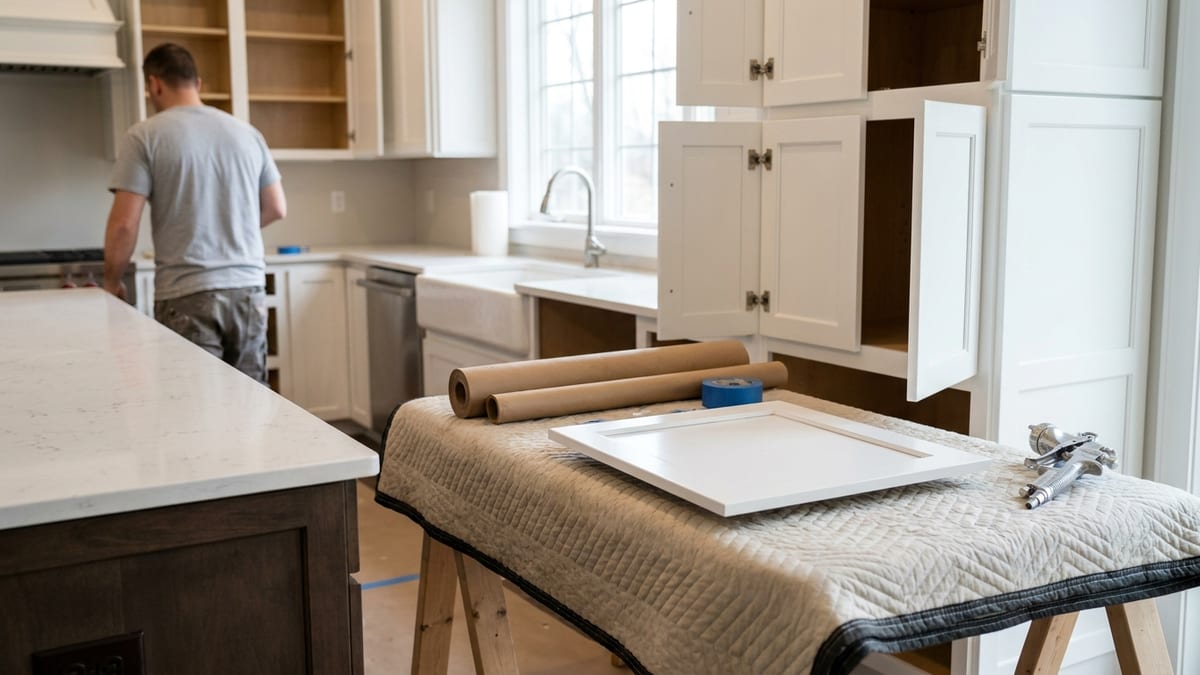
A full kitchen remodel is $40,000 and eight weeks of no kitchen. Cabinet refacing is $12,000 to $20,000. Spraying the existing boxes and doors is $3,000 to $7,000 and the homeowner is cooking again by the weekend.
That price gap is the entire sales argument, and most painting companies never put it in front of anybody. They run a generic "interior painting" campaign, get walls-and-ceilings leads at $2,800 a job, and never touch the kitchen work that pays twice as much per crew day.
Here is how cabinet painting leads actually behave, what the ticket is worth, and the math for deciding what you can pay to get one.
Why is cabinet painting a different sale than interior painting?
Because the homeowner is not buying paint. They are buying out of a remodel they already priced and rejected.
The refresh buyer
This homeowner has already decided. The oak is dated, the white laminate is yellowed, they saw a neighbor's kitchen, and they want a quote. They call two or three painters, ask about spray versus brush, ask how long the kitchen is out of service, and book whoever sounds like they do this every week instead of once a quarter.
Ticket: $3,000 to $7,000. Sales cycle: days to two weeks. Close rate on a good exclusive lead: 25 to 35 percent.
These leads go to whoever answers and gets an estimator in the door first. If your phone rolls to voicemail during a job, you are losing these on response time alone, not on price.
The comparison shopper
This homeowner has a $35,000 kitchen quote sitting on the counter and no intention of spending it. They are scrolling, pricing refacing, pricing new doors, half-convinced painted cabinets look cheap because they once saw a brushed DIY job with runs in it.
Ticket: the same $3,000 to $9,000, but they take three to eight weeks to decide and they need proof before they will call anyone. They are not searching for a painter. They are researching a kitchen. That is the buyer our painting lead generation campaigns are built to reach, because nobody wins them at the search stage.
What is a cabinet painting job actually worth in 2026?
You cannot set a lead-cost ceiling until you know your real ticket mix. Regional pricing, door count, and prep condition move these, but the ranges are typical for professionally sprayed work with a quality finish.
| Scope of work | Typical price | Buyer type |
|---|---|---|
| Scope of workBathroom vanity or laundry cabinets | Typical price$800-$1,800 | Buyer typeAdd-on / test job |
| Scope of workSmall kitchen, 15-20 doors, doors and frames | Typical price$2,000-$3,500 | Buyer typeRefresh |
| Scope of workStandard kitchen, 25-35 doors and drawer fronts | Typical price$3,000-$7,000 | Buyer typeRefresh / comparison |
| Scope of workLarge kitchen with island in accent color | Typical price$5,500-$9,000 | Buyer typeComparison shopper |
| Scope of workKitchen plus interior box painting and new hardware | Typical price$6,000-$10,000 | Buyer typeComparison shopper |
| Scope of workCabinets plus full kitchen walls, trim, and ceiling | Typical price$7,000-$12,000 | Buyer typeWhole-room refresh |
The pattern matters more than any single line. The homeowner who adds the island, the hardware, and the kitchen walls is worth two refresh jobs, and the upsell happens at the estimate, not in the ad. Every cabinet estimate should quote the walls and trim as a line item the homeowner has to decline.
The formula that sets your lead ceiling
Run this per campaign, not per company.
Max cost per lead = (average job value x gross margin x close rate) / 3
Cabinet campaign: $4,500 x 0.50 margin x 0.30 close = $675, divided by 3 = a $225 maximum cost per lead.
Walls-and-ceilings campaign: $2,800 x 0.45 margin x 0.30 close = $378, divided by 3 = a $126 maximum cost per lead.
That difference is why cabinet work deserves its own campaign and its own budget. If you blend them and hold the whole thing to a $126 ceiling, you will get outbid on the kitchen buyer every time by somebody who did the math.
Why is cost per lead the wrong number for cabinet painting leads?
Because the invoice price ignores how many other painters got handed the same homeowner. Cost per acquired job is what pays your sprayer.
| Channel | Cost per lead | Typical close rate | Cost per acquired job |
|---|---|---|---|
| ChannelReferrals and past customers | Cost per lead$0 | Typical close rate40-60% | Cost per acquired jobNear $0 |
| ChannelGoogle Business Profile / organic | Cost per lead$0-50 | Typical close rate20-40% | Cost per acquired job$100-250 |
| ChannelShared marketplace leads | Cost per lead$20-60 | Typical close rate5-12% | Cost per acquired job$250-900 |
| ChannelLocal Services Ads | Cost per lead$20-65 | Typical close rate15-30% | Cost per acquired job$130-400 |
| ChannelMeta advertising | Cost per lead$25-90 | Typical close rate10-20% | Cost per acquired job$200-900 |
| ChannelExclusive leads (performance partner) | Cost per lead$50-200 | Typical close rate20-35% | Cost per acquired job$200-900 |
| ChannelExclusive booked estimates | Cost per lead$200-400 | Typical close rate25-40% | Cost per acquired job$600-1,400 |
A $35 shared lead closing at 8 percent costs $438 per job. A $125 exclusive lead closing at 30 percent costs $417 per job, and the ticket is usually bigger because you are not the third painter that week underbidding the same kitchen. The full version of that math is in our breakdown of exclusive vs. shared leads.
There is a second cost painters rarely track on cabinet work: the estimate itself. A cabinet quote means counting doors and drawer fronts, checking for thermofoil or laminate that will not take a finish, inspecting grease on the uppers over the range, and walking color options. That is 45 to 60 minutes plus travel. At an 8 percent close rate you are running twelve of those to sell one kitchen.
If you want to run your own numbers against your current source before you change anything, the ROI calculator will give you cost per closed job in about two minutes.
How do you reach homeowners before they call a remodeler?
The comparison shopper is not in a search box. They are deciding whether their kitchen is worth $35,000, and your ad has to arrive during that decision.
What the creative has to show
Cabinet painting is sold on finish quality, full stop. Every objection is some version of "won't it look painted?"
- Lead with the same kitchen before and after, shot from the same angle, same light. Nothing else converts this trade.
- Show a close-up of a sprayed door edge. Homeowners who have seen a bad brush job need to see no brush marks.
- Name the price gap in the ad: a refreshed kitchen for a fraction of a remodel. Do not post a flat price you cannot honor on a 40-door kitchen.
- Say how long the kitchen is out of service. Three to five days beats eight weeks, and that line closes people who were never going to remodel anyway.
- Use real job photos. Stock kitchens and AI-rendered cabinets read as fake and they attract the wrong lead.
The same visual logic drives high-ticket kitchen work generally, which we covered in the guide to kitchen and bathroom remodeling leads.
Seasonality a painter can actually use
Cabinet work is interior, which makes it the thing that keeps crews paid when exterior stops. Two reliable windows:
- September to early November. Homeowners want the kitchen done before holiday hosting. Start six to eight weeks ahead so the calendar is booked when exterior dies.
- January and February. Nothing else is selling, post-holiday remodel plans get priced and rejected, and your competition has pulled their ad budget.
How many cabinet painting leads do you need to hit a revenue target?
Work backward. Here is $300,000 in added cabinet revenue.
- Set the ticket. $4,500 average kitchen.
- Jobs needed. $300,000 / $4,500 = 67 jobs.
- Apply the close rate. At 30 percent on exclusive leads: 67 / 0.30 = 223 leads a year, about 19 a month.
- Price the ad spend. At roughly $45 per lead in Meta spend, that is about $855 a month paid directly to Meta out of your own ad account.
- Add the per-lead fee. Qualified exclusive leads run $50 to $200 depending on trade and volume, charged only on delivery.
Now run it at a 15 percent close rate, which is what shared leads realistically produce: 67 / 0.15 = 447 leads, about 37 a month, and roughly 450 extra estimate hours a year for the same revenue. The lead price was never the expensive part.
What kills cabinet painting leads after they come in?
Three things, in order.
Response time. Painting is a crew business and the owner is usually on a job site. A cabinet lead that sits four hours has already talked to two other companies. Five-minute callbacks produce dramatically higher qualification rates, which is the whole argument in our piece on speed to lead.
Quoting over the phone. "About four grand" with no door count is how you lose the job and how you lose money on the ones you win. Book the in-home estimate. That estimate is a sales appointment, and it is where the island, the hardware, and the kitchen walls get added.
No finish proof at the table. Bring a sprayed sample door. Let them run a fingernail across it. The homeowner comparing you to a $20,000 reface is buying confidence in the finish, not a color.
What should a painting company do first?
Split the campaign. Cabinet work carries a higher ticket, a higher margin per crew day, and a higher lead ceiling than walls and ceilings, and blending them into one "interior painting" ad buy caps what you can pay for the better buyer. Then fix the phone, because every one of these leads is a race.
Minyona installs and manages that system inside your own Meta ad account. You see every dollar of ad spend, the pixel and audiences stay yours, every lead is exclusive, and you pay when a qualified lead or a booked estimate is delivered. Setup is $2,000 one time, normally $4,000. No retainer.
If you want cabinet kitchens on the calendar when exterior season ends, get started here and we will show you the live numbers for your market.
Frequently asked questions
What does a cabinet painting job cost in 2026?
A typical full kitchen of 25 to 35 doors and drawer fronts runs about $3,000 to $7,000 professionally sprayed, with per-door pricing commonly in the $75 to $150 range. Adding a painted island in an accent color, new hardware, or interior box painting pushes larger kitchens toward $8,000 to $12,000. Small kitchens, bathroom vanities, and laundry cabinets land between $800 and $2,500.
What do cabinet painting leads cost?
Shared marketplace painting leads typically run $20 to $60 each but close at 5 to 12 percent because three to five companies get the same homeowner. Exclusive painting leads generally run $50 to $200 and close at 20 to 35 percent. Meta advertising for cabinet work usually produces leads in the $25 to $90 range in ad spend paid directly to Meta out of your own account.
How many cabinet painting leads do I need to add $300,000 in revenue?
At a $4,500 average ticket you need about 67 jobs. At a 30 percent close rate that is roughly 223 leads a year, about 19 a month. If your close rate is 15 percent because the leads are shared, the same revenue takes about 37 leads a month and twice the estimating hours.
Is Meta advertising or Google better for cabinet painting leads?
Meta, for most painters. Homeowners thinking about their kitchen are not searching for cabinet painting yet, they are weighing a remodel they cannot afford, and Meta reaches them during that window with finished before-and-after photography. Google captures the homeowner who already decided to paint, which is a smaller, higher-intent pool with less volume.
When is the best season to run cabinet painting campaigns?
Cabinet painting is one of the few painting services that holds up in cold months because the work is interior. Demand spikes in September through early November as homeowners prepare to host, then again in January and February when exterior work is dead. Start the fall campaign six to eight weeks before the holidays so the schedule is full when outdoor jobs stop.
Frequently asked questions
What does a cabinet painting job cost in 2026?
A typical full kitchen of 25 to 35 doors and drawer fronts runs about $3,000 to $7,000 professionally sprayed, with per-door pricing commonly in the $75 to $150 range. Adding a painted island in an accent color, new hardware, or interior box painting pushes larger kitchens toward $8,000 to $12,000. Small kitchens, bathroom vanities, and laundry cabinets land between $800 and $2,500.
What do cabinet painting leads cost?
Shared marketplace painting leads typically run $20 to $60 each but close at 5 to 12 percent because three to five companies get the same homeowner. Exclusive painting leads generally run $50 to $200 and close at 20 to 35 percent. Meta advertising for cabinet work usually produces leads in the $25 to $90 range in ad spend paid directly to Meta out of your own account.
How many cabinet painting leads do I need to add $300,000 in revenue?
At a $4,500 average ticket you need about 67 jobs. At a 30 percent close rate that is roughly 223 leads a year, about 19 a month. If your close rate is 15 percent because the leads are shared, the same revenue takes about 37 leads a month and twice the estimating hours.
Is Meta advertising or Google better for cabinet painting leads?
Meta, for most painters. Homeowners thinking about their kitchen are not searching for cabinet painting yet, they are weighing a remodel they cannot afford, and Meta reaches them during that window with finished before-and-after photography. Google captures the homeowner who already decided to paint, which is a smaller, higher-intent pool with less volume.
When is the best season to run cabinet painting campaigns?
Cabinet painting is one of the few painting services that holds up in cold months because the work is interior. Demand spikes in September through early November as homeowners prepare to host, then again in January and February when exterior work is dead. Start the fall campaign six to eight weeks before the holidays so the schedule is full when outdoor jobs stop.