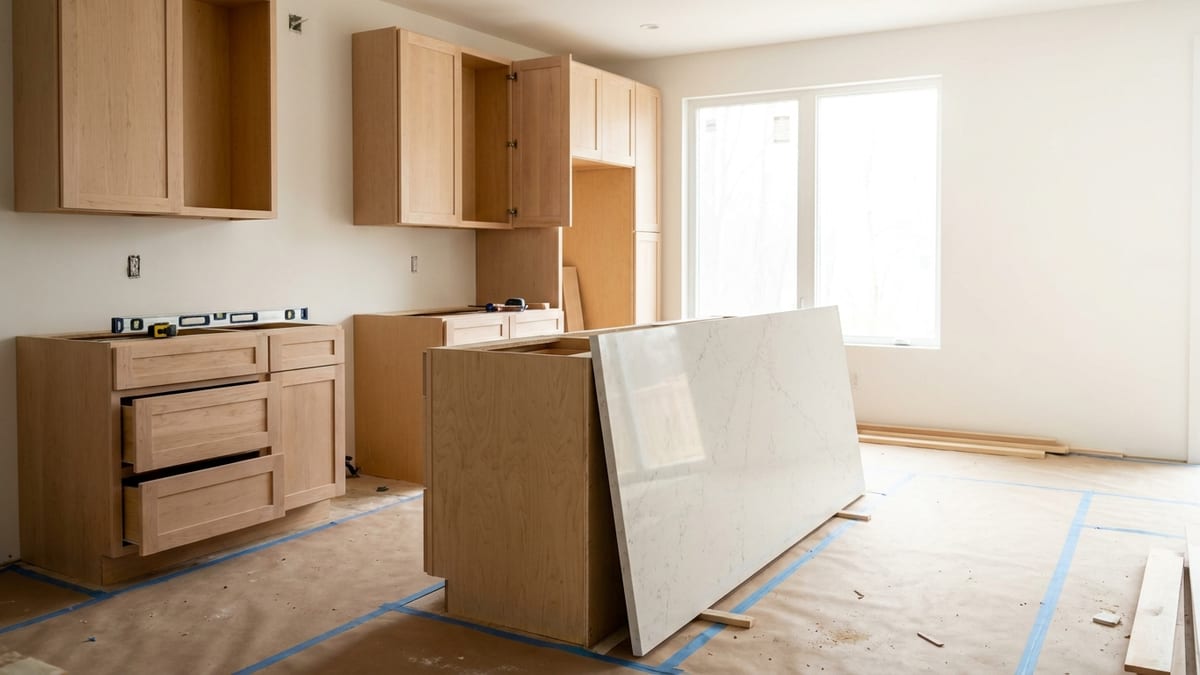
A kitchen remodeler can run two identical marketing campaigns and end up with two completely different companies. One fills the calendar with homeowners who want a countertop swap and a refacing quote, averages $9,000 a job, and burns designer hours on estimates that never sign. The other books full-gut projects at $45,000 to $80,000, runs half the appointments, and does three times the revenue.
The difference is almost never the crew or the showroom. It is who the marketing brought through the door.
This is the ticket math, the channel economics, and the qualification framework for booking $40K+ kitchen projects instead of cabinet shoppers.
Why do kitchen remodeling leads come in two completely different sizes?
Kitchen work attracts two buyers who look identical on a lead form and behave nothing alike.
The component shopper. This homeowner wants one thing fixed. New countertops. Cabinet refacing. A backsplash and a sink. They are price-shopping a defined product, they know roughly what it should cost, and they are collecting three quotes on the same specification. Typical ticket: $4,000 to $15,000. Close rate is decent, margin is thin, and the job competes directly with big-box installers and cabinet-only outfits.
The full-gut buyer. This homeowner does not want a product. They want a different kitchen. Walls move, the island changes, appliances get relocated, plumbing and electrical get touched, and the whole room is down for six to twelve weeks. Typical ticket: $30,000 to $100,000+. They are not comparing line-item prices because no two proposals are the same scope. They are comparing companies.
The component shopper searches Google when they are ready. The full-gut buyer spends three to eighteen months thinking about it before they type anything into a search bar, and the company that reaches them during that window usually writes the scope everyone else has to bid against. That timing gap is the whole game, and it is why campaign structure matters more here than in almost any other trade. Our kitchen remodeling lead generation page covers how campaigns get built for each side.
What is a kitchen remodel actually worth in 2026?
You cannot set a lead-cost ceiling until you know your real ticket mix. Prices vary by market, cabinet line, and how much structure moves, but these ranges are typical.
| Scope of work | Typical installed price | Buyer type |
|---|---|---|
| Scope of workCountertop replacement only | Typical installed price$3,000-$8,000 | Buyer typeComponent shopper |
| Scope of workCabinet refacing | Typical installed price$5,000-$15,000 | Buyer typeComponent shopper |
| Scope of workCosmetic refresh (paint, hardware, backsplash, counters) | Typical installed price$8,000-$18,000 | Buyer typeComponent shopper |
| Scope of workMid-range full remodel, same footprint | Typical installed price$30,000-$60,000 | Buyer typeFull-gut buyer |
| Scope of workFull remodel with layout changes | Typical installed price$50,000-$90,000 | Buyer typeFull-gut buyer |
| Scope of workHigh-end custom kitchen | Typical installed price$90,000-$150,000+ | Buyer typeFull-gut buyer |
| Scope of workKitchen plus adjacent living space open-up | Typical installed price$75,000-$150,000+ | Buyer typeFull-gut buyer |
The pattern matters more than any single number. Moving one homeowner from a $12,000 refresh into a $52,000 full remodel is worth more than winning four extra countertop jobs, and it costs the same designer hour to sit at the table.
The formula that sets your lead-cost ceiling
Run this before you spend a dollar.
Max cost per lead = (average job value x gross margin x close rate) / 3
A remodeler averaging $45,000 per project at a 38% gross margin and a 20% close rate on qualified leads: $45,000 x 0.38 x 0.20 = $3,420, divided by 3 = a $1,140 maximum cost per lead.
That number surprises people. It should. High-ticket remodeling can absorb lead costs that would bankrupt a gutter company, which is exactly why kitchen remodelers should stop optimizing for the cheapest lead and start optimizing for the biggest project. A $200 exclusive lead that closes a $52,000 kitchen is a rounding error against the gross profit.
Run your own numbers through the ROI calculator before you judge any lead source.
Why is cost per lead the wrong number for kitchen remodelers?
Because cost per lead ignores two things that decide whether a channel pays: how many other companies got the same homeowner, and how big the project was.
| Channel | Cost per lead | Typical close rate | Cost per acquired job |
|---|---|---|---|
| ChannelReferrals and past clients | Cost per lead$0 | Typical close rate40-60% | Cost per acquired jobNear $0 |
| ChannelOrganic search and Google Business Profile | Cost per lead$0-60 | Typical close rate20-40% | Cost per acquired job$150-300 |
| ChannelShared marketplace leads | Cost per lead$40-120 | Typical close rate4-10% | Cost per acquired job$600-2,500 |
| ChannelGoogle Ads (search intent) | Cost per lead$100-350 | Typical close rate15-30% | Cost per acquired job$500-2,000 |
| ChannelMeta advertising | Cost per lead$30-120 | Typical close rate10-20% | Cost per acquired job$250-1,000 |
| ChannelExclusive leads through a performance partner | Cost per lead$50-200 | Typical close rate15-30% | Cost per acquired job$300-1,100 |
| ChannelExclusive booked design consultations | Cost per lead$200-400 | Typical close rate25-40% | Cost per acquired job$600-1,400 |
A $70 shared lead closing at 6% costs $1,167 per acquired job. A $150 exclusive lead closing at 25% costs $600. And the shared lead almost always arrives smaller, because a homeowner who filled out a marketplace form for "kitchen remodel" and got called by five companies in ten minutes is now shopping price on a spec sheet. That is a component-shopper conversation whether they started as one or not. The full math on that gap lives in our breakdown of exclusive vs. shared leads.
There is a second cost buried in cheap kitchen leads that nobody puts on a spreadsheet: designer time. A real kitchen consultation is 60 to 120 minutes in the home, plus travel, plus concept work and a proposal. Ten shared leads at a 6% close means roughly eight or nine consultations to sell one job. Price that at your designer's loaded hourly cost and the $70 lead is the most expensive thing in your pipeline.
How do you reach $40K+ kitchen buyers before they start shopping?
The $52,000 kitchen does not begin with a search. It begins with a homeowner standing in a kitchen they have hated for six years, scrolling on a phone at 9pm.
That is why Meta advertising outperforms search on the high-ticket side of this trade. You are not capturing demand. You are creating the moment the homeowner decides this is the year.
Creative that filters out cabinet shoppers
- Show whole rooms, never product close-ups. A tight shot of cabinet doors attracts people shopping cabinet doors. A wide shot of a finished kitchen with a new island, new lighting, and a changed layout attracts people who want a different kitchen. The photo sets the price expectation before a word gets read.
- Use real project photography. Stock kitchens get recognized and they get ignored. Photograph your own finished work in the homes you built it in, including before shots. Homeowners buy proof, not renderings.
- Put a starting investment range in the copy. "Full kitchen remodels typically start at $40,000" costs you a pile of unqualified form fills and saves your designers a hundred hours. This is the single highest-leverage line in a kitchen ad.
- Sell the layout, not the materials. "Open up the wall between your kitchen and living room" pulls a bigger buyer than "new cabinets and counters." Structural language signals scope.
- Name the trigger events. A new baby, a parent moving in, hosting the holidays, a house you have owned twelve years, a refinance that freed up equity. These are the moments a tolerated kitchen becomes a project.
- Lead with the design consultation, not a quote. "Free in-home design consultation" frames a professional process. "Free estimate" frames a bidding war. Be clear that the consultation is a sales appointment with a designer who will scope and price the work.
The two questions that belong on every kitchen form
Ask scope and ask budget. Nothing else moves the needle.
- Scope: cosmetic refresh, cabinets and counters, or full remodel with layout changes.
- Budget range: under $25,000, $25,000-$50,000, $50,000-$100,000, $100,000+.
Some homeowners will guess low because they have no idea what a kitchen costs. That is fine. The point is not perfect data, it is intent sorting. Anyone selecting "full remodel" and "$50,000-$100,000" goes straight to a designer. Anyone selecting "cosmetic refresh" and "under $25,000" goes into a different pipeline with a different call script and, often, a different product offering.
If you want a bigger picture on how kitchen and bath buyers behave across the remodeling category, our kitchen and bathroom lead guide covers the visual-first and financing angles in more depth.
Ready to stop paying for cabinet shoppers? Get started here and we will build the campaign against your actual ticket target.
How many kitchen remodeling leads do you need to hit a revenue target?
Work backward from the revenue number, not forward from a budget.
Say you want to add $1,000,000 in kitchen revenue over the next twelve months.
- Divide by average project value. $1,000,000 / $45,000 = 23 additional jobs.
- Divide by close rate on qualified leads. 23 / 0.22 = 105 qualified leads a year.
- Convert to monthly. 105 / 12 = roughly 9 qualified leads a month.
- Apply lead cost. 9 x $150 = about $1,350 a month in lead fees, plus ad spend paid directly to Meta out of your own ad account.
- Check it against gross profit. 23 jobs x $45,000 x 38% margin = $393,000 in gross profit against roughly $16,200 in annual lead fees and your ad spend.
Nine leads a month sounds absurdly low to a contractor used to chasing 60 marketplace leads. That is the point. High-ticket trades do not need volume. They need the right nine homeowners and a sales process that does not waste them.
What happens when you raise the average ticket
| Average project | Jobs needed for $1M | Qualified leads/year at 22% | Leads/month |
|---|---|---|---|
| Average project$20,000 | Jobs needed for $1M50 | Qualified leads/year at 22%227 | Leads/month19 |
| Average project$35,000 | Jobs needed for $1M29 | Qualified leads/year at 22%132 | Leads/month11 |
| Average project$45,000 | Jobs needed for $1M23 | Qualified leads/year at 22%105 | Leads/month9 |
| Average project$65,000 | Jobs needed for $1M16 | Qualified leads/year at 22%73 | Leads/month6 |
Every dollar you add to the average ticket removes leads, appointments, and designer hours from the equation. Ticket size is a marketing decision long before it is a pricing decision.
What kills kitchen remodeling leads after they come in?
Most kitchen leads that get written off as "bad" were fumbled, not bad.
Slow first contact. A homeowner who fills out a form at 9pm and hears from you Thursday has already talked to someone else. Kitchen buyers are not as time-sensitive as an emergency plumbing call, but the first real conversation still frames the whole project. Our guide on speed to lead covers the response infrastructure that fixes this.
Only one decision-maker at the appointment. A $50,000 kitchen does not get approved by one spouse. Confirm both are present when you book, and reschedule if they are not. A solo appointment is a wasted designer afternoon nine times out of ten.
Quoting instead of designing. Handing over a number on the first visit turns your company into a line item. Scope the project, present a concept, then present the investment. The proposal should be impossible to compare apples-to-apples with a cabinet shop's quote.
Quitting the follow-up at day 14. The homeowners who take an appointment in the first week sign at that appointment. The rest go quiet for their own reasons. They talk to a lender, wait for a bonus, argue about the island. A 90-day structured nurture with project photos, timeline reminders, and financing options recovers a meaningful share of leads other remodelers already deleted.
No financing conversation. A $52,000 project reframed as a monthly payment converts homeowners who would never write that check. Put financing in the ad, on the landing page, and in the proposal.
What should a kitchen remodeler do first?
In order:
- Calculate your real average project value and gross margin. Not the number you wish. The last twenty signed contracts.
- Set your maximum cost per lead with the formula above and stop comparing lead prices to anything but that ceiling.
- Sort your last 90 days of leads into component shoppers and full-gut buyers. If most were component shoppers, the campaign is the problem.
- Rebuild creative around whole finished kitchens with real photography and a starting investment range.
- Add scope and budget questions to every form and route the two pipelines separately.
- Build a 90-day follow-up sequence so no five-figure project dies from silence at day 14.
Kitchen remodeling is one of the few trades where the marketing decides the ticket. Get exclusive leads, reach homeowners during the planning phase, qualify hard, and let your designers spend their hours on projects worth designing.
Want the campaign built around $40K+ projects instead of countertop quotes? Get started and we will run the numbers on your market.
Frequently asked questions
What do kitchen remodeling leads cost in 2026?
Shared marketplace leads typically run $40-120 each but close at 4-10% because three to five remodelers get the same homeowner. Exclusive kitchen remodeling leads generally run $50-200 each and close at 15-30% once qualified. Booked in-home design consultations usually run $200-400 and close at 25-40%.
How many kitchen remodeling leads do I need to add $1 million in revenue?
At a $45,000 average project you need about 22 additional jobs. At a 22% close rate on qualified leads that is roughly 100 leads a year, or 8 to 9 exclusive leads a month. At $150 per lead that is about $1,300 a month in lead cost, plus the ad spend you pay directly to Meta out of your own account.
How do you keep cabinet shoppers out of a kitchen remodeling campaign?
Filter with creative and with the form. Show full-gut finished kitchens instead of cabinet close-ups, put a realistic starting investment range in the ad copy, and ask two qualifying questions on the form: project scope and rough budget range. You lose raw lead volume and gain appointment quality, which is the only trade worth making at a $45,000 ticket.
Is Meta or Google better for kitchen remodeling leads?
Use both for different jobs. Google captures homeowners already searching for a kitchen remodeler at roughly $100-350 per lead with high intent and limited volume. Meta reaches homeowners during the planning phase, months before they search, at roughly $30-120 per lead, and that is where the larger full-gut projects come from because you set the scope before any competitor is in the conversation.
How fast does a kitchen remodel actually close?
Appointments land in the first week and get signed at the appointment, provided your designer can price and present in the home with both decision-makers there. A kitchen shuts down the most-used room in the house for six to twelve weeks, so bring the timeline and the financing options to that appointment rather than mailing them afterward. The homeowners who go quiet are a follow-up problem, and a structured 90-day nurture closes leads other remodelers already wrote off.
Frequently asked questions
What do kitchen remodeling leads cost in 2026?
Shared marketplace leads typically run $40-120 each but close at 4-10% because three to five remodelers get the same homeowner. Exclusive kitchen remodeling leads generally run $50-200 each and close at 15-30% once qualified. Booked in-home design consultations usually run $200-400 and close at 25-40%.
How many kitchen remodeling leads do I need to add $1 million in revenue?
At a $45,000 average project you need about 22 additional jobs. At a 22% close rate on qualified leads that is roughly 100 leads a year, or 8 to 9 exclusive leads a month. At $150 per lead that is about $1,300 a month in lead cost, plus the ad spend you pay directly to Meta out of your own account.
How do you keep cabinet shoppers out of a kitchen remodeling campaign?
Filter with creative and with the form. Show full-gut finished kitchens instead of cabinet close-ups, put a realistic starting investment range in the ad copy, and ask two qualifying questions on the form: project scope and rough budget range. You lose raw lead volume and gain appointment quality, which is the only trade worth making at a $45,000 ticket.
Is Meta or Google better for kitchen remodeling leads?
Use both for different jobs. Google captures homeowners already searching for a kitchen remodeler at roughly $100-350 per lead with high intent and limited volume. Meta reaches homeowners during the planning phase, months before they search, at roughly $30-120 per lead, and that is where the larger full-gut projects come from because you set the scope before any competitor is in the conversation.
How fast can a kitchen remodeling lead actually close?
Appointments get set in the first week, and a designer who can measure, present selections, and price the job in the home normally signs it that same day. A kitchen is a five-figure decision that shuts down the most-used room in the house for six to twelve weeks and almost always requires both decision-makers to agree, which is exactly why both of them belong at that appointment. The homeowners who do not book right away are a follow-up problem, not a lead-quality problem, and remodelers who run a structured 90-day nurture close leads their competitors already wrote off.