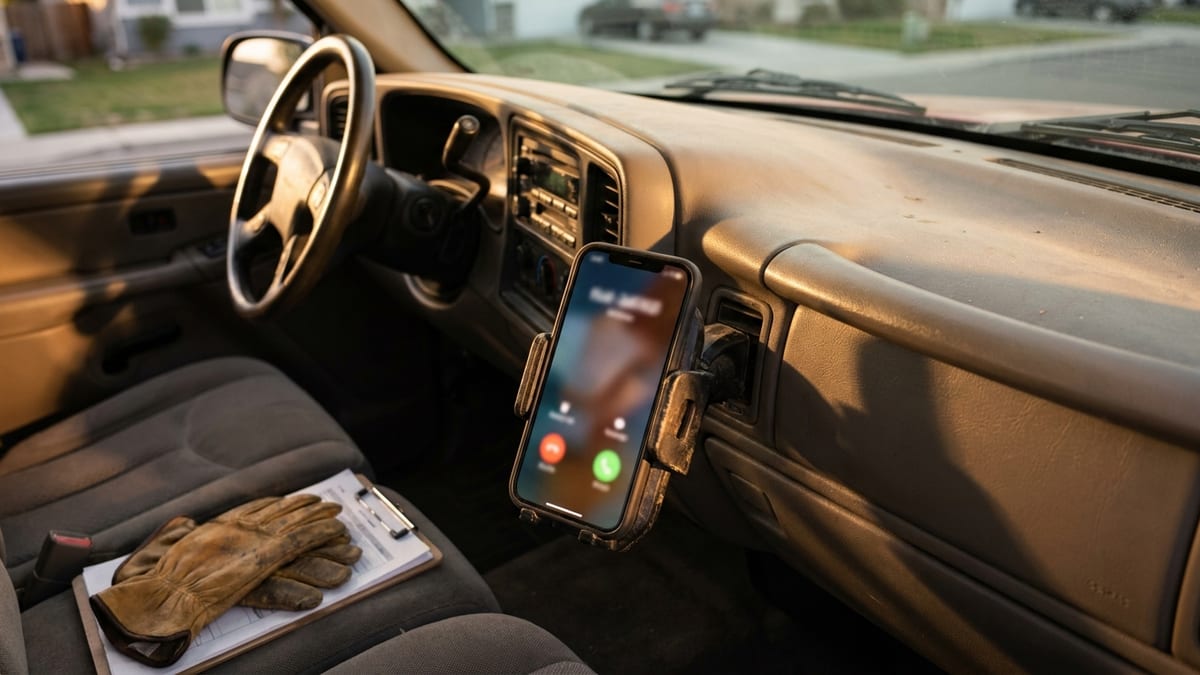
A contractor pays $50 to $200 for an exclusive lead. The homeowner fills out the form at 4:50 p.m. The crew chief is on a roof until six, the office manager left at five, and nobody touches that lead until 9:15 the next morning. By then the homeowner has already talked to two other companies.
That is not a lead quality problem. That is a staffing problem with a clock attached to it. And it is the exact problem that has every contractor in the country being pitched an AI voice agent right now.
The pitch is good. The technology is real. But most contractors are being sold the wrong half of it. AI should be solving your timing problem. It should not be having your sales conversations.
What does it actually cost when a lead sits for an hour?
The research everybody quotes says you are 21x more likely to qualify a lead when you call within five minutes versus thirty, and 35 to 50 percent of sales go to whoever responds first. That is the part of speed to lead most contractors already know. The part they do not price out is what it does to the economics of the leads they already paid for.
Run the math on 50 leads a month at $100 each. That is $5,000 in lead cost before a dollar of ad spend.
| Response time | Realistic contact rate | Leads reached | Close rate on contacted | Jobs closed | Cost per acquired job |
|---|---|---|---|---|---|
| Response timeUnder 5 minutes | Realistic contact rate70% | Leads reached35 | Close rate on contacted30% | Jobs closed10.5 | Cost per acquired job$476 |
| Response timeWithin 1 hour | Realistic contact rate50% | Leads reached25 | Close rate on contacted25% | Jobs closed6.3 | Cost per acquired job$794 |
| Response timeNext business day | Realistic contact rate30% | Leads reached15 | Close rate on contacted18% | Jobs closed2.7 | Cost per acquired job$1,852 |
Same leads. Same price. Same salesperson. The only variable is how fast somebody got to the phone, and it moved cost per acquired job by nearly 4x.
That gap is what automation exists to close. Not to replace your sales process, but to make sure the lead is still warm when your sales process arrives. That is also why our client platform front-loads the things software does better than people under pressure: real-time delivery, click-to-call, property data attached to the lead, and routing to the right rep before anybody picks up a phone.
What should AI handle for contractor leads?
Automate the things that fail because a human was busy, not the things that fail because a human was bad at them.
The 60-second text-back
This is the single highest-return automation in contracting. The moment a form hits, the homeowner gets a text from your company name, referencing the service they asked about, telling them a real person will call within a few minutes. It does three things: it confirms they reached a real business, it plants your name before the competitor calls, and it opens a text thread the homeowner can reply to on their own schedule.
No AI judgment required. It is a trigger and a template.
Routing and ownership
Round-robin assignment, territory rules, and instant notification to the rep who owns that zip code. Every minute spent deciding who calls is a minute the lead is cooling off. Software should have made that decision before the notification buzzes.
Data enrichment before the call
Your rep should know the home value, year built, square footage, roof and exterior type, and whether the property sold in the last twelve months before they dial. A rep who opens with informed questions sounds like a professional. A rep reading a name and a phone number sounds like a telemarketer. That enrichment is pure automation and there is no downside to it.
Confirmations, reminders, and reschedules
Appointment set for Thursday at 6? The confirmation text goes out immediately, the reminder goes out 24 hours ahead, and another goes out two hours ahead with the rep's name and a photo. No-show rates drop on reminders alone. Nobody needs a human for that.
The long tail
Most contractors quit after three attempts. Most sales that happen on paid leads happen after five or more touches. A 30 to 90 day drip that keeps texting and emailing a homeowner who went quiet is the cheapest revenue in the business, and no human being will run it consistently for 400 old leads. Our contractor follow-up system lays out the day-by-day cadence this should run.
After-hours triage
At 9 p.m. the choice is not between AI and a person. It is between AI and voicemail. AI wins that one every time. Let it answer, capture the project type, confirm the address is in your service area, and offer a booking link.
What should contractors never automate?
Here is the line: the moment the conversation involves price, scope, or trust, a person needs to own it.
The real qualifying conversation
Qualifying is not a checklist. It is reading whether a homeowner is actually going to spend $18,000 this quarter or is pricing a project for next spring. An AI agent qualifies on words. A human qualifies on hesitation, on who else is in the room, on how fast they answer the budget question. The difference shows up in your sat rate, not your booking rate.
The first price question
Every homeowner asks it. "Ballpark, what does a bathroom like mine run?" That question is a trust test, and the answer decides whether you get in the house. An automated range either scares them off or anchors them low enough that your rep spends the whole appointment climbing back up. A trained person handles it with a range, a reason, and a reason to book.
Objections and anything emotional
Storm damage, a flooded basement, a failed inspection before a closing. These homeowners are stressed and they are deciding whether your company is competent. A bot that misunderstands them once has permanently answered that question.
Booking a high-ticket in-home appointment
A $25,000 remodel appointment only works if both decision makers are home, the length is set, and the homeowner knows an on-site estimate is a sales appointment with a price at the end of it. A human sets those expectations. AI books slots.
Which tasks go where?
| Task | Automate | Human | Why |
|---|---|---|---|
| TaskInstant text-back | AutomateYes | HumanNo | WhyPure timing, zero judgment |
| TaskLead routing and assignment | AutomateYes | HumanNo | WhyRules beat decisions under time pressure |
| TaskProperty and address data | AutomateYes | HumanNo | WhyBetter data, faster, every time |
| TaskAfter-hours first contact | AutomateYes | HumanBackup | WhyCompeting against voicemail, not a person |
| TaskQualifying for intent and budget | AutomateAssist | HumanYes | WhyRead the hesitation, not the words |
| TaskFirst price conversation | AutomateNo | HumanYes | WhyIt is a trust test, not a data request |
| TaskBooking high-ticket appointments | AutomateAssist | HumanYes | WhyBoth decision makers, set expectations |
| TaskConfirmations and reminders | AutomateYes | HumanNo | WhyConsistency problem, not a skill problem |
| Task30-90 day revival drip | AutomateYes | HumanSpot-check | WhyNo human runs 400 of these reliably |
| TaskObjections and complaints | AutomateNo | HumanYes | WhyOne bad bot reply ends the relationship |
How do you build a hybrid stack that actually books jobs?
Five steps, in this order. Doing them out of order is how contractors end up paying for an AI agent that is politely burning exclusive leads.
- Fix the plumbing first. Leads land in one place, with a status, an owner, and a timestamp. If you cannot pull up how long each lead sat before first contact, no automation is going to help you, because you will not be able to tell whether it worked. Our CRM setup guide covers the fields and pipelines that matter.
- Automate the 60-second text-back and routing. This is a one-afternoon build and it moves contact rate more than anything else on the list.
- Staff the live call window. Decide who answers between 8 a.m. and 8 p.m. and hold them to a five-minute standard. This is the expensive step and the one people skip. If you cannot staff it in-house, outsource it before you automate it. We run a staffed call floor for exactly this reason.
- Layer AI on the edges. After-hours capture, overflow when every rep is on a roof, weekends, and the long-tail drip. Edges only.
- Measure sat appointments, not booked ones. A calendar full of appointments nobody is home for is worse than an empty one, because it burns windshield time. Track booked, sat, and closed by source and by who made first contact.
If you want the speed side handled without hiring, see how the platform and call floor work together and we will walk you through the live numbers.
How do you tell if your AI is costing you jobs?
Run this audit monthly. Four numbers tell the story.
- Contact rate. Percentage of delivered leads that reached a live conversation with your company. If automation went in and this did not move, the automation is cosmetic.
- Booked-to-sat rate. If AI books 30 appointments and 14 sit, you do not have a lead problem. You have a bot writing checks your calendar cannot cash. Human-booked appointments should sit at a noticeably higher rate.
- Close rate by first-contact type. Split closed jobs by whether the first conversation was automated or human. On tickets above $10,000 the human column almost always wins, and that is your signal for where to draw the line.
- Complaints and hang-ups. Listen to recordings. If homeowners are asking "is this a real person?" you have found your leak.
The deeper mechanics of the response window are in our speed to lead breakdown, which treats fast response as staffed infrastructure rather than a software purchase. That framing is the whole point.
What is the honest verdict on AI for contractor follow-up?
AI is a spectacular answering machine, a tireless texter, and a perfect reminder system. It is a mediocre salesperson on a $20,000 purchase, and homeowners can tell faster every year.
The contractors winning with it right now are not replacing people. They are using automation to guarantee that a homeowner is never ignored, then putting a trained human on the phone the moment that homeowner is actually reachable. Speed from the machine. Trust from the person. That combination is what moves cost per acquired job from $1,800 back down to $500.
If you are paying for exclusive leads and losing them to response time, the fix is a system, not another subscription. Book a call and we will show you the live numbers on how fast your leads should be getting worked and what that does to your close rate.
Frequently asked questions
Should AI call my contractor leads back?
AI should text them back instantly and attempt contact after hours, but a person should own the real qualifying conversation on any job worth more than a few thousand dollars. The first live conversation sets price expectations and builds the trust that gets the estimate scheduled, and that is the part homeowners notice when it is handled by a bot.
Does an AI voice agent hurt close rates?
It can, in two ways. Homeowners who realize they are talking to a machine on a $20,000 project often hang up and call the next company, and AI agents routinely mark a lead as qualified based on words rather than intent, which fills your calendar with appointments that do not sit. Used as a safety net for after-hours and overflow instead of as the primary responder, it usually helps more than it hurts.
What should contractors automate in lead follow-up?
Automate the instant text-back within 60 seconds, lead routing to the right rep, property and address data enrichment, appointment confirmations and reminders, and the long-tail drip that revives leads 30 to 90 days out. All of those are timing and consistency problems, which is exactly where software beats a busy human.
Can AI book appointments for a $20,000 remodel?
It can put something on a calendar, but booking and sitting are two different metrics. High-ticket remodeling buyers need a person to confirm both decision makers will be home, set the length and purpose of the visit, and handle the first price question, so the human-booked appointment typically shows up far more reliably.
What does AI follow-up cost compared to a call center?
Automation tooling generally runs in the low hundreds per month, while staffed or outsourced calling costs more per lead but converts a higher share of them into sat appointments. Judge both on cost per sat appointment and cost per acquired job rather than monthly subscription price, because a cheap tool that loses one $12,000 job a month is the most expensive thing in your stack.
Frequently asked questions
Should AI call my contractor leads back?
AI should text them back instantly and attempt contact after hours, but a person should own the real qualifying conversation on any job worth more than a few thousand dollars. The first live conversation sets price expectations and builds the trust that gets the estimate scheduled, and that is the part homeowners notice when it is handled by a bot.
Does an AI voice agent hurt close rates?
It can, in two ways. Homeowners who realize they are talking to a machine on a $20,000 project often hang up and call the next company, and AI agents routinely mark a lead as qualified based on words rather than intent, which fills your calendar with appointments that do not sit. Used as a safety net for after-hours and overflow instead of as the primary responder, it usually helps more than it hurts.
What should contractors automate in lead follow-up?
Automate the instant text-back within 60 seconds, lead routing to the right rep, property and address data enrichment, appointment confirmations and reminders, and the long-tail drip that revives leads 30 to 90 days out. All of those are timing and consistency problems, which is exactly where software beats a busy human.
Can AI book appointments for a $20,000 remodel?
It can put something on a calendar, but booking and sitting are two different metrics. High-ticket remodeling buyers need a person to confirm both decision makers will be home, set the length and purpose of the visit, and handle the first price question, so the human-booked appointment typically shows up far more reliably.
What does AI follow-up cost compared to a call center?
Automation tooling generally runs in the low hundreds per month, while staffed or outsourced calling costs more per lead but converts a higher share of them into sat appointments. Judge both on cost per sat appointment and cost per acquired job rather than monthly subscription price, because a cheap tool that loses one $12,000 job a month is the most expensive thing in your stack.