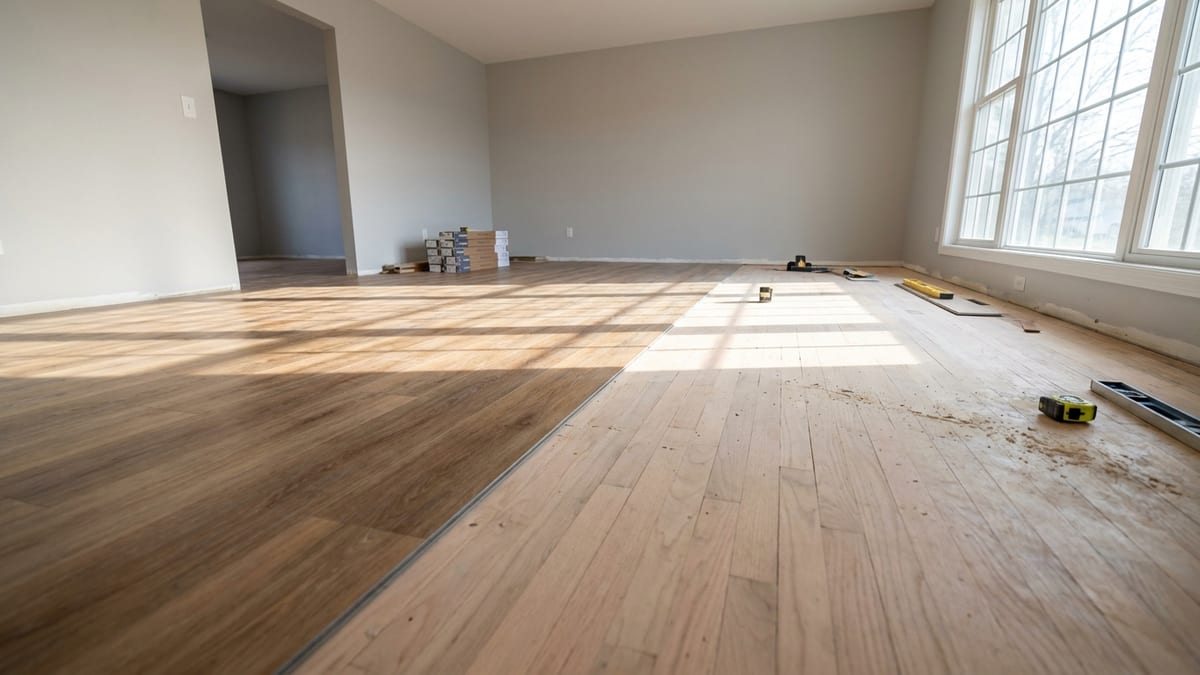
Two flooring leads come in on the same Tuesday. One wants LVP in a basement rec room. The other wants the oak on the main level refinished and hardwood run into the two bedrooms that still have carpet. Same marketing budget, same crew, same week on the calendar.
One of those jobs invoices around $5,000. The other invoices around $18,000 and takes maybe a day and a half more of crew time.
Most flooring companies run one campaign, take whatever comes in, and then wonder why the average ticket keeps sliding. It slides because LVP is the easier ad to run, the easier price to quote, and the easier yes to get. If you do not deliberately fund the hardwood side, it starves.
Here is what each buyer is actually worth, what each one should cost you to acquire, and how to run both without letting one cannibalize the other.
Why do LVP and hardwood flooring leads behave like two different businesses?
Because they are two different purchases triggered by two different things.
The LVP buyer
This homeowner has a problem with a floor. A dog destroyed the carpet. A dishwasher leaked. A basement flooded. They want something waterproof, something that looks decent, and they want it installed in the next three weeks. They search, they call two or three companies, and they book whoever answers the phone and can give a square-foot number fast.
Ticket: $4,000 to $8,000 for a typical 1,000 to 1,500 square foot area. Decision window: days. Close rate on a good exclusive lead: 28 to 35 percent, because the choice is small enough to make from a sample and a price.
This is a volume business. It works when your cost per lead is low, your measure gets scheduled inside 48 hours, and someone picks up on the first ring.
The hardwood buyer
This homeowner is not solving a problem. They are upgrading a house. They are planning to floor the main level before the holidays, or they are pulling carpet after a kitchen remodel, or they bought a 1960s ranch with oak under the carpet and want to see what is down there. They have been saving photos for three months. They will collect two or three quotes and take a week or two to decide.
Ticket: $10,000 to $25,000, sometimes more on a whole-home install with stairs and transitions. Decision window: two to six weeks. Close rate on a well-worked exclusive lead: 20 to 30 percent, with three times the revenue per closed job.
That buyer is almost never searching for a flooring contractor when the campaign first reaches them. They are in the planning phase. That is why the channel that wins hardwood looks nothing like the channel that wins a basement LVP job, and why our flooring lead generation page builds them as separate campaigns with separate budgets.
What is a flooring job actually worth per square foot in 2026?
You cannot set a lead ceiling until you know your real mix. Regional labor, subfloor prep, and stair work move these, but the ranges are typical for installed work.
| Product | Typical installed price | Typical job total | Buyer type |
|---|---|---|---|
| ProductCarpet replacement | Typical installed price$3-$6 / sq ft | Typical job total$2,000-$5,000 | Buyer typeFast / forced |
| ProductLuxury vinyl plank (LVP) | Typical installed price$4-$8 / sq ft | Typical job total$4,000-$8,000 | Buyer typeFast / problem-driven |
| ProductLaminate | Typical installed price$4-$7 / sq ft | Typical job total$3,500-$7,000 | Buyer typeFast / price-shopped |
| ProductTile (bath, entry, mudroom) | Typical installed price$10-$20 / sq ft | Typical job total$3,000-$9,000 | Buyer typeRemodel-attached |
| ProductHardwood refinishing | Typical installed price$4-$8 / sq ft | Typical job total$3,500-$9,000 | Buyer typePlanned |
| ProductEngineered hardwood | Typical installed price$8-$14 / sq ft | Typical job total$10,000-$18,000 | Buyer typePlanned |
| ProductSolid hardwood install | Typical installed price$10-$20 / sq ft | Typical job total$12,000-$25,000+ | Buyer typePlanned / whole-home |
The pattern matters more than any single line. Converting one homeowner from a single-room LVP job to a main-level hardwood install is worth more than winning three extra LVP jobs, and it costs you one job site instead of three.
The formula that sets your lead ceiling
Run this per campaign, not per company.
Max cost per lead = (average job value x gross margin x close rate) / 3
LVP campaign: $5,500 x 0.30 margin x 0.30 close = $495, divided by 3 = a $165 maximum cost per lead.
Hardwood campaign: $16,000 x 0.33 margin x 0.25 close = $1,320, divided by 3 = a $440 maximum cost per lead.
Those numbers are nowhere near each other. Hold one blended campaign to $165 and you will never outbid anybody for the hardwood buyer, because that homeowner is more expensive to reach and slower to convert. Hold it to $440 and you will bleed money on every basement LVP job you book. That gap is the entire argument for splitting the campaigns.
If you want to run your own numbers against your real close rate and job value, the ROI calculator does the arithmetic in about two minutes.
Why does cost per lead mislead flooring contractors?
Because the invoice price of a lead ignores how many other companies got handed the same homeowner, and flooring is one of the worst trades for that. Square-foot pricing is easy to compare, so a shared lead turns into a three-way price fight before you have even measured.
| Channel | Cost per lead | Typical close rate | Cost per acquired job |
|---|---|---|---|
| ChannelReferrals and past customers | Cost per lead$0 | Typical close rate40-60% | Cost per acquired jobNear $0 |
| ChannelGoogle Business Profile / organic | Cost per lead$0-$50 | Typical close rate20-40% | Cost per acquired job$100-$250 |
| ChannelShared marketplace leads | Cost per lead$20-$70 | Typical close rate5-12% | Cost per acquired job$250-$1,200 |
| ChannelLocal Services Ads | Cost per lead$20-$65 | Typical close rate15-30% | Cost per acquired job$120-$400 |
| ChannelMeta advertising | Cost per lead$25-$110 | Typical close rate10-20% | Cost per acquired job$250-$1,000 |
| ChannelExclusive leads (performance partner) | Cost per lead$50-$200 | Typical close rate20-35% | Cost per acquired job$200-$900 |
| ChannelExclusive booked in-home measures | Cost per lead$200-$400 | Typical close rate25-40% | Cost per acquired job$600-$1,400 |
A $35 shared lead closing at 8 percent costs $438 per acquired job. A $120 exclusive lead closing at 30 percent costs $400 per acquired job, and the ticket is usually bigger because you are not one of four companies racing each other down on the same square footage. The full breakdown of that math lives in our guide on exclusive vs. shared leads.
There is a second cost flooring companies almost never track: the in-home measure. A proper measure with subfloor inspection, transitions, stairs, and a sample drop is 45 to 90 minutes plus drive time. At an 8 percent close rate you are running twelve measures to sell one job. Price that at your estimator's loaded hourly cost and cheap leads stop being cheap in a hurry.
How do you reach the hardwood buyer before they search?
The $18,000 hardwood job rarely starts with a search box. It starts with a homeowner staring at carpet they are tired of, or walking a room they just emptied. Search advertising cannot find that person, because they are not typing anything yet.
Meta can. Here is the sequence that works.
- Lead with finished floors, not products. Wide shots of a completed main level in natural light. Whole rooms, furniture staged, trim and transitions visible. Homeowners buy the room, not the plank.
- Show the before. Carpet pulled back with oak underneath, or a tired 1990s floor next to the new install. Before-and-after outperforms product photography in flooring by a wide margin.
- Name the project, not the material. "Main level hardwood" and "pull the carpet, refinish the oak" pull a different homeowner than "flooring installation near me."
- Qualify square footage and rooms in the form. Rooms, approximate square footage, and timeline. Three fields is enough to separate a bedroom from a main level.
- Offer a real in-home measure and quote. That is a sales appointment and you should say so plainly. Homeowners are fine with it as long as nobody pretends otherwise.
- Retarget for six weeks. Hardwood decisions run two to six weeks. If your retargeting window is seven days, you are paying to find buyers and then walking away before they decide.
Run this campaign under your own brand, in your own ad account, so the pixel data, audiences, and retargeting lists stay yours. That is the whole point of building demand instead of renting it — the homeowner remembers your company name, not a marketplace.
If you want this built for your market instead of assembled from scratch, see how flooring lead generation works and where the numbers land for your ticket mix.
How do you win the fast LVP lead?
Differently, and mostly on speed.
The LVP buyer with a soaked basement or shredded carpet is calling three companies in a fifteen-minute window. Whoever answers, gives a credible square-foot range, and puts a measure on the calendar usually wins before the other two call back. Research consistently shows the first responder takes 35 to 50 percent of these, and our breakdown of speed to lead covers the staffing side of that.
Three things move the LVP close rate more than anything else:
- Answer live, every time, including after 5 p.m. Voicemail on a same-week job is a lost job.
- Give a range on the first call. "Most rooms that size land between X and Y installed" earns the measure. "We'd have to come out to say" loses it to whoever gave a number.
- Book the measure inside 48 hours. Beyond that, the homeowner has already had someone else in the house.
Do not spend hardwood-level money chasing these. Keep the LVP campaign efficient, keep the phone staffed, and let the ticket math justify the budget rather than the other way around.
What does the math look like against a revenue target?
Work backward from the number, not forward from the ad budget.
Say you want to add $600,000 in flooring revenue over twelve months.
All LVP, at $5,500 average and a 30 percent close rate:
- 600,000 / 5,500 = 109 jobs
- 109 / 0.30 = 364 leads
- Roughly 30 leads per month
All hardwood, at $16,000 average and a 25 percent close rate:
- 600,000 / 16,000 = 38 jobs
- 38 / 0.25 = 150 leads
- Roughly 13 leads per month
A realistic 60/40 split by revenue:
- $360,000 LVP = 65 jobs = 218 leads = about 18 per month
- $240,000 hardwood = 15 jobs = 60 leads = about 5 per month
- About 23 leads per month total
The hardwood side does 40 percent of the revenue on 22 percent of the leads. That is the argument for funding it deliberately instead of hoping a few big jobs fall out of a general campaign.
How should you split the budget between the two?
A simple rule: fund the LVP campaign to keep the crews busy, fund the hardwood campaign to raise the average ticket.
| Decision | LVP campaign | Hardwood campaign |
|---|---|---|
| DecisionMax cost per lead | LVP campaign$100-$175 | Hardwood campaign$250-$450 |
| DecisionPrimary channel | LVP campaignLocal search and LSAs | Hardwood campaignMeta, planning-phase targeting |
| DecisionCreative focus | LVP campaignWaterproof, fast install, price range | Hardwood campaignFinished rooms, before-and-after, craftsmanship |
| DecisionResponse requirement | LVP campaignUnder 5 minutes | Hardwood campaignUnder 30 minutes |
| DecisionRetargeting window | LVP campaign7-14 days | Hardwood campaign45-60 days |
| DecisionFollow-up cadence | LVP campaign10-14 days | Hardwood campaign30-45 days |
| DecisionSeasonal push | LVP campaignYear-round, spikes after water events | Hardwood campaignLate summer into fall, pre-holiday |
If your average ticket has been falling for two years, you do not have a sales problem. You have a campaign-mix problem. Every dollar is buying the easiest lead to generate, and the easiest lead to generate in flooring is also the cheapest job.
The short version
Hardwood buyers spend two to three times more per job. They are also slower, more deliberate, and invisible to search advertising during the window when they are actually deciding. LVP buyers are fast, cheap to reach, and gone in fifteen minutes if nobody answers.
Run both. Price them separately. Judge both on cost per acquired job, not cost per lead. And make sure the campaigns run under your own name and your own ad account, so the audience you build this year still belongs to you next year.
If you want a flooring lead system built around your real ticket mix instead of whatever is cheapest to generate, get started here and we will walk through the numbers for your market.
Frequently asked questions
Do hardwood flooring leads really produce bigger jobs than LVP leads?
Yes, usually two to three times bigger. A 1,200 square foot LVP install typically lands between $4,000 and $8,000, while the same square footage in engineered or solid hardwood typically lands between $10,000 and $20,000 installed. The hardwood buyer also tends to floor more of the house at once instead of one room.
Should flooring contractors run separate campaigns for LVP and hardwood?
Yes. The two products have different tickets, different decision timelines, and different maximum costs per lead, so a blended campaign forces you to judge a $16,000 hardwood job by the economics of a $5,500 LVP job. Split the budgets and give each campaign its own cost-per-lead ceiling.
What do flooring leads cost in 2026?
Shared marketplace flooring leads typically run $20 to $70 each but close at 5 to 12 percent because three to five companies get the same homeowner. Exclusive flooring leads generally run $50 to $200 and close at 20 to 35 percent. Local Services Ads land in the $20 to $65 range with high intent but limited volume.
How many flooring leads do I need to add $600,000 in revenue?
It depends entirely on product mix. At a $5,500 average LVP job and a 30 percent close rate you need roughly 364 leads a year, about 30 a month. At a $16,000 average hardwood job and a 25 percent close rate you need about 150 leads a year, roughly 13 a month. Same revenue, less than half the lead volume.
Is Meta advertising or Google better for hardwood flooring leads?
Meta for hardwood and whole-home projects, Google for urgent single-room and repair work. Homeowners planning a hardwood install are not searching yet, they are looking at rooms and saving photos, and Meta reaches them in that window. Google and Local Services Ads capture the homeowner who already knows what they want, which skews toward faster, smaller LVP tickets.
Frequently asked questions
Do hardwood flooring leads really produce bigger jobs than LVP leads?
Yes, usually two to three times bigger. A 1,200 square foot LVP install typically lands between $4,000 and $8,000, while the same square footage in engineered or solid hardwood typically lands between $10,000 and $20,000 installed. The hardwood buyer also tends to floor more of the house at once instead of one room.
Should flooring contractors run separate campaigns for LVP and hardwood?
Yes. The two products have different tickets, different decision timelines, and different maximum costs per lead, so a blended campaign forces you to judge a $16,000 hardwood job by the economics of a $5,500 LVP job. Split the budgets and give each campaign its own cost-per-lead ceiling.
What do flooring leads cost in 2026?
Shared marketplace flooring leads typically run $20 to $70 each but close at 5 to 12 percent because three to five companies get the same homeowner. Exclusive flooring leads generally run $50 to $200 and close at 20 to 35 percent. Local Services Ads land in the $20 to $65 range with high intent but limited volume.
How many flooring leads do I need to add $600,000 in revenue?
It depends entirely on product mix. At a $5,500 average LVP job and a 30 percent close rate you need roughly 364 leads a year, about 30 a month. At a $16,000 average hardwood job and a 25 percent close rate you need about 150 leads a year, roughly 13 a month. Same revenue, less than half the lead volume.
Is Meta advertising or Google better for hardwood flooring leads?
Meta for hardwood and whole-home projects, Google for urgent single-room and repair work. Homeowners planning a hardwood install are not searching yet, they are looking at rooms and saving photos, and Meta reaches them in that window. Google and Local Services Ads capture the homeowner who already knows what they want, which skews toward faster, smaller LVP tickets.