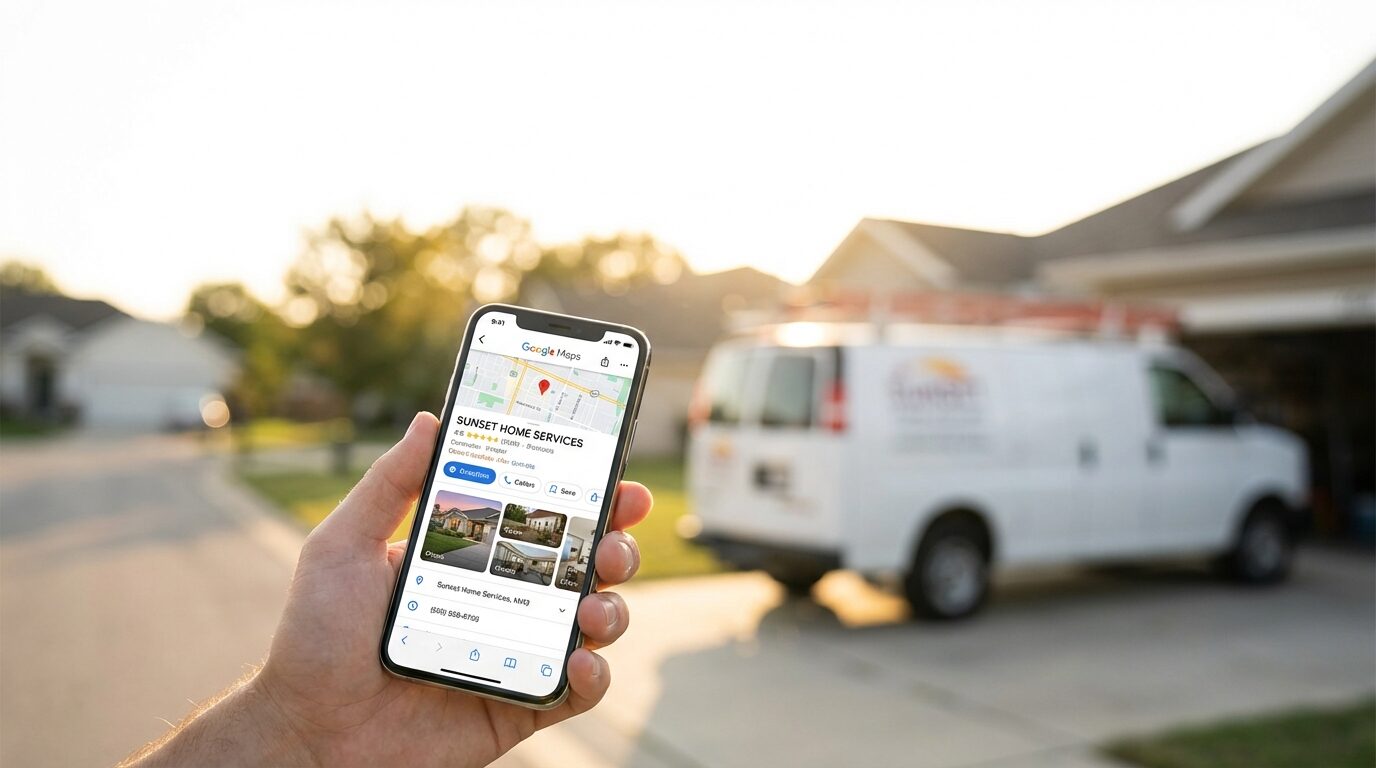
Why Does Google Business Profile Matter for Contractors?
When a homeowner has a roof leak, a failing HVAC system, or a bathroom they want remodeled, where do they go first? Google. Not Yelp, not Angi, not their neighborhood Facebook group. Google.
The data on this is overwhelming. Over 90% of consumers use Google to find local businesses, and for home improvement services specifically, the number is even higher. When someone types "roofing contractor near me" or "best HVAC company in [city]," they're not browsing casually. They have a problem and they want it solved. These are high-intent searches from homeowners who are ready to take action.
And here's what they see first: the Map Pack.
The Map Pack is the box of three local business listings that appears at the top of search results, complete with a map, star ratings, phone numbers, and hours. It appears above the organic search results. It appears above the paid ads in many cases. It's the single most prominent real estate in Google search for local contractors.
That means nearly half of everyone searching for a contractor in your area is clicking on one of those three businesses. Not the fourth. Not the fifth. The top three.
If you're not in that Map Pack, you're invisible to almost half of your potential customers. And unlike paid advertising, showing up here doesn't cost you a cent. Your Google Business Profile is completely free. Google is essentially offering you a premium storefront in the world's largest mall, and most contractors either ignore it or set it up half-heartedly and forget about it.
Your GBP listing is also the first impression homeowners get of your business. Before they ever visit your website, they see your star rating, your review count, your photos, and your business description. They're making judgments about whether to call you based on a 3-second scan of your Google profile. If your profile looks thin, outdated, or incomplete, they scroll right past you to the contractor below who looks more established. Our research on what homeowners actually look for when evaluating contractors confirms that reviews, photos, and credentials are the top three trust signals.
The bottom line: if you're a contractor and you're not actively optimizing your Google Business Profile, you're handing leads to your competitors for free.
How to Set Up Your Google Business Profile Correctly
If you haven't already claimed your Google Business Profile, do it now. Go to business.google.com and either claim an existing listing or create a new one. Google will verify your business through a postcard, phone call, or email. This step is non-negotiable. You can't optimize what you don't own.
Once you're in, here's what most contractors get wrong right at the setup phase:
Choose the Right Primary Category
This is arguably the most important decision you'll make on your GBP. Your primary category tells Google what you do, and it directly affects which searches you show up for.
Critical tip: Don't pick "General Contractor" if you specialize in roofing. Pick "Roofing Contractor." Don't pick "Home Improvement Store" if you do bathroom remodeling. Pick "Bathroom Remodeler." Google matches searches to categories, and the more specific your category is to what homeowners are actually searching for, the more likely you are to show up.
After your primary category, add all relevant secondary categories. If you're a roofing contractor who also does siding and gutters, add "Siding Contractor" and "Gutter Cleaning Service" as secondary categories. You can add up to 10 secondary categories, and each one opens up another set of searches where you might appear.
Service Area vs. Storefront
Most contractors are service-area businesses, meaning you go to the customer rather than having a walk-in storefront. When setting up your profile, choose "Service Area Business" and define the areas you serve. You can add up to 20 service areas by city, county, or zip code.
If you do have a physical location where customers visit (like a showroom), you can set it as a storefront. Some contractors have both — a showroom and a service area. You can indicate both in your profile.
Phone Number and Website
Use your real, primary business phone number as your main GBP phone number. Don't use a call tracking number as your primary — Google cross-references your phone number across the web, and inconsistencies hurt your ranking. You can add a secondary number for tracking purposes, but the primary should be the number that matches your website, your Yelp page, your BBB listing, and everywhere else your business appears online.
For your website, link to your homepage or, even better, a location-specific landing page if you have one. If you serve multiple cities, you can create dedicated landing pages for each market and link accordingly.
How to Optimize Your GBP Listing for Maximum Visibility
Setting up your profile is step one. Optimizing it is where the real competitive advantage comes from. Here's what to focus on:
Business Description
You get 750 characters for your business description. Use every one of them. This is your elevator pitch, and it should be keyword-rich without sounding robotic. Mention your primary services, the areas you serve, what makes you different, and how long you've been in business.
A strong description might read: "ABC Roofing is a full-service roofing contractor serving the greater Houston area since 2008. We specialize in roof replacement, roof repair, storm damage restoration, and new construction roofing for residential homeowners. Licensed, insured, and GAF Master Elite certified with over 500 five-star reviews."
Notice how that naturally includes "roofing contractor," "Houston," "roof replacement," "roof repair," and "storm damage" — all terms homeowners search for — without keyword stuffing.
Services Section
Add every service you offer with a clear description for each. Don't just list "Roofing." Break it down: Roof Replacement, Roof Repair, Emergency Roof Tarping, Roof Inspection, Storm Damage Assessment, Gutter Installation, Attic Insulation. Each service listing is another opportunity for Google to match you with relevant searches.
Photos and Visual Content
This is where most contractors fail badly. They either upload zero photos or they upload three blurry iPhone pictures from 2019 and call it a day.
Target: 20+ high-quality photos on your GBP. Include before-and-after job photos, your team at work, your equipment/trucks (branded), your office or showroom, and your team in company uniforms. Google explicitly rewards profiles with more photos — businesses with photos receive 42% more requests for driving directions and 35% more click-throughs to their websites.
Add new photos regularly. Set a goal of uploading 2-3 photos per week from recent job sites. This signals to Google that your business is active, and it gives homeowners visual proof that you do quality work. Geo-tag your photos with location data before uploading — this reinforces your relevance to specific service areas.
Google Posts
Google Posts are like mini social media updates that appear directly on your GBP listing. You can share updates, promotions, events, and project highlights. Most contractors never use this feature, which means doing it even once a week puts you ahead of 90% of your competition.
Post about recently completed projects, seasonal promotions, community involvement, or helpful tips. Each post stays live for about seven days, so aim for a weekly cadence. Include a photo and a call to action (like "Call Now" or "Learn More") with every post.
Q&A Section
Here's a hack that almost no one uses: seed your own Q&A section. Anyone can ask and answer questions on your Google listing. So ask and answer the questions homeowners most commonly have.
"Do you offer free estimates?" "What areas do you serve?" "Are you licensed and insured?" "Do you offer financing?" "What brands do you install?"
Post these questions yourself, then answer them with detailed, helpful responses. This gives Google more content to index, and it helps homeowners find the information they need without having to call you. It's free content marketing directly on your GBP.
Attributes and Business Details
Fill out every attribute Google offers: "Veteran-owned," "Woman-owned," "Locally owned," "Free estimates," "Online estimates," "Emergency services available." These attributes appear on your listing and can influence which searches you appear in. Set accurate business hours and update them for holidays.
How to Get More Google Reviews (And Why They Matter Most)
If there's one section of this guide that deserves the most attention, it's this one. Reviews are the lifeblood of your Google Business Profile, and they are the single most impactful factor in local search rankings.
According to multiple studies on local search ranking factors, Google reviews consistently rank as the most influential signal for Map Pack placement. It's not just about star rating — it's about review quantity, review velocity (how often you get new reviews), review diversity (reviews that mention specific services and locations), and your response rate.
How to Ask for Reviews Systematically
The contractors who have 200+ reviews didn't get there by accident. They built a system. Here's what works:
Ask at the right moment
- Ask immediately after job completion when the homeowner is happiest
- In person is the most effective — "Would you mind leaving us a Google review?"
- Have your crew lead or project manager make the ask before they leave the job site
Follow up with a direct link
- Send a text or email within 2 hours of job completion with your direct Google review link
- Google provides a shortlink — find it in your GBP dashboard under "Get more reviews"
- One tap should take them directly to the review form — zero friction
Automate the reminder
- If they don't leave a review within 24 hours, send one more friendly reminder
- Use your CRM to automate this — most CRMs can trigger review requests after job status changes
- Two reminders maximum. Don't annoy your customers.
Respond to every review
- Respond to every positive review with a genuine, personalized thank you
- Respond to every negative review professionally and constructively
- Google confirms that responding to reviews improves your local ranking
- Potential customers read your responses — they're evaluating how you handle feedback
Target: 50+ reviews with a 4.5+ average rating. That's the threshold where you start to look credible against competitors. The contractors dominating most markets have 100-300+ reviews. Getting there takes time, but with a systematic approach, you can add 5-10 reviews per month easily.
Warning: Never buy fake reviews. Never offer incentives for reviews (this violates Google's terms). Never have employees or friends write fake reviews. Google's algorithms are increasingly sophisticated at detecting fraudulent reviews, and the penalty is severe — they can remove all your reviews or suspend your profile entirely. Build your reviews honestly, through great work and a consistent ask.
For a deeper dive on building a review strategy: Online Reviews for Contractors: The Complete 2026 Guide
What Are the Google Maps Ranking Factors for Contractors?
Google doesn't publish its exact algorithm for local search rankings, but through extensive research and testing, the SEO community has identified the key factors. Here's what matters most, ranked by impact:
| Ranking Factor | Impact | What It Means |
|---|---|---|
| Google Reviews | Very High | Quantity, quality, velocity, and keywords in reviews |
| GBP Completeness | Very High | Every field filled out, categories set correctly |
| Proximity to Searcher | Very High | How close your business address is to the person searching |
| NAP Consistency | High | Name, Address, Phone identical across every website and directory |
| Website Signals | Medium-High | Your website's authority, content, and local relevance |
| Behavioral Signals | Medium | Click-through rate, calls, direction requests from your listing |
| Local Citations | Medium | Listings on Yelp, BBB, Angi, trade association directories |
| Backlinks | Medium | Links from other local websites, suppliers, news articles |
| Google Posts Activity | Low-Medium | Regular posting signals an active, engaged business |
Let's break down the top factors:
Proximity is the factor you can't control. If a homeowner in the north side of Houston searches for a roofer, Google will favor roofers located near the north side of Houston. You can't change where your business is located (though if you serve a wide area, having your service areas properly defined helps).
Relevance is how well your profile matches what the person is searching for. This is where categories, services, descriptions, and review keywords come in. If your profile clearly says you're a roofing contractor and your reviews mention "roof replacement" and "storm damage," Google has strong signals to show you for those searches.
Prominence is how well-known and reputable your business is. Google measures this through reviews, citations, backlinks, and overall online presence. A contractor with 200 reviews and listings on 50 directories will outrank a contractor with 10 reviews and no directory listings, all else being equal.
NAP consistency deserves special attention. NAP stands for Name, Address, Phone number. Your business name, address, and phone number should be exactly identical everywhere they appear online. Not similar — identical. "ABC Roofing LLC" on your website and "ABC Roofing" on Yelp is an inconsistency. "123 Main Street" and "123 Main St." is an inconsistency. Google uses NAP matching as a trust signal. If your information is inconsistent across the web, Google trusts your listing less and ranks you lower.
How to Rank in the Google Map Pack as a Contractor
You understand the basics. Now let's talk about the advanced tactics that separate contractors who dominate the Map Pack from those who show up on page two.
Geo-Tagged Photos
When you upload photos to your GBP, geo-tag them with your service area location data first. Most smartphones embed GPS coordinates in photos automatically, but you can also use free tools to add or modify geo data before uploading. This signals to Google that your business is active in specific geographic areas.
Take photos at every job site. Upload them with the location data intact. Over time, you're building a geographic footprint of verified activity across your service area.
Local Landing Pages
If you serve multiple cities or neighborhoods, create dedicated pages on your website for each one. "Roofing Contractor in Katy, TX" and "Roofing Contractor in Sugar Land, TX" should be separate, unique pages with locally relevant content. Link your GBP to the most relevant landing page, and include your NAP on every page.
These pages also help your organic website rankings, which feed back into your GBP prominence score. A well-built contractor website with strong local pages is one of the most effective long-term investments you can make. For the full playbook on making your website generate leads, see our guide to contractor website lead generation.
Local Citations and Directories
Get listed on every relevant directory with consistent NAP information. The most important ones for contractors:
- Yelp — still a major trust signal for Google
- Better Business Bureau (BBB) — high authority, strong trust signal
- Angi (formerly Angie's List) — heavily indexed by Google for home services
- HomeAdvisor — same company as Angi, still a separate citation
- Facebook Business Page — high domain authority, easy to set up
- Industry associations — NRCA for roofers, ACCA for HVAC, local builder associations
- Local Chamber of Commerce — strong local trust signal
- Apple Maps / Bing Places — smaller search engines but still count as citations
Aim for 40-50 consistent citations across the web. You can use services like BrightLocal or Moz Local to audit and manage your citations.
Local Link Building
Backlinks from local websites tell Google that your business is a real, trusted part of the community. Some effective ways to earn local backlinks:
- Sponsor a local sports team or charity event (they'll link to your site from theirs)
- Get featured in a local news article or home improvement segment
- Partner with complementary businesses (a roofer and a real estate agent, for example)
- Join your local Chamber of Commerce (usually includes a directory link)
- Write a guest post for a local blog or community site
- Get listed on your supplier's "Find a Contractor" page (GAF, Owens Corning, etc.)
Consistent Posting Schedule
As mentioned in the optimization section, Google Posts signal that your business is active. But beyond the SEO benefit, posts keep your listing fresh and give homeowners a reason to engage. Post at least once a week. Mix it up: project highlights, seasonal tips, promotions, community news, team spotlights.
While You Build Your GBP, Let Us Handle Paid Lead Gen
Google Business Profile handles organic local search. Minyona handles Facebook and Instagram lead generation. Together, you cover homeowners who search AND homeowners who are reached through targeted ads. The most successful contractors diversify.
Get Started with MinyonaCommon Google Business Profile Mistakes Contractors Make
After reviewing hundreds of contractor GBP listings, these are the mistakes I see most often:
- Wrong or overly broad primary category
- No secondary categories added
- Business description is blank or one sentence
- 3 blurry photos from 2021
- No Google Posts — ever
- 12 reviews with no owner responses
- Business name stuffed with keywords
- Different phone number on website vs. GBP
- Precise primary category matching core service
- 5-8 relevant secondary categories
- Full 750-character keyword-rich description
- 50+ high-quality, geo-tagged photos updated weekly
- Weekly Google Posts with photos and CTAs
- 150+ reviews with personalized owner responses to all
- Clean, real business name (no keyword stuffing)
- Identical NAP across all web properties
Let me call out the most dangerous mistake: keyword stuffing your business name.
Some contractors change their business name on Google to something like "Best Roofing Company | Houston Roofer | #1 Roof Repair." This is a direct violation of Google's guidelines. Your business name on GBP must match your real-world business name — the one on your license, your vehicle, your invoices.
Google has gotten aggressive about enforcing this. If your profile gets flagged for a misleading business name, you can be suspended. Your listing disappears from Google entirely. All your reviews, photos, and posts — gone. I've seen contractors lose profiles with 200+ reviews because they tried to game the name field. Don't do it.
The other critical mistake is ignoring NAP consistency. This is tedious, boring work, but it matters enormously. Your business name, address, and phone number need to be exactly the same on your website, your GBP, your Yelp, your BBB listing, your Facebook page, and every other directory you're listed on. "Street" vs. "St." matters. "LLC" vs. no "LLC" matters. Google is matching these strings algorithmically, and inconsistencies erode trust.
And finally, ignoring reviews. Both in terms of not asking for them and not responding to them. Every unanswered review — positive or negative — is a missed opportunity. Homeowners reading your reviews are paying attention to whether you engaged with the feedback. A thoughtful response to a negative review can actually build more trust than a 5-star review with no response.
How GBP and Paid Lead Generation Work Together
Some contractors think they need to choose between organic marketing (GBP, SEO, content) and paid lead generation (Facebook ads, Google Ads, pay-per-lead services). That's a false choice. The most successful contractors do both.
Here's why they complement each other:
GBP captures homeowners who are actively searching. When someone types "roofer near me," they already know they need a roofer. They have a problem, and they're looking for a solution right now. GBP is how you capture that demand.
Paid lead generation captures homeowners who haven't started searching yet. Facebook and Instagram ads reach homeowners who might need a new roof but haven't gotten around to searching for a contractor. Maybe they've been putting it off. Maybe they don't realize they have an issue. Paid lead gen — the kind we specialize in at Minyona — interrupts them with a compelling offer and gets them into your pipeline before they ever Google a competitor.
Think of it this way: GBP is a net that catches fish swimming toward you. Paid lead gen is a boat that goes out and finds fish that don't even know they're hungry yet.
Together, they cover the full spectrum of homeowner intent. High-intent searchers find you on Google. Low-to-mid intent homeowners are reached through targeted ads. You're not dependent on a single channel, and when one channel has a slow month, the other picks up the slack.
There's also a compounding effect. When a homeowner sees your Facebook ad, they often Google your company name before reaching out. If your GBP has a strong rating, lots of reviews, and professional photos, it validates the ad they just saw. The two channels reinforce each other. A strong GBP makes every other marketing channel more effective. GBP optimization is one of 8 methods we cover in our guide to getting leads without cold calling or door knocking.
The Bottom Line
Your Google Business Profile is not a "set it and forget it" tool. It's a living, breathing representation of your business that needs regular attention. But the return on that attention is enormous.
Here's your action plan:
This week: Claim and complete your profile
- Claim or verify your GBP at business.google.com
- Set the right primary category and add all secondary categories
- Write a full 750-character business description
- Add all services with descriptions
- Set accurate hours and attributes
This month: Build your visual and review foundation
- Upload 20+ high-quality, geo-tagged photos
- Seed your Q&A section with 5-10 common questions
- Start posting weekly Google Posts
- Implement a systematic review request process
- Respond to every existing review
Ongoing: Maintain and build authority
- Upload 2-3 new photos weekly from recent job sites
- Post on Google at least once a week
- Build local citations to 40-50 directories
- Audit NAP consistency quarterly
- Pursue local backlinks through sponsorships and partnerships
The contractors who invest 30 minutes a week in their GBP — uploading photos, posting updates, requesting reviews, responding to feedback — will consistently outrank competitors who ignore it. And because this is free marketing, every lead that comes from your Google listing is pure profit. No ad spend, no cost per lead, no middleman.
But don't rely on organic alone. While GBP captures homeowners who are already searching, you're missing the massive market of homeowners who need your services but haven't started looking yet. That's where paid lead generation fills the gap.
The contractors who dominate their markets play both sides: they rank at the top of Google Maps, and they have a paid lead pipeline filling their calendar with appointments from homeowners who weren't even thinking about calling a contractor until an ad caught their attention. That's the full picture. That's how you build a business that doesn't have slow months.
Ready to Fill the Other Half of Your Pipeline?
Your GBP handles organic. We handle paid. Exclusive, qualified leads from Facebook and Instagram — delivered directly to your calendar. Let's talk about what that looks like for your market.
Get Your Free Strategy Call